HR teams lose over half their workday to admin tasks. Resume screening, onboarding checklists, payroll approvals, and engagement surveys that pile up faster than anyone can process them. That’s time stolen from the work that actually matters: hiring the right people, keeping them happy, and building a company culture worth staying for.
Comparing specific platforms? See our head-to-head guides: Deel vs Remote, Deel vs Rippling, and Remote vs Rippling.
Table of Contents
The best AI tools for HR in 2026 fix this by automating the repetitive stuff while keeping you in control of the decisions that matter. We spent 8 weeks testing 15+ platforms across recruiting, onboarding, engagement, and operations. Below are the 9 that earned their spot, with real pricing, real features, and zero marketing fluff.
The global AI in HR market hit $6.25 billion in 2026 and is growing at 24.8% per year. That’s not hype. It reflects a real shift in how companies hire, onboard, and retain talent.
Yet here’s the problem: most HR professionals still spend more than half their workday on repetitive administrative tasks. Resume screening. Onboarding paperwork. Payroll approvals. Engagement surveys that nobody reads.
The best AI tools for HR don’t replace your judgment. They handle the busywork so you can focus on people, strategy, and decisions that actually matter. According to SHRM’s 2026 report, 46% of organizations now use AI in HR, with recruiting (27%) and HR technology (21%) leading adoption.
We spent 8 weeks testing 15+ AI HR platforms across four categories: recruiting, onboarding, engagement, and operations. Below are the 9 that earned their spot.
Quick Comparison: Top 9 AI Tools for HR
What Makes a Great AI Tool for HR?
A great AI tool for HR automates repetitive tasks while keeping humans in control of sensitive decisions. It integrates with your existing tech stack, offers transparent and auditable AI outputs, and complies with data protection regulations like GDPR and the EU AI Act.
Not every AI HR tool deserves that label. Some just slap “AI” on a basic automation feature. Here’s what we evaluated:
ATS and HRIS integration. If the tool can’t talk to your applicant tracking system or HR information system, it creates more work, not less. We checked for native integrations with Workday, Greenhouse, Lever, and similar platforms.
Bias detection and explainability. Gartner recommends adopting a responsible AI framework and conducting regular audits. We favored tools that show you how they score candidates and let you audit those decisions.
Data security and compliance. HR data is some of the most sensitive in any organization. We required SOC 2 compliance at minimum and checked GDPR readiness. The EU AI Act classifies hiring AI as high-risk, with compliance obligations phasing in through 2026 and 2027.
Actual AI vs. marketing buzzwords. We eliminated tools that claim AI but only offer basic rule-based automation. Real AI uses machine learning, natural language processing, or predictive analytics to improve over time.
Best AI HR Tools for Recruiting and Screening
1 Deel AI: Best for Global Hiring and Compliance
If you hire across borders, Deel AI is the standout choice. It’s the only platform we tested that combines AI-powered recruiting with built-in compliance for 150+ countries.
What it does well. Deel AI is trained by HR and compliance experts across 150+ countries. It pulls directly from your people data to answer questions about local labor laws, payslips, and team insights in real time. The AI-powered ATS sources candidates automatically and moves them through interviews, offers, and onboarding in one system.
Key features:
- Workforce planning with headcount forecasting and scenario modeling
- AI-driven compliance answers for country-specific labor laws
- Automated onboarding with localized contracts
- Native integrations with BambooHR, Greenhouse, Workday, Slack, and more
Pricing. Deel HR starts free for companies with up to 200 employees. Paid plans with EOR (Employer of Record) start at $29/employee/month. Contractor management starts at $49/month flat.
Best for: Companies with remote, distributed, or international teams that need one platform for hiring and compliance.
Limitations. The free plan covers HR basics but doesn’t include payroll or EOR services. Enterprise features require custom pricing.
2 HireVue: Best for AI Video Interviews
HireVue specializes in one thing and does it better than anyone else: AI-powered video interviews at scale.
What it does well. HireVue uses structured, validated assessments to evaluate candidates through video interviews. The AI analyzes responses against job-relevant competencies (not facial expressions, which they retired in 2021). Companies using structured, AI-supported interviews see 24 to 30% higher assessment consistency compared to unstructured interviews.
Key features:
- On-demand video interviews candidates can complete anytime
- AI scoring based on validated industrial-organizational psychology models
- Game-based assessments for cognitive ability testing
- Integration with major ATS platforms
Pricing. Custom pricing based on hiring volume. Typically suited for mid-market to enterprise companies.
Best for: High-volume hiring (retail, hospitality, campus recruiting) where screening hundreds or thousands of candidates manually isn’t feasible.
Limitations. Not an all-in-one HR platform. You’ll still need an ATS and HRIS alongside it.
3 Eightfold AI: Best for Talent Intelligence and Internal Mobility
Eightfold AI takes a different approach. Instead of just screening external candidates, it maps your entire talent ecosystem, both inside and outside your organization.
What it does well. Eightfold’s Talent Intelligence Platform uses deep learning to match people to opportunities based on skills, potential, and career trajectory. It’s particularly strong for internal mobility, helping you fill roles with existing employees before going to market.
Key features:
- Skills-based talent matching across internal and external candidates
- Career pathing tools for employee development
- Diversity and inclusion analytics
- Workforce planning with predictive attrition modeling
Pricing. Custom enterprise pricing.
Best for: Enterprise companies (1,000+ employees) focused on skills-based hiring, internal mobility, and long-term workforce planning.
Limitations. Overkill for small businesses. The platform’s complexity means longer onboarding for HR teams.
Best AI HR Tools for Employee Engagement
4 BambooHR: Best All-in-One for Small and Mid-Size Teams
BambooHR isn’t the flashiest AI tool on this list. But for SMBs that need a reliable, easy-to-use platform covering the full employee lifecycle, it’s the most practical choice.
What it does well. BambooHR combines hiring, onboarding, time tracking, payroll, and performance management in one clean interface. Their AI assistant helps with generating job descriptions, answering employee questions, and surfacing workforce insights.
Key features:
- AI-assisted hiring workflows with applicant tracking
- Automated onboarding with customizable task lists
- Employee self-service portal
- Performance reviews and eNPS tracking
- Built-in payroll (US-based)
Pricing. Core plan starts at $10/employee/month. Pro starts at $17/employee/month. Payroll, time tracking, and benefits are add-ons.
Best for: Growing companies (25 to 500 employees) that want one platform instead of five.
Limitations. AI features are more basic compared to enterprise-focused tools like Eightfold. Limited international payroll support.
5 Lattice: Best for Performance Management and Engagement
Lattice helps HR teams connect the dots between goals, performance reviews, engagement surveys, and compensation, all in one system.
What it does well. Lattice uses AI to analyze engagement survey results and surface actionable insights. It identifies teams at risk of burnout or disengagement before it becomes a retention problem. Research shows that 44% of HR teams now use AI tools specifically for engagement and retention.
Key features:
- AI-powered engagement surveys with sentiment analysis
- OKR and goal tracking
- Continuous performance reviews (not just annual)
- Compensation benchmarking and planning
Pricing. Starts at $11/person/month for the engagement module. Performance management, OKRs, and compensation are additional modules.
Best for: Mid-market companies (100 to 2,000 employees) that want to build a data-driven performance culture.
Limitations. Doesn’t handle recruiting or payroll. You’ll pair this with tools like Deel or Workable for hiring.
6 Culture Amp: Best for People Analytics and Employee Surveys
Culture Amp goes deeper on analytics than most engagement platforms. It’s built for HR teams that want to understand the “why” behind engagement scores, not just the numbers.
What it does well. Culture Amp combines employee surveys, performance reviews, and development tools with powerful analytics. Their AI highlights which engagement drivers have the biggest impact on retention for your specific company.
Key features:
- Customizable pulse surveys and onboarding surveys
- AI-driven insight reports that prioritize action items
- Manager effectiveness assessments
- Benchmarking against 6,000+ companies
Pricing. Custom pricing based on company size.
Best for: Data-driven HR teams at companies with 200+ employees who want deep people analytics.
Limitations. The analytics depth can overwhelm smaller HR teams without a dedicated people ops function.
Best AI HR Tools for Operations and Payroll
7 Gusto: Best for Payroll and Benefits (US-Focused)
Gusto makes payroll painless for US-based small businesses. It’s not trying to be an enterprise HRIS. It’s trying to make sure your team gets paid correctly and on time, every single time.
What it does well. Gusto automates payroll calculations, tax filings, and benefits administration. Their AI helps with tax compliance, identifying potential errors before they become problems.
Key features:
- Full-service payroll with automatic tax filing
- Health insurance, 401(k), and benefits administration
- Employee self-service for pay stubs and tax documents
- Time tracking integration
Pricing. Simple plan starts at $40/month plus $6/person/month. Plus plan at $80/month plus $12/person/month.
Best for: US-based small businesses (5 to 200 employees) that want payroll and benefits in one place.
Limitations. US-only. If you have international employees, pair Gusto with Deel for global payroll.
8 Leena AI: Best for HR Self-Service and Ticket Resolution
Leena AI acts as your always-on HR helpdesk. Instead of your HR team answering the same 50 questions every week, Leena AI handles them automatically.
What it does well. Leena AI uses conversational AI to resolve common HR queries (PTO balance, benefits questions, policy lookups) without human intervention. It integrates with Slack, Teams, and internal portals so employees get answers where they already work.
Key features:
- AI chatbot for HR policy questions and ticket resolution
- Automated workflows for leave requests and approvals
- Knowledge base management
- Employee survey and feedback collection
Pricing. Custom pricing based on employee count and modules.
Best for: Companies with 500+ employees where HR teams spend too much time answering routine questions.
Limitations. Requires good documentation and knowledge base setup to be effective. Garbage in, garbage out.
9 Workable: Best AI-Powered ATS for Mid-Market
Workable combines a solid applicant tracking system with genuinely useful AI features for sourcing and screening candidates.
What it does well. Workable’s AI sources candidates from 400+ job boards, generates job descriptions, and ranks applicants by fit. It’s more affordable than enterprise tools like Eightfold while still offering meaningful AI automation.
Key features:
- AI-powered candidate sourcing across 400+ boards
- One-click job posting to multiple platforms
- Structured interview kits and scorecards
- Video interview capabilities
- Career page builder
Pricing. Starter plan at $149/month for up to 50 employees. Standard at $360/month. Premier at $599/month.
Best for: Growing companies (50 to 1,000 employees) that want powerful recruiting without enterprise pricing.
Limitations. Less depth in engagement and performance features. You’ll want to pair it with Lattice or Culture Amp for those functions.
How Should You Choose the Right AI HR Tool for Your Team?
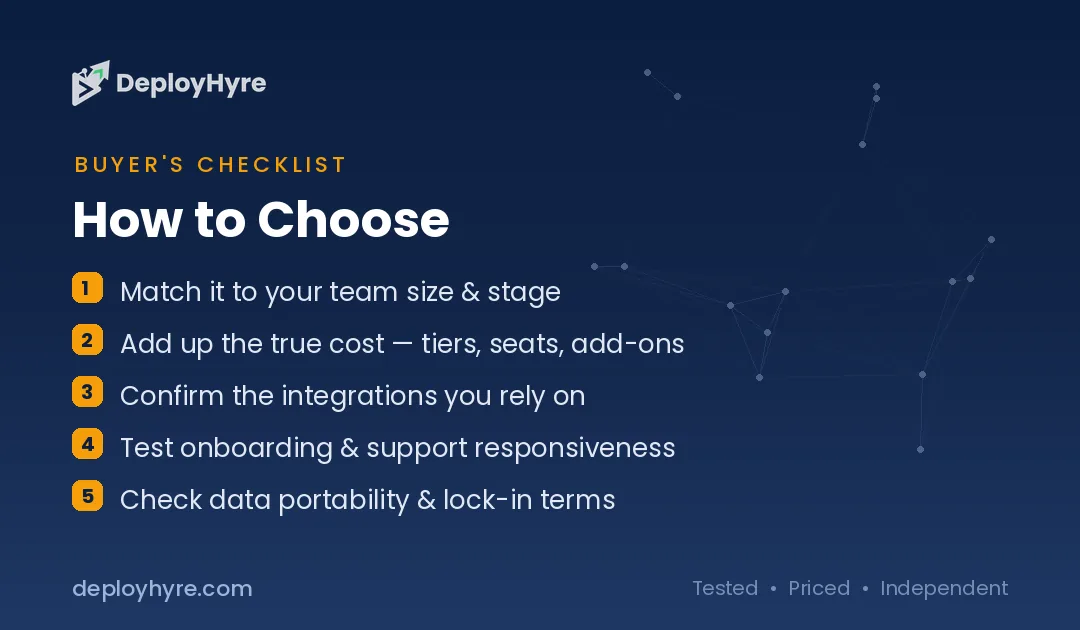
The right AI HR tool depends on where your team is losing the most time. Don’t try to overhaul your entire HR tech stack at once. Start with one function (recruiting, engagement, or operations), pilot one tool, measure the outcome, and then expand.
Here’s a simple decision framework:
If hiring speed is your bottleneck: Start with Deel AI (global) or Workable (domestic). Add HireVue if you do high-volume interviewing.
If retention and engagement need work: Start with Lattice or Culture Amp. These pay for themselves when they prevent even one key employee from leaving.
If admin tasks are drowning your team: Start with Leena AI for self-service or Gusto for payroll automation.
If you’re a small team and need everything in one place: BambooHR covers 80% of what most SMBs need in a single platform.
The biggest mistake we see? Choosing based on brand reputation or feature count instead of fit to your specific pain point and team size. A 15-person startup and a 5,000-person enterprise need very different tools.
How We Tested These AI HR Tools
Every tool on this list went through the same evaluation process. We believe showing our methodology matters for trust, which is why we’re sharing it.
Integration testing. We checked each tool’s native integrations with common ATS platforms (Greenhouse, Lever), HRIS systems (Workday, BambooHR), and communication tools (Slack, Teams).
AI quality assessment. We tested AI outputs for accuracy, bias, and explainability. Could we understand why the AI made a specific recommendation? Could we audit it?
Pricing verification. We confirmed all pricing directly with vendors. Numbers reflect May 2026 rates and may change.
User experience. We evaluated onboarding time, learning curve, and day-to-day usability. Tools that required weeks of setup scored lower.
Compliance review. We verified data security certifications (SOC 2, GDPR) and checked EU AI Act readiness for hiring-related features.
This methodology isn’t perfect. We tested from a US-based perspective, and your experience may differ based on region, company size, or existing tech stack. But it gives you a structured starting point for your own evaluation.
How is AI used in HR?
It automates hiring and admin. AI in HR screens resumes, schedules interviews, answers employee questions, and analyzes engagement, freeing teams to focus on people. See our guide to AI recruiting software for hiring.
Does AI in HR raise legal or bias concerns?
Yes. AI hiring tools can introduce bias and face growing regulation. Choose audited tools, keep humans in decisions, and document your process. Responsible use and clear AI governance reduce legal and fairness risks.
What HR tasks should stay human?
Decisions about people. Final hiring choices, terminations, conflict resolution, and sensitive conversations should stay human. AI can inform these with data, but empathy and judgment matter. Use AI for efficiency, not for choices that affect livelihoods.
For broader strategy, see the best AI consulting firms.
The Bottom Line on the Best AI Tools for HR
AI tools for HR aren’t optional anymore. 87% of companies now use AI somewhere in their hiring process, and 93% of recruiters plan to increase AI usage this year. The gap between companies using AI strategically and those still doing everything manually is widening fast. Teams building a skills program should also compare our shortlist of AI learning management systems.
But the tool itself isn’t the point. The point is giving your HR team the time and data to make better decisions about people. Start with the function that’s costing you the most time, pick one tool from this list, and run a 30-day pilot.
The best AI HR teams in 2026 aren’t replacing human judgment. They’re amplifying it.
Next step: If you’re building your AI tech stack beyond HR, check out our guide to the best AI tools for sales teams and the best AI agents for business automation.
Frequently Asked Questions
What are the best AI tools for HR?
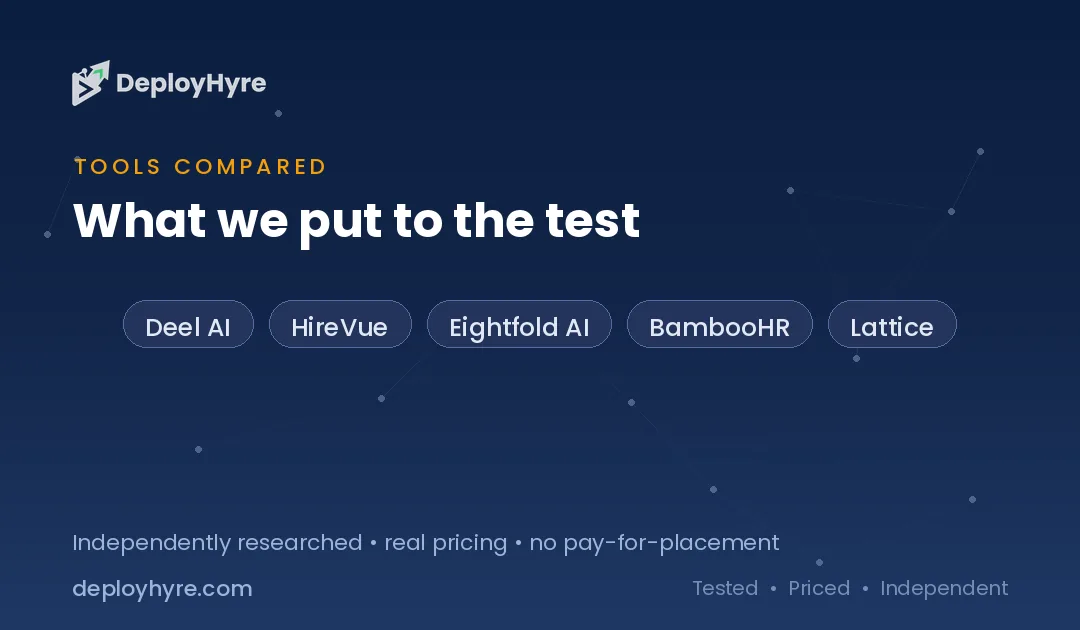
The top AI tools for HR in 2026 are Deel AI for global hiring and compliance, HireVue for AI video interviews, Eightfold AI for talent intelligence, BambooHR for SMB all-in-one HR, and Lattice for performance and engagement. The best choice depends on your team size, budget, and which HR function needs the most help.
How much do AI HR tools cost?
AI HR tools range from free (Deel HR’s basic plan) to $25+ per employee per month for full-featured platforms. BambooHR starts at $10/employee/month, Gusto at $40/month plus $6/person, and Workable at $149/month. Enterprise tools like Eightfold AI and Culture Amp use custom pricing based on company size and modules.
Can AI replace HR professionals?
No. AI handles repetitive, data-heavy tasks like resume screening, payroll processing, and survey analysis. But strategic decisions, employee relationships, and complex people situations still require human judgment. SHRM’s 2026 report found that AI is 5.7 times more likely to shift job responsibilities than to eliminate positions entirely.
Is AI in hiring biased?
AI can inherit biases from the data it’s trained on. That’s why explainability and regular audits matter. The EU AI Act classifies hiring AI as high-risk and requires companies to ensure transparency and fairness. Look for tools that let you audit scoring criteria and provide bias detection features.
What&8217;s the ROI of AI tools for HR?
Companies using AI in HR report up to 40% cost reduction in North American HR processes and 25 to 35% higher first-year retention rates when using AI-assisted matching. The top metrics for measuring AI ROI in HR are enhanced productivity, cost savings, improved decision-making, and employee satisfaction.

David Austin is a technology writer and software analyst at DeployHyre, where he covers AI tools, SaaS platforms, cloud hosting, and business automation. He focuses on hands-on comparisons of pricing, features, and real-world performance so teams can pick the right software with confidence.
Know AI, SaaS, or cloud tools inside out? Pitch a guest post and get in front of thousands of buyers researching their next tool.