Attackers now use AI, so defenders must too. The volume of alerts has outpaced human analysts, and AI cybersecurity tools close the gap by prioritizing real threats, automating investigation, and responding in seconds.
Table of Contents
The market has organized around use cases. Most buyers do not need a single tool for everything, but rather the best platform for their specific needs, whether endpoint protection, network defense, or SOC efficiency. This guide tests the best AI cybersecurity tools in 2026 by that lens. For policy and risk, see our AI governance guide.
What Are AI Cybersecurity Tools?
AI cybersecurity tools use machine learning and AI agents to detect threats, prioritize alerts, and automate investigation and response across endpoints, networks, and security operations centers. Unlike rule-based tools, they learn attacker behaviors and correlate signals to catch novel attacks and cut false positives. In 2026, the leading platforms add agentic automation that triages and investigates alerts with minimal human input.
The value is speed and focus. AI surfaces the alerts that matter and handles routine investigation, so analysts spend time on real incidents instead of noise.
Quick Comparison: 8 Best AI Cybersecurity Tools in 2026
| Tool | Best For | Category |
|---|---|---|
| CrowdStrike Falcon | Unified detection and response | Endpoint + SOC |
| Vectra AI | Network detection and response | NDR |
| Microsoft Security Copilot | Microsoft-stack SOC | SOC assistant |
| SentinelOne | Autonomous endpoint protection | Endpoint |
| Darktrace | Self-learning anomaly detection | Network + email |
| Checkmarx | AI application security | AppSec |
| Palo Alto Cortex | SOC automation (XSIAM) | SOC platform |
| Agentic SOC platforms | Automated triage and investigation | SOC automation |
What Makes a Great AI Cybersecurity Tool?
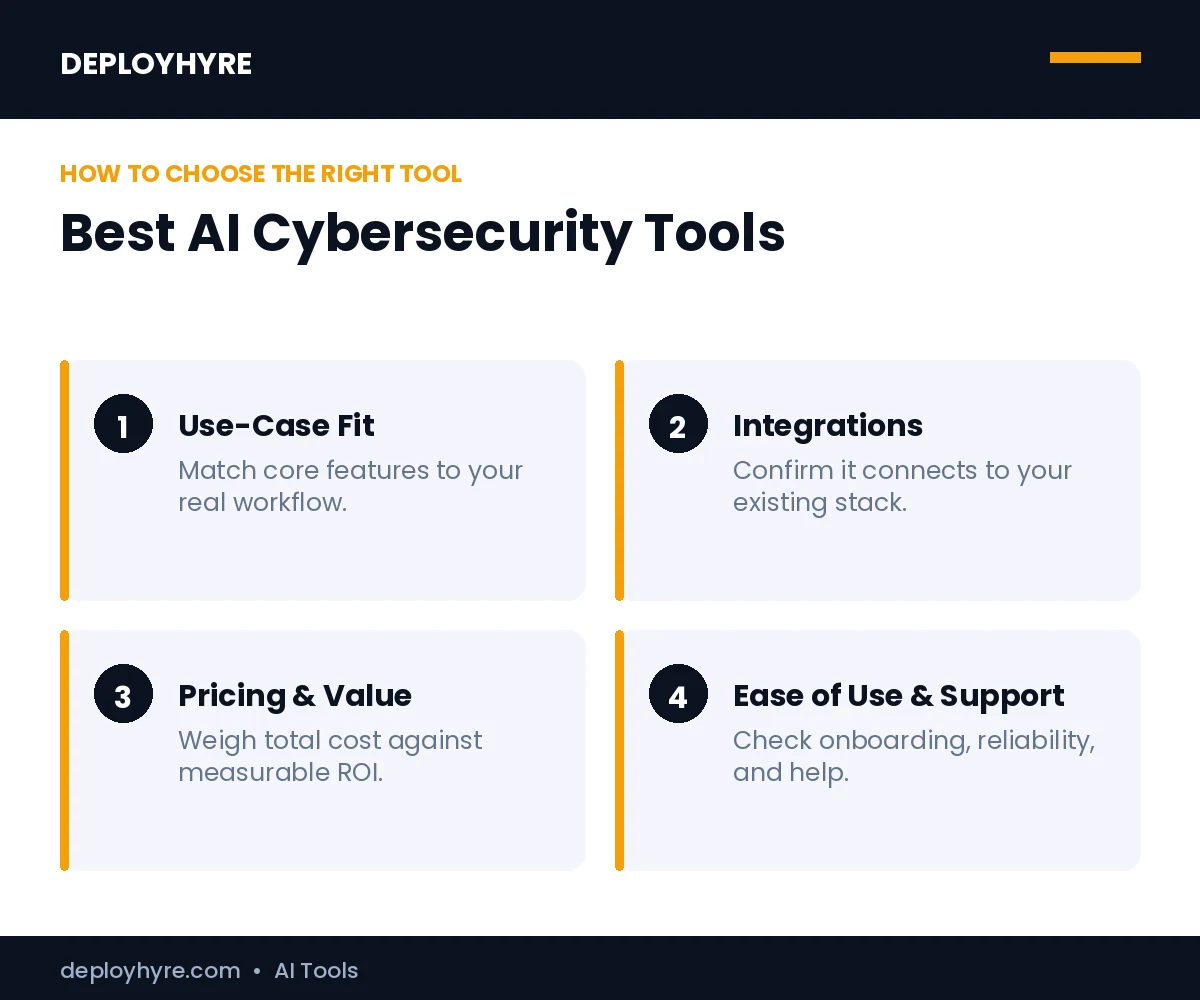
A great AI cybersecurity tool detects real threats accurately, prioritizes alerts so analysts focus on what matters, automates investigation and response, and integrates with your existing security stack. The best ones learn attacker behaviors rather than relying only on signatures, and add agentic automation that handles triage at scale.
We weighed five things: detection accuracy, alert prioritization, automation depth, integration breadth, and fit to a specific use case (endpoint, network, or SOC).
Best Endpoint and Unified Platforms
1 CrowdStrike Falcon: Best for Unified Detection and Response
CrowdStrike is the most complete platform for endpoint and SOC.
What it does well. Falcon unifies data, AI, and automation to accelerate detection and response, with Next-Gen SIEM correlating signals across domains and Charlotte AI providing agents to automate triage, investigation, and response.
Key features:
- Unified endpoint, SIEM, and SOC
- Charlotte AI agents for triage and response
- Cross-domain signal correlation
- Automated playbooks
Best for: Teams wanting one platform across endpoint and SOC.
Limitations. Full platform value (and cost) suits mid-market and enterprise.
2 SentinelOne: Best for Autonomous Endpoint Protection
SentinelOne focuses on AI-driven endpoint defense.
What it does well. SentinelOne uses AI to detect and autonomously respond to endpoint threats in real time, with rollback and strong automation.
Key features:
- Autonomous endpoint detection and response
- Real-time threat blocking
- Rollback and remediation
- AI-driven analytics
Best for: Teams prioritizing autonomous endpoint protection.
Limitations. Endpoint-centric; pair with network tools for full coverage.
Best Network and Anomaly Detection
3 Vectra AI: Best for Network Detection and Response
Vectra leads at spotting attacker behavior on the network.
What it does well. The Vectra AI Platform is a network detection and response solution powered by over 150 specialized AI models that deliver real-time detection based on attacker behaviors, automatically correlating and prioritizing alerts by severity.
Key features:
- 150+ specialized AI detection models
- Behavior-based network detection
- Automatic alert prioritization
- Real-time attack signal intelligence
Best for: Teams needing strong network detection and response.
Limitations. Focused on network; combine with endpoint protection.
4 Darktrace: Best for Self-Learning Anomaly Detection
Darktrace learns your environment to spot the unusual.
What it does well. Darktrace builds a model of normal activity across network and email, then flags anomalies that signal novel or insider threats, with autonomous response options.
Key features:
- Self-learning behavioral baseline
- Network and email coverage
- Anomaly and insider-threat detection
- Autonomous response
Best for: Teams wanting anomaly detection that adapts to their environment.
Limitations. Tuning is needed to balance detection and false positives.
Best SOC Automation and AppSec
5 Microsoft Security Copilot and 6 Palo Alto Cortex: Best for SOC Operations
For SOC efficiency, two platforms stand out.
What they do well. Microsoft Security Copilot brings AI assistance to investigation and response across the Microsoft security stack, while Palo Alto Cortex (XSIAM) automates SOC operations with AI-driven detection and playbooks. Both provide alert prioritization, automated triage, and faster response through automated playbooks.
Key features:
- AI-assisted investigation and response
- Alert prioritization and triage
- Automated SOC playbooks
- Stack integration (Microsoft / Palo Alto)
Best for: SOC teams on the Microsoft or Palo Alto ecosystem.
Limitations. Best value when standardized on that vendor’s stack.
7 Checkmarx and 8 Agentic SOC Platforms: Best for AppSec and Automated Triage
Two more categories round out the list.
What they do well. Checkmarx applies AI to application security, finding and prioritizing code vulnerabilities, while emerging agentic SOC platforms automate triage and investigation end to end with usage-based pricing per investigation. Both reduce manual workload on specialized teams.
Key features:
- AI application security (Checkmarx)
- Automated SOC triage and investigation
- Vulnerability prioritization
- Usage-based options
Best for: AppSec teams (Checkmarx) and SOCs wanting automated triage.
Limitations. Each targets a specific function rather than full-stack coverage.
How Should You Choose an AI Cybersecurity Tool?
Start with your biggest gap. For endpoint, choose CrowdStrike or SentinelOne; for network, Vectra or Darktrace; for SOC efficiency, Microsoft Security Copilot, Palo Alto Cortex, or an agentic SOC platform; for code, Checkmarx. Most organizations combine a couple rather than buying one tool for everything.
Then evaluate integration and automation. Confirm the tool fits your existing stack and offers the alert prioritization and automated response that cut analyst workload. Pilot against real traffic, measure false positives, and involve your security team before rolling out.
How We Evaluated These AI Cybersecurity Tools
We assessed each tool on five criteria: detection accuracy, alert prioritization, automation depth, integration breadth, and use-case fit (endpoint, network, SOC, or AppSec). We prioritized platforms with documented 2026 capabilities and cross-checked against independent analyses. Security needs are highly specific, so validate any tool in your own environment and consult your security team before deployment.
How does AI improve cybersecurity?
It detects threats faster. AI spots unusual patterns across networks, triages alerts, and automates response, reducing analyst overload. AI cuts detection time, but skilled teams still set strategy and handle complex incidents.
Can AI replace a security team?
No. AI automates detection, triage, and routine response, but security teams investigate, decide, and manage risk. AI handles scale and speed; humans handle judgment. Strong defense pairs AI tools with experienced analysts and clear AI governance.
Do small businesses need AI cybersecurity tools?
Yes. Small businesses face automated attacks with limited staff, so AI tools that monitor and respond automatically help close the gap. Many affordable options scale down. AI protection lets small teams defend like larger ones.
Healthcare teams handling patient data should also see the best AI medical scribe tools.
The Bottom Line
The best AI cybersecurity tool depends on your gap. CrowdStrike Falcon leads unified detection and response, Vectra and Darktrace lead network and anomaly detection, and agentic SOC platforms plus Security Copilot and Cortex lead SOC automation.
Pick by use case, prioritize tools that cut alert fatigue with accurate prioritization and automation, and pilot before committing. AI will not replace security teams, but it lets them defend at machine speed.
Next steps: Pair tooling with policy in our AI governance guide and see the broader strategy in our AI for business guide.
Frequently Asked Questions
What are the best AI cybersecurity tools in 2026?
The best AI cybersecurity tools in 2026 include CrowdStrike Falcon for unified detection and response, Vectra AI for network detection, SentinelOne for autonomous endpoint protection, Darktrace for anomaly detection, Microsoft Security Copilot and Palo Alto Cortex for SOC automation, and Checkmarx for application security. Most organizations combine the best tools for their specific use cases rather than one platform for everything.
How does AI improve cybersecurity?
AI improves cybersecurity by learning attacker behaviors to detect novel threats, prioritizing alerts so analysts focus on real incidents, and automating triage, investigation, and response through playbooks. This reduces alert fatigue and dwell time, letting security teams defend at machine speed. Agentic platforms in 2026 can handle much of the routine investigation work automatically.
How much do AI cybersecurity tools cost?
AI cybersecurity pricing varies widely by platform and model. Many use subscription pricing with a platform fee plus user licenses, while emerging agentic SOC tools use usage-based pricing per investigation. Enterprise platforms can run into significant annual contracts. Pricing depends on your environment size, coverage needs, and which functions (endpoint, network, SOC) you deploy, so request a tailored quote.
Can AI replace security analysts?
No. AI automates triage, investigation, and routine response, but human analysts remain essential for judgment, complex incident handling, threat hunting, and decisions on high-stakes actions. In 2026, AI acts as a force multiplier that handles alert volume and routine work, freeing analysts to focus on serious threats and strategy rather than replacing them.
What is an agentic SOC platform?
An agentic SOC platform uses AI agents to automate security operations tasks such as alert triage, log correlation, and investigation with minimal human input, often priced per investigation. It goes beyond alerting to actually work through incidents, escalating only what needs human judgment. These platforms aim to cut analyst workload and speed response in busy security operations centers.

David Austin is a technology writer and software analyst at DeployHyre, where he covers AI tools, SaaS platforms, cloud hosting, and business automation. He focuses on hands-on comparisons of pricing, features, and real-world performance so teams can pick the right software with confidence.