Clinicians spend hours every week on notes, and documentation is a leading driver of burnout. Ambient AI scribes change that: they listen to the visit, then generate a structured note, so you can focus on the patient instead of the keyboard.
Table of Contents
The category has matured and prices have dropped. CMS and major insurance payers accept AI-generated notes for billing (with provider attestation) as of mid-2026, and entry-level pricing is now below $100/month. Importantly, all reputable AI scribes offer HIPAA-compliant infrastructure and sign Business Associate Agreements, but compliance is a shared responsibility between vendor and practice.
This guide tests the best AI medical scribe tools in 2026 by practice type. It is informational, not medical or legal advice; review each vendor’s BAA and security documentation with your compliance officer before deploying.
What Is an AI Medical Scribe?
An AI medical scribe is software that listens to a clinician-patient conversation and automatically drafts a structured clinical note, often writing it back into the EHR. Unlike dictation, an ambient scribe works in the background during a natural conversation, capturing the visit and producing a SOAP note the provider reviews and signs. The clinician stays responsible for accuracy and final attestation.
The value is time. Scribes reduce after-hours charting and let providers see patients without typing through the visit, while billing-code suggestions can also support cleaner claims.
Quick Comparison: 7 Best AI Medical Scribes in 2026
| Scribe | Best For | Starting Price | Notable Feature |
|---|---|---|---|
| Freed | Solo and small practices | ~$99/mo | Clinical-grade speech recognition |
| Twofold Health | US clinicians, flat pricing | $49/mo (annual) | Unlimited notes, no stored recordings |
| DeepCura | Budget and workflow automation | ~$17/mo+ | EHR write-back, automation |
| VoiceboxMD | Dictation plus ambient scribe | $79/mo | CPT/ICD-10 code suggestions |
| Abridge | Health systems and enterprises | Custom | Enterprise ambient documentation |
| Nuance DAX Copilot | Large EHR-integrated systems | Custom | Deep EHR integration |
| Suki / Nabla | Assistant-style scribing | Varies | Voice assistant workflows |
What Makes a Great AI Medical Scribe?
A great AI medical scribe produces accurate, well-structured notes from natural conversation, integrates with your EHR, protects patient data with HIPAA-compliant infrastructure and a signed BAA, and keeps the clinician in control of the final note. The best ones save real documentation time without adding clicks, and offer transparent pricing.
We weighed five things: note accuracy, EHR integration, security and compliance posture, time saved, and pricing transparency. We did not test clinical outcomes; always validate any tool in your own workflow.
Best AI Scribes for Solo and Small Practices
1 Twofold Health: Best for US Clinicians and Flat Pricing
Twofold is the value pick for solo providers and small clinics that want simple, predictable pricing.
What it does well. Twofold is preferred for US clinicians, with a HIPAA/HITECH posture, recordings never stored, and transparent flat pricing at $49/month billed annually with unlimited notes.
Key features:
- Unlimited notes on a flat plan
- Recordings never stored
- HIPAA/HITECH posture
- Simple setup for solo providers
Pricing. $49/month billed annually, unlimited notes.
Best for: Solo providers and small clinics wanting flat, predictable pricing.
Limitations. Lighter enterprise and deep-EHR features than health-system platforms.
2 Freed: Best Clinical-Grade Recognition for Small Practices
Freed is a popular, clinician-friendly scribe built for accuracy.
What it does well. Freed uses automatic speech recognition trained for clinical environments and medical terminology, and is HIPAA and HITECH compliant with zero storage of patient recordings.
Key features:
- Clinical-grade speech recognition
- Medical terminology accuracy
- Zero storage of recordings
- Clinician-friendly note output
Pricing. Around $99/month for individual clinicians.
Best for: Solo and small practices that prioritize note accuracy.
Limitations. Per-clinician pricing adds up for larger groups.
3 DeepCura: Best for Budget and Workflow Automation
DeepCura offers the lowest entry price plus automation features.
What it does well. DeepCura provides ambient scribing, EHR write-back, AI reception, and workflow automation, with pricing from about $17/month (yearly Audio Lite) to about $58/month (yearly Unlimited).
Key features:
- Ambient scribing with EHR write-back
- Workflow automation and AI reception
- Low entry pricing
- Scalable tiers
Pricing. Approximately $17/month to $58/month (billed yearly).
Best for: Budget-conscious practices wanting automation beyond notes.
Limitations. Lowest tiers limit features; verify EHR compatibility first.
4 VoiceboxMD: Best for Dictation Plus Ambient Scribing
VoiceboxMD combines dictation and ambient capture with billing support.
What it does well. VoiceboxMD combines real-time medical dictation, ambient AI scribe, post-visit dictation, custom templates, and CPT/ICD-10 billing code suggestions, starting at $79/month with no annual contract.
Key features:
- Real-time dictation plus ambient scribe
- CPT/ICD-10 code suggestions
- Custom templates
- No annual contract
Pricing. From $79/month, month-to-month available.
Best for: Clinicians who want both dictation and ambient scribing with billing help.
Limitations. More features mean a slightly steeper learning curve.
Best AI Scribes for Clinics and Enterprises
5 Abridge, 6 Nuance DAX Copilot, and 7 Suki/Nabla: Best for Health Systems
For larger organizations, enterprise ambient platforms offer deep integration and governance.
What they do well. Abridge and Nuance DAX Copilot are widely used by health systems for enterprise ambient documentation with deep EHR integration, while Suki and Nabla offer assistant-style scribing workflows. These platforms emphasize scale, integration, security, and support for large clinician teams.
Key features:
- Enterprise-grade ambient documentation
- Deep EHR integration and governance
- Scalable deployment and support
- Strong security posture for health systems
Pricing. Custom enterprise pricing; contact vendors.
Best for: Hospitals and large groups needing integration, governance, and scale.
Limitations. Custom pricing and implementation make these overkill for solo providers; confirm current capabilities and pricing directly with each vendor.
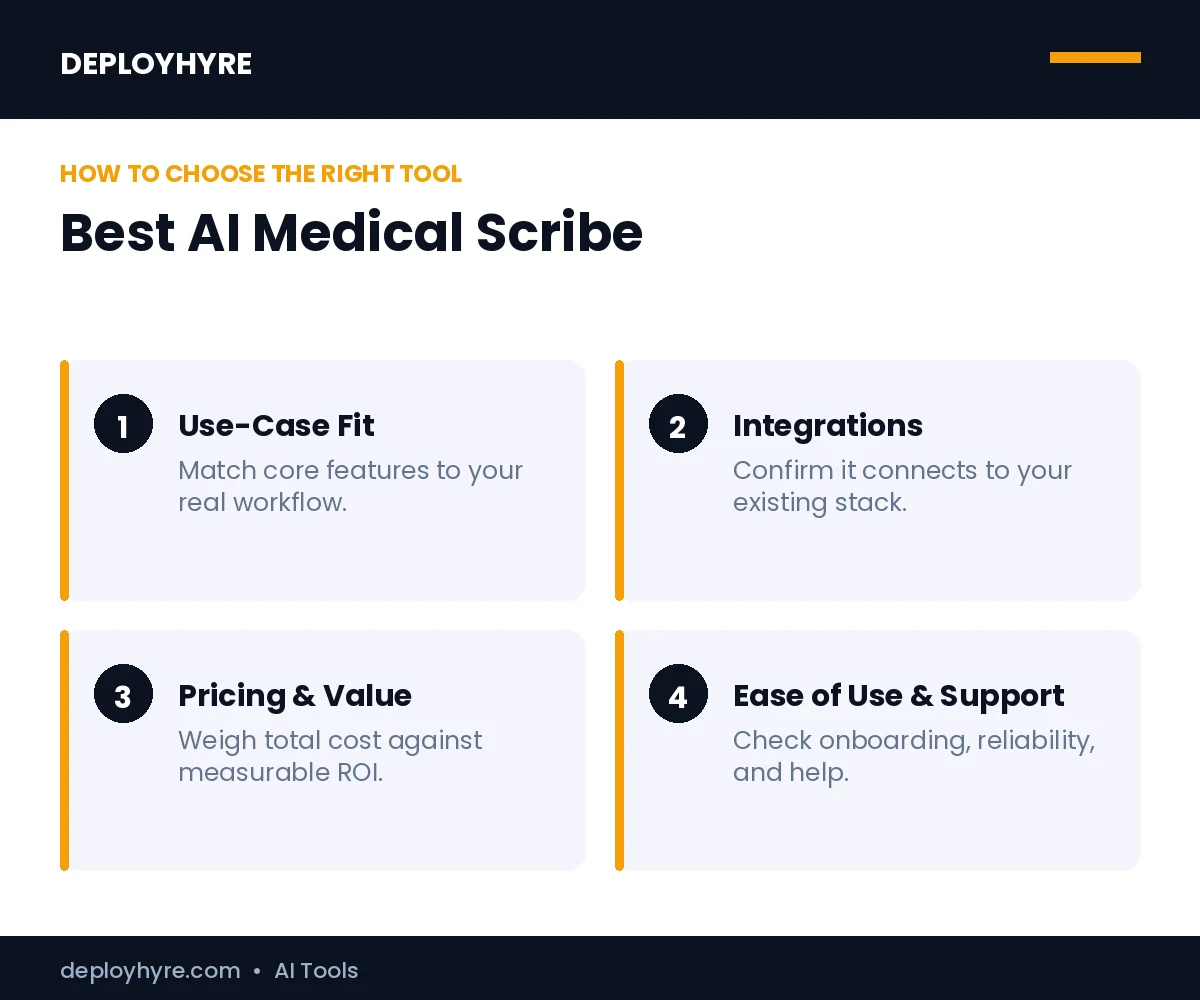
How Should You Choose an AI Medical Scribe?
Start with practice size. Solo providers and small clinics get the best value from Twofold, Freed, DeepCura, or VoiceboxMD, while hospitals and large groups need enterprise platforms like Abridge or Nuance DAX Copilot for integration and governance. Then confirm EHR compatibility, since write-back support varies by tool.
Compliance comes next. Confirm the vendor signs a BAA, review its security documentation, and remember that HIPAA compliance is shared: your practice must configure access controls and train staff. Always pilot with real visits, check note accuracy against your standards, and keep clinician review and attestation on every note.
How We Evaluated These AI Medical Scribes
We assessed each scribe on five criteria: note accuracy as reported, EHR integration, security and HIPAA posture, time saved, and pricing transparency. We prioritized tools with published pricing and documented compliance practices, and cross-checked against independent 2026 reviews. We did not conduct clinical testing; this guide is informational, and practices should validate any tool and review BAAs with a compliance officer before use.
Are AI medical scribes HIPAA compliant?
Leading scribes offer HIPAA-compliant plans. They use encryption and signed agreements, but confirm each vendor terms and a business associate agreement. Verify safeguards before using patient data, and review your AI cybersecurity tools for added protection.
How accurate are AI medical scribes?
Highly accurate, with review needed. Modern AI scribes transcribe visits well and structure notes by section. Accents and rare terms lower accuracy. Clinicians must review and sign each note, since the provider remains responsible for the record.
Do AI scribes integrate with EHR systems?
Many do. Top scribes push notes into common EHRs, reducing copy-paste work. Integration depth varies, so confirm support for your specific EHR. Tight integration is the biggest time-saver, so prioritize it when choosing a tool.
The Bottom Line
AI medical scribes are now affordable and good enough to meaningfully cut documentation time, with entry pricing below $100/month and payer acceptance of AI-assisted notes (with attestation) in 2026. The best choice depends on your size: Twofold, Freed, DeepCura, or VoiceboxMD for small practices, and Abridge or Nuance DAX Copilot for health systems.
Pilot before you commit, confirm EHR integration and a signed BAA, and keep clinician review on every note. Done right, an AI scribe gives time back to patients and to providers.
Next steps: Explore more workflow tools in our AI for business guide and the best AI agents for automating routine tasks.
Frequently Asked Questions
What is the best AI medical scribe in 2026?
It depends on your practice. Twofold Health is best for solo US clinicians with flat $49/month pricing, Freed is best for clinical-grade accuracy, DeepCura is best for budget and automation, and VoiceboxMD adds dictation plus billing-code suggestions. Health systems are better served by enterprise platforms like Abridge or Nuance DAX Copilot. Match the scribe to your size and EHR.
How much does an AI medical scribe cost?
AI medical scribe pricing now starts below $100/month for individual clinicians in 2026. Examples include DeepCura from about $17/month (billed yearly), Twofold at $49/month annual, VoiceboxMD at $79/month, and Freed around $99/month. Enterprise platforms for health systems use custom pricing based on size, integration, and support needs.
Are AI medical scribes HIPAA compliant?
Reputable AI medical scribes offer HIPAA-compliant infrastructure and will sign a Business Associate Agreement. However, HIPAA compliance is a shared responsibility: your practice must configure access controls, train staff, and review each vendor’s BAA and security documentation with a compliance officer before deploying the tool with real patient data.
Do AI scribes integrate with my EHR?
Many do, through EHR write-back that places the drafted note directly into your system, but support varies by tool and EHR. Tools like DeepCura emphasize EHR write-back, and enterprise platforms offer deep integration. Always confirm your specific EHR is supported and test the integration during a pilot before rolling out across your practice.
Can I bill for visits documented by an AI scribe?
As of mid-2026, CMS and major payers accept AI-generated notes for billing with provider attestation, meaning the clinician must review and attest to the note’s accuracy. The AI drafts the documentation, but the provider remains responsible for the final note and its clinical accuracy. Confirm current payer rules and your organization’s policies before relying on this.

David Austin is a technology writer and software analyst at DeployHyre, where he covers AI tools, SaaS platforms, cloud hosting, and business automation. He focuses on hands-on comparisons of pricing, features, and real-world performance so teams can pick the right software with confidence.