MailerLite is the best Brevo alternative for most small businesses in 2026. It starts at $12 per month, includes automation on every paid plan, and prices by contacts instead of email volume. ActiveCampaign wins for advanced automation, and Omnisend wins for ecommerce stores that need email and SMS together.
Brevo charges by emails sent per month, not by contact count. The Starter plan costs $9 per month for 5,000 emails. That model is cheap for large lists that send rarely. It gets expensive fast for small lists that send often, and core features like A/B testing sit on the $18 Business tier, according to EmailTooltester's 2026 pricing analysis.
Email remains the highest-return channel in marketing. Litmus research puts the average return at $36 for every $1 spent. Picking the right platform protects that return. We tested seven Brevo competitors on pricing, automation, deliverability tools, and ease of use. Start with our complete guide to the best AI marketing tools if you are building a full stack, then use this list to replace Brevo specifically.
Table of Contents
Quick Comparison: Top 7 Brevo Alternatives
| Platform | Best For | Starting Price | Key Advantage |
|---|---|---|---|
| MailerLite | Best overall value | $12/mo (500 subscribers) | Automation on every paid plan |
| Moosend | Lowest price | $9/mo (500 contacts) | Unlimited emails on Pro |
| ActiveCampaign | Advanced automation | $15/mo (1,000 contacts) | Deepest workflow builder |
| Omnisend | Ecommerce email + SMS | $16/mo (500 contacts) | Prebuilt store workflows |
| Mailchimp | All-round marketing suite | $20/mo (500 contacts, Standard) | Largest integration library |
| GetResponse | All-in-one with webinars | $19/mo (1,000 contacts) | Webinars and funnels built in |
| Klaviyo | Data-driven ecommerce | $20/mo (500 contacts) | Revenue attribution and segments |
Why Switch From Brevo?
Users switch from Brevo for three reasons: per-email pricing punishes frequent senders, key features like A/B testing and landing pages require the $18 Business plan, and marketing automation depth trails dedicated platforms. Contact-based competitors cost a similar amount and remove the monthly send ceiling.
Brevo is a strong product for the right sender. The free plan allows 300 emails per day, and the built-in CRM is useful. The problems appear as you grow. A store emailing 2,000 contacts three times a week burns through 24,000 sends a month. That pushes you into higher Starter tiers quickly. Competitors like MailerLite and Moosend charge for the list, not the sends, and include unlimited emails.
Automation is the second gap. Brevo caps advanced workflows and testing behind Business. ActiveCampaign and Omnisend ship deeper builders at comparable prices. If transactional email is your main use case, compare dedicated senders in our SendGrid alternatives guide instead.
The 7 Best Brevo Alternatives
1 MailerLite: Best Overall Brevo Alternative
MailerLite replaces Brevo for most small businesses without raising costs.
What it does well. MailerLite charges by subscribers and includes unlimited monthly emails on its Growing Business plan. Every paid plan includes automation workflows, landing pages, and embedded forms. The drag-and-drop editor is faster than Brevo's, and deliverability scores consistently rank near the top of independent tests. The interface stays simple even as your list grows.
Key features:
- Unlimited email sends on paid plans
- Visual automation builder with multi-trigger workflows
- Landing pages, pop-ups, and embedded forms included
- Free plan for up to 1,000 subscribers and 12,000 emails per month
- AI writing assistant and campaign generator
Pricing. The Growing Business plan starts at $12 per month for 500 subscribers. The Advanced plan adds unlimited users, promotion pop-ups, and custom HTML from $18 per month.
Best for: Small businesses and newsletters that send frequently and want predictable contact-based pricing.
Limitations. The built-in CRM is thinner than Brevo's. Phone support is not offered on entry plans.
2 Moosend: Best Budget Brevo Alternative
Moosend undercuts Brevo while removing the send limit entirely.
What it does well. Moosend's Pro plan starts at $9 per month and includes unlimited email campaigns, automation, landing pages, and forms, according to EmailVendorSelection's 2026 breakdown. That is the same entry price as Brevo Starter with no monthly email cap. The automation builder covers cart abandonment, weather-based triggers, and repeat-purchase flows.
Key features:
- Unlimited emails on every paid plan
- Prebuilt automation recipes for ecommerce
- Landing pages and subscription forms included
- 30-day free trial with 1,000 subscribers
- 20% discount on annual billing
Pricing. Pro starts at $9 per month for 500 contacts and scales to roughly $315 per month at 50,000 contacts.
Best for: Price-sensitive senders who want Brevo's affordability without per-email math.
Limitations. The template library is smaller than Mailchimp's. No built-in CRM or SMS channel.
3 ActiveCampaign: Best for Advanced Automation
ActiveCampaign is the automation upgrade Brevo's Business plan tries to be.
What it does well. ActiveCampaign's workflow builder handles branching logic, lead scoring, site tracking, and sales sequences in one canvas. It supports over 900 integrations. Where Brevo offers a handful of automation templates, ActiveCampaign ships hundreds of prebuilt recipes and lets you split-test entire automations, not just subject lines.
Key features:
- Multi-step visual automations with conditional branching
- Lead scoring and site tracking on marketing plans
- Built-in sales CRM with pipelines
- Predictive sending powered by machine learning
- 900+ native integrations
Pricing. The Starter plan begins at $15 per month for 1,000 contacts. The Plus plan with full automation starts at $49 per month.
Best for: Teams that outgrew Brevo's automation and want behavior-driven campaigns.
Limitations. Costs climb quickly with list size. The learning curve is the steepest on this list.
4 Omnisend: Best for Ecommerce Email and SMS
Omnisend gives stores the email-plus-SMS combo Brevo charges extra for.
What it does well. Omnisend is built for Shopify, WooCommerce, and BigCommerce stores. Prebuilt workflows cover cart abandonment, browse abandonment, and post-purchase upsells. Email, SMS, and web push live in one workflow builder, so you can follow an ignored email with a text automatically. Reporting ties every message to store revenue.
Key features:
- Prebuilt ecommerce automation workflows
- Email, SMS, and web push in one builder
- Product picker pulls items straight from your store
- Segmentation based on purchase behavior
- 24/7 support on all plans
Pricing. The Standard plan starts at $16 per month for 500 contacts and includes unlimited web push.
Best for: Online stores that want revenue-focused email and SMS without stitching tools together.
Limitations. Overkill for content newsletters. SMS credits cost extra beyond plan allowances. See our full Omnisend alternatives guide if you want to compare it against its own rivals.
5 Mailchimp: Best All-Round Marketing Suite
Mailchimp offers the broadest feature set and integration library in this comparison.
What it does well. Mailchimp bundles email, landing pages, social posting, and a website builder. Its 300+ integrations connect nearly every SaaS product a small business runs. The Content Optimizer and AI campaign generator shorten production time. Reporting benchmarks your open and click rates against your industry, which Brevo does not do.
Key features:
- Industry benchmark reporting
- AI-generated campaigns and subject lines
- 300+ integrations including Canva and Shopify
- Customer journey builder on Standard and up
- Built-in social ads and postcards
Pricing. The Standard plan starts at $20 per month for 500 contacts. The cheaper Essentials tier drops journey branching, so most switchers should start at Standard. See our Mailchimp vs Brevo comparison for a head-to-head breakdown.
Best for: Businesses that want one subscription covering email, ads, and landing pages.
Limitations. Charges for unsubscribed contacts. Pricing rises steeply past 10,000 contacts.
6 GetResponse: Best All-in-One With Webinars
GetResponse folds webinars and conversion funnels into a Brevo-priced platform.
What it does well. GetResponse is the only platform on this list with native webinar hosting. The Marketing Automation plan adds event-based workflows, funnels, and web push. Its AI campaign generator builds full emails from a prompt. For coaches, course sellers, and B2B teams, replacing a separate webinar tool usually pays for the subscription by itself.
Key features:
- Native webinars for up to 1,000 attendees
- Conversion funnels with templates
- Event-based automation workflows
- AI email and campaign generator
- Web push notifications included
Pricing. The Starter plan begins at $19 per month for 1,000 contacts. Webinars require the Marketing Automation tier from $59 per month.
Best for: Creators and B2B teams that run webinars and want funnels in the same tool.
Limitations. The interface feels dated in places. Entry plan excludes automation beyond autoresponders.
7 Klaviyo: Best for Data-Driven Ecommerce
Klaviyo turns store data into revenue-attributed segments Brevo cannot match.
What it does well. Klaviyo syncs full purchase history from Shopify and WooCommerce, then predicts churn risk, next order date, and lifetime value per customer. Segments update in real time. Its benchmark data shows exactly how your flows perform against similar stores. Brands that outgrow Brevo's segmentation move here when revenue justifies the spend.
Key features:
- Predictive analytics for churn and lifetime value
- Real-time behavioral segmentation
- Revenue attribution per email and flow
- Prebuilt flows benchmarked by industry
- Email and SMS under one roof
Pricing. Paid plans start at $20 per month for 500 contacts and 5,000 monthly sends. Costs scale with active profiles. Compare rivals in our Klaviyo alternatives guide.
Best for: Ecommerce brands past $10,000 monthly revenue that want data depth.
Limitations. The most expensive option here at scale. Profile-based billing needs active list hygiene.
How Should You Choose the Right Brevo Alternative?
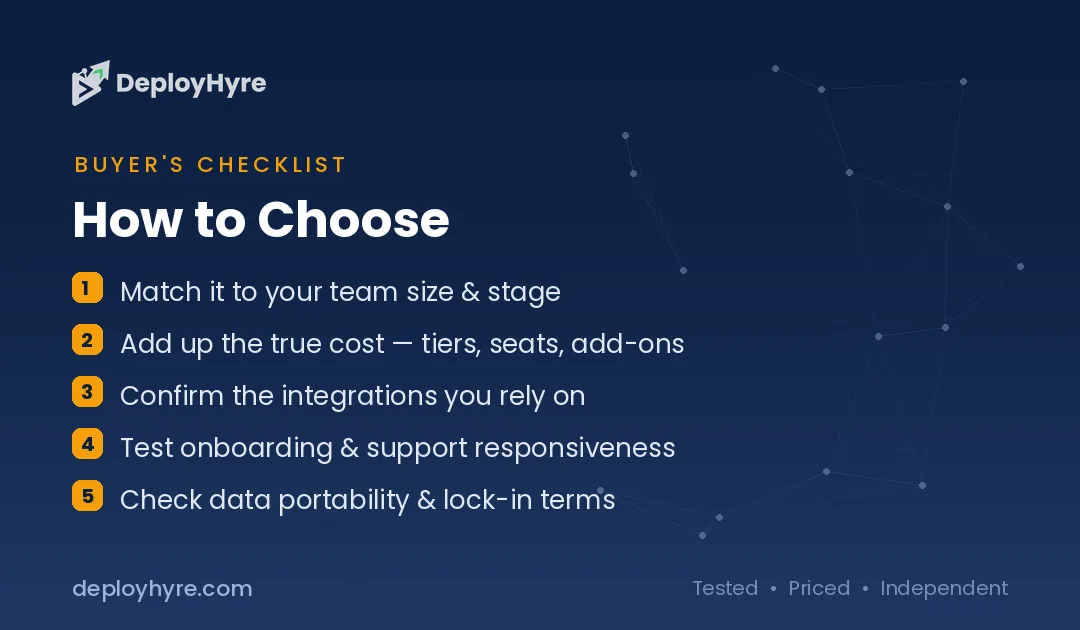
Match the platform to your sending pattern first. Frequent senders with small lists save money on contact-based pricing like MailerLite or Moosend. Ecommerce stores need Omnisend or Klaviyo. Automation-heavy teams need ActiveCampaign. Then verify migration support and deliverability before you commit.
Work through four questions. First, how often do you send? Multiply your list size by monthly campaigns. If sends exceed 3 to 4 times your list size, per-email pricing works against you and any contact-based platform on this list wins. Second, do you sell online? Store owners should shortlist Omnisend and Klaviyo only, because prebuilt revenue flows beat generic automation. Third, which Brevo features do you actually use? If you rely on the built-in CRM, ActiveCampaign is the only alternative that improves it. Fourth, what is your migration path? Every platform here imports CSV contacts, but automation rebuilds take a weekend. MailerLite and Moosend offer free migration help on annual plans.
Run your top two picks through their free trials with a real campaign. Deliverability differences show up in your first send report, not on pricing pages. Our guide to the best AI email marketing software covers testing methodology in more depth.
How We Evaluated These Platforms
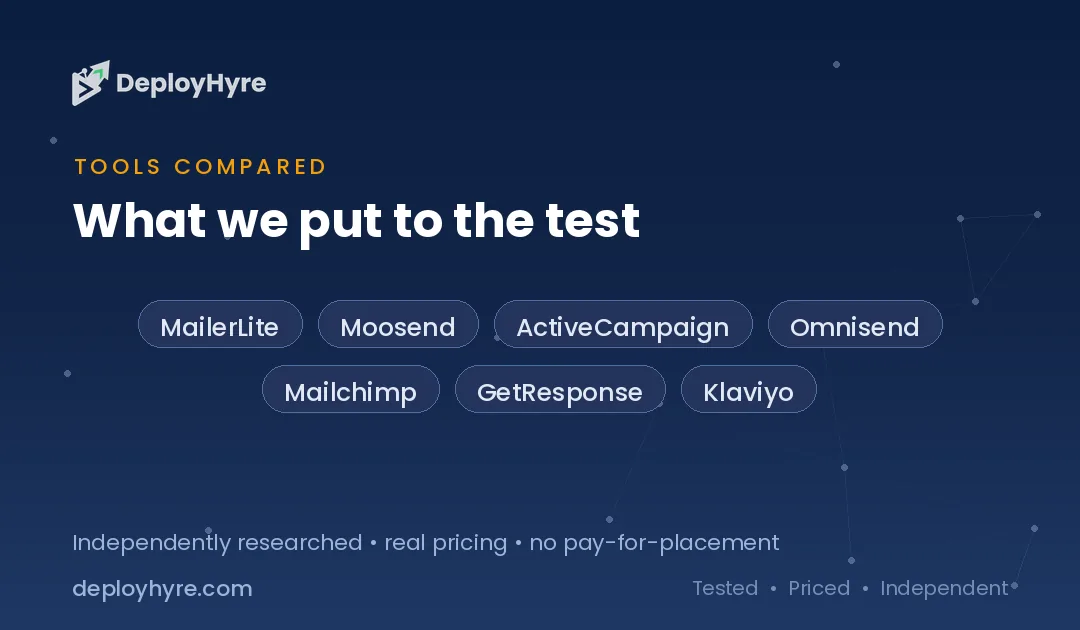
We scored each platform on five weighted criteria: pricing transparency at 500, 5,000, and 25,000 contacts (30%), automation depth (25%), deliverability tooling and sender reputation controls (20%), ease of migration from Brevo (15%), and support quality on entry plans (10%). Pricing was verified against official vendor pages and independent trackers including EmailTooltester in July 2026. We favored platforms that include automation on entry tiers, because that is the most common Brevo complaint we see. We do not accept payment for placement. Some links are affiliate links, which never affects rankings.
The Bottom Line
MailerLite is the best Brevo alternative for most businesses. It matches Brevo's price point, removes the send ceiling, and includes automation everywhere. Choose Moosend to spend less, ActiveCampaign for serious automation, Omnisend or Klaviyo for ecommerce, GetResponse for webinars, and Mailchimp for the broadest suite.
Start with a free trial of your top pick and send one real campaign before migrating your list. If you are still comparing categories, our AI marketing tools guide maps every channel, and our AWeber alternatives guide covers another legacy platform switchers leave for the same reasons.
Frequently Asked Questions
What is the best Brevo alternative?
MailerLite is the best Brevo alternative for most users in 2026. It starts at $12 per month, prices by contacts instead of emails sent, includes unlimited sends, and ships automation, landing pages, and forms on every paid plan.
Is there a cheaper alternative to Brevo?
Moosend is cheaper than Brevo for most senders. Its Pro plan starts at $9 per month for 500 contacts with unlimited emails. Brevo's $9 Starter caps you at 5,000 emails per month, so frequent senders pay less with Moosend.
What is the best Brevo alternative for ecommerce?
Omnisend is the best Brevo alternative for ecommerce stores. It starts at $16 per month and includes prebuilt cart abandonment, browse abandonment, and post-purchase workflows with email and SMS in one builder. Klaviyo is the stronger pick past $10,000 monthly revenue.
Does Brevo have a free plan?
Yes. Brevo's free plan allows 300 emails per day with unlimited contacts. The daily cap resets every 24 hours, which makes large one-day campaigns impossible. MailerLite's free plan allows 12,000 monthly emails to 1,000 subscribers with no daily limit.
Why is Brevo so cheap compared to competitors?
Brevo prices by emails sent per month, not by contact count. You can store 50,000 contacts and pay $9 per month if you send under 5,000 emails. The model is cheap for occasional senders and expensive for frequent senders, which is the main reason users switch.

David Austin is a technology writer and software analyst at DeployHyre, where he covers AI tools, SaaS platforms, cloud hosting, and business automation. He focuses on hands-on comparisons of pricing, features, and real-world performance so teams can pick the right software with confidence.
Know AI, SaaS, or cloud tools inside out? Pitch a guest post and get in front of thousands of buyers researching their next tool.
Pitch your idea →