TL;DR: The best Trustpilot alternatives in 2026 depend on where your buyers read reviews. Google Business Profile is free and wins for local businesses. Judge.me and Yotpo suit Shopify stores. Reviews.io and Feefo fit mid-size ecommerce brands. Birdeye and Podium serve multi-location service firms. Shopper Approved targets Google store ratings. Bazaarvoice covers enterprise retail, and G2 or Capterra are the right home for B2B software reviews. Match the platform to your sales channel before you compare price.
Trustpilot is huge. Its own Trust Report 2025 says more than 61 million reviews were written on the platform in 2024, a 15% rise on the year before. That scale is the reason many brands start there.
Scale does not always mean fit. Trustpilot’s paid plans start at $319 per month per domain, billed annually, with a 12-month contract, according to its plans page. For a small store or a local service firm, that is a lot to pay for reviews that may never show up where customers search.
This guide compares ten review platforms for businesses that collect reviews. It sits inside our wider guide to the best AI marketing tools, because reviews now feed search, ads and AI answers at the same time.
Quick Comparison: Trustpilot Alternatives at a Glance
| Tool | Best For | Starting Price | Key Strength |
|---|---|---|---|
| Google Business Profile | Local businesses | Free | Reviews show in Search and Maps |
| Judge.me | Small Shopify stores | Free; Awesome plan $15/month | Unlimited reviews on the free plan |
| Yotpo | Growing ecommerce brands | Free; Starter $89/month | Reviews plus UGC and loyalty tools |
| Reviews.io | Mid-size online stores | Check the current price | Product and company reviews together |
| Feefo | Verified, invite-only reviews | Check the current price | Reviews only from real buyers |
| Birdeye | Multi-location service firms | Custom quote | Review requests plus messaging |
| Podium | Local service businesses | Custom quote | Text-based review requests |
| Bazaarvoice | Enterprise retail brands | Custom quote | Review syndication to retailers |
| Shopper Approved | Google store ratings in ads | Check the current price | Built around Google store ratings |
| G2 and Capterra | B2B software companies | Free listing; paid tiers by quote | Buyers research software there |
What Makes a Great Trustpilot Alternative?
A great Trustpilot alternative puts your reviews where your buyers already look. For local firms that means Google. For online stores it means product pages and Google Shopping. For B2B software it means G2 and Capterra. It should also send automatic review requests, block fake reviews, show star ratings in search results, and cost less per review than you earn from the trust it builds.
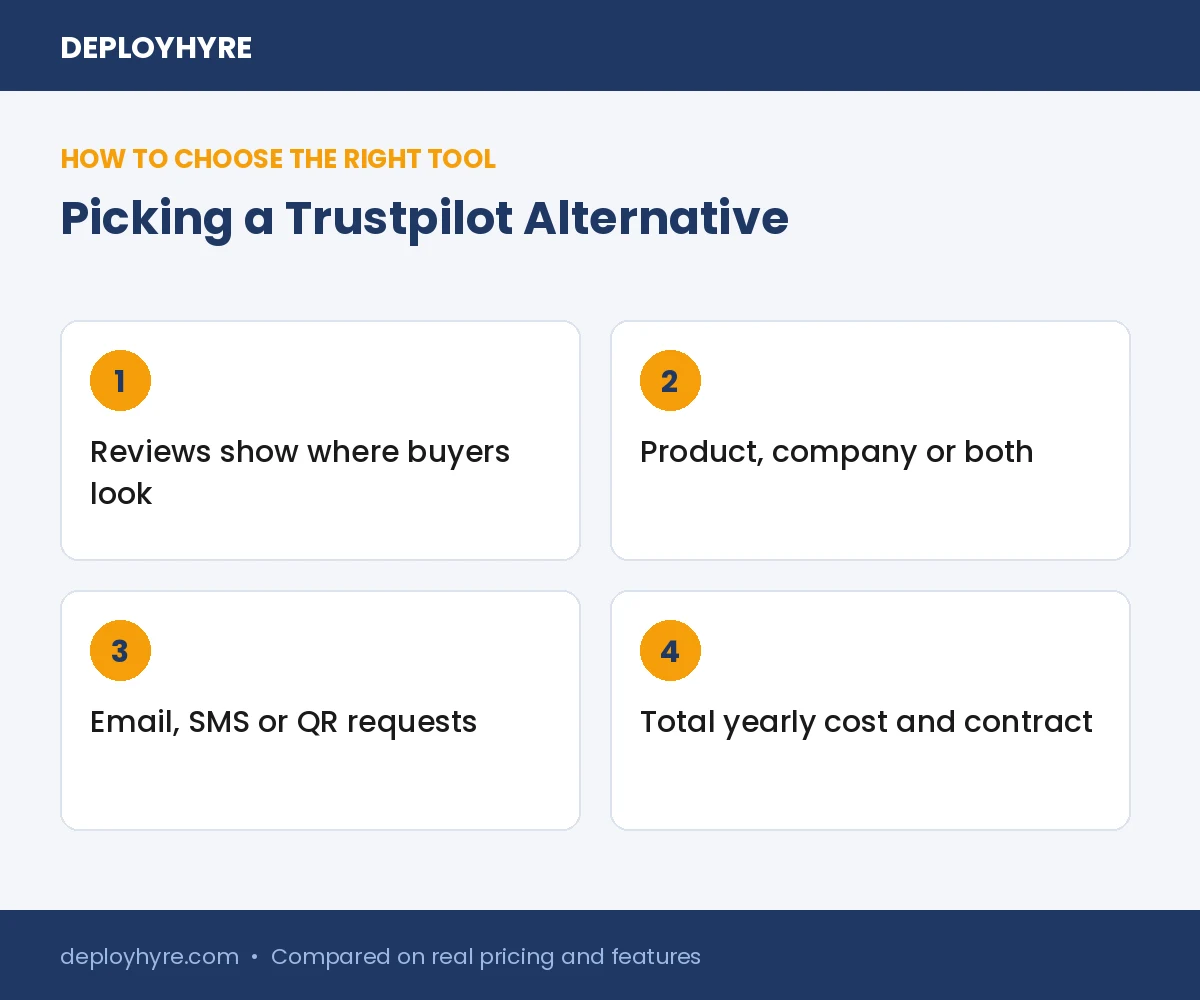
Beyond that, check four things. First, look at how the tool asks for reviews: email, SMS or QR code. Second, check whether it supports product reviews, company reviews, or both. Third, confirm how it handles Google rich snippets. Fourth, read the contract terms before you sign.
Why Do Businesses Switch From Trustpilot?
Most switches come down to cost, contracts and channel fit. Here is what Trustpilot’s own plans page shows as of November 2026:
- Free plan limits. The free plan allows 50 automated review invitations per month and one user login.
- Paid plan cost. Plus starts at $319 per month per domain and Premium at $799 per month per domain, both billed annually.
- Contract length. Trustpilot states that all contracts are a 12-month commitment.
- Per-domain pricing. Brands with several country sites pay for each domain.
There is also a channel issue. A plumber’s customers check Google Maps, not Trustpilot. A Shopify shopper reads reviews on the product page. If your reviews live on a site your buyers do not visit, you pay for trust they never see.
Best Free Trustpilot Alternatives for Local and Small Businesses
#1 Google Business Profile: Best for local businesses
The free Google listing that puts your star rating in Search and Maps.
What it does well. Google says you can manage how your business shows up on Maps and Search at no charge, and that you can collect and respond to reviews from customers, per its Business Profile help page. For any business with a physical location or service area, this is where most review readers start. If you want help ranking your profile, see our list of AI tools for Google Business Profile optimization.
Key features:
- Reviews appear in Google Search and Google Maps
- Shareable review link you can send by email or text
- Owner replies shown publicly under each review
- Photos, hours, services and posts on one profile
Pricing. Free.
Best for: Restaurants, clinics, trades, salons and any business that serves a local area.
Limitations. There is no built-in automation for review requests. You cannot show Google reviews on your site without a widget or third-party tool. It does not cover product reviews for online stores.
#2 Judge.me: Best for small Shopify stores
A low-cost product review app built mainly for Shopify merchants.
What it does well. Judge.me gives away more on its free plan than most rivals. Its pricing page lists unlimited product and store reviews, unlimited photo and video reviews, and Google rich snippets on the Forever Free plan. If you are still picking a store builder, our Shopify alternatives guide covers the main options.
Key features:
- Unlimited product and store reviews on the free plan
- Photo and video reviews
- Review carousels and rating badges
- AI summaries and replies on the paid plan
- Google Shopping and social sharing on the paid plan
Pricing. Free plan available. The Awesome plan is $15 per month, billed monthly. The page does not list an annual rate.
Best for: Small and mid-size Shopify stores that want product reviews without a big monthly bill.
Limitations. It is built around ecommerce, so it does little for service firms. Brands that need loyalty programs or deep retail syndication will outgrow it.
Best Trustpilot Alternatives for Ecommerce Brands
#3 Yotpo: Best for growing ecommerce brands
A retention platform that bundles reviews, user content and loyalty.
What it does well. Yotpo works well when reviews are one part of a bigger retention plan. Its Reviews and UGC product pairs with its loyalty and SMS tools, so a growing store can run several programs from one vendor.
Key features:
- Product reviews with photos and videos
- User-generated content galleries
- Review request flows after purchase
- Links to Yotpo loyalty and referral programs
Pricing. Yotpo’s pricing page lists a Free plan for up to 50 monthly orders, Starter at $89 per month and Pro at $169 per month, each for up to 500 orders per month. Premium and Enterprise are custom quotes. Annual rates are not listed. The page’s FAQ also mentions paid plans “from $15/month,” so check the current price before you buy.
Best for: DTC brands that plan to add loyalty or referrals alongside reviews.
Limitations. Order caps mean the cost rises as you grow. The best features sit in higher tiers.
#4 Reviews.io: Best for mid-size online stores
A review platform that collects company and product reviews in one place.
What it does well. Reviews.io is the closest like-for-like swap for Trustpilot on this list. It gathers both company reviews and product reviews, which lets a store show a brand rating and item ratings from the same system.
Key features:
- Company reviews and product reviews
- Email and SMS review invitations
- On-site widgets and rating badges
- Integrations with major ecommerce platforms
Pricing. We could not verify current prices from the vendor’s page. Check the current price.
Best for: Online stores that want Trustpilot-style company reviews plus product reviews.
Limitations. Its public review profile has less brand recognition among shoppers than Trustpilot or Google.
#5 Feefo: Best for verified, invite-only reviews
A review service that only accepts reviews from customers who were invited after a real purchase.
What it does well. Feefo’s core pitch, in the vendor’s words, is that reviews come only from genuine customers. That invite-only model appeals to brands in regulated or high-trust fields such as finance, travel and insurance.
Key features:
- Invite-only review collection
- Service and product reviews
- Rating widgets for your site
- Feedback analysis and reporting
Pricing. We could not verify current prices from the vendor’s page. Check the current price.
Best for: Brands that want every review tied to a real transaction.
Limitations. The invite-only model can mean fewer reviews overall. It is better known in the UK than in the US.
Best Trustpilot Alternatives for Service and Multi-Location Businesses
#6 Birdeye: Best for multi-location service firms
A reputation and customer messaging platform sold per location.
What it does well. Birdeye helps businesses with many branches ask for reviews and track them across sites like Google and Facebook. It adds messaging, listings and surveys, so one team can manage reputation for dozens of locations.
Key features:
- Review requests by text and email
- Review monitoring across many sites
- Business listings management
- Customer messaging and surveys
Pricing. Birdeye’s pricing page says plans are customized and based on what you deploy at your locations. You must request a quote.
Best for: Dental groups, franchises, auto dealers and home services brands with several sites.
Limitations. No public prices make it hard to compare. A single small shop may pay for features it never uses.
#7 Podium: Best for text-first local service businesses
A messaging platform that uses SMS to ask customers for reviews.
What it does well. Podium is built around text messages. Staff can send a review request by text right after a visit, which suits businesses where the customer leaves the counter and never opens an email.
Key features:
- SMS review invitations
- Shared inbox for texts and web chat
- Text-to-pay options
- AI Employee add-on, per the vendor
Pricing. Podium’s pricing page does not list prices. You need to talk to sales for a quote.
Best for: Local service firms that talk to customers mainly by text.
Limitations. Pricing is not public. It is not built for ecommerce product reviews.
Best Trustpilot Alternatives for Enterprise and B2B
#8 Bazaarvoice: Best for enterprise retail brands
An enterprise ratings and reviews network used by large consumer brands.
What it does well. Bazaarvoice’s main draw is syndication. A brand can collect reviews once and share them across a network of retail partner sites, which matters when your product sells through many stores.
Key features:
- Review syndication to retail partners
- Product sampling programs
- Visual and social content tools
- Moderation and analytics
Pricing. Bazaarvoice does not publish prices. Check the current price with its sales team.
Best for: Consumer goods brands that sell through big retail chains.
Limitations. It is built and priced for large companies. Small brands will find it hard to justify.
#9 G2 and Capterra: Best for B2B software companies
The review sites where business buyers compare software before they book a demo.
What it does well. If you sell software, your buyers check G2 and Capterra, not Trustpilot. A free listing on each lets you collect reviews from verified users. Paid tiers add buyer intent data and lead programs. Capterra is part of Gartner Digital Markets, alongside GetApp and Software Advice, so one review program can reach several directories.
Key features:
- Free vendor profiles
- Category rankings and grids
- Buyer intent data on paid plans
- Review badges for your site
Pricing. Basic profiles are free. Paid tiers are quote-based, so check the current price with G2 and Gartner Digital Markets.
Best for: SaaS and B2B tech vendors.
Limitations. These sites only cover software and services. Paid visibility can get costly in busy categories.
#10 Shopper Approved: Best for Google store ratings
An ecommerce review service focused on star ratings in Google Ads and Shopping.
What it does well. Shopper Approved says its Store Ratings product, formerly called Seller Ratings, can display ratings in Google Ads, Google Shopping and organic search. Google’s store ratings help page explains that it pulls ratings from approved review partners. Google adds that most merchants get a rating after about 100 eligible reviews, and the rating must be 3.5 stars or higher to show on text ads.
Key features:
- Store ratings and product reviews
- Video reviews and Q&A
- Reputation management tools
- 15-day free trial, per the vendor
Pricing. The homepage lists no prices. Check the current price.
Best for: Online stores that spend heavily on Google Ads and Shopping.
Limitations. No public pricing. Its value depends on running paid Google campaigns.
Other Trustpilot Alternatives Worth a Look
Several other names show up often in rival lists. Okendo, Loox and Stamped are popular Shopify review apps, with Loox known for photo reviews. Yelp is a free listing that matters for restaurants and local services. Yext and Reputation focus on enterprise listings and reputation. BrightLocal pairs review tools with local SEO reporting. Check each against the same four tests below.
Which Trustpilot Alternatives Are Free?
Several strong options cost nothing to start. Google Business Profile is free for any local business. Judge.me’s free plan includes unlimited product and store reviews. Yotpo has a free plan for up to 50 monthly orders. G2 and Capterra offer free vendor profiles. Google Customer Reviews is a free program in Merchant Center that collects reviews after an order, per Google.
Free plans usually limit automation, design control or support. They are a good way to test whether reviews move your sales before you sign a paid contract.
How Do Review Platform Pricing Models Compare?
Review tools charge in four main ways. The model matters as much as the headline price, because it decides how your bill grows.
| Pricing Model | Example | Cost Grows With | Watch Out For |
|---|---|---|---|
| Per domain, annual contract | Trustpilot | Each extra site or country | 12-month lock-in |
| Flat monthly fee | Judge.me | Feature tier only | Fewer advanced features |
| Order volume tiers | Yotpo | Monthly orders | Jumps as sales rise |
| Per location quote | Birdeye, Podium | Number of locations | No public price to compare |
How Should You Choose the Right Review Platform?
Choose the platform where your buyers already read reviews, then pick the cheapest tool that automates requests there. Local firms should start with Google Business Profile. Online stores need product reviews on their own pages. B2B software firms need G2 and Capterra. Only then should you compare price and features.
Use these four tests:
- Channel fit. Where do your buyers check reviews before they buy?
- Review type. Do you need product reviews, company reviews, or both?
- Request method. Will your customers answer an email, a text or a QR code?
- Total cost. Add up the yearly price, the contract length and any per-domain or per-location fees.
Many brands use two tools. A store might run Judge.me for product reviews and Google Business Profile for local trust. A SaaS firm might run G2 and also ask happy users for Google reviews. Reviews also help your store convert, so pair them with the tactics in our guide to the best AI tools for ecommerce.
How We Evaluated These Tools
We compared each platform on channel reach, review types, request methods, fraud controls, integrations and public pricing. We reviewed each vendor’s own pricing and product pages in November 2026. Where a vendor did not publish a price, we say so and link to the page. We did not run paid trials of every tool, and we do not report test scores. Vendor claims are labeled as the vendor’s. Trustpilot data comes from its plans page and Trust Report 2025.
The Bottom Line
Trustpilot is a strong brand, but it is not the right home for every business. Its paid plans start at $319 per month per domain on a 12-month contract, and its reviews may not appear where your buyers look.
For most local firms, Google Business Profile is the first and best step because it is free. Shopify stores should start with Judge.me and move to Yotpo or Reviews.io as they grow. Multi-location service brands should get quotes from Birdeye and Podium. Stores running Google Ads should check Shopper Approved. Enterprise retailers should look at Bazaarvoice. B2B software firms belong on G2 and Capterra.
Whatever you pick, keep your review program tied to your wider growth stack. Our guides to AI marketing tools and AI ecommerce chatbots show how to turn that trust into sales.
Frequently Asked Questions
What is the best free alternative to Trustpilot?
Google Business Profile is the best free alternative for local businesses because reviews show in Google Search and Maps at no charge. For Shopify stores, Judge.me’s free plan includes unlimited product and store reviews and Google rich snippets. B2B software firms can list free on G2 and Capterra.
How much does Trustpilot cost in 2026?
Trustpilot offers a free plan with 50 review invitations per month. Its plans page lists Plus from $319 per month per domain and Premium from $799 per month per domain, both billed annually. Enterprise pricing is by quote. Trustpilot says all contracts are a 12-month commitment.
Is Google better than Trustpilot for reviews?
For local businesses, Google is usually the better choice because shoppers see your rating in Maps and Search before they visit. Trustpilot is stronger for online brands that want a public company review page. Many businesses use both, starting with Google because it is free.
Which review platform is best for Shopify?
Judge.me is a strong pick for small Shopify stores because its free plan includes unlimited reviews and its paid plan costs $15 per month. Yotpo suits growing brands that also want loyalty and referrals. Reviews.io fits stores that want company and product reviews in one tool.
Where should B2B software companies collect reviews?
B2B software companies should collect reviews on G2 and Capterra, because business buyers use these sites to shortlist tools. Both offer free vendor profiles. Capterra belongs to Gartner Digital Markets, which also runs GetApp and Software Advice, so its reviews can reach several directories.
Related Articles


David Austin is a technology writer and software analyst at DeployHyre, where he covers AI tools, SaaS platforms, cloud hosting, and business automation. He focuses on hands-on comparisons of pricing, features, and real-world performance so teams can pick the right software with confidence.