Table of Contents
The best AI API testing tool for most teams is Postman for collaborative API development and testing, ReadyAPI for enterprise functional and performance testing, and SoapUI or Bruno for free open-source basics. API testing tools verify that your APIs return the right responses, handle errors correctly, perform under load, and stay reliable as you change them, catching breakages before they reach the applications and partners that depend on your APIs.
The structure to know: the market splits three ways, collaborative platforms, unbundled enterprise modules, and free open-source. Postman owns collaborative API development at $9 to $49 per user; ReadyAPI unbundles functional testing, performance, and virtualization into separately-priced modules ($659 to $5,999 a year each); and open-source tools (SoapUI, Bruno) cover the basics free. Understanding that ReadyAPI’s true cost is the sum of the modules you need, while Postman is one per-seat price, is the key to comparing them.
Every price below is a recent observed figure. Because enterprise tiers quote per deployment, treat each as a band.
Quick Comparison: API Testing Tools at a Glance
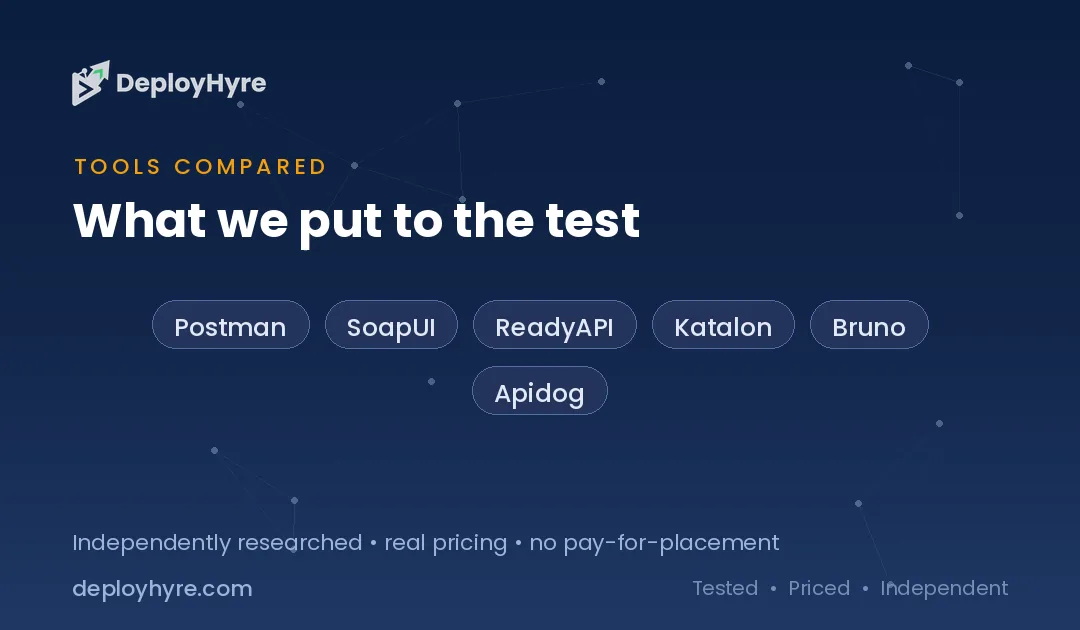
| Tool | Best For | Observed Price | Model |
|---|---|---|---|
| Postman | Collaborative API dev + testing | Free; $9 Solo / $19 Team / $49 Enterprise per user/mo | Collaborative platform |
| SoapUI | Free open-source testing | Free (OSS); Pro $659/yr | Open source |
| ReadyAPI | Enterprise functional + performance | Test $659/yr; Performance $5,999/yr; Virtualization $1,199/yr | Unbundled modules |
| Katalon | Codeless API + UI testing | Free tier; seat-based paid (quote) | Codeless platform |
| Bruno | Open-source, offline-first | Free (open source) | Open source |
| Apidog | All-in-one API design + test | Free tier; paid tiers | Integrated platform |
What AI API Testing Tools Do
APIs are the connective tissue of modern software, your services talk to each other and to partners through them, so when an API breaks or misbehaves, applications fail. API testing tools verify that each endpoint returns the correct data, handles bad input and errors gracefully, enforces authentication, and performs acceptably under load. They cover functional testing (does it work correctly), performance and load testing (does it hold up under traffic), and increasingly contract testing (does it match its specification), run manually during development and automatically in CI/CD pipelines.
The AI layer is making API testing faster to author and maintain: it generates test cases from API specifications, creates realistic test data, detects anomalies in responses, and helps maintain tests as APIs evolve, addressing the maintenance burden that makes teams skip testing. Combined with API design and documentation (which many of these tools now bundle), the category is consolidating the whole API lifecycle, design, test, mock, monitor, into integrated platforms rather than standalone testers.
API testing is part of the delivery pipeline and overlaps with API management and security. It complements the broader QA in our best AI test automation tools guide, the governance in our best API management tools guide, and the runtime protection in our best AI API security tools guide.
Collaborative Platform vs Unbundled Modules vs Free OSS
The three pricing models, collaborative per-seat platform, unbundled enterprise modules, and free open-source, are the real distinction, because they make “the cost of API testing” mean very different things. Postman prices as one collaborative platform per user ($9 Solo, $19 Team, $49 Enterprise), so cost scales with team size and everyone gets the whole tool. ReadyAPI unbundles capabilities into separate products, Test ($659 a year), Performance ($5,999), Virtualization/service mocking ($1,199), so your true cost is the sum of the modules you actually need. Open-source tools (SoapUI’s free edition, Bruno) cover core testing at no license cost.
The practical consequence is that comparing headline prices misleads. A team needing only functional testing pays ReadyAPI Test’s $659 a year, but one needing performance and virtualization too stacks to $7,000-plus, while the same team on Postman pays per seat for an integrated tool. Decide which capabilities you need, functional, performance, virtualization, collaboration, then price each model against that requirement. Often Postman’s per-seat simplicity wins for collaborative teams, while ReadyAPI wins when you need its specialized, deep performance and virtualization modules.
Best Collaborative API Platform
Postman is the best choice for collaborative API development and testing, the de facto standard used across the industry, with a free tier and paid plans at $9 (Solo), $19 (Team), and $49 (Enterprise) per user a month. Its strength is the whole API workflow in one collaborative tool: designing, testing, documenting, mocking, and monitoring APIs, with teams sharing collections and environments. Because it is ubiquitous, developers know it, integrations are everywhere, and onboarding is easy. For most teams, Postman is the pragmatic default, covering functional testing and the broader API lifecycle at an accessible per-seat price.
Apidog is a rising all-in-one alternative that integrates API design, testing, and documentation, appealing to teams that want Postman-style breadth with a free tier and competitive paid pricing. Both are integrated, collaborative platforms; Postman for its ubiquity and mature ecosystem, Apidog for an all-in-one design-plus-test experience. For teams whose API testing lives alongside API development and documentation, these platform approaches beat standalone testers, and they slot into the pipelines in our best AI DevOps tools guide.
Best Enterprise and Specialized Testing
ReadyAPI (from SmartBear) is the enterprise choice for deep functional, performance, and virtualization testing, sold as separately-priced modules: Test at $659 a year, Performance at $5,999, and Virtualization at $1,199. Its strength is depth in the specialized areas, robust load and performance testing, and service virtualization (mocking dependencies so you can test in isolation), that lightweight tools lack. For enterprise QA teams that need rigorous performance testing and virtualization, ReadyAPI’s dedicated modules are worth their cost, though you should price only the modules you need, since the full suite stacks to several thousand dollars a year.
Katalon is the other strong option for teams wanting codeless API and UI testing together, with a free tier and seat-based paid plans, favored by QA teams that test both APIs and user interfaces and prefer a codeless approach. Both serve teams needing more than basic testing; ReadyAPI for deep performance and virtualization on unbundled modules, Katalon for codeless combined API-and-UI testing. Choose ReadyAPI when specialized performance or virtualization is the requirement, and Katalon when codeless breadth across API and UI matters, complementing our best AI test automation tools guide.
Best Free and Open-Source Options
SoapUI is the established free, open-source API testing tool, covering functional and basic API testing at no license cost, with a Pro version at $659 a year for teams that want advanced features and support. For teams that want capable API testing without a subscription, SoapUI’s open-source edition is a long-standing standard, especially strong for SOAP and REST functional testing. It suits budget-conscious teams and those that prefer open-source tooling, with the Pro upgrade available when advanced capabilities or support become necessary.
Bruno is the modern open-source alternative, an offline-first, Git-friendly API client that has gained popularity as a lightweight, privacy-respecting option (it stores collections as files in your repo rather than in the cloud), free and open source. It appeals to developers who want a fast, local, version-controllable API tool without cloud dependency. Both are free open-source options; SoapUI as the established functional-testing standard, Bruno as the modern offline-first client. Choose these when you want capable API testing at no license cost and have the setup preference for open-source or local-first tooling.
How Should You Choose an API Testing Tool?
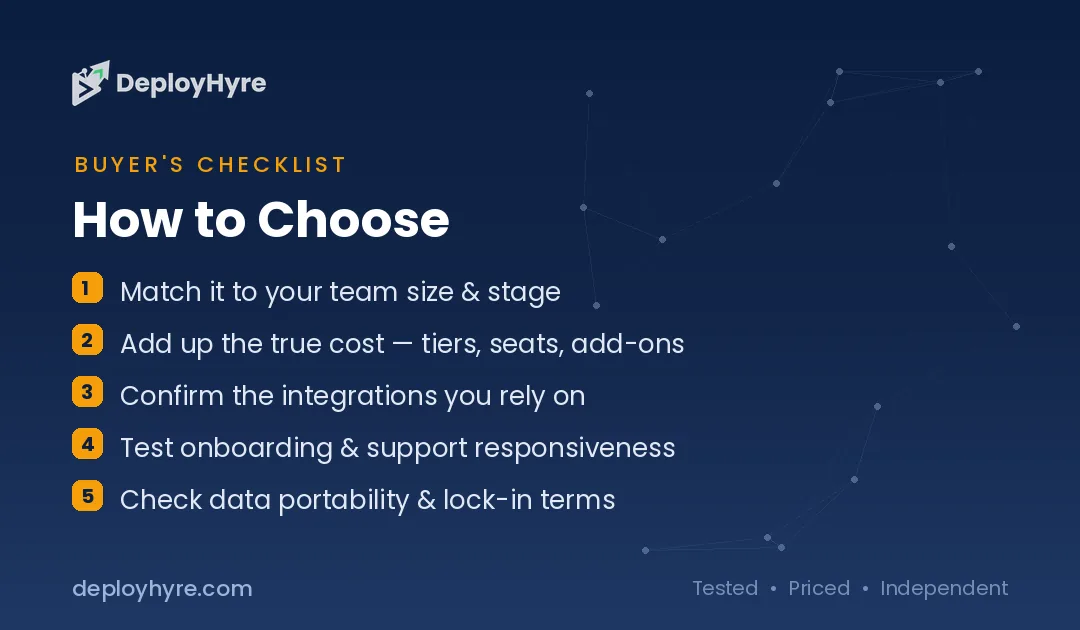
Decide which pricing model fits first, because the three make cost mean different things. Collaborative teams wanting one integrated tool point to Postman’s per-seat platform. Teams needing deep, specialized performance or virtualization point to ReadyAPI’s unbundled modules, priced only for what you use. Budget or open-source-preferring teams point to SoapUI or Bruno at no license cost.
Then scope your capabilities. If you need only functional testing, Postman, SoapUI, or ReadyAPI Test cover it affordably. If you need performance/load testing and service virtualization, ReadyAPI’s specialized modules are the fit (price the stack). If you test both APIs and UIs codelessly, Katalon. Match the tool to the specific testing types you actually run.
Finally, weigh collaboration and lifecycle breadth. Postman and Apidog integrate testing with API design, documentation, and mocking, valuable when API testing lives alongside development. Bruno’s Git-friendly, offline model suits teams that want tests version-controlled in their repo. Choose based on whether integrated collaboration or local-first control matters more, and use the AI test-generation features to cut authoring and maintenance effort.
How We Evaluated These Platforms
We evaluated each tool on functional, performance, and virtualization testing, collaboration and lifecycle features, AI test generation, open-source availability, and pricing model. Figures come from vendor pages and comparison sources. Because the market splits into collaborative-platform, unbundled-module, and open-source pricing, we present observed rates and stress scoping the capabilities you need. We accepted no payment for placement; rankings reflect fit for a stated use case.
The Bottom Line
Postman is the collaborative default for most teams at $9 to $49 per user, ReadyAPI the enterprise choice for deep performance and virtualization (priced as separate modules), and SoapUI or Bruno the free open-source options. Katalon serves codeless API-and-UI testing and Apidog all-in-one API work. Decide which of the three pricing models, collaborative per-seat, unbundled modules, or free OSS, fits your capability needs, since that determines what API testing actually costs you.
Frequently Asked Questions
How much do API testing tools cost?
It depends on the model. Postman is per user: free, $9 Solo, $19 Team, $49 Enterprise. ReadyAPI unbundles modules, Test at $659 a year, Performance at $5,999, Virtualization at $1,199, so your cost is the sum you need. SoapUI’s open-source edition and Bruno are free (SoapUI Pro is $659 a year). Katalon and Apidog offer free tiers plus paid plans.
What is API testing?
API testing verifies that your APIs return correct responses, handle errors and bad input gracefully, enforce authentication, and perform under load. It covers functional testing (does it work), performance/load testing (does it hold up), and contract testing (does it match its spec), run during development and automatically in CI/CD to catch breakages before they reach dependent applications.
Is Postman the best API testing tool?
For most teams, yes, it is the de facto standard for collaborative API development and testing, covering the whole lifecycle (design, test, document, mock, monitor) in one tool at $9 to $49 per user. Teams needing deep performance testing or service virtualization may prefer ReadyAPI’s specialized modules, and budget teams may choose free open-source SoapUI or Bruno.
What is service virtualization in API testing?
Service virtualization creates mock versions of the APIs or services your application depends on, so you can test in isolation even when those dependencies are unavailable, incomplete, or costly to call. ReadyAPI offers it as a dedicated module ($1,199 a year). It is valuable for testing complex systems without needing every real dependency running.
Are free open-source API testing tools good enough?
For functional API testing, yes. SoapUI’s open-source edition is a long-standing capable standard, and Bruno is a modern, Git-friendly, offline-first client, both free. They cover core testing well, with SoapUI Pro available for advanced features. Teams needing deep performance testing, virtualization, or heavy collaboration may still prefer Postman or ReadyAPI.
Related Articles

David Austin is a technology writer and software analyst at DeployHyre, where he covers AI tools, SaaS platforms, cloud hosting, and business automation. He focuses on hands-on comparisons of pricing, features, and real-world performance so teams can pick the right software with confidence.