TL;DR: Seeking Alpha Premium renews at $299 a year, and Pro renews at $2,400. If that feels steep, Danelfin is the best pick for AI stock scores, TipRanks is best for tracking analyst accuracy, and Stock Rover is best for deep screening. Zacks, Koyfin, Simply Wall St, Morningstar, Finviz and Motley Fool fill other needs. Most offer a free tier or a trial, so you can compare before you pay.
Seeking Alpha Premium renews at $299 per year, and the Pro plan renews at $2,400 per year, according to the company’s own subscriptions page. That is a lot to pay for research you mostly read. Many investors start looking for Seeking Alpha alternatives once the first renewal bill arrives.
The good news is that the market has changed. Many tools now use AI models, quant scores and large data sets to rate stocks. You can get ratings, screens and charts for less money, or get deeper data for about the same price.
This guide compares nine research tools on price, data depth and how they use AI. It fits inside our larger guide to AI tools for finance. This guide compares research tools and is not financial advice.
Quick Comparison: The Best Seeking Alpha Alternatives at a Glance
| Tool | Best For | Starting Price | Key Strength |
|---|---|---|---|
| Danelfin | AI stock scores | Free; Plus $22/mo | AI Score from 1 to 10 per stock |
| TipRanks | Analyst tracking | Premium $13.50/mo (promo) | Smart Score and expert track records |
| Zacks Premium | Earnings revision ratings | $249/yr | Zacks Rank system |
| Stock Rover | Deep screening | $29/mo billed yearly | Hundreds of screening metrics |
| Koyfin | Charts and market data | Free; Plus $39/mo | Pro style dashboards |
| Simply Wall St | Visual analysis | Free tier; check current price | Snowflake company graphic |
| Morningstar Investor | Independent analyst ratings | Check current price | Fair value and moat ratings |
| Finviz Elite | Fast screening and heatmaps | $39.50/mo or $299.50/yr | Real time screener and backtests |
| Motley Fool Stock Advisor | Curated stock picks | Check current price | Two new picks each month |
What Makes a Great Seeking Alpha Alternative?
A great Seeking Alpha alternative gives you a clear rating system, data you can check, and a fair price. It should explain how its scores are built. It should cover the stocks you own. It should also save you time, either through AI ratings, fast screens or curated picks. A free tier or trial helps you test it before paying.
Seeking Alpha mixes three things. It has crowd written articles, Quant Ratings and Factor Grades, and news. Few rivals copy all three. So the right swap depends on which part you used most.
- If you used the Quant Ratings, look at Danelfin, Zacks or TipRanks.
- If you used the data and screens, look at Stock Rover, Koyfin or Finviz.
- If you used the analysis articles, look at Morningstar or Simply Wall St.
- If you used Alpha Picks, look at Motley Fool Stock Advisor.
Best AI and Quant Rating Tools for Picking Stocks
These tools turn lots of data into one simple score. They are the closest match to Seeking Alpha’s Quant Ratings.
#1 Danelfin: Best for AI Stock Scores
Danelfin is the most AI focused tool on this list, built around one AI Score per stock.
What it does well. Danelfin rates stocks and ETFs with an AI Score from 1 to 10. The score aims to show the odds that a stock beats the market over the next three months. Danelfin says the model looks at technical, fundamental and sentiment signals. It also shows which signals pushed each score up or down. That makes the AI less of a black box than many rivals.
Key features:
- AI Score from 1 to 10 for US and European stocks and ETFs
- Separate technical, fundamental and sentiment sub scores
- Explanations of the top features behind each rating
- Ranked lists and AI driven trade ideas
- Free plan with limited access
Pricing. Danelfin’s pricing page lists a free plan. Paid plans are Plus at $22 a month ($264 a year), Pro at $59 a month ($708 a year) and Elite at $134 a month ($1,608 a year).
Best for: Investors who liked Seeking Alpha’s Quant Ratings and want a cheaper, AI first score.
Limitations. The scores focus on a short window, so long term investors may find them less useful. There are no long written reports or community debate.
#2 TipRanks: Best for Tracking Analyst Accuracy
TipRanks tells you who to trust by scoring the experts, not just the stocks.
What it does well. TipRanks tracks the calls of Wall Street analysts, bloggers, hedge funds and company insiders. It then ranks those experts by past results. Its Smart Score rolls several data sets into one rating from 1 to 10. This helps you see if a bullish call comes from someone with a good record.
Key features:
- Smart Score rating from 1 to 10
- Analyst rankings by success rate and average return
- Insider trading and hedge fund activity
- Price targets and consensus ratings
- Portfolio tools and stock screeners
Pricing. The TipRanks plans page showed Premium at $13.50 a month, down from $30, and Ultimate at $22.50 a month, down from $50. These are promo prices, so check the current price before you buy.
Best for: Investors who want to know which analysts and bloggers have a real track record.
Limitations. Analyst coverage can be thin on small cap stocks. The site has many features, so it can feel busy at first.
#3 Zacks Premium: Best for Earnings Revision Ratings
Zacks Premium is the long running quant option, built on how analysts change their earnings forecasts.
What it does well. The Zacks Rank sorts stocks from #1 (Strong Buy) to #5 (Strong Sell). It is based mainly on changes in analyst earnings estimates. Zacks has used this system for decades, which gives it a long public history. Premium adds full access to the Rank lists, Style Scores, equity research reports and screens.
Key features:
- Zacks Rank #1 to #5 for thousands of stocks
- Style Scores for value, growth and momentum
- Zacks Industry Rank
- Equity research reports
- Premium stock screens
Pricing. The Zacks registration page lists Zacks Premium at $249 for one year, with a trial offer.
Best for: Investors who trust earnings momentum and want a rating system with a long history.
Limitations. The site design feels dated. Expect a lot of marketing email offering higher priced services.
Best Data and Screening Platforms for DIY Research
These tools give you the raw numbers. You do the thinking, but you get far more data than Seeking Alpha shows.
#4 Stock Rover: Best for Deep Screening
Stock Rover is a research and screening platform for investors who want to check every number themselves.
What it does well. Stock Rover lets you screen on hundreds of metrics. It says it holds up to 20 years of fundamental history. You can build screens by hand or describe one in plain words and let its AI build it. It also links to your brokerage, so you can track real portfolio returns next to your research.
Key features:
- Screener with hundreds of financial metrics
- AI assisted screen building
- Long fundamental and dividend history
- Research reports on higher plans
- Brokerage linked portfolio tracking
Pricing. Stock Rover’s plans page lists Premium at $29 a month billed yearly ($348), Premium Plus at $49 ($588), Ultimate at $79 ($948) and Ultimate Pro at $149 ($1,788). Monthly billing costs more, from $34 a month.
Best for: Value and dividend investors who want data over opinions.
Limitations. It has a learning curve. Its entry plan costs a bit more per year than Seeking Alpha Premium.
#5 Koyfin: Best for Charts and Market Data
Koyfin brings pro style market dashboards to individual investors at a fraction of terminal prices.
What it does well. Koyfin covers stocks, ETFs, mutual funds and macro data in clean, custom dashboards. You can chart almost any metric, compare companies side by side and read earnings call transcripts. The free plan is useful on its own, which makes Koyfin easy to try.
Key features:
- Custom dashboards and watchlists
- Charts for fundamentals, prices and macro data
- Earnings transcripts and analyst estimates
- Stock and fund screeners
- Portfolio tracking and model portfolios
Pricing. Koyfin’s pricing page lists a free plan, Plus at $39 a month and Premium at $79 a month. Advisor Core ($209) and Advisor Pro ($299) are for financial advisors.
Best for: Investors who used Seeking Alpha as a morning market dashboard.
Limitations. Koyfin does not give buy or sell ratings. You must form your own view from the data.
#6 Finviz Elite: Best for Fast Screening and Heatmaps
Finviz is the quickest way to scan the whole market and spot what is moving.
What it does well. Finviz is famous for its market heatmap and fast stock screener. The free version already does a lot. Elite adds real time quotes, advanced charts, backtesting and alerts. It also removes ads, which makes the site much faster to use.
Key features:
- Fast screener with many filters
- Market heatmaps by sector and industry
- Real time data and intraday charts on Elite
- Strategy backtesting
- Email alerts and data export
Pricing. The Finviz Elite page lists $39.50 a month or $299.50 a year.
Best for: Active traders and investors who screen often and want speed.
Limitations. There are no written analysis or proprietary ratings. Fundamental history is shallow next to Stock Rover or Koyfin.
Best Analyst Research and Visual Tools for Long Term Investors
These options replace the reading side of Seeking Alpha. They focus on what a business is worth over many years.
#7 Morningstar Investor: Best for Independent Analyst Ratings
Morningstar Investor gives you research from a paid analyst team that follows one public method.
What it does well. Morningstar analysts set a fair value estimate and an economic moat rating for the companies they cover. Its star ratings compare a stock’s price to that fair value. It is also one of the strongest sources for mutual fund and ETF research. You get one steady point of view instead of many contributors who may disagree.
Key features:
- Fair value estimates and star ratings
- Economic moat and uncertainty ratings
- Deep fund and ETF research
- Portfolio X ray analysis
- Screeners for stocks and funds
Pricing. We could not confirm the price on Morningstar’s own page for this update. Please check the current price on Morningstar’s site.
Best for: Long term investors who want consistent, method driven analyst views and fund research.
Limitations. Analyst coverage is narrower than Seeking Alpha’s contributor base. It does not try to time the market.
#8 Simply Wall St: Best for Visual Stock Analysis
Simply Wall St turns financial statements into pictures that most people can read in minutes.
What it does well. Every company gets a Snowflake graphic. It scores value, future growth, past performance, financial health and dividends. Reports then explain each area with charts and plain text. This makes it a good choice for newer investors who find Seeking Alpha articles too dense.
Key features:
- Snowflake score across five areas
- Visual company reports
- Curated screeners and idea lists
- Portfolio tracking with alerts
- Wide global stock coverage
Pricing. Simply Wall St offers a free tier. Its plans page did not show prices we could confirm, so check the current price there.
Best for: Beginners and visual learners who want fast, clear company snapshots.
Limitations. The automated reports can miss context a human analyst would catch. Power users may want more raw data.
#9 Motley Fool Stock Advisor: Best for Curated Stock Picks
Stock Advisor is the closest match to Alpha Picks, with a small set of picks instead of a research library.
What it does well. Stock Advisor sends two new stock picks each month, plus lists of top stocks to buy now. Each pick comes with a write up. You do not need to screen or read dozens of articles. This is why people often search for “seeking alpha vs motley fool” when deciding where to spend.
Key features:
- Two new stock picks each month
- Ranked lists of current top picks
- Written reports on each pick
- Long term, buy and hold focus
- Member community and podcasts
Pricing. Motley Fool lists Stock Advisor at $99 for the first year for new members, and it renews at $199 a year. Check the current offer before you sign up, since intro prices change often.
Best for: Busy, long term investors who want a short list of ideas.
Limitations. You get few tools for your own research. Expect frequent upsell offers for other Motley Fool services.
How Does Seeking Alpha Compare on Price?
Seeking Alpha Premium renews at $299 a year, and Pro renews at $2,400 a year. New Premium members may see a short intro offer first. Several tools here cost less, including Danelfin Plus, Zacks Premium and TipRanks on promo. Stock Rover and Koyfin Plus can cost more but give deeper data.
Alpha Picks is a separate Seeking Alpha product. Its sign up page describes two stock picks per month based on Quant Ratings. We could not confirm its price there, so check the current price on that page.
Price alone does not tell the full story. A $22 AI score tool and a $79 data platform do very different jobs. Match the cost to the job you need done.
How Should You Choose the Right Seeking Alpha Alternative?
Start with the part of Seeking Alpha you used most. Then pick the tool that does that job best for your budget. Use free tiers and trials to compare two or three options with your own stocks. Keep the one you actually open each week, and cancel the rest before renewal.
Ask yourself these questions:
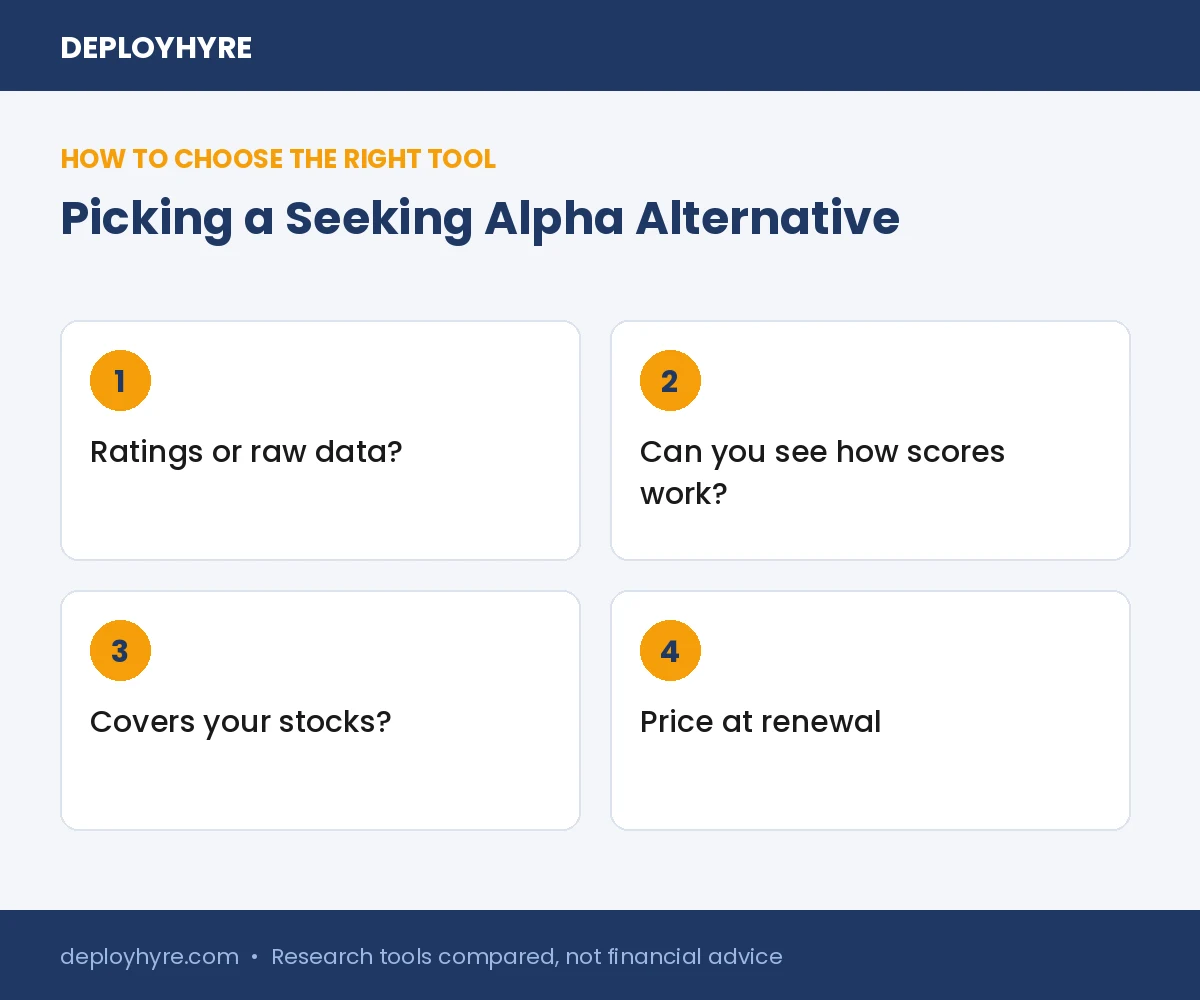
- Do you want ratings or raw data? Ratings save time. Raw data gives you control.
- How long do you hold stocks? Short term scores like Danelfin suit active investors. Morningstar suits buy and hold investors.
- Can you see how the score works? Prefer tools that explain their inputs, such as Danelfin’s feature breakdown or Zacks’ estimate revision method.
- Does it cover your holdings? Check small caps, foreign stocks and ETFs before you pay.
- What will you pay at renewal? Many intro deals rise sharply in year two.
Many investors pair two tools. A common setup is one rating tool for ideas and one data tool for checking them. If you also want help with the wider picture, see our guide to AI financial planning software.
Are AI Stock Ratings Worth Paying For?
AI stock ratings are worth paying for if you use them as a first filter, not a final answer. They can sort thousands of stocks fast and flag ones to study. But no score can promise future returns. Check how the model works, how it has done in the past, and whether its time frame matches yours.
Look for tools that show their work. Danelfin lists the features behind each AI Score. TipRanks shows each analyst’s record. Zacks publishes how its Rank is built. These details help you judge a score instead of trusting it blindly. For tools that go deeper into company financials, see our list of AI financial analysis software.
How We Evaluated These Tools
We compared and reviewed these tools using public information. We did not run trading tests or measure returns. Here is what we looked at:
- Pricing: We took prices from each vendor’s own pricing page in November 2026. Where we could not confirm a price, we say so and link to the vendor.
- AI and quant features: We checked whether each tool offers scores or ratings, and how clearly it explains them.
- Data depth: We looked at screening options, history length and asset coverage as each vendor describes them.
- Fit as a replacement: We mapped each tool to the Seeking Alpha feature it replaces best.
- Ease of trial: We gave credit for free plans and trials.
Rankings reflect our view of overall fit for investors leaving Seeking Alpha. Prices and features change often, so confirm details on each vendor’s site.
The Bottom Line
The best Seeking Alpha alternatives depend on what you want to replace. For AI driven ratings, Danelfin is our top pick, with TipRanks and Zacks close behind. For deep data, Stock Rover and Koyfin lead, and Finviz Elite wins on speed. For long term research, Morningstar and Simply Wall St are strong choices. Motley Fool Stock Advisor is the easy swap for Alpha Picks fans.
Many of these tools have free plans or trials. Try two that match your style before you commit to a yearly bill. Then use the money you save wisely. Our guide to AI budgeting software can help you plan it, and our AI tools for finance hub covers the rest of your money stack.
Frequently Asked Questions
What is the best Seeking Alpha alternative?
There is no single best option for everyone. Danelfin is the best pick for AI stock scores. TipRanks is best for checking analyst track records. Stock Rover is best for deep screening and data. Motley Fool Stock Advisor is best if you want a few curated picks. Choose based on the Seeking Alpha feature you used most.
Is there a free alternative to Seeking Alpha?
Yes. Koyfin, Danelfin, Finviz and Simply Wall St all offer free plans. Free tiers limit features or the number of stocks you can view. They are good for testing a tool before you pay. For basic charts and news, the free Finviz screener and Koyfin dashboards cover a lot of what casual investors need.
How much does Seeking Alpha Premium cost?
Seeking Alpha’s subscriptions page shows Premium renewing at $299 per year, with an intro offer for new members. Seeking Alpha Pro renews at $2,400 per year. Alpha Picks is sold separately. Prices can change, so check the subscriptions page on seekingalpha.com for the latest offer before you sign up.
Is Seeking Alpha or Motley Fool better?
They serve different needs. Seeking Alpha is a research library with articles, Quant Ratings and news. Motley Fool Stock Advisor gives you two new stock picks a month with less reading. If you want to do your own research, Seeking Alpha or a data tool fits better. If you want a short list of ideas, Stock Advisor fits better.
Which seekingalpha alternatives use AI?
Danelfin is the most AI focused, with an AI Score for each stock. TipRanks uses data models to build its Smart Score. Stock Rover offers AI assisted screen building. Zacks relies on a quant model based on earnings estimate revisions. Treat any AI or quant rating as a starting point for research, not a buy signal.

David Austin is a technology writer and software analyst at DeployHyre, where he covers AI tools, SaaS platforms, cloud hosting, and business automation. He focuses on hands-on comparisons of pricing, features, and real-world performance so teams can pick the right software with confidence.