Table of Contents
The best API management tool for most teams is Apigee for hyper-scale multi-cloud governance, Kong for Kubernetes-native deployments, AWS API Gateway for serverless architectures, and MuleSoft for integration-heavy enterprises. These platforms sit in front of your APIs to handle the operational work, authentication, rate limiting, routing, analytics, and developer portals, so your teams publish and consume APIs safely and at scale.
The budgeting trap to watch: the entry price ranges from $0 to a few thousand a month, but hidden costs can double or triple what you expected. Kong and Tyk have free open-source editions, while Apigee’s Comprehensive environment reaches about $3,431 a month per region. The catch is that data egress, developer-portal licensing, and SSO upcharges are frequently separate line items that balloon the real bill well beyond the headline gateway price. Pricing the whole platform, not just the gateway, is essential.
Every price below is a recent observed figure. Because enterprise platforms quote per deployment and usage-based fees scale with API calls, treat each as a band.
Quick Comparison: API Management Tools at a Glance
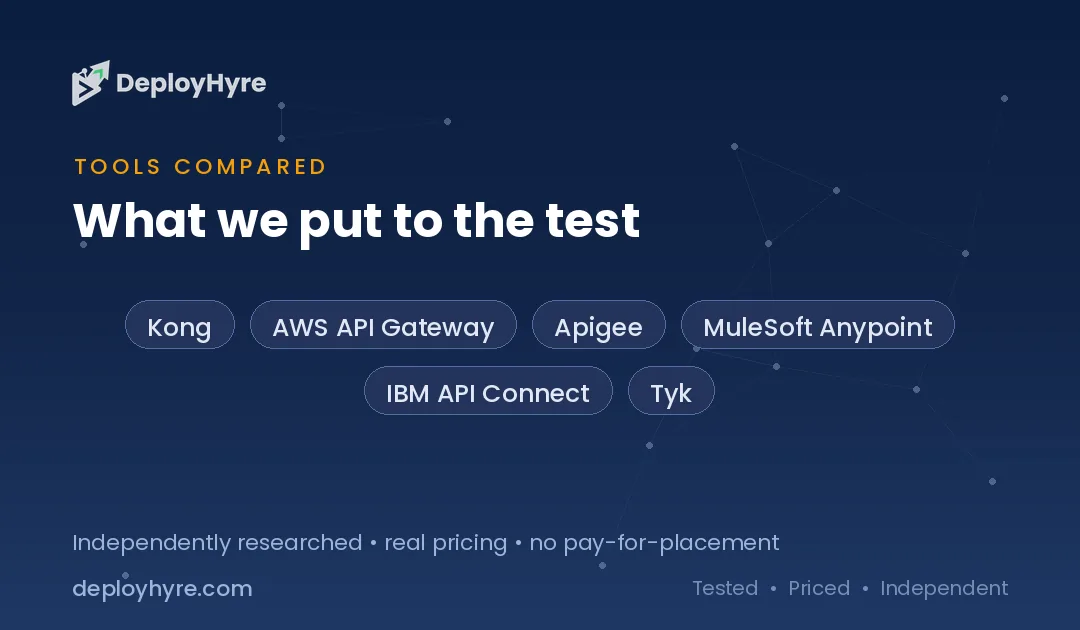
| Platform | Best For | Observed Price | Model |
|---|---|---|---|
| Kong | Kubernetes-native deployments | OSS free; Konnect ~$48K/yr (moderate) | Open source + enterprise |
| AWS API Gateway | Serverless architectures | $1.00/M HTTP; $3.50/M REST calls | Per call |
| Apigee | Hyper-scale multi-cloud governance | $0–$3,431/mo/region + $20/M calls | Environment + usage |
| MuleSoft Anypoint | Integration-heavy enterprises | Six figures/yr (quote) | Enterprise quote |
| IBM API Connect | Regulated industries, legacy | Enterprise quote | Enterprise |
| Tyk | Open-source flexibility | OSS free; paid tiers | Open source + cloud |
What API Management Tools Do
APIs are how modern software connects, your services to each other, your product to partners, your data to mobile apps, and API management is the layer that governs them. An API management platform provides a gateway that authenticates callers, enforces rate limits and quotas, routes and transforms requests, and collects analytics, plus a developer portal where consumers discover and subscribe to your APIs. It turns a collection of raw endpoints into a governed, monetizable, observable API program.
The core components are the gateway (the runtime that processes API traffic), the management plane (where you configure policies), the developer portal (documentation and onboarding for API consumers), and analytics. The AI layer adds anomaly detection on API traffic, automated documentation generation, and increasingly assistance with API design and policy configuration, reducing the manual work of running an API program at scale.
API management overlaps with API security and the delivery pipeline. It pairs with the runtime protection in our best AI API security tools guide and the CI/CD practices in our best AI DevOps tools guide, and it fronts the services hosted per our best cloud hosting guide.
The Entry Price Hides the Real Cost
API management entry prices span from free open-source to a few thousand a month, but the headline gateway cost routinely understates the real bill because egress, developer-portal licensing, and SSO are separate charges. Kong, Tyk, KrakenD, and WSO2 all have free open-source gateways, while Apigee’s Comprehensive environment runs to about $3,431 a month per region plus usage. The trap is that the features that make a platform genuinely useful in production, a branded developer portal, enterprise SSO, higher egress allowances, are frequently upcharges that can double or triple the number you first saw.
The usage dimension compounds this. AWS API Gateway charges $1.00 per million HTTP API requests and $3.50 per million for REST APIs, and Apigee adds around $20 per million calls on top of its environment fee. So a platform’s true cost is the gateway plus per-call usage plus the add-on features you actually need. Ask every vendor for a fully-loaded quote including egress, portal, SSO, and usage at your call volume, because comparing headline gateway prices alone is how teams get surprised at renewal.
Best Enterprise and Multi-Cloud Platforms
Apigee, from Google Cloud, is the enterprise leader for hyper-scale, multi-cloud API governance, with deep policy control, analytics, and developer-portal capabilities, priced on an environment fee (up to about $3,431 a month per region for Comprehensive) plus roughly $20 per million calls. It is built for large organizations running extensive API programs across clouds that need robust governance, monetization, and analytics. The layered pricing, environment plus usage plus add-ons, rewards careful modeling, but for enterprises whose APIs are a strategic product surface, Apigee’s depth justifies its position.
MuleSoft Anypoint is the choice for integration-heavy enterprises, combining API management with a full integration platform (iPaaS) to connect applications and data, sold on six-figure enterprise quotes. IBM API Connect serves regulated industries with legacy systems, strong where compliance and integration with established enterprise infrastructure matter. All three are enterprise-grade; Apigee for multi-cloud API governance, MuleSoft for integration breadth, IBM for regulated legacy environments. For securing the APIs these manage, see our best AI API security tools guide.
Best Cloud-Native and Kubernetes Options
Kong is the leading choice for Kubernetes-native and cloud-native API management, with a free open-source gateway and Kong Konnect enterprise from around $48,000 a year for moderate scale (10 to 50 APIs, 50 million calls a month), including a unified control plane, RBAC, and support. Its lightweight, high-performance gateway is designed for microservices and containerized environments, and its open-source foundation lets teams start free and upgrade to the managed control plane as they scale. For organizations running Kubernetes and microservices, Kong is the natural, performant fit.
Kong’s dual model, free open-source gateway plus paid Konnect control plane, means you can adopt it incrementally: run the OSS gateway to prove value, then add enterprise management when governance needs grow. This suits engineering-led teams that want a modern, container-native gateway without committing to an enterprise contract upfront. It is the standout when your architecture is Kubernetes and microservices rather than serverless or monolithic, complementing the delivery tooling in our best AI DevOps tools guide.
Best Serverless and Open-Source Options
AWS API Gateway is the obvious choice for serverless architectures, especially those built on Lambda, charging $1.00 per million HTTP API requests and $3.50 per million for REST APIs with no upfront cost, so you pay only for the traffic you serve. Its native integration with the AWS serverless stack means APIs connect to Lambda functions, DynamoDB, and other AWS services with minimal configuration. For teams already building serverless on AWS, it is the low-friction default, and its pure per-call pricing suits variable or spiky traffic where you pay nothing during idle periods.
Tyk is the strong open-source alternative for teams wanting flexibility and control, with a free open-source gateway and paid cloud and enterprise tiers, favored by organizations that want to self-host or avoid the hyperscaler platforms. Along with Kong’s OSS edition and others like KrakenD and WSO2, it lets cost-conscious teams run capable API management for the price of infrastructure. Both AWS API Gateway (for serverless on AWS) and Tyk (for open-source flexibility) are the pragmatic choices when Apigee or MuleSoft is more than you need.
How Should You Choose an API Management Tool?
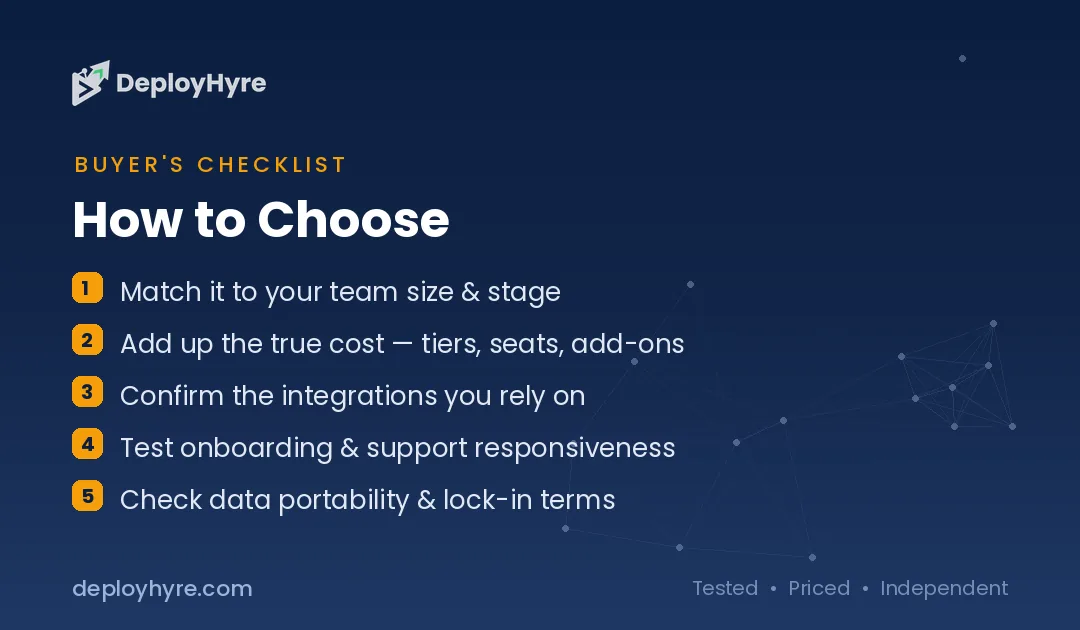
Follow your architecture first. Serverless on AWS points to AWS API Gateway. Kubernetes and microservices point to Kong. Multi-cloud enterprise API programs point to Apigee. Integration-heavy environments point to MuleSoft. Regulated legacy estates point to IBM API Connect. Your deployment model narrows the field faster than any feature comparison.
Then price the whole platform, not the gateway. Because egress, developer-portal licensing, SSO, and per-call usage are frequently separate, get a fully-loaded quote at your actual API call volume including every add-on you need. The headline gateway price, sometimes $0, routinely understates the real cost by a wide margin.
Finally, weigh open-source against managed. Kong and Tyk’s open-source editions let you start free and self-host, trading operational effort for cost control. Managed platforms and hyperscaler gateways remove that burden at higher cost. Match this to your engineering capacity and whether you want to run the gateway yourself or buy it as a service.
How We Evaluated These Platforms
We evaluated each platform on gateway performance, governance and policy depth, developer-portal and analytics capability, architecture fit (serverless, Kubernetes, multi-cloud), and total cost including add-ons. Figures come from vendor pages and comparison sources. Because entry prices understate real cost through egress, portal, and SSO upcharges, we present observed rates and stress fully-loaded pricing. We accepted no payment for placement; rankings reflect fit for a stated use case.
The Bottom Line
Apigee leads for hyper-scale multi-cloud governance, Kong for Kubernetes-native deployments, AWS API Gateway for serverless on AWS, and MuleSoft for integration-heavy enterprises, with Tyk and Kong’s OSS edition the open-source picks. Follow your architecture to the shortlist, then price the whole platform, gateway plus usage plus egress, portal, and SSO, because the headline entry price routinely hides two or three times the real cost.
Frequently Asked Questions
How much do API management tools cost?
Entry ranges from $0 (Kong and Tyk open-source editions) to about $3,431 a month per region for Apigee’s Comprehensive environment. AWS API Gateway charges $1.00 per million HTTP requests and $3.50 per million REST calls, Apigee adds roughly $20 per million calls, and Kong Konnect runs around $48,000 a year for moderate scale. Egress, developer portals, and SSO are often separate charges.
What does an API management platform actually do?
It provides a gateway that authenticates callers, enforces rate limits and quotas, routes and transforms requests, and collects analytics, plus a developer portal where API consumers discover and subscribe to your APIs. It turns raw endpoints into a governed, observable, and monetizable API program.
What is the difference between API management and API security?
API management governs how APIs are published and consumed, authentication, rate limiting, routing, developer portals, analytics. API security specifically defends APIs against attacks, discovering shadow APIs and detecting abuse and business-logic attacks. They overlap at the gateway but solve different problems, and many organizations use both together.
Which API management tool is best for serverless?
AWS API Gateway is the natural choice for serverless architectures, especially on AWS Lambda, with native integration and pure per-call pricing ($1.00 per million HTTP requests) so you pay nothing during idle periods. For Kubernetes and microservices instead, Kong’s cloud-native gateway is the stronger fit.
Are open-source API gateways good enough?
For many teams, yes. Kong and Tyk offer capable open-source gateways that handle authentication, rate limiting, and routing at no licensing cost, with the option to add a managed control plane later. The trade-off is that you self-host and maintain the gateway, and advanced governance, portals, and support typically require the paid editions.

David Austin is a technology writer and software analyst at DeployHyre, where he covers AI tools, SaaS platforms, cloud hosting, and business automation. He focuses on hands-on comparisons of pricing, features, and real-world performance so teams can pick the right software with confidence.