Table of Contents
The best customer data platform for most teams is Segment for the widest integration ecosystem, RudderStack for cost-effective high-volume event collection, Hightouch for warehouse-native activation, and mParticle for mobile-first companies. A CDP unifies customer data from every touchpoint, website, app, email, support, into a single profile, then activates it by syncing those profiles to the marketing, sales, and analytics tools that act on them.
The decision that shapes everything: the architecture split between traditional event CDPs and warehouse-native composable ones. Traditional CDPs (Segment, mParticle) collect events and store a copy of customer data themselves. Composable CDPs (Hightouch, Census, RudderStack) build on your existing data warehouse, avoiding a second copy and letting analytics engineers own the logic in SQL. If you already have a warehouse, the composable approach usually wins; if you need real-time collection out of the box, the traditional approach does.
Every price below is a recent observed figure. Because CDPs price by monthly tracked users or events, treat each as a band and estimate your volume.
Quick Comparison: Customer Data Platforms at a Glance
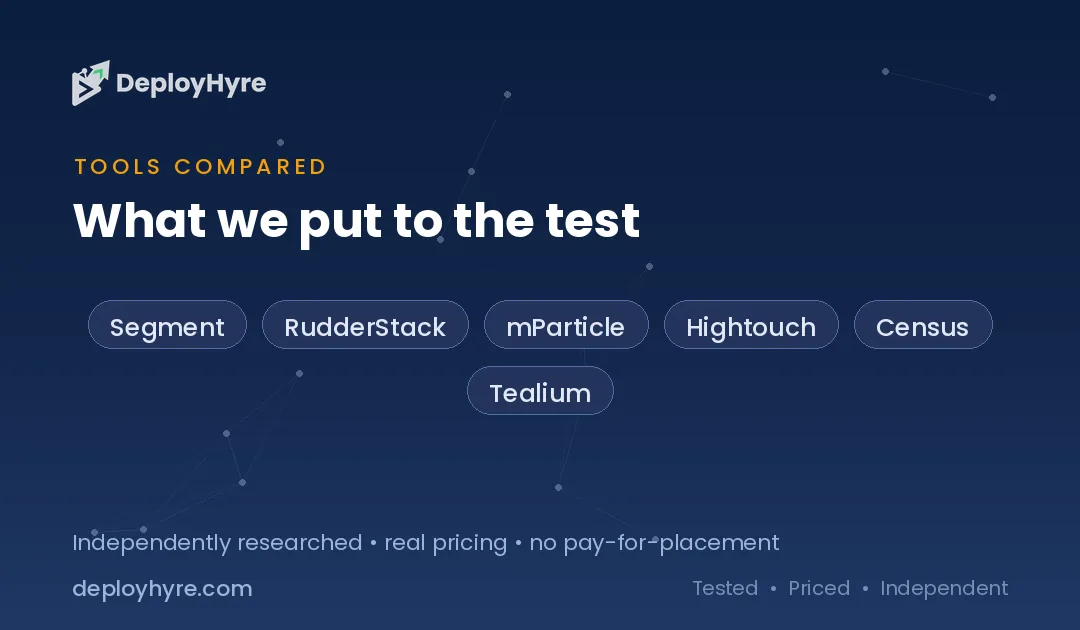
| Platform | Best For | Observed Price | Architecture |
|---|---|---|---|
| Segment | Widest integration ecosystem | Free to 1,000 MTUs; Team from $120/mo | Traditional event |
| RudderStack | Cost-effective high volume | Free to 250K events; Growth $265/mo (1M) | Warehouse-first event |
| mParticle | Mobile-first, multi-platform | From ~$100,000/yr | Traditional event |
| Hightouch | Warehouse-native activation | From ~$350/mo (by records synced) | Composable |
| Census | Warehouse-native, sync-based | Per sync workflow (Fivetran-owned) | Composable |
| Tealium | Enterprise real-time CDP | Enterprise quote | Traditional event |
What a Customer Data Platform Does
A CDP solves the fragmented-customer-data problem. Your customer interacts with you across a website, a mobile app, email campaigns, support tickets, and purchases, and that data lands in separate silos. A CDP collects it all, resolves it into a single unified profile per customer (identity resolution), and makes that profile available to every tool that needs it, so your email platform, ad targeting, and analytics all work from the same complete view rather than partial fragments.
The two halves are collection and activation. Collection gathers events and attributes into unified profiles; activation syncs those profiles out to destinations, ad platforms, email tools, CRMs, so they can act on them. The AI layer adds predictive audiences (scoring which customers are likely to churn or convert), automated identity resolution, and intelligent segmentation, turning raw profiles into actionable audiences without manual rule-building.
A CDP sits between your data and your marketing stack. It overlaps with the pipelines in our best AI ETL tools guide and the activation in our best AI reverse ETL tools guide, and it feeds the campaigns in our best AI email marketing software guide.
The Architecture Split: Event vs Composable
The biggest CDP decision is architectural: traditional event CDPs store their own copy of your customer data, while composable CDPs build on your existing warehouse, and which fits depends on whether you already have a warehouse and value real-time collection or data ownership. Traditional CDPs (Segment, mParticle, Tealium) win on real-time collection latency and work out of the box without a warehouse. Composable CDPs (Hightouch, Census, and RudderStack’s warehouse-first model) avoid a second copy of customer data, let analytics engineers own the logic in SQL, and keep the warehouse as the single source of truth.
The trend favors composable for teams that have invested in a cloud data warehouse, because duplicating customer data into a separate CDP store is redundant when the warehouse already holds it, and SQL-based logic is more flexible and auditable than a vendor UI. But traditional CDPs remain the right choice when you need low-latency real-time collection, lack a warehouse, or want an all-in-one collect-and-activate platform without building on your own data infrastructure. Decide this architecture question first, because it determines your shortlist entirely.
Best Traditional Event CDPs
Segment is the most complete and polished traditional CDP, with the widest integration ecosystem in the category, free up to 1,000 monthly tracked users and Team plans from $120 a month. Its breadth of destinations means whatever tool you want to send data to, Segment likely connects to it, and its maturity makes it the safe default for teams wanting proven event collection and activation. Now part of Twilio, it also folds in reverse-ETL capabilities. For teams that want the broadest, most battle-tested CDP and do not want to build on their own warehouse, Segment is the default.
mParticle is the specialist for mobile-first companies with complex, multi-platform requirements, excelling where customer journeys span iOS, Android, and web with sophisticated real-time needs, priced from around $100,000 a year for enterprise. Tealium is the other enterprise real-time CDP, strong on real-time data collection and governance. All three are traditional event CDPs; Segment for ecosystem breadth, mParticle for mobile complexity, Tealium for enterprise real-time. They activate to the marketing tools in our best AI email marketing software guide.
Best Warehouse-Native and Composable CDPs
Hightouch is the leading composable CDP, activating customer data straight from your existing warehouse to hundreds of destinations without storing a second copy, priced by records synced from around $350 a month. It is the safest default when your warehouse is the source of truth and marketing needs audience activation, and it has the broadest connector library in the reverse-ETL/composable category. For teams that have centralized customer data in Snowflake, BigQuery, or Redshift, Hightouch lets analytics engineers define audiences in SQL and push them everywhere, keeping the warehouse authoritative.
Census is the other major composable CDP, syncing warehouse data to business tools and now part of Fivetran, giving a combined stack that spans ingest, model, and activate. It prices by sync workflow rather than records, a different model worth comparing against Hightouch for your volume. Both represent the modern, warehouse-native approach that avoids duplicating customer data, and for organizations built around a cloud data warehouse they are usually the more efficient and flexible choice. See our best cloud data warehouses guide for the foundation they build on.
Best Value for High Volume
RudderStack is the most cost-effective choice for data-conscious teams at high volume, offering warehouse-first event collection with a free tier to 250,000 events a month and a Growth plan at $265 a month for 1 million events, materially cheaper than Segment at scale. Its open-source roots give teams more control, and its warehouse-first design means it collects events but treats your warehouse as central, blending the traditional and composable approaches. For teams that need real event collection but want to avoid Segment’s cost as volume grows, RudderStack is the value leader.
RudderStack’s appeal is precisely the combination of event collection with warehouse-centric architecture and lower high-volume pricing, which suits engineering-led teams that want control and cost efficiency. It is the pragmatic middle path between a fully traditional CDP and a purely composable one, and the natural choice when your event volume is high enough that Segment’s pricing becomes painful. For the pipelines that complement it, see our best AI ETL tools guide.
How Should You Choose a CDP?
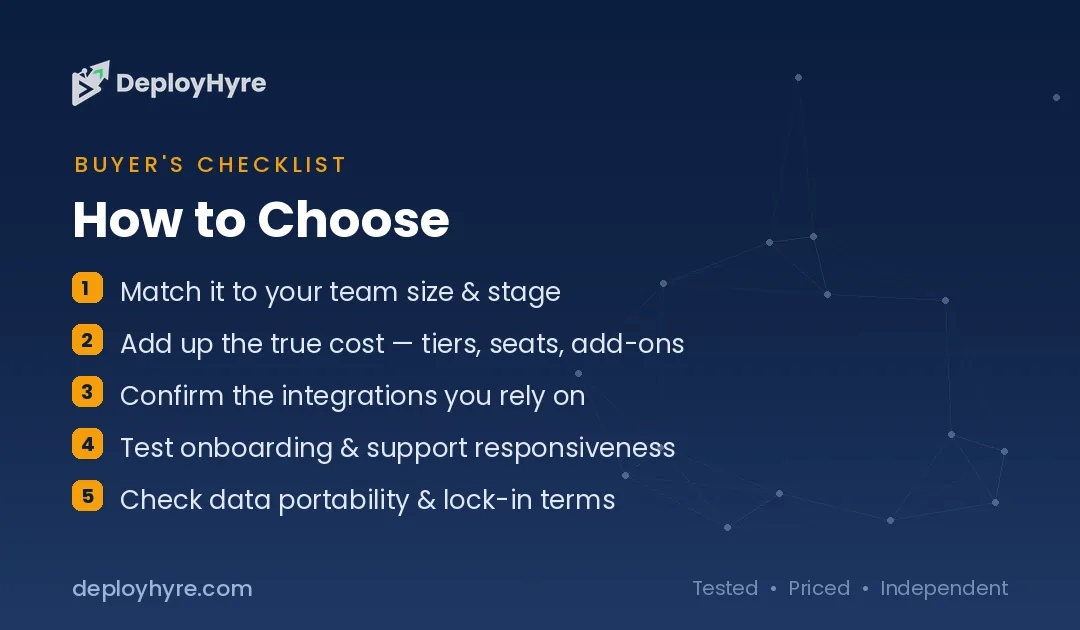
Answer the architecture question first. If you already have a cloud data warehouse and want it to stay the single source of truth, a composable CDP, Hightouch or Census, avoids duplicating data and gives SQL-based flexibility. If you need real-time collection out of the box, lack a warehouse, or want an all-in-one platform, a traditional event CDP, Segment or mParticle, fits. This split determines your whole shortlist.
Then match the tool to your specifics. Widest integration breadth points to Segment. Mobile-first complexity points to mParticle. Warehouse-native activation points to Hightouch. Cost efficiency at high event volume points to RudderStack. Enterprise real-time governance points to Tealium.
Finally, model your volume, because CDPs price by monthly tracked users or events, and the cheapest at low volume may not be at high volume, RudderStack undercutting Segment as events grow is the clearest example. Estimate your real user and event counts and price each tool on its unit before committing.
How We Evaluated These Platforms
We evaluated each platform on collection and identity resolution, activation and destination breadth, architecture (event versus composable), AI-driven audiences, and pricing model. Figures come from vendor pages and comparison sources. Because CDPs price by tracked users or events and split on architecture, we present observed rates and stress the event-versus-composable decision. We accepted no payment for placement; rankings reflect fit for a stated use case.
The Bottom Line
Segment leads traditional event CDPs on ecosystem breadth, mParticle on mobile-first complexity, and Tealium on enterprise real-time. Hightouch and Census lead the warehouse-native composable approach, and RudderStack is the value pick for high-volume event collection. Decide the event-versus-composable architecture first based on whether you have a warehouse, then match the tool to your specifics and model your volume, since pricing scales with tracked users and events.
Frequently Asked Questions
How much does a customer data platform cost?
Segment is free up to 1,000 monthly tracked users with Team plans from $120 a month, and RudderStack is free to 250,000 events then $265 a month for 1 million. Hightouch starts around $350 a month by records synced, while mParticle and enterprise CDPs like Tealium run from around $100,000 a year. Pricing scales with tracked users or events.
What is a composable CDP?
A composable CDP builds on your existing data warehouse instead of storing its own copy of customer data. Tools like Hightouch and Census read unified profiles from the warehouse and activate them to destinations, letting analytics engineers define audiences in SQL. This avoids duplicating customer data and keeps the warehouse as the single source of truth.
Should I use a traditional or composable CDP?
If you already have a cloud data warehouse and want it authoritative, a composable CDP (Hightouch, Census) avoids a second data copy and offers SQL flexibility. If you need low-latency real-time collection, lack a warehouse, or want an all-in-one platform, a traditional event CDP (Segment, mParticle) fits better. The choice hinges on your data infrastructure.
Is RudderStack cheaper than Segment?
At higher event volumes, generally yes. RudderStack’s warehouse-first design and pricing (free to 250,000 events, $265 a month for 1 million) undercut Segment as volume grows, and its open-source roots give more control. For data-conscious, engineering-led teams with significant event volume, RudderStack is often the more cost-effective choice.
What does AI add to a CDP?
AI adds predictive audiences (scoring which customers are likely to churn or convert), automated identity resolution to unify profiles more accurately, and intelligent segmentation that builds audiences without manual rules. This turns raw unified profiles into actionable, targeted audiences that marketing can activate immediately.

David Austin is a technology writer and software analyst at DeployHyre, where he covers AI tools, SaaS platforms, cloud hosting, and business automation. He focuses on hands-on comparisons of pricing, features, and real-world performance so teams can pick the right software with confidence.