Table of Contents
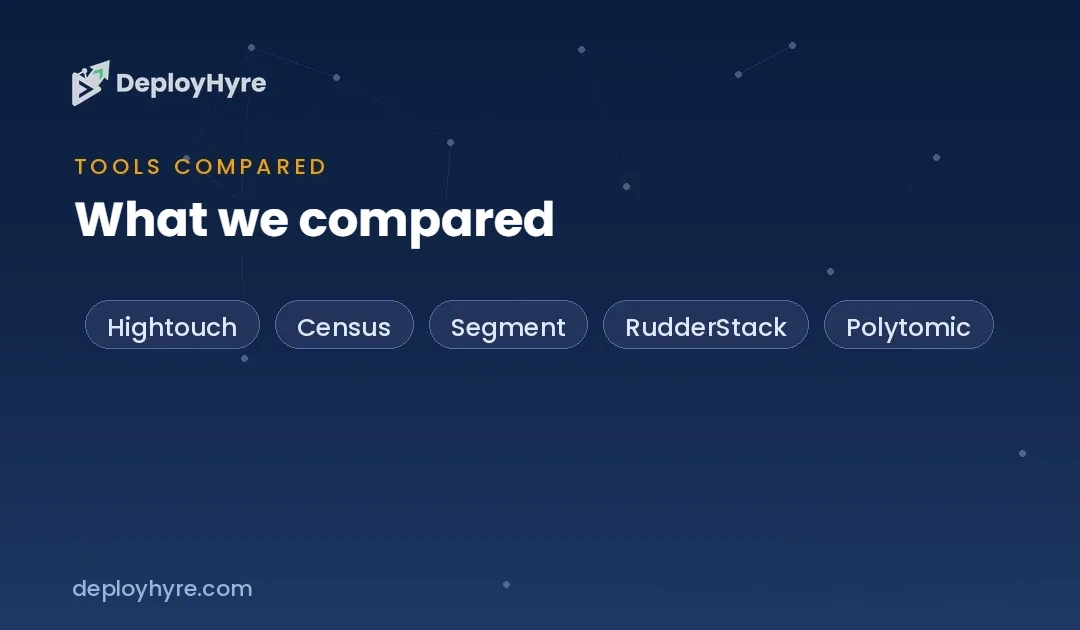
The best reverse ETL tool for most teams is Hightouch for the broadest destination coverage and warehouse-native activation, Census for teams wanting it integrated with Fivetran’s ingestion stack, and Segment when you also need full CDP event collection. Reverse ETL is the last mile of the modern data stack: it takes the clean, modeled data sitting in your warehouse and pushes it back out into the business tools, CRMs, ad platforms, email, support desks, where teams actually use it.
The detail that decides your bill: the pricing unit differs by vendor, and it flips which tool is cheaper depending on your data shape. Hightouch charges by the number of records synced each month, while Census charges by the number of sync workflows. A team syncing a few large audiences pays very differently from one running many small syncs, so the same activation need costs more or less depending on which unit the vendor counts. Matching the unit to your usage pattern is the practical key to controlling cost.
Every price below is a recent observed figure. Because these tools price by records or workflows, treat each as a band and model your sync pattern.
Quick Comparison: Reverse ETL Tools at a Glance
| Tool | Best For | Observed Price | Billing Unit |
|---|---|---|---|
| Hightouch | Broadest destinations, activation | Free (1 dest); Starter $350/mo; Pro $800/mo | Records synced (MTR) |
| Census | Integrated with Fivetran stack | Per sync workflow (quote) | Sync workflows |
| Segment | Reverse ETL plus full CDP | CDP pricing (MTUs) | Bundled with CDP |
| RudderStack | Warehouse-first, engineering-led | Free to 250K events; $265/mo (1M) | Events |
| Polytomic | Flexible syncs, ops use cases | Quote | Per sync / model |
What Reverse ETL Tools Do
Traditional ETL moves data from your sources into the warehouse. Reverse ETL does the opposite: it moves data from the warehouse back out to operational tools. Your warehouse holds the richest, most complete view of each customer, unified across every source and modeled by your analytics team, but that value is trapped if it only feeds dashboards. Reverse ETL activates it, syncing a computed audience like “high-value customers likely to churn” directly into your ad platform, email tool, or CRM so teams can act on it.
This is the “last mile” of the modern data stack. Analytics engineers define audiences, scores, and traits in SQL against the warehouse, and reverse ETL keeps those definitions synced to the business tools continuously. The AI and modeling layer lets teams build predictive traits (churn scores, propensity models) in the warehouse and activate them everywhere, turning the warehouse from a reporting store into the engine that drives marketing, sales, and support.
Reverse ETL is the mirror of ingestion and often the activation half of a composable CDP. It pairs with the pipelines in our best AI ETL tools guide, builds on the warehouse in our best cloud data warehouses guide, and underpins the composable approach in our best AI customer data platforms guide.
The Pricing Unit Flips the Cheaper Option
Hightouch bills by records synced and Census bills by sync workflows, so the cheaper tool depends entirely on whether you sync many records through few workflows or few records through many workflows. A team syncing a handful of large audiences (millions of records, a few syncs) may find Census’s per-workflow model cheaper. A team running many small, targeted syncs (few records each, many syncs) may find Hightouch’s per-record model cheaper. The activation need is identical; the bill diverges purely on how each vendor counts.
Hightouch’s published tiers, free for one destination, Starter around $350 a month for two destinations, Pro around $800 for four, or by monthly-tracked-records (roughly $1,000 a month for 500,000 records), make it easy to model against your record volume. Census, now part of Fivetran, prices by workflow and fits teams that want reverse ETL inside a single ingest-model-activate stack. Map your sync pattern, record counts and number of distinct syncs, against both units before choosing, because that pattern, not a headline rate, determines your cost.
Best Overall for Data Activation
Hightouch is the safest default for reverse ETL, with the broadest connector library in the category and warehouse-native activation, making it the go-to when your warehouse is the source of truth and marketing needs audiences pushed to their tools. Its published pricing, free for one destination up to Pro around $800 a month, and its record-based model let teams start small and scale, and its breadth of destinations means whatever tool your business uses, Hightouch likely syncs to it. For most teams adopting reverse ETL, its combination of destination coverage, transparent tiers, and warehouse-native design makes it the default choice.
Hightouch’s positioning as the activation layer of a composable CDP is central to its appeal: rather than duplicating customer data into a separate platform, it activates straight from the warehouse, letting analytics engineers own audience logic in SQL. For organizations that have invested in a cloud data warehouse and want to drive operational tools from it without a second data store, Hightouch is purpose-built. It activates the profiles described in our best AI customer data platforms guide.
Best Integrated With Your Data Stack
Census is the strongest choice for teams that want reverse ETL integrated into one end-to-end data stack, because its acquisition by Fivetran means the combined platform spans ingest, model, and activate under a single vendor. If you already use Fivetran for ingestion, adding Census for activation keeps your whole data movement, in and out of the warehouse, with one provider and one relationship. Its per-sync-workflow pricing is a different model from Hightouch’s per-record, so it can be cheaper for teams running fewer, larger syncs, worth modeling against your pattern.
Polytomic rounds out this tier as a flexible reverse-ETL and data-sync tool that handles operational use cases beyond marketing activation, favored by teams with varied sync needs across business systems. Both are strong alternatives to Hightouch; Census for Fivetran-stack integration and workflow-based pricing, Polytomic for flexible operational syncs. Choose Census especially if you value a single-vendor data stack, connecting to the ingestion covered in our best AI ETL tools guide.
Best When You Also Need a CDP
Segment is the right choice when you need reverse ETL as part of a full customer data platform rather than a standalone activation tool, bundling reverse-ETL capabilities alongside event collection and identity resolution. If your requirement is broader than pushing warehouse data out, if you also need to collect events, resolve identities, and manage a full CDP, Segment provides reverse ETL within that larger platform, so you do not run a separate tool for activation. For teams that want an all-in-one collect-unify-activate platform, folding reverse ETL into the CDP simplifies the stack.
RudderStack similarly blends warehouse-first event collection with activation, appealing to engineering-led teams that want both in a cost-effective, warehouse-centric platform, free to 250,000 events and $265 a month for 1 million. Both are the pick when reverse ETL is one need among several CDP requirements rather than a standalone last-mile tool. If your only need is activating warehouse data, a dedicated tool like Hightouch is usually more focused; if you need full CDP capability too, Segment or RudderStack consolidate it.
How Should You Choose a Reverse ETL Tool?
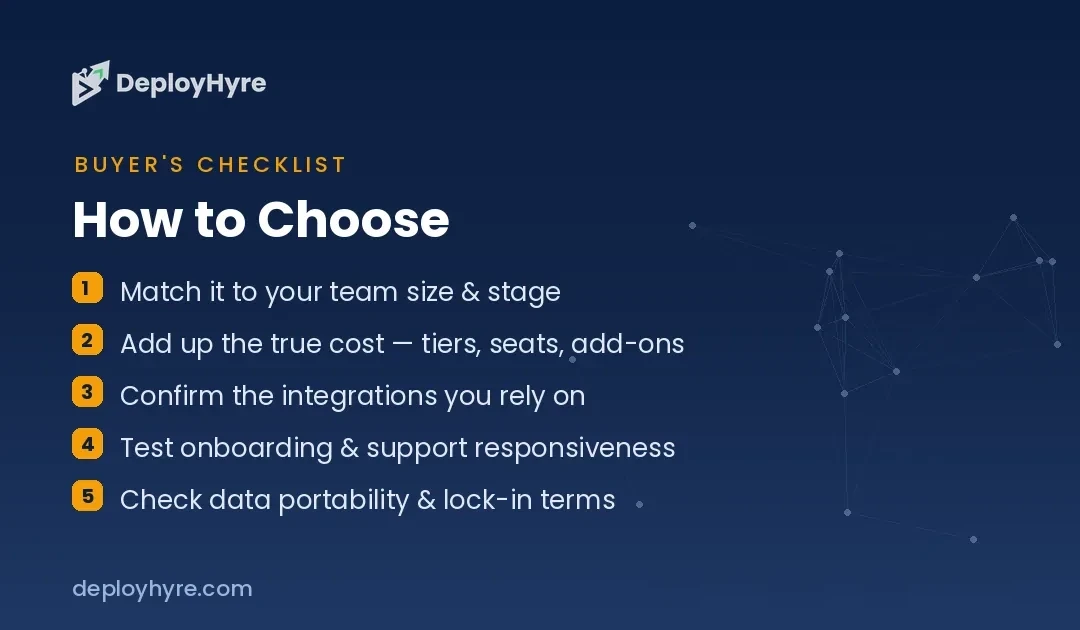
Model your sync pattern first, because the billing unit, records synced versus sync workflows, flips the cheaper option. Many small syncs favor Hightouch’s per-record tiers at low volume; fewer large syncs may favor Census’s per-workflow model. Count both your record volumes and your number of distinct syncs, then price each tool on its own unit.
Then decide whether you need standalone reverse ETL or a broader platform. If you just need to activate warehouse data to business tools, a dedicated tool, Hightouch or Census, is the most focused choice. If you also need event collection and full CDP capability, Segment or RudderStack fold reverse ETL into a larger platform and simplify the stack.
Finally, weigh single-vendor integration. If you already run Fivetran, Census keeps your whole data movement with one provider. If destination breadth is paramount, Hightouch’s connector library is the widest. Match the tool to whether you value a consolidated stack, the broadest destinations, or bundled CDP capability, and confirm it syncs to the specific business tools your teams actually use.
How We Evaluated These Platforms
We evaluated each tool on destination breadth, warehouse-native architecture, modeling and audience capabilities, integration with the broader data stack, and pricing model. Figures come from vendor pages and comparison sources. Because tools bill by records or workflows, which flips the cheaper option by data shape, we present observed rates and stress modeling your sync pattern. Rankings reflect fit for a stated use case.
The Bottom Line
Hightouch is the safest default for reverse ETL, with the broadest destinations and transparent record-based tiers, while Census suits teams wanting it integrated with Fivetran’s ingestion stack on workflow-based pricing. Segment and RudderStack are the picks when you also need full CDP event collection, and Polytomic for flexible operational syncs. Model your sync pattern against each billing unit first, because records-versus-workflows pricing flips which tool is cheaper for your data shape.
Frequently Asked Questions
How much do reverse ETL tools cost?
Hightouch is free for one destination, then Starter around $350 a month (two destinations), Pro around $800 (four), or by records synced (roughly $1,000 a month for 500,000). Census prices by sync workflow on a quote, and RudderStack is free to 250,000 events then $265 a month for 1 million. The billing unit, records versus workflows, changes which is cheaper for your usage.
What is reverse ETL?
Reverse ETL moves data from your warehouse back out to operational business tools like CRMs, ad platforms, and email, the opposite of traditional ETL that loads data into the warehouse. It activates the rich, modeled data in your warehouse by syncing computed audiences and traits to the tools where teams act on them, forming the “last mile” of the modern data stack.
Hightouch or Census: which is cheaper?
It depends on your sync pattern because they bill differently. Hightouch charges by records synced, so it can be cheaper for many small, targeted syncs. Census charges by sync workflows, so it can be cheaper for fewer, larger syncs. Model your record volumes and number of distinct syncs against both units to see which wins for your usage.
Is reverse ETL the same as a CDP?
Not exactly. Reverse ETL is the activation layer that pushes warehouse data to business tools, and it is the activation half of a composable CDP. A full CDP also collects events and resolves identities. Dedicated reverse ETL tools like Hightouch focus on activation, while Segment bundles reverse ETL into a complete CDP with collection and identity resolution.
Do I need reverse ETL if I have a data warehouse?
If you want the rich data in your warehouse to drive operational tools, not just dashboards, then yes. Reverse ETL is what activates warehouse data, syncing modeled audiences and traits into your marketing, sales, and support tools. Without it, your warehouse’s unified customer view stays trapped in reporting rather than powering the tools teams use daily.
Related Articles


The DeployHyre Editorial Team writes buyer guides on AI tools, SaaS, cloud hosting and proxies. We compare tools using published pricing, official documentation and third-party reviews. All content is for educational and informational purposes only.