

The best UpCloud alternatives are Hetzner for the lowest price per vCPU, DigitalOcean for developer tooling, and Vultr for the widest region choice. Akamai Cloud suits data-heavy workloads, OVHcloud adds unmetered traffic, Scaleway bills by the hour with a European footprint, and Netcup rewards long terms with extra RAM.
UpCloud is a Finnish cloud provider that started in Helsinki in 2011. UpCloud’s about page lists 15 data centers in 12 countries and credits the company with introducing MaxIOPS storage in 2014. Its plans start at €3 per month.
The lineup changed in 2026. UpCloud’s April 2026 announcement replaced the Developer plan with Starter and Premium plans. Developer, General Purpose, High CPU, and High Memory plans closed to new deployments, and existing servers kept their terms.
Buyers still look elsewhere for four reasons: storage is priced per gigabyte on top of the plan, the free trial is a 7-day resource quota, the monthly bill is estimated on a 30-day month, and rivals undercut it on raw vCPU price. Gartner forecast worldwide public cloud spending at $723.4 billion for 2025, so the market offers plenty of choice.
This guide compares 7 UpCloud alternatives on price, specs, billing, and regions. It sits inside our cloud hosting hub and extends our best VPS hosting guide. Every price comes from the provider’s own page, checked in October 2026.
Quick Comparison: Best UpCloud Alternatives
| Provider | Best For | Entry Price | Entry Specs | Billing |
|---|---|---|---|---|
| Hetzner | Lowest price per vCPU | €5.49/mo (before VAT and IPv4) | CX23: 2 vCPU, 4 GB, 40 GB NVMe | Hourly, monthly cap |
| DigitalOcean | Developer tooling | $4/mo | 1 vCPU, 512 MiB, 10 GiB SSD | Per-second, monthly cap |
| Vultr | Global regions | $3.50/mo (IPv4 included) | 1 vCPU, 0.5 GB, 10 GB | Hourly, monthly cap |
| Akamai Cloud (Linode) | Included transfer | $5/mo | Nanode: 1 vCPU, 1 GB, 25 GB, 1 TB | Hourly, monthly cap |
| Scaleway | Pay-per-hour experiments | €0.00898/hr (about €6.55/mo) | DEV1-S: 2 vCPU, 2 GB, 200 Mbps | Hourly |
| OVHcloud | Unmetered traffic | $4.54/mo | VPS-1: 2 vCores, 4 GB, 40 GB NVMe | Monthly or upfront term |
| Netcup | RAM on long terms | €8.26/mo (12-month term) | 2 vCores, 4 GB, 64 GB | 1, 12, or 24 months |
What Makes a Good UpCloud Alternative?
A good UpCloud alternative matches its hourly billing and fast storage, then beats it on one thing: price, region count, transfer allowance, or tooling. It publishes full prices, includes a public IPv4 address, and lets you leave without a long contract.
Four UpCloud details explain why buyers compare options.
Storage is a separate line item. UpCloud’s pricing page prices MaxIOPS storage at €0.22 per GB per month and Standard storage at €0.085 per GB. Plans include a base disk, and extra capacity adds to the bill.
Starter trades speed for price. The Starter plan costs €3 per month for 1 vCPU, 1 GB of RAM, and 10 GB of SSD. UpCloud says it runs on previous-generation AMD CPUs. Premium starts at €5 per month with 25 GB of MaxIOPS storage.
The bill caps at 28 days. UpCloud bills by the started hour and caps a month at 28 days. Its monthly figures assume a 30-day month, so a server left on all month costs less than the headline estimate.
The trial is a quota, not credit. UpCloud’s free trial lasts 7 days and caps usage at 2 cores and 4 GB of RAM. It needs a card for verification and blocks SMTP port 25.
The 7 Best UpCloud Alternatives
1 Hetzner: Best for the lowest price per vCPU
Hetzner is the best UpCloud alternative for buyers who want more CPU and RAM per euro with hourly billing.
What it does well. Hetzner bills hourly with a monthly cap, the same model UpCloud uses. Hetzner regular performance plans include at least 20 TB of traffic on EU servers, which beats a fair transfer policy on clarity.
Key features:
- Shared and dedicated vCPU plans
- Load balancers, firewalls, volumes, and snapshots
- Official Terraform provider and REST API
- Six locations: Falkenstein, Nuremberg, Helsinki, Hillsboro, Ashburn, and Singapore
Pricing. Hetzner price table lists the CX23 at €5.49 per month from June 15, 2026, before VAT and IPv4. The Arm CAX11 costs €5.99 per month.
Best for: Developers who want strong CPU value and a European base.
Limitations. Hetzner raised prices twice in 2026, and it has fewer locations than UpCloud. Read our Hetzner alternatives guide for the other side of the comparison.
2 DigitalOcean: Best for developer tooling
DigitalOcean is the best UpCloud alternative for teams that want simple tooling, managed databases, and clear documentation.
What it does well. DigitalOcean moved to per-second billing on January 1, 2026, with a 60-second minimum. DigitalOcean Droplet pricing caps each month at the listed monthly price.
Key features:
- Basic Droplets with 500 GiB of outbound transfer
- Managed databases, Kubernetes, and app hosting
- Regions in North America, Europe, and Asia-Pacific
- Strong tutorials and community docs
Pricing. The Basic Droplet costs $4 per month ($0.00595 per hour) for 1 vCPU, 512 MiB of RAM, and 10 GiB of SSD.
Best for: Startups and solo developers who value ease of use over raw specs.
Limitations. The $4 plan has little RAM, and larger Droplets cost more than Hetzner. See our DigitalOcean alternatives guide for more.
3 Vultr: Best for global regions
Vultr is the best UpCloud alternative for teams that need servers close to users on every continent.
What it does well. Vultr pricing lists hourly billing with a monthly cap, and the provider runs more than 30 cloud regions. That is a wider spread than UpCloud’s 15 data centers.
Key features:
- Regular Performance, High Frequency, and bare metal options
- Managed Kubernetes and managed databases
- Hourly billing with a monthly cap
- Region choice on six continents
Pricing. The entry Regular Performance plan with IPv4 costs $3.50 per month for 1 vCPU, 0.5 GB of RAM, and 10 GB of storage.
Best for: Teams placing servers in many countries, including emerging markets.
Limitations. The entry plan has half a gigabyte of RAM, so most real workloads need a larger tier. Our Vultr alternatives guide covers other options.
4 Akamai Cloud (Linode): Best for included transfer
Akamai Cloud, the former Linode, is the best UpCloud alternative for workloads that move a lot of data.
What it does well. Akamai cloud pricing includes 1 TB of transfer on the 1 GB Nanode and charges $0.005 per GB of overage. Hourly billing applies with a monthly cap.
Key features:
- Shared, dedicated, and high-memory compute plans
- Object storage, Kubernetes, and managed databases
- Linux-first tooling with a long track record
- Backed by the Akamai network
Pricing. The Nanode 1 GB costs $5 per month ($0.0075 per hour) for 1 vCPU, 1 GB of RAM, and 25 GB of storage.
Best for: Data-heavy apps and teams that already use Akamai services.
Limitations. The entry plan costs more per GB of RAM than Vultr and Hetzner. Read our Linode alternatives guide for context.
5 Scaleway: Best for pay-per-hour experiments
Scaleway is the best UpCloud alternative for European buyers who want hourly billing and a very cheap test instance.
What it does well. Scaleway Instance pricing bills by the hour in euros before tax. The STARDUST1-S costs €0.0006 per hour, about €0.43 per month.
Key features:
- Instances, Kubernetes, object storage, and managed services
- Hourly billing on every Instance
- Listed Instance prices include egress and IPv6
- Backed by the iliad Group
Pricing. The DEV1-S costs €0.00898 per hour, about €6.55 per month, for 2 vCPUs, 2 GB of RAM, and 200 Mbps. Public IPv4 and storage cost extra.
Best for: European teams that run short-lived test servers.
Limitations. The headline price excludes IPv4 and block storage, so the real monthly cost is higher. The tiny STARDUST1-S is too small for most apps.
6 OVHcloud: Best for unmetered traffic
OVHcloud is the best UpCloud alternative for budget buyers who need generous RAM and unmetered traffic.
What it does well. OVHcloud VPS page lists unlimited traffic and a 500 Mbps public connection on VPS-1. Inbound traffic is free on its Public Cloud.
Key features:
- 2 vCores, 4 GB of RAM, and 40 GB of NVMe on VPS-1
- Anti-DDoS protection included
- Public Cloud with hourly billing for larger workloads
- Large global data center footprint
Pricing. VPS-1 costs $4.54 per month on the listed term, and OVHcloud rewards longer commitments.
Best for: Budget projects that need RAM and traffic headroom.
Limitations. The lowest rates need a term commitment. See our OVHcloud alternatives guide for details.
7 Netcup: Best for RAM on long terms
Netcup is the best UpCloud alternative for self-hosters who accept a 12-month term in return for more RAM.
What it does well. Netcup VPS page lists KVM servers in Vienna, Nuremberg, Amsterdam, Manassas, and Singapore.
Key features:
- KVM virtualization with dedicated RAM
- Contract terms of 1, 12, or 24 months
- German provider with EU locations
- Good fit for mail, databases, and Nextcloud
Pricing. The VPS 500 G12.5 costs €8.26 per month excluding VAT on a 12-month term, with 2 vCores, 4 GB of RAM, and 64 GB of storage.
Best for: Self-hosters and small businesses on long terms.
Limitations. Netcup has no hourly billing, so it removes UpCloud’s flexibility. Compare it with the budget picks in our Contabo alternatives guide.
How Should You Choose the Right UpCloud Alternative?
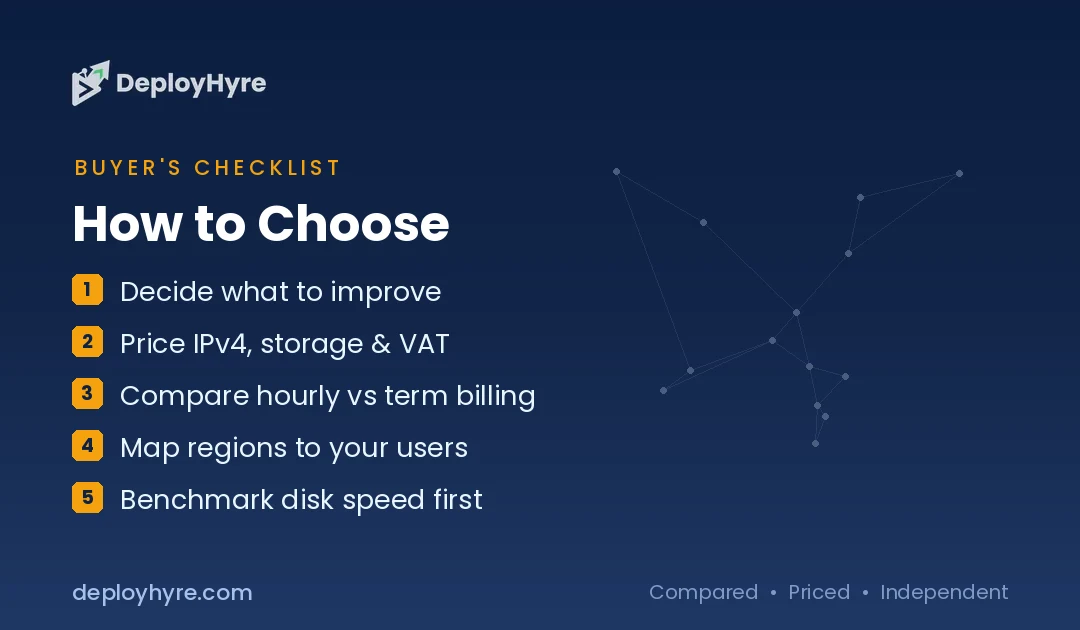
Choose an UpCloud alternative by deciding what you want to improve: price, regions, transfer, or tooling. Then price the full monthly bill with IPv4, storage, and VAT.
- Cutting cost: pick Hetzner, OVHcloud, or Netcup and compare the price per GB of RAM.
- Adding regions: pick Vultr for more than 30 regions.
- Moving more data: pick Akamai Cloud or OVHcloud for large transfer allowances.
- Improving tooling: pick DigitalOcean for docs and managed services.
- Testing cheaply: pick Scaleway and delete servers when the test ends.
Always check disk speed, because UpCloud sells MaxIOPS storage as its edge. Run the same benchmark on a trial server from each shortlisted provider before you migrate.
How We Evaluated These UpCloud Alternatives
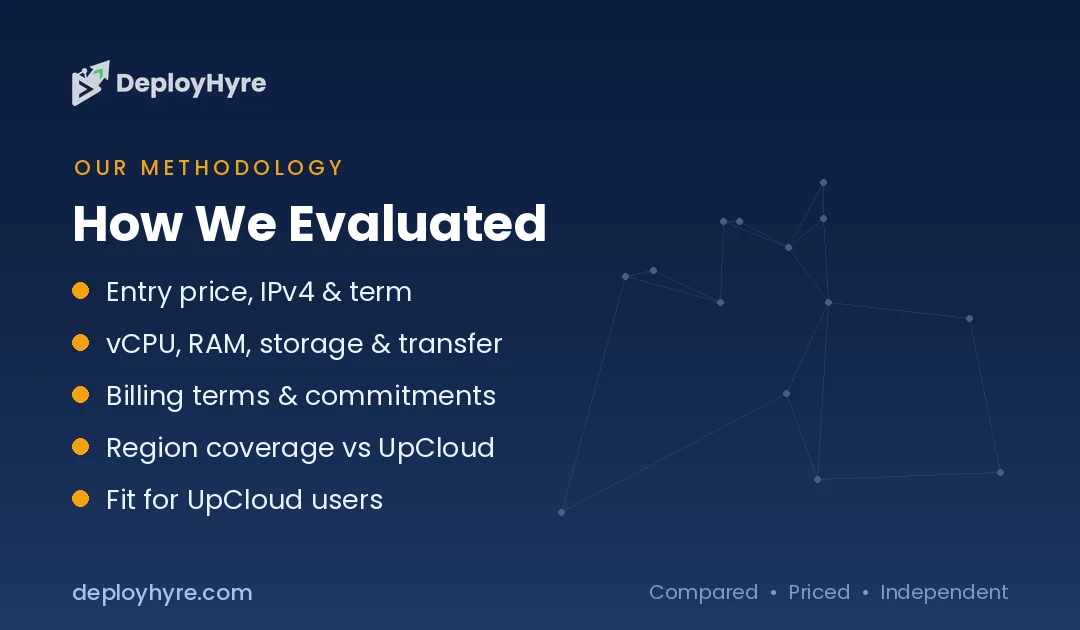
We compared each provider on public pricing, specs, billing terms, and region coverage, using the provider’s own pricing and documentation pages. We did not run benchmarks, and no provider paid for placement.
- Entry price: the cheapest usable plan, with notes on IPv4, VAT, and term.
- Specs: vCPU, RAM, storage, and included transfer.
- Billing terms: hourly, per-second, monthly, or fixed-term.
- Regions: coverage compared with UpCloud’s 15 data centers.
- Fit for UpCloud users: how well each plan matches UpCloud’s hourly billing and storage speed.
Prices were checked in October 2026 and change often. Confirm current figures on each provider’s page before you buy.
The Bottom Line
Hetzner is the best UpCloud alternative for most buyers, because it offers more CPU and RAM per euro with the same hourly billing. DigitalOcean wins on tooling, Vultr on regions, Akamai Cloud on transfer, and Netcup on long-term RAM value. Buyers who prefer a French provider can also read our Scaleway alternatives guide.
Start with one non-critical server, benchmark its disk and CPU against your UpCloud box, then migrate the rest. For more options, see our best VPS hosting roundup.

Frequently Asked Questions
What is the best alternative to UpCloud?
Hetzner is the best overall alternative to UpCloud, with a €5.49 CX23 plan, hourly billing, and at least 20 TB of EU traffic. DigitalOcean leads on tooling and Vultr leads on regions.
Is UpCloud cheaper than DigitalOcean?
At the entry tier, UpCloud gives more memory. UpCloud Starter costs €3 per month for 1 vCPU and 1 GB of RAM, while DigitalOcean’s $4 Basic Droplet has 512 MiB of RAM.
Does UpCloud have a free trial?
Yes. UpCloud offers a 7-day trial limited to 2 cores and 4 GB of RAM for Cloud Servers. It needs a card for verification, and it excludes Windows, GPU, and Private Cloud.
How does UpCloud bill its servers?
UpCloud bills by the started hour and caps each month at 28 days. Its listed monthly prices assume a 30-day month, so a server running all month costs less than the headline figure.
Did UpCloud change its plans in 2026?
Yes. UpCloud launched Starter and Premium plans on April 16, 2026. Developer, General Purpose, High CPU, and High Memory plans closed to new deployments, and existing servers kept their terms.

David Austin is a technology writer and software analyst at DeployHyre, where he covers AI tools, SaaS platforms, cloud hosting, and business automation. He focuses on hands-on comparisons of pricing, features, and real-world performance so teams can pick the right software with confidence.