
The best Vultr alternatives are DigitalOcean for the simplest developer experience, Akamai Cloud (Linode) for a large global footprint, and Hetzner for the lowest compute prices in Europe. AWS Lightsail suits teams already on AWS, UpCloud suits buyers who want a 99.99% SLA on cheap plans, and Cloudways suits anyone who wants managed hosting on top of a cloud server.
Cloud infrastructure spending keeps climbing. Gartner forecasts infrastructure-as-a-service spending of $287 billion in 2026, up 29.3% from 2025. That growth has made the independent cloud market crowded, and Vultr is one strong option among several.
Vultr is a well-funded independent cloud. Vultr raised $333 million at a $3.5 billion valuation in December 2024, led by LuminArx and AMD Ventures. Buyers still compare it against other providers on price, support, region coverage, and billing rules.
This guide compares 6 Vultr alternatives on entry price, specs, regions, and billing. It is part of our best cloud hosting guide. Every price comes from the vendor’s pricing page as checked in October 2026, and reported figures are labeled.
Quick Comparison: Best Vultr Alternatives
| Provider | Best For | Entry Price (IPv4) | Entry Specs | Billing |
|---|---|---|---|---|
| Vultr (baseline) | Many regions, GPUs | $3.50/mo ($2.50 IPv6-only) | 1 vCPU, 0.5 GB RAM, 10 GB SSD, 0.5 TB | Hourly, capped at 672 hours |
| DigitalOcean | Developer simplicity | $4/mo | 1 vCPU, 512 MiB RAM, 10 GiB SSD, 500 GiB | Per second, monthly cap |
| Akamai Cloud (Linode) | Global footprint | $5/mo | 1 CPU, 1 GB RAM, 25 GB, 1 TB | Hourly, monthly cap |
| Hetzner Cloud | Lowest EU prices | €5.49/mo reported (EU, CX23) | 2 vCPU, 4 GB RAM, 40 GB | Hourly, monthly cap |
| AWS Lightsail | Teams already on AWS | $5/mo | 2 vCPU, 0.5 GB RAM, 20 GB SSD, 1 TB | Fixed monthly bundle |
| UpCloud | SLA on budget plans | €3/mo | 1 vCPU, 1 GB RAM, 10 GB | Hourly, capped at 28 days |
| Cloudways | Managed hosting on cloud servers | $14/mo | 1 vCPU, 1 GB RAM, 25 GB NVMe, 1 TB | Hourly, monthly cap |
Why Do People Look for Vultr Alternatives?
People look for Vultr alternatives to get more RAM per dollar, a simpler control panel, managed services, or a provider with a different support model. Vultr’s cheapest plans run on older hardware with small memory, so price-sensitive buyers compare entry plans closely before they commit.
Entry specs are the first reason. Vultr’s pricing page lists its cheapest Regular Performance plan at $2.50 per month, but that plan is IPv6-only. The cheapest plan with a public IPv4 address costs $3.50 per month for 0.5 GB of RAM.
Hardware age is the second reason. Vultr states that Regular Performance plans use previous-generation Intel CPUs and regular SSD storage. Faster NVMe plans cost more.
Support and account reviews are the third reason. Some Trustpilot reviewers report locked accounts and slow, templated support replies. These are individual reports, not a measured rate, but they push some teams toward providers with phone support or managed plans.
What Makes a Good Vultr Alternative?
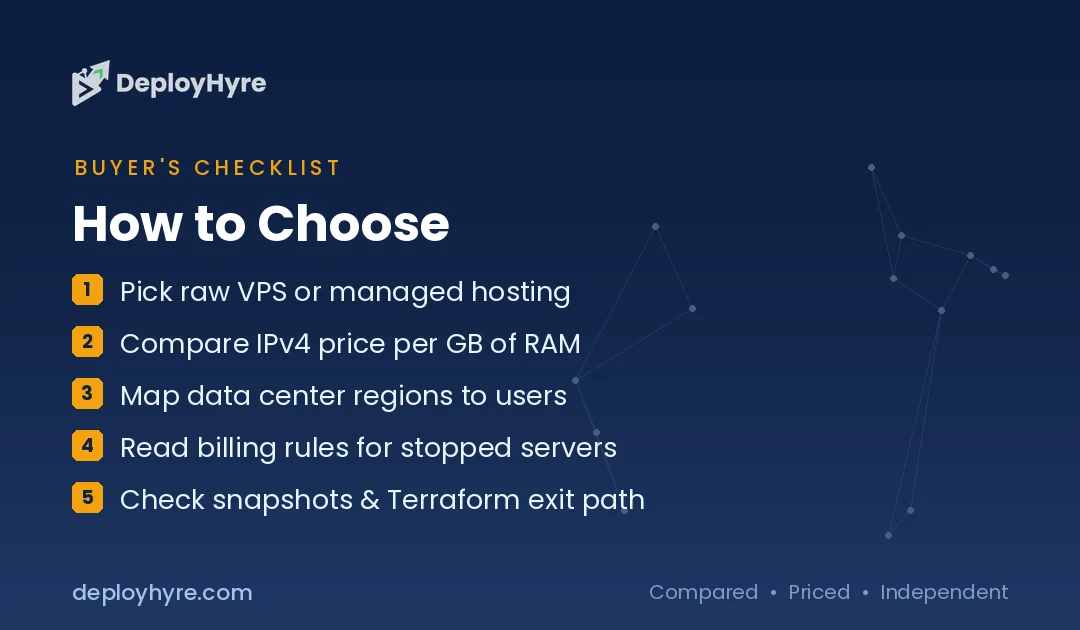
A good Vultr alternative matches Vultr on hourly billing and API access, then wins on at least one of price per GB of RAM, region coverage, managed services, or support. The right choice depends on where your users are and how much server work your team wants to handle.
Check 4 things on every provider. First, compare the IPv4 price, since IPv6-only plans break many apps. Second, compare RAM, because 0.5 GB plans struggle with databases. Third, check region coverage near your users. Fourth, read the billing rules, including stopped-instance charges.
The Best Vultr Alternatives in Detail
1 DigitalOcean: Best for Developer Simplicity
DigitalOcean is the best Vultr alternative for developers who want a clean dashboard, strong documentation, and per-second billing. Its Droplets cover the same small-VPS use cases as Vultr, and its managed databases and App Platform remove server work as projects grow.
What it does well. DigitalOcean keeps cloud servers simple. The same account runs managed databases, Kubernetes, object storage, and load balancers.
Key features:
- Per-second billing since January 1, 2026, with a 60-second minimum and a monthly cap
- Managed databases and managed Kubernetes
- App Platform for deploying code without managing servers
- Large tutorial library for Linux and app setup
Pricing. DigitalOcean’s Basic Droplet starts at $4 per month for 1 vCPU, 512 MiB RAM, 10 GiB SSD, and 500 GiB of transfer.
Best for: solo developers, startups, and small SaaS teams.
Limitations. DigitalOcean lists fewer data center cities than Vultr’s 33 regions, and its pricing page states that it does not offer refunds. Compare it with other options in our DigitalOcean alternatives guide.
2 Akamai Cloud (Linode): Best for Global Footprint
Akamai Cloud, formerly Linode, is the best Vultr alternative for teams that want simple VPS pricing backed by a global network company. It keeps Linode’s flat pricing and adds Akamai’s edge and security products for larger deployments.
What it does well. Akamai Cloud combines straightforward virtual machines with one of the largest content delivery networks. Its 1 GB Nanode is a direct match for Vultr’s $5 plan.
Key features:
- 25 core pricing locations across North America, Europe, Asia-Pacific, and South America
- Shared, dedicated, and GPU compute plans
- Managed Kubernetes (LKE) and object storage
- Network up to 40 Gbps in and 1 Gbps out on the entry plan
Pricing. Akamai lists the Nanode 1 GB at $5 per month with 1 CPU, 25 GB storage, and 1 TB transfer. Akamai’s main pricing page lists 25 global pricing locations.
Best for: teams that need many regions and room to grow into enterprise network services.
Limitations. Akamai notes that shared CPU plans run on legacy hardware. See more options in our Linode alternatives guide.
3 Hetzner Cloud: Best for Lowest EU Prices
Hetzner Cloud is the best Vultr alternative for European workloads where raw price per GB of RAM matters most. Even after two 2026 price increases, its EU cloud servers give more memory per euro than most rivals, though stock and US plan choice are limited.
What it does well. Hetzner runs its own data center parks in Germany and Finland. Hetzner’s cloud page lists servers in Germany, Finland, Singapore, Ashburn, and Hillsboro, plus GDPR compliance and a 99.9% uptime SLA.
Key features:
- Generous included traffic and low extra-transfer prices
- Free stateful firewalls and private networks
- One-click apps such as Docker, Coolify, and WordPress
- ISO/IEC 27001 certified German and Finnish data center parks
Pricing. Prices changed twice in 2026. WZ-IT reports that the CX23 plan (2 vCPU, 4 GB RAM, 40 GB) rose from €3.99 to €5.49 per month in Germany and Finland on June 15, 2026. Heise reported steeper increases for US locations. Confirm the live price in the Hetzner Console before ordering.
Best for: EU-focused apps, side projects, and self-hosted tools.
Limitations. Hetzner’s cloud page showed its shared Cost-Optimized line as “currently not available” in October 2026. The US and Singapore locations do not offer the cheapest CX line.
4 AWS Lightsail: Best for Teams Already on AWS
AWS Lightsail is the best Vultr alternative for teams that want fixed monthly VPS bundles with a path into the full AWS platform. Each bundle includes compute, storage, transfer, and a static IP, so the bill stays predictable.
What it does well. Lightsail hides AWS complexity behind simple bundles. Teams can later connect Lightsail instances to services such as Amazon RDS, S3, and CloudFront.
Key features:
- Fixed monthly bundles with a static IP included
- Managed databases, load balancers, and container services
- Free Tier offer for new Lightsail users
- Upgrade path into EC2 and the wider AWS catalog
Pricing. AWS lists the entry Lightsail bundle with public IPv4 at $5 per month for 2 vCPUs, 0.5 GB RAM, 20 GB SSD, and 1 TB transfer. An IPv6-only bundle costs $3.50 per month.
Best for: small apps that will likely move deeper into AWS later.
Limitations. The $5 bundle has only 0.5 GB of RAM. Transfer allowances are halved in regions such as Mumbai, Sydney, and São Paulo.
5 UpCloud: Best for SLA on Budget Plans
UpCloud is the best Vultr alternative for buyers who want a 99.99% SLA and free egress on low-cost cloud servers. The Finnish provider focuses on fast storage and uptime guarantees rather than a huge product catalog.
What it does well. UpCloud offers an uptime promise usually seen on enterprise plans. Its Starter plans include IPv4 and charge nothing for egress under a fair-transfer policy.
Key features:
- 99.99% SLA on Starter plans
- Free egress under a fair-transfer policy
- Hourly billing capped at 28 days per month
- General Purpose plans from €5 per month
Pricing. UpCloud lists its Starter plan at €3 per month for 1 vCPU, 1 GB RAM, 10 GB storage, and an IPv4 address.
Best for: European businesses that want uptime guarantees on a small budget.
Limitations. UpCloud limits 1 GB plans to 5 deployments per customer, and it prices in euros.
6 Cloudways: Best for Managed Hosting on Cloud Servers
Cloudways is the best Vultr alternative for site owners who want cloud server performance without managing Linux themselves. It runs a managed layer on top of providers including DigitalOcean, Vultr, and AWS, and handles updates, backups, caching, and security patches.
What it does well. Cloudways turns a raw cloud server into managed hosting for WordPress, WooCommerce, Magento, Laravel, and PHP apps. DigitalOcean owns Cloudways, which it acquired in 2022.
Key features:
- Choice of cloud provider, including Vultr itself
- Unlimited websites and visits per server
- Automated backups, staging, and server monitoring
- 24/7 support chat
Pricing. Cloudways listed its Flexible plan from $14 per month for a 1 GB DigitalOcean server with 25 GB NVMe storage and 1 TB transfer, checked in October 2026.
Best for: agencies and WordPress site owners. See how it stacks up in our Cloudways vs DigitalOcean comparison.
Limitations. Cloudways costs more than the raw server underneath, and it gives no root access to the server.
How Should You Choose a Vultr Alternative?
Choose a Vultr alternative by matching the provider to your workload first, then comparing IPv4 price per GB of RAM, regions, and billing rules. A developer side project, an EU SaaS app, and a WordPress agency each need a different provider.
- Pick your management level. Raw VPS (DigitalOcean, Akamai, Hetzner, UpCloud) or managed hosting (Cloudways).
- Compare RAM per dollar. A 1 GB plan at $5 beats a 0.5 GB plan at $4 for most database-backed apps.
- Map regions to users. Choose the provider with a data center closest to your main audience.
- Read billing rules. Vultr and others charge for stopped instances; delete servers you no longer need.
- Check the exit path. Standard Linux images, Terraform support, and snapshots make later moves easy.
Teams that would rather not run servers at all can compare platforms in our best PaaS platforms guide. For a wider view of unmanaged servers, see our best VPS hosting picks.
How We Evaluated These Vultr Alternatives
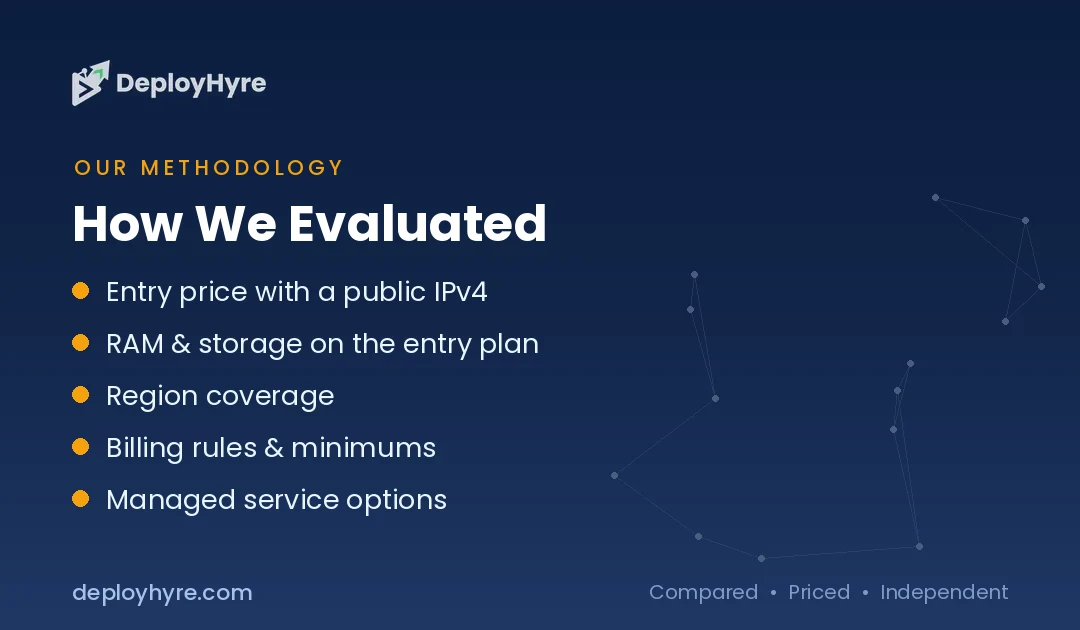
We compared each provider using its public pricing page, product documentation, and dated third-party reporting, checked in October 2026. We did not run benchmark tests for this guide, so we make no performance claims beyond what each vendor publishes.
We scored providers on 5 criteria: entry price with IPv4, RAM and storage on the entry plan, region coverage, billing rules, and managed service options. We dropped OVHcloud and Kamatera from this edition because we could not confirm their current US prices on their own pages. Cloud prices changed often in 2026, so confirm current terms before you buy.
The Bottom Line
DigitalOcean is the best overall Vultr alternative for developers, Akamai Cloud is best for global reach, and Hetzner is best for low EU prices. AWS Lightsail fits teams heading into AWS, UpCloud fits buyers who want a 99.99% SLA, and Cloudways fits anyone who wants managed hosting.
Start by moving one non-critical server, measure latency and support response, then migrate the rest. For the full landscape, return to our best cloud hosting guide.

Frequently Asked Questions
What is the best alternative to Vultr?
DigitalOcean is the best overall alternative to Vultr for developers, with Droplets from $4 per month and per-second billing. Akamai Cloud (Linode) is best for global reach, and Hetzner is best for low prices in Europe.
Is DigitalOcean cheaper than Vultr?
No. Vultr’s cheapest IPv4 plan costs $3.50 per month, while DigitalOcean’s cheapest Droplet costs $4 per month. Both entry plans include 0.5 GB of RAM, so the gap is small, and DigitalOcean bills per second instead of per hour.
Is Hetzner cheaper than Vultr?
Yes, for RAM per dollar in Europe. Hetzner’s CX23 was reported at €5.49 per month for 4 GB of RAM after June 2026, while Vultr’s 1 GB plan costs $5. Hetzner’s cheapest line is not sold in the US and was out of stock in October 2026.
Does Vultr charge for stopped servers?
Yes. Vultr bills stopped instances because the resources stay reserved. Billing ends only when you destroy the instance. Vultr bills hourly with a monthly cap of 672 hours.
Can I use Vultr with managed hosting?
Yes. Cloudways offers Vultr as one of its cloud providers, so you get Vultr servers with managed updates, backups, caching, and support. Cloudways plans cost more than the raw Vultr server underneath.

David Austin is a technology writer and software analyst at DeployHyre, where he covers AI tools, SaaS platforms, cloud hosting, and business automation. He focuses on hands-on comparisons of pricing, features, and real-world performance so teams can pick the right software with confidence.