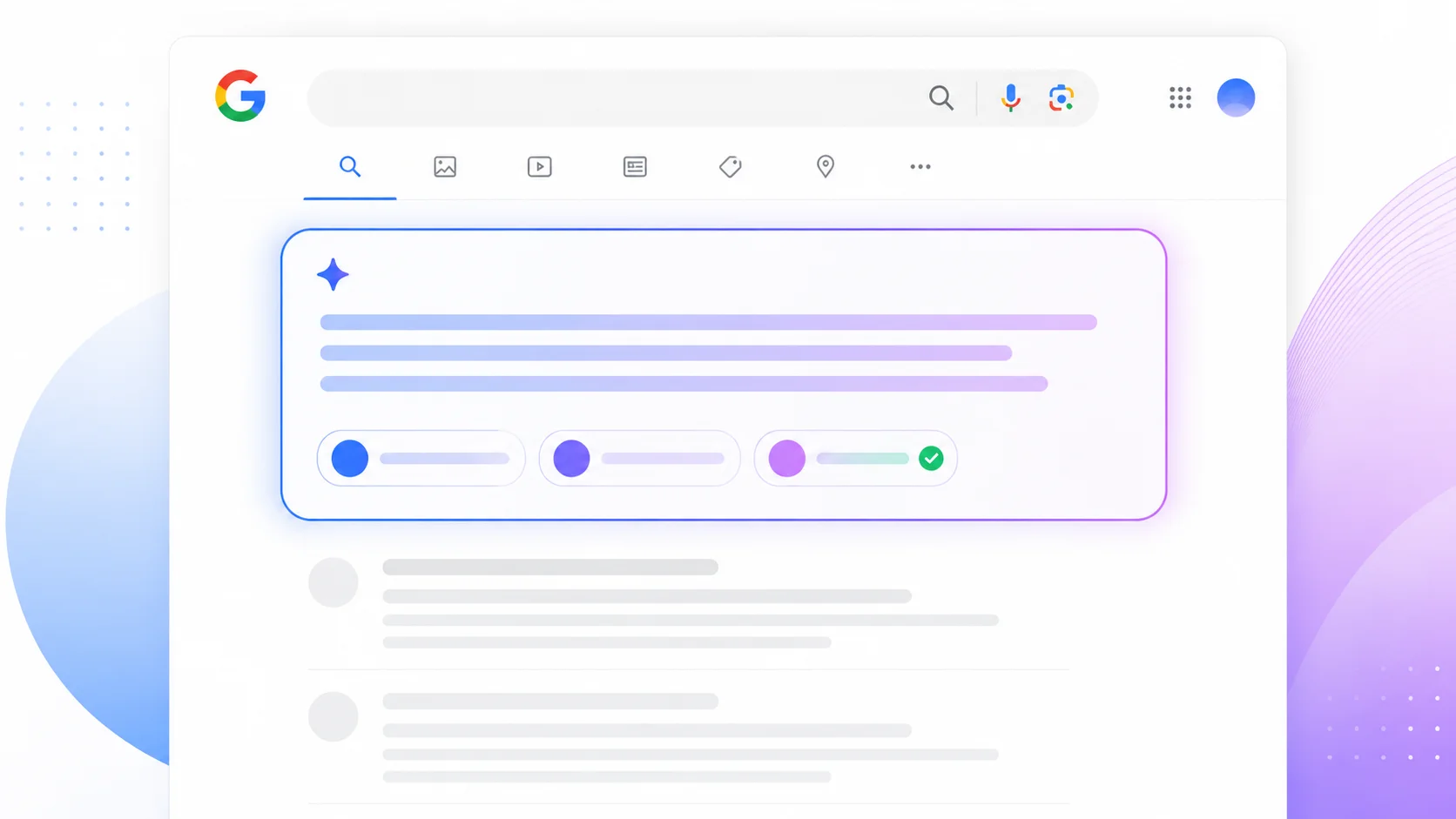
Something fundamental has shifted in search. Google AI Overviews now appear on 40 to 60% of all US search queries, concentrated on how-to, definition, comparison, and research-type questions. They command up to 75.7% of mobile screen real estate when combined with featured snippets.
Table of Contents
For the full picture, see our complete guide to AI for SEO.
Here’s the number that should change how you think about SEO: top-ranked pages lose an average of 34.5% of their CTR when an AI Overview appears above them. But pages that earn a citation inside the AI Overview itself can see CTR lifts of up to 35%.
Being cited is the new ranking. And the criteria for citation aren’t a new algorithm. They’re a deeper, stricter enforcement of signals Google has been weighting for years: content quality, E-E-A-T, semantic clarity, and direct answers to specific questions.
This playbook covers exactly how to rank in AI Overviews in 2026. Every tactic below is based on published research and real-world testing, not speculation.
What Are Google AI Overviews and Why Do They Matter?
Google AI Overviews are AI-generated summaries that appear at the top of search results for informational queries. They pull from multiple web sources, cite them inline, and present a synthesized answer in an easy-to-consume format.
Unlike featured snippets (which pull from a single source), AI Overviews synthesize information from multiple pages. Google’s AI uses a process called query fan-out, analyzing multiple sources to build the most accurate, intent-matched response. This means your content doesn’t need to rank #1 to get cited. It needs to provide the most clear, specific, and trustworthy answer to a piece of the query.
Why this matters for your traffic:
- AI Overviews reduce clicks to uncited pages by 20 to 60%
- Pages cited inside AI Overviews see CTR lifts of up to 35%
- Google CEO Sundar Pichai confirmed that content and links within AI Overviews get higher click-through rates than content placed outside them
- You don’t need to rank in the top 10 to be cited. Content quality and authority matter more than current ranking position
The opportunity is clear: optimize for AI Overviews or watch your traffic decline as they expand across more queries.
7 Content Formats That Get Featured in AI Overviews
Not all content is equally likely to get cited. Based on analysis of thousands of AI Overview results, these 7 formats appear most frequently.
1. Answer-First Paragraphs (50 to 70 Words)
This is the single most important format. Start every major section with an approximately 60-word answer block that directly answers the question posed in the heading. This self-contained paragraph is what Google’s AI extracts and cites.
How to structure it: Write your H2 as a question a real person would ask. Immediately follow it with a 50 to 70 word paragraph that answers the question completely, even if pulled out of context. Then expand with examples, data, and nuance below the answer block.
Example: This section you’re reading right now uses the answer-first format. The first paragraph after each H2 heading is a self-contained answer.
2. Comparison Tables
Tables comparing products, features, or options appear frequently in AI Overviews because they provide structured, scannable data that AI can easily extract and reference.
How to use them: Include comparison tables with clear column headers whenever you’re comparing 3+ options. Use consistent formatting. Include specific data points (pricing, ratings, features) rather than vague descriptions.
3. Numbered Step-by-Step Guides
When someone searches “how to” do something, AI Overviews strongly prefer content structured as numbered steps. Each step should have a clear heading and a concise explanation.
How to structure it: Use H3 headings for each step (Step 1, Step 2, etc.). Keep each step explanation to 2 to 3 sentences. Include the key action in the first sentence of each step.
4. Definition Blocks
AI Overviews frequently cite content that provides clear, concise definitions for terms. Use simple language to answer common questions in one or two sentences. This helps Google pull exact answers into AI summaries.
How to use them: When introducing a concept, lead with a one-sentence definition before expanding. Format: “[Term] is [clear definition]. It [key function or purpose].”
5. FAQ Sections with Schema
FAQ sections serve double duty: they provide answer-formatted content that AI can extract, and FAQ schema markup helps Google understand the question-answer structure. Content with FAQ schema is cited 60% more often in AI-generated summaries.
6. Bulleted Lists and Feature Breakdowns
Bullet lists for comparing options, listing benefits, and providing examples are preferred by AI Overview’s citation algorithm. Keep each bullet to one key point with a brief explanation.
7. Data-Backed Statements with Sources
AI Overviews prefer citing content that includes specific statistics, research references, and expert attributions. AI systems reward clarity and depth, not shortcuts. Content that includes verifiable claims with linked sources gets cited more than content making unsourced assertions.
Which Schema Markup Increases Your AI Overview Chances?
Schema markup helps Google’s AI understand the structure and type of your content. Implementing schema markup (FAQ, HowTo, Article) increases the probability of being referenced in AI Overviews.
Here are the four schemas that matter most:
FAQPage Schema. Add this to any page with a FAQ section. It signals to Google that your content contains structured question-answer pairs. WordPress users can implement this automatically through Rank Math or Yoast SEO.
HowTo Schema. Add this to any step-by-step guide. It tells Google your content follows a sequential process, making it easy for the AI to extract and cite individual steps.
Article Schema. Add this to every blog post. Include author name, date published, date modified, and organization. This supports your E-E-A-T signals and helps Google verify content freshness.
Speakable Schema. This newer schema type identifies sections of your content that are particularly suitable for text-to-speech playback and AI extraction. It signals which paragraphs are the most concise, self-contained answers on your page.
Implementation tip: If you use WordPress, Rank Math handles most schema markup automatically. Configure your Article schema with proper author information, add FAQ schema to every FAQ section, and add HowTo schema to tutorial content. No coding required.
The 5-Step AI Overview Optimization Process
Here’s the step-by-step process we used to get pages cited in AI Overviews. Follow these in order.
Step 1: Target Question-Based Long-Tail Keywords
AI Overviews are most commonly triggered by conversational queries. Phrases like “how to optimize content for Google AI Overviews in 2026” are far more likely to trigger an AI Overview than a broad term like “SEO tips.”
Use Google’s People Also Ask section, AlsoAsked, and AnswerThePublic to find the exact questions your audience is asking. Build dedicated content around these queries. Target formats like “how does X work,” “what is the best X for Y,” “why is X happening,” and “what is the difference between X and Y.”
Step 2: Structure Every Section with Answer-First Format
Write your H2 headings as questions. Start each section with a 50 to 70 word self-contained answer paragraph. This answer block format is the most extractable content type for AI systems. Then expand below with supporting details, examples, and data.
This isn’t optional. It’s the single format change that has the highest impact on AI Overview citations.
Step 3: Build Deep E-E-A-T Signals
Google’s AI Overview algorithm weighs E-E-A-T (Experience, Expertise, Authoritativeness, Trustworthiness) more heavily than traditional search rankings. Here’s how to build each signal:
Experience: Include first-person case studies, original screenshots, and testing methodology. “We tested this across 5 sites” is more citable than “experts recommend.”
Expertise: Create detailed author bio pages with credentials, LinkedIn profiles, and published work. Link to your author page from every article.
Authoritativeness: Earn citations from other respected sites in your niche. Get mentioned in industry publications. Build topical authority through comprehensive content clusters.
Trustworthiness: Cite primary sources for every claim. Include last-updated dates. Be transparent about methodology and limitations.
Step 4: Implement Schema and Technical Optimization
Add FAQPage, HowTo, and Article schema to every relevant page. Ensure your site loads fast (LCP under 2.5 seconds). Make sure AI crawlers can access your content (check your robots.txt for blocks on Googlebot, GPTBot, and other AI crawlers).
Use Surfer SEO’s AI Tracker or OtterlyAI’s crawlability audit to verify that AI systems can discover and parse your content.
Step 5: Refresh Content Every 3 to 6 Months
Google’s AI prefers recent, accurate information, and outdated content gradually loses its visibility through a process called content decay. Update statistics, add new insights, and revise outdated advice every 3 to 6 months. Always update the “dateModified” field in your Article schema when you refresh.
How Can You Track Your AI Overview Appearances?
You can’t optimize what you can’t measure. Traditional rank trackers don’t show whether your content is cited in AI Overviews. You need dedicated tools.
Google Search Console is your starting point. The Performance report shows impressions and clicks that come from AI Overviews (look for the “AI Overview” filter in Search Appearance). This is free and first-party data.
OtterlyAI tracks citations across Google AI Overviews, ChatGPT, Perplexity, and other AI engines. It shows which of your pages get cited, where competitors appear instead, and provides recommendations for improvement. Starts at $29/month.
Surfer AI Tracker (included with Surfer SEO plans) monitors your content’s visibility in AI search results alongside traditional ranking data. Best for teams already using Surfer for content optimization.
LLMrefs tracks AI visibility across 20+ countries and 10+ languages with keyword-based monitoring. Starts at $29/month.
For a deeper comparison of all available tools, see our complete guide to the best AI search visibility tools in 2026.
How to Rank in AI Overviews: The Bottom Line
AI Overviews aren’t going away. They’re expanding. The brands that optimize for them now will capture the traffic that others lose over the next 12 months.
The formula isn’t complicated: target question-based keywords, structure every section with answer-first paragraphs, build genuine E-E-A-T signals, implement proper schema markup, and track your results with dedicated visibility tools.
Start with your highest-traffic pages. Restructure them using the answer-first format. Add FAQ schema. Monitor the results in Google Search Console over 4 to 8 weeks. Then apply the same process to new content.
The sites that treat AI Overview optimization as a core part of their SEO strategy in 2026 will be the ones still growing when everyone else is trying to figure out where their traffic went.
Next steps: Get the tools to track your progress with our guide to best AI SEO tools and learn how to make your brand visible across all AI engines in our AI search visibility tools guide.
How do I get cited in Google AI Overviews?
Publish clear, sourced answers. Use concise summaries, strong headings, schema, and credible citations. AI Overviews favor trustworthy, extractable content, so clarity and authority drive citations. The right GEO tools help you optimize.
Does schema markup help with AI Overviews?
Yes. Schema helps engines understand your content, supporting inclusion in AI answers. FAQ, Article, and How-To schema clarify structure. Schema alone does not guarantee citations, but it strengthens how clearly engines read your page.
How long does it take to appear in AI Overviews?
Often weeks to months. New, authoritative pages can appear faster on low-competition queries. Consistent quality and updates improve your odds. Track appearances with AI Overviews rank tracking software.
Measure progress with the best AI Mode SEO rank tracking software.
Frequently Asked Questions
How do you rank in Google AI Overviews?
Rank in AI Overviews by targeting question-based long-tail keywords, structuring content with 50 to 70 word answer-first paragraphs at the top of each section, implementing FAQ and HowTo schema markup, building strong E-E-A-T signals, and refreshing content every 3 to 6 months. You don’t need to rank in the top 10. Content quality and authority matter more than current ranking position.
Do AI Overviews hurt SEO traffic?
AI Overviews reduce clicks to uncited pages by 20 to 60%, with the average top-ranked page losing 34.5% CTR when an AI Overview appears above it. However, pages cited inside AI Overviews see CTR lifts of up to 35%. The key is being cited, not just ranking. Optimizing for AI Overview citations protects and can grow your traffic.
What percentage of searches trigger AI Overviews?
AI Overviews appear on approximately 40 to 60% of all US search queries in 2026, with the highest concentration on informational queries (how-to, definition, comparison, and research questions). This percentage has been growing steadily and is expected to increase further as Google expands the feature.
Does schema markup help with AI Overviews?
Yes. Implementing FAQ, HowTo, and Article schema markup increases your probability of being cited in AI Overviews. FAQ schema is particularly effective because it signals structured question-answer content that AI can easily extract. WordPress users can add schema automatically through plugins like Rank Math or Yoast SEO.
How long does it take to appear in AI Overviews?
Existing pages that are restructured with answer-first format and schema markup can start appearing in AI Overviews within 4 to 8 weeks. New content targeting low-difficulty, question-based keywords can appear in 2 to 3 months. Consistent topical authority building and content refreshing accelerate the timeline.

David Austin is a technology writer and software analyst at DeployHyre, where he covers AI tools, SaaS platforms, cloud hosting, and business automation. He focuses on hands-on comparisons of pricing, features, and real-world performance so teams can pick the right software with confidence.