Search now runs through AI answers, and your brand either shows up inside them or disappears. Outbound referral traffic from ChatGPT to the rest of the web grew 206 percent in 2025, and AI engines now drive an estimated 12 to 18 percent of total referral traffic in early 2026. Generative engine optimization, or GEO, is how you win that visibility.
Table of Contents
For the full picture, see our complete guide to AI for SEO.
The problem is measurement. You cannot improve what you cannot see, and classic rank trackers do not read ChatGPT, Gemini, or Perplexity answers. GEO tools fill that gap. They track where your brand appears in AI responses, which prompts trigger you, and which competitors take your share.
We tested 9 of the best generative engine optimization tools in 2026 against tracking accuracy, AI engine coverage, pricing, and fit. For the wider category, see our guide to the best AI SEO tools, and to act on what you find, read how to rank in AI Overviews.
What Are Generative Engine Optimization Tools?
Generative engine optimization tools track and improve how your brand appears inside AI search answers from ChatGPT, Gemini, Perplexity, and Google AI Overviews. They monitor brand mentions, citation share, prompt coverage, and sentiment, then show the content and entity gaps that keep you out of AI responses.
These tools differ from classic rank trackers. A rank tracker records your position in ten blue links. A GEO tool reads the generated answer, checks whether the model names your brand, and counts how often rivals appear instead. Brands with active GEO strategies capture 30 to 40 percent more AI referral traffic, so the measurement pays for itself.
Quick Comparison: 9 Best GEO Tools in 2026
| Tool | Best For | Starting Price | Core Strength |
|---|---|---|---|
| Profound | Enterprise AI visibility | $99/mo | Conversation-level intelligence |
| Goodie AI | All-in-one GEO + content | ~$400/mo | Optimization plus tracking |
| Scrunch AI | Agencies and mid-market | $300/mo | Scaled multi-brand tracking |
| AthenaHQ | Structured visibility analytics | $295/mo | Clean dashboards and trends |
| Peec AI | Startups and small teams | ~€85/mo | Fast, affordable tracking |
| Otterly.ai | Budget mention tracking | $29/mo | Simple setup, low cost |
| Semrush AI Toolkit | Existing Semrush users | $99/mo | GEO inside a full SEO suite |
| HubSpot AI Search Grader | Free first check | Free | Instant visibility snapshot |
| Ahrefs Brand Radar | SEOs already on Ahrefs | From ~$129/mo | AI mentions beside backlink data |
What Makes a Great GEO Tool?
A great GEO tool covers every major AI engine, updates often, and explains why you appear or vanish. The best platforms track citation share, surface the exact prompts that trigger your brand, benchmark competitors, and connect findings to the content fixes that raise your AI visibility.
We weighed five things: AI engine coverage, tracking accuracy, prompt and competitor insight, pricing clarity, and whether the tool guides action. Coverage matters most. ChatGPT still leads generative AI traffic, but Gemini climbed past 25 percent of the market by March 2026, so a tool that reads only one engine misses a quarter of the field.
Best Enterprise GEO Platforms
1. Profound: Best for Enterprise AI Visibility Intelligence
Profound is the deepest GEO platform for large brands that need answer-level intelligence, not just mention counts.
What it does well. Profound tracks your brand across more than ten AI platforms and breaks down the conversations that surface you. Its Conversation Explorer shows the real prompts users ask, so teams see intent, not just rankings.
Key features:
- Coverage across 10-plus AI engines
- Conversation and prompt-level analysis
- Competitive citation benchmarking
- Agent and crawler analytics
Best for: Enterprises and agencies that treat AI visibility as a core channel.
Limitations. The depth is overkill for a solo site, and full features sit on higher tiers.
2. Goodie AI: Best for All-in-One GEO and Content
Goodie AI pairs visibility tracking with content optimization, so you measure and fix in one place.
What it does well. Goodie AI monitors brand mentions across AI engines, then recommends the content and structure changes that earn citations. The loop from insight to action is tighter than monitoring-only tools.
Key features:
- AI visibility and sentiment tracking
- Content optimization recommendations
- Competitor share monitoring
- Brand-controlled agent workflows
Pricing. Full GEO platforms like Goodie AI run roughly $400 to $500 per month.
Best for: Marketing teams that want measurement and optimization bundled.
Limitations. Cost sits above pure trackers, and smaller teams may not use every feature.
Best GEO Tools for Agencies and Mid-Market
3. Scrunch AI: Best for Tracking Many Brands at Scale
Scrunch AI suits agencies that manage AI visibility for several clients at once.
What it does well. Scrunch AI tracks brand appearance, sentiment, and competitor share across AI engines, with tiers built for growing portfolios. Reporting is clean enough to send straight to clients.
Key features:
- Multi-brand AI visibility tracking
- Competitor and sentiment analysis
- Scheduled client reporting
- Prompt coverage monitoring
Pricing. Scrunch AI runs four tiers: Starter at $300, Growth at $500, and Pro at $1,000 per month.
Best for: Agencies and mid-market teams tracking multiple brands.
Limitations. Entry pricing is steep for a single small brand.
4. AthenaHQ: Best for Structured Visibility Analytics
AthenaHQ focuses on clean, structured analytics for teams that want trends they can trust.
What it does well. AthenaHQ tracks AI visibility across engines and presents share and movement in simple dashboards. The data is organized for repeatable reporting, not one-off checks.
Key features:
- Cross-engine visibility tracking
- Trend and share dashboards
- Competitor benchmarking
- Prompt and topic breakdowns
Pricing. AthenaHQ starts at $295 for Starter and $595 for Growth, with custom enterprise pricing.
Best for: In-house teams that report AI visibility monthly.
Limitations. It tracks and reports more than it prescribes fixes.
Best Affordable GEO Tools for Small Teams
5. Peec AI: Best for Startups and Consultants
Peec AI gives startups and consultants clean visibility data without enterprise overhead.
What it does well. Peec AI benchmarks your visibility, tracks competitor mentions, and ships an interface built for speed. Setup is fast, and the data stays readable.
Key features:
- Prompt-based visibility tracking
- Competitor mention benchmarks
- Unlimited country coverage
- Fast, lightweight dashboards
Pricing. Peec AI starts near €85 per month for 50 prompts.
Best for: Startups, consultants, and small marketing teams.
Limitations. Prompt limits on lower tiers cap large catalogs.
6. Otterly.ai: Best for Budget Mention Tracking
Otterly.ai is the easiest low-cost entry into GEO monitoring.
What it does well. Otterly.ai tracks brand mentions and links across AI search with simple dashboards and minimal setup. It is built for fast time-to-value, not deep analysis.
Key features:
- AI mention and link tracking
- Prompt monitoring
- Simple, beginner dashboards
- Low entry price
Pricing. Otterly.ai starts at $29 per month on its Lite plan.
Best for: Small teams testing GEO for the first time.
Limitations. Analysis is shallower than enterprise platforms.
7. Semrush AI Toolkit: Best for Existing Semrush Users
The Semrush AI Toolkit adds GEO tracking inside the SEO suite many teams already run.
What it does well. The toolkit tracks brand visibility and sentiment across AI engines and sits beside your keyword, backlink, and rank data. One login covers classic SEO and GEO.
Key features:
- AI visibility and sentiment tracking
- Integration with Semrush SEO data
- Competitor mention analysis
- Prompt and topic tracking
Pricing. The Semrush AI Toolkit costs $99 per month per domain.
Best for: Teams already paying for Semrush.
Limitations. Value drops if you do not use the wider suite.
Best Free GEO Tools
8. HubSpot AI Search Grader: Best Free First Check
HubSpot AI Search Grader gives you a free snapshot of your AI visibility in minutes.
What it does well. The grader checks how AI engines describe your brand and where you stand against competitors, then scores your presence. It is the fastest way to confirm whether GEO is a problem worth funding.
Key features:
- Free AI visibility score
- Brand sentiment snapshot
- Competitor comparison
- No setup required
Pricing. HubSpot AI Search Grader is free.
Best for: Anyone validating GEO before buying a tracker.
Limitations. It is a one-time check, not ongoing monitoring.
9. Ahrefs Brand Radar: Best for SEOs Already on Ahrefs
Ahrefs Brand Radar tracks AI mentions next to the backlink and keyword data SEOs already trust.
What it does well. Brand Radar monitors how often your brand appears in AI Overviews and answer engines, then ties that to your wider Ahrefs reporting. SEO teams keep one tool for links and AI visibility.
Key features:
- AI Overview and answer mention tracking
- Share-of-voice across brands
- Integration with Ahrefs data
- Trend monitoring
Pricing. Brand Radar is included with paid Ahrefs subscriptions, which start near $129 per month.
Best for: SEO teams standardized on Ahrefs.
Limitations. It assumes you already pay for Ahrefs.
How Should You Choose a GEO Tool?
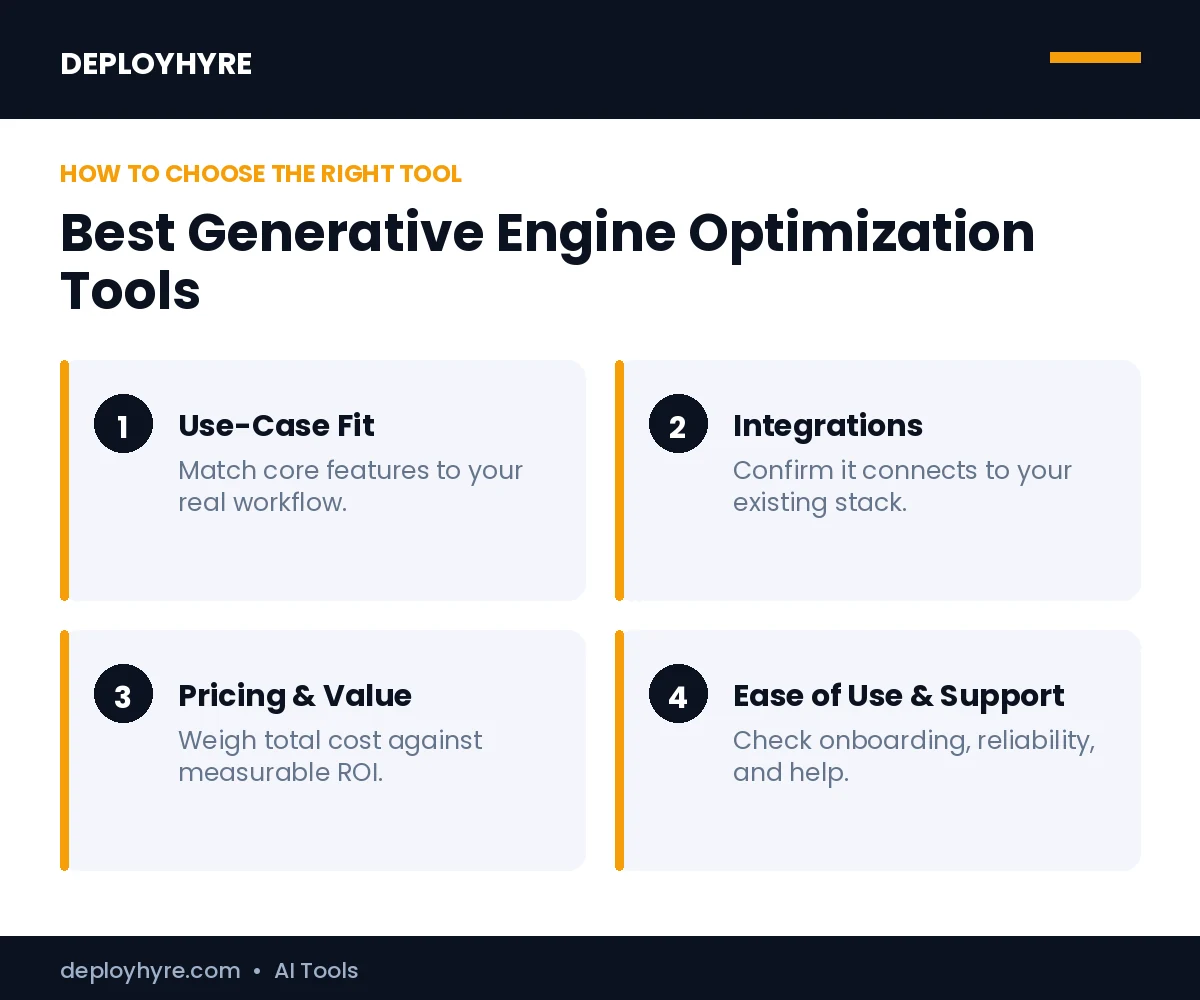
Start with your size and budget. Pick Otterly.ai or HubSpot AI Search Grader to validate GEO cheaply, Peec AI or the Semrush AI Toolkit for a growing in-house team, Scrunch AI or AthenaHQ for agencies, and Profound or Goodie AI for enterprise depth. The right tool matches your scale, not the longest feature list.
Next, check engine coverage and action. Confirm the tool reads ChatGPT, Gemini, and Perplexity, then ask whether it only reports or also guides fixes. Run a free check first, then pilot one paid tool for a month before you commit budget. Align the work with your wider plan using our guide to AI search visibility tools.
How We Evaluated These GEO Tools
We assessed each tool on five criteria: AI engine coverage, tracking accuracy, prompt and competitor insight, pricing transparency, and whether it guides action. We cross-checked features and current pricing against vendor pages and independent 2026 reviews, then grouped tools by the team size they serve best. GEO pricing changes fast, so confirm current rates and prompt limits before buying.
What is generative engine optimization?
GEO gets your content cited in AI answers. It targets tools like ChatGPT, Perplexity, and Google AI Overviews by making content clear, sourced, and extractable. Start with our guide on how to rank in AI Overviews.
How is GEO different from SEO?
SEO ranks links; GEO earns AI citations. SEO targets positions in search results, while GEO targets being quoted inside AI answers. They overlap on quality and structure, but GEO weighs clear answers, sources, and entities more heavily.
Do GEO tools guarantee AI citations?
No. GEO tools track and improve your chances of being cited, but no tool guarantees AI mentions. They show where you appear and what to fix. Citations depend on content quality, authority, and how engines weigh sources.
The Bottom Line
Generative engine optimization is no longer optional. AI referral traffic could reach 20 to 28 percent of the web by the end of 2026, and brands that measure their AI visibility will defend that share. The right GEO tool turns invisible AI answers into a channel you can manage.
Match the tool to your scale. Start free with HubSpot AI Search Grader, grow with Peec AI or the Semrush AI Toolkit, and scale to Profound or Goodie AI when AI visibility becomes a core channel. Pilot one tool, fix the gaps it surfaces, and expand once the traffic proves out.
Next steps: Compare the full stack in our best AI SEO tools guide, learn the tactics in how to rank in AI Overviews, and track positions with the best AI Overviews rank tracking software.
Frequently Asked Questions
What is the best generative engine optimization tool in 2026?
There is no single best tool; it depends on your size. Profound leads for enterprise AI visibility intelligence, Scrunch AI and AthenaHQ suit agencies, Peec AI and the Semrush AI Toolkit fit small teams, and HubSpot AI Search Grader is the best free first check. Match the tool to your scale and budget.
How much do GEO tools cost?
GEO tools range from free to enterprise. HubSpot AI Search Grader is free, Otterly.ai starts at $29 per month, and Peec AI and the Semrush AI Toolkit sit near $85 to $99 per month. Agency platforms like Scrunch AI and AthenaHQ start near $295 to $300 per month, while full platforms like Profound and Goodie AI reach $400 or more.
How are GEO tools different from rank trackers?
Rank trackers record your position in classic search results. GEO tools read AI-generated answers and check whether ChatGPT, Gemini, or Perplexity name your brand, count citation share, and reveal the prompts that trigger you. GEO tools measure visibility inside answers, not blue-link rankings.
Can small businesses use GEO tools?
Yes. Small businesses can start with the free HubSpot AI Search Grader or Otterly.ai at $29 per month, then move to Peec AI as they grow. These tools track AI mentions and competitor share without enterprise pricing. Begin with a free check, confirm GEO matters for your niche, then add a paid tracker.
Do GEO tools fix my AI visibility or just measure it?
Most GEO tools measure visibility, and some also guide fixes. Trackers like Otterly.ai and AthenaHQ report where you appear, while platforms like Goodie AI add content recommendations that earn citations. Pair a tracker with strong, well-structured content to actually raise your presence in AI answers.

David Austin is a technology writer and software analyst at DeployHyre, where he covers AI tools, SaaS platforms, cloud hosting, and business automation. He focuses on hands-on comparisons of pricing, features, and real-world performance so teams can pick the right software with confidence.