TL;DR: AI for SEO means using artificial intelligence to research keywords, create content, fix technical issues, and track rankings faster than manual work allows. In 2026, it also means optimizing for AI answers, not just blue links. This guide explains how AI SEO works, which tactics matter now, and how to earn visibility inside Google AI Overviews and tools like ChatGPT.
Table of Contents
AI for SEO has moved from novelty to necessity. Search itself is changing under our feet. Google AI Overviews now reach roughly 2 billion users every month, and they sit on top of a growing share of search results. That single shift rewrote the rules for how content earns clicks.
Marketers noticed. Around 45% of marketers now use AI to support their SEO work, and adoption climbs every quarter. AI handles the repetitive tasks that once ate whole afternoons: clustering keywords, drafting outlines, auditing pages, and scanning rank data.
The shift is measurable. Nearly a third of the US population will use generative AI search in 2026, and reliance on traditional search is projected to drop by as much as 25%. SEO now spans two arenas at once.
This guide is part of our larger resource on AI for business. Here we focus on one job: winning search visibility in an AI-first world. Read on to see how each piece fits together.
What is AI for SEO and how does it work?
AI for SEO is the practice of applying machine learning and generative AI to search optimization tasks. It speeds up keyword research, content production, technical audits, and rank tracking. It also helps you optimize for AI-generated answers. The goal stays the same: earn visibility for the right queries.
AI works across the full SEO workflow. Machine learning models scan millions of search results to spot patterns humans miss. Large language models draft, summarize, and rewrite content in seconds. Automated crawlers flag broken links, slow pages, and thin content at scale.
The results show up in the data. Nearly 44% of SEO tasks are now automated through AI tools, according to industry surveys. That frees teams to focus on strategy, original research, and brand building.
AI does not replace SEO judgment. It removes grunt work. You still decide which topics to target, what makes your content unique, and how to build authority. AI simply gets you there faster.
How does AI improve keyword research and content?
AI transforms keyword research by clustering thousands of related terms into topics in seconds. It reveals search intent, groups queries, and surfaces gaps your competitors missed. For content, AI drafts outlines, first drafts, and briefs that writers refine into publishable work.
Keyword research used to be slow. You exported spreadsheets, sorted by volume, and guessed at intent. AI tools now read intent directly. They separate informational queries from commercial ones and map each to the right page type.
Content creation sped up too. Around 87% of marketers use AI to assist content creation, and 75% use it to cut time on manual tasks like keyword research. The smartest teams treat AI drafts as raw material, not finished pages.
Quality still wins. AI can write fast, but it cannot invent your first-hand experience or proprietary data. Add both. Layer expert quotes, real examples, and original numbers on top of any AI draft.
Intent matching is where AI adds real leverage. It reads the search results already ranking for a term and infers what Google rewards there. A guide, a comparison, or a product page each earn different queries. AI maps that for you before you write a word.
Content briefs benefit most. A good AI brief lists the questions to answer, the entities to mention, and the subtopics competitors cover. Writers then produce deeper, more complete pages in less time. The output improves because the plan improves.
To go deeper on the software side, see our roundup of the best AI SEO tools. It compares platforms for research, writing, and optimization in one place.
How is AI used for technical SEO?
AI handles technical SEO by crawling sites at scale and flagging issues faster than any human audit. It detects broken links, slow pages, duplicate content, crawl errors, and weak internal linking. Some tools even suggest fixes and rewrite meta tags automatically.
Technical SEO rewards consistency, and consistency is where AI shines. A model can crawl 100,000 URLs overnight and rank problems by impact. That turns a week of manual auditing into a morning review.
AI also improves structured data. It reads your pages, recommends schema markup, and validates it. Clean structured data helps both traditional search engines and AI answer engines understand your content.
Internal linking gets smarter too. AI maps semantic relationships between pages and suggests links that spread authority to your priority content. That signal helps search engines and AI crawlers grasp your site architecture.
Speed and crawlability matter more in the AI era. AI crawlers from OpenAI, Google, and others fetch your pages constantly. Fast, well-structured sites get parsed cleanly and cited more often.
How does rank tracking work in the AI search era?
Rank tracking now spans traditional results, AI Overviews, and AI chat platforms like ChatGPT and Perplexity. A single keyword can rank differently in each surface. Modern trackers monitor all of them so you know where your brand appears and where it disappears.
Old rank trackers watched ten blue links. That view is no longer enough. AI Overviews and AI Mode pull citations from a different mix of pages. The overlap between Google’s top-10 organic results and AI citations dropped from about 75% in mid-2025 to as low as 17% in early 2026.
That gap changes what you measure. Ranking first no longer guarantees a citation in the AI answer. You need to track both positions separately.
For AI Overviews specifically, dedicated tools now report which queries trigger an overview and whether you are cited. Explore our guide to the best AI Overviews rank tracking software to pick the right monitor.
Google AI Mode is its own frontier. It answers complex, conversational queries with a custom results layout. To measure visibility there, review our comparison of AI Mode rank tracking software. It shows which tools already cover this surface.
What are AI Overviews and Generative Engine Optimization?
AI Overviews are Google’s AI-generated summaries at the top of search results, and GEO is the practice of optimizing content to be cited inside them and other AI engines. GEO stands for Generative Engine Optimization. It targets ChatGPT, Perplexity, Gemini, and Google AI answers, not just ranking positions.
The stakes are real. Ahrefs found that AI Overviews reduce the average click-through rate for top-ranking pages by 58%, based on 300,000 keywords analyzed through December 2025. When Google answers the question, fewer users click.
There is upside for cited brands. Seer Interactive found cited brands earned a 0.70% organic CTR versus 0.52% for uncited brands, a 35% lift. Being the source of the answer still pays.
GEO methods work. A landmark study from Princeton, Georgia Tech, and IIT Delhi showed GEO techniques can lift content visibility in AI answers by up to 40%. Adding statistics, citing sources, and using clear quotations drove the biggest gains.
To rank inside these summaries, study our step-by-step guide on how to rank in AI Overviews. For the broader software category, see the generative engine optimization tools we recommend.
Measuring your presence across every AI engine is its own discipline. Our list of AI search visibility tools covers platforms that track brand mentions inside ChatGPT, Perplexity, and Gemini.
How does AI help with local SEO and Google Business Profile?
AI improves local SEO by writing optimized business descriptions, generating review responses, and surfacing local keyword opportunities. It also helps keep your Google Business Profile accurate, active, and aligned with what local searchers want to know.
Local search runs on freshness and relevance. AI drafts posts, answers questions, and suggests service categories that match local demand. That keeps your profile active without constant manual effort.
Reviews matter for local ranking, and AI speeds up responses. It drafts personalized replies that match your brand voice. Faster, thoughtful responses signal an engaged business to both customers and Google.
AI Overviews now appear for local queries too. So your local content needs the same clear, factual structure that AI engines prefer. Concise answers and accurate details help you get pulled into local AI summaries.
Consistency across the web still drives local rankings. AI tools scan directories and citations to flag mismatched names, addresses, and phone numbers. Fixing those inconsistencies strengthens the trust signals that both Google and AI engines rely on.
For tools built specifically for this job, see our picks for Google Business Profile optimization. They automate the repetitive parts of local SEO.
What are the risks, and what is Google’s stance on AI content?
Google permits AI content as long as it is helpful, accurate, and created for people, not for manipulating rankings. The risk is not using AI. The risk is publishing low-quality, mass-produced pages that add no value. Google calls that scaled content abuse and penalizes it.
Google states its position clearly. Appropriate use of AI is not against Google’s guidelines. Google rewards quality regardless of how content is produced. It judges the result, not the tool.
The danger sits at the extremes. Publishing hundreds of thin AI pages to game search triggers Google’s spam policies. That approach can crater a site’s visibility overnight.
Protect yourself with E-E-A-T. Google’s raters look for experience, expertise, authoritativeness, and trustworthiness. Add real author bios, first-hand insight, and cited sources. AI drafts the words; humans add the credibility.
Accuracy is your other guardrail. AI models invent facts, so fact-check everything before publishing. One fabricated statistic can damage the trust you spent years building.
How do you choose the right AI SEO tools?
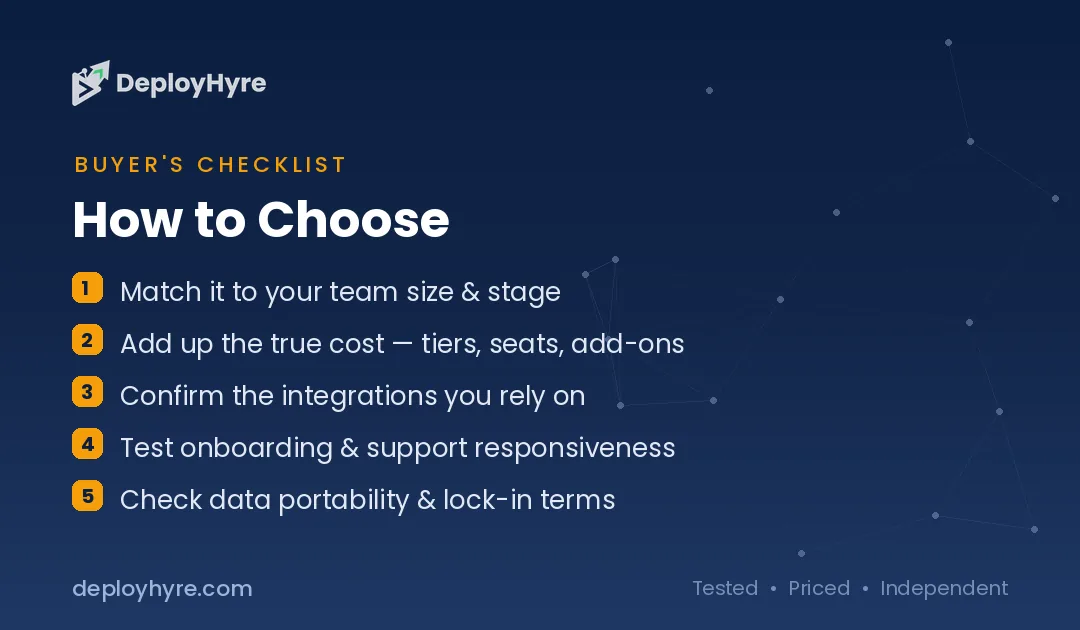
Choose AI SEO tools by matching them to your biggest bottleneck, whether that is research, content, technical audits, or AI visibility tracking. Look for accurate data, clean integrations, and coverage of AI search surfaces. Avoid paying for features you will not use.
Start with your workflow, not the feature list. A content-heavy team needs strong drafting and optimization tools. A technical team needs a fast, thorough crawler. Buy for the gap you actually have.
Data quality separates good tools from noisy ones. Test a tool against keywords and pages you already understand. If its numbers match reality, trust it. If they drift, keep looking.
AI search coverage is now a must-have. The best modern platforms track your visibility inside AI Overviews and chat engines, not just classic rankings. That future-proofs your investment.
Some teams prefer to hand the whole job to experts. If that is you, review our list of the top AI SEO agencies. They combine AI tooling with strategic oversight so you do not have to build it in-house.
The Bottom Line
AI for SEO is no longer optional in 2026. Search has split into two arenas: traditional rankings and AI-generated answers. You need to compete in both. AI tools make that possible by automating research, content, technical fixes, and multi-surface rank tracking.
The winners will not be the fastest publishers. They will be the teams that pair AI speed with genuine expertise. Use AI to remove grunt work, then add original data, first-hand experience, and cited sources that machines cannot fake.
Start with your biggest bottleneck. Pick one tool, prove its value, then expand. In an era where AI Overviews can cut clicks by more than half, being the cited source is the new page one. Optimize for that, and you win.
Frequently Asked Questions
Is AI good for SEO?
Yes. AI is good for SEO when used to speed up research, content, and technical work while humans add expertise and accuracy. It automates roughly 44% of SEO tasks. The risk comes from publishing low-quality, mass-produced AI content, which Google penalizes.
Does Google penalize AI-generated content?
No, not by default. Google penalizes low-quality content created to manipulate rankings, regardless of whether AI wrote it. Google’s guidelines confirm that appropriate AI use is allowed. High-quality, helpful, accurate AI content that serves users can rank well.
What is GEO in SEO?
GEO stands for Generative Engine Optimization. It is the practice of optimizing content to be cited by AI engines like ChatGPT, Perplexity, Gemini, and Google AI Overviews. Research shows GEO techniques can lift AI answer visibility by up to 40%.
Can AI do SEO on its own?
No. AI automates SEO tasks like keyword clustering, drafting, and auditing, but it cannot replace strategy or judgment. Humans still choose targets, add original insight, and ensure accuracy. The best results come from combining AI speed with human expertise.
How do I optimize for AI Overviews?
Optimize for AI Overviews by writing clear, factual, well-structured answers to specific questions. Add original statistics, cite trustworthy sources, and use direct quotations. These GEO tactics help Google’s AI pull and cite your content inside its generated summaries.
Know AI, SaaS, or cloud tools inside out? Pitch a guest post and get in front of thousands of buyers researching their next tool.

David Austin is a technology writer and software analyst at DeployHyre, where he covers AI tools, SaaS platforms, cloud hosting, and business automation. He focuses on hands-on comparisons of pricing, features, and real-world performance so teams can pick the right software with confidence.