Mordor Intelligence values the field service management market at $6.26 billion in 2026 and projects $9.87 billion by 2031, a 9.54% compound annual growth rate. Contractors are buying software faster than they are hiring technicians.
The reason is a single metric. Industry benchmarks put the average first-time fix rate at 77% to 80%, so roughly one job in five needs a second visit. Every return trip burns a truck roll, a technician hour, and a slice of customer goodwill.
AI changes where that fix rate comes from. Older field service software stored jobs and printed invoices. Current platforms predict job duration, score which technician closes the most revenue on a given call type, rebuild the dispatch board when a job runs long, and answer missed calls with a booking agent. The dispatcher stops playing Tetris and starts handling exceptions.
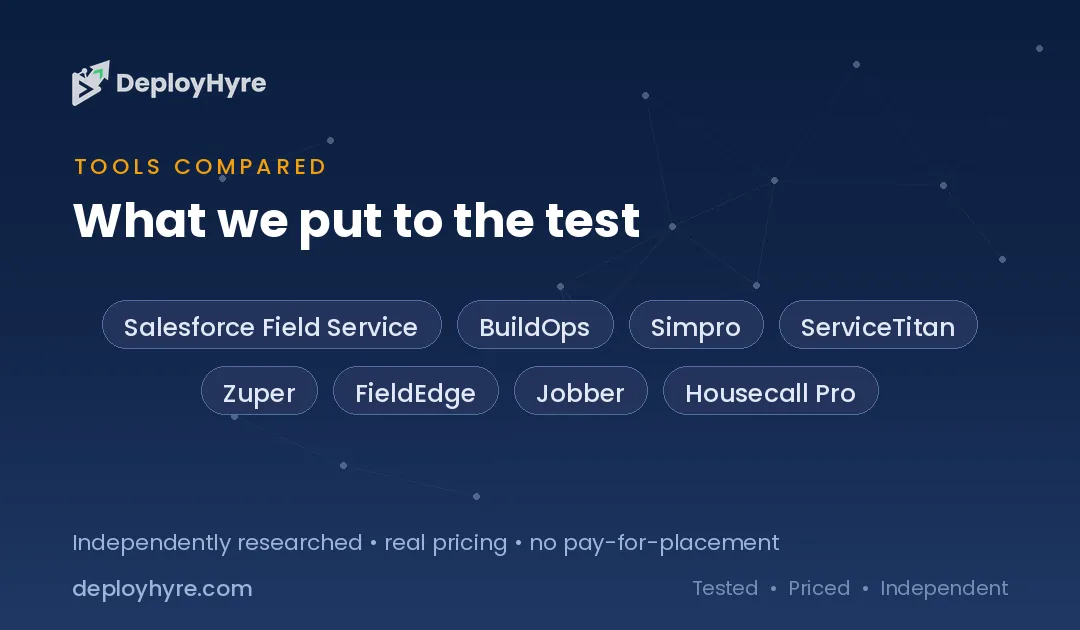
We reviewed 9 platforms across enterprise contractors, high-volume home service, and small crews. Pricing models differ sharply: some charge per technician, some per company, and the biggest names publish nothing at all. This guide is part of our wider coverage of AI for business operations, and it groups tools by the size of the team running them.
Quick Comparison: Top 9 AI Field Service Management Platforms
| Platform | Best For | Starting Price | Signature AI Capability |
|---|---|---|---|
| Salesforce Field Service | Enterprise scheduling at scale | From $50 per user per month | Agentforce agents inside the scheduling engine |
| BuildOps | Commercial contractors with service and projects | Quote only | AI quoting and project margin forecasting |
| Simpro | Multi-trade contractors with inventory | Quote only | Predictive scheduling and stock forecasting |
| ServiceTitan | High-volume residential trades | Quote only, per technician | Titan Intelligence and the Atlas AI assistant |
| Zuper | Mid-market teams wanting published pricing | From $55 per user per month | AI quote generation from past job data |
| FieldEdge | HVAC and plumbing with deep QuickBooks use | Quote only | Technician performance and pricebook intelligence |
| Jobber | Small crews and solo operators | From $29 per month | AI-assisted quoting and route optimization |
| Housecall Pro | Residential service under 10 users | From $59 per month billed annually | AI receptionist and automated follow-up |
| Workiz | Locksmiths, garage door, and junk removal | Quote only | AI call scoring and missed-call recovery |
What Does AI Field Service Management Software Actually Do?
AI field service management software assigns jobs, routes trucks, and prices work using machine learning trained on your own job history. It predicts job duration, ranks technicians by close rate per job type, rebuilds the dispatch board when work runs long, and books inbound calls automatically. The dispatcher supervises the system instead of building the schedule by hand.
Four capabilities separate an AI platform from a digital job book.
Revenue-aware dispatch. Classic scheduling optimizes for drive time. ServiceTitan’s Dispatch Pro optimizes the board to maximize profit by combining job value predictions with technician performance data. Two technicians can reach the same address in 20 minutes, and the platform sends the one who closes that call type.
Duration prediction. A job booked as a two-hour call that always takes four hours wrecks the rest of the day. Models trained on completed work orders learn the real duration by job type, equipment age, and technician, then block the calendar honestly.
Missed-call recovery. Home service businesses lose revenue at the phone, not the truck. ServiceTitan flags unbooked calls that follow-up can save and runs an SMS booking agent that texts back automatically. Housecall Pro and Workiz ship comparable answering layers.
Autonomous agents. Salesforce embedded Agentforce across its field service scheduling engine, which moves the software from recommending a slot to committing one. Agent-based scheduling is the clearest dividing line between 2024-era tools and current ones.
Teams already running AI CRM software will recognize the pattern. The forecast is only as good as the history you feed it, so platforms reward companies that close out work orders properly.
Best AI Field Service Management Software for Enterprise and Commercial Contractors
1 Salesforce Field Service: Best for AI scheduling at enterprise scale
Salesforce Field Service is the strongest scheduling engine in the category, and the price of entry is the Salesforce ecosystem.
What it does well. The platform optimizes complex, multi-constraint schedules: skills, certifications, parts on the van, service-level agreements, contractor networks, and territory boundaries. SelectHub’s review puts entry pricing at $50 per user per month. Agentforce agents now sit inside that engine, handling dispatch decisions and customer updates without a human trigger. Because it runs on the Salesforce platform, service history joins sales and support records in one object model.
Key features:
-
Constraint-based schedule optimization across skills, parts, and SLAs
-
Agentforce AI agents embedded in dispatch and customer comms
-
Contractor and third-party workforce management
-
Offline-capable mobile app for technicians
-
Native reporting through Salesforce dashboards
Pricing. From $50 per user per month, with Dispatcher and Technician licenses priced separately. Most deployments add implementation cost.
Best for: Enterprises with 100 or more technicians that already run Salesforce.
Limitations. Implementation takes months and usually needs a partner. Small contractors pay for flexibility they will never configure.
2 BuildOps: Best for commercial contractors running service and projects
BuildOps is built for commercial mechanical, electrical, and plumbing contractors whose revenue splits between recurring service and construction projects.
What it does well. Most field service platforms handle service calls well and projects badly. BuildOps runs both on one record, so a service technician who finds a failing chiller can hand a quote to the project team without rekeying anything. Asset histories live at the equipment level, which matters when you maintain 400 rooftop units across a hospital campus. AI assists quoting and flags projects drifting off margin.
Key features:
-
Unified service, maintenance contract, and project workflows
-
Equipment-level asset history and warranty tracking
-
AI-assisted quoting from historical job costs
-
Project margin and work-in-progress reporting
-
Technician mobile app with asset scan
Pricing. Quote only. BuildOps publishes no public price list.
Best for: Commercial contractors above roughly $10 million in revenue with mixed service and project work.
Limitations. No pricing transparency. Overbuilt for residential-only companies.
3 Simpro: Best for multi-trade contractors carrying inventory
Simpro is strongest where parts management is the bottleneck rather than scheduling.
What it does well. Simpro treats inventory as a first-class object: van stock, warehouse stock, supplier catalogs, and purchase orders tie back to each job. For contractors whose second truck roll is caused by a missing part rather than a missing skill, that is the fix. The platform covers quoting, scheduling, timesheets, and invoicing in one system, which suits multi-trade firms running electrical and HVAC under one roof.
Key features:
-
Van and warehouse inventory with automated reordering
-
Supplier catalog integration and purchase orders
-
Recurring maintenance contract scheduling
-
Job costing against estimates in real time
-
Multi-trade and multi-location support
Pricing. Quote only, after a demo.
Best for: Multi-trade contractors with 20 to 200 technicians and heavy parts usage.
Limitations. The interface takes longer to learn than Jobber or Housecall Pro. Pricing requires a sales call.
Best AI Field Service Software for High-Volume Home Service
4 ServiceTitan: Best for high-volume residential trades
ServiceTitan is the default answer for large HVAC, plumbing, and electrical companies, and it has the deepest AI feature set in home service.
What it does well. Titan Intelligence spans dispatch, demand-based scheduling, benchmark pricing, invoice review, and technician guidance. Dispatch Pro sets up the board to maximize profit using job value predictions and technician performance. The platform automatically reviews unbooked calls and flags the ones a follow-up can recover, and an SMS booking agent texts customers back with AI-generated messages. Smarter Routing trims drive time to fit more jobs into a day.
Key features:
-
Dispatch Pro profit-optimized board assignment
-
Unbooked-call detection and SMS booking agent
-
Benchmark pricing against market data
-
Atlas AI assistant for insights and actions
-
Membership, financing, and marketing attribution modules
Pricing. Quote only, priced per technician. Expect a setup fee and an annual commitment.
Best for: Residential trades above roughly 15 technicians with call-center volume.
Limitations. The most expensive option in home service by a wide margin. Onboarding is a project, not a weekend. Small shops rarely recover the cost.
5 Zuper: Best for mid-market teams that want published pricing
Zuper sits between the small-team tools and the enterprise suites, and it publishes a number.
What it does well. Zuper generates quotes with AI that pulls from past job data, so estimators stop rebuilding the same proposal. Scheduling intelligence sits inside a broader workforce management platform covering timesheets, certifications, and contractor dispatch. Capterra lists pricing from $55 per user per month, which makes budgeting possible without a discovery call.
Key features:
-
AI quote generation from historical job data
-
Skills and certification-aware scheduling
-
Workforce management with timesheets and leave
-
Customer portal and self-service booking
-
Open API and integrations with major CRMs
Pricing. From $55 per user per month. Reported tiers run to roughly $150 per user per month for enterprise features.
Best for: Service teams of 10 to 100 that want enterprise scheduling without enterprise procurement.
Limitations. Smaller partner ecosystem than Salesforce or ServiceTitan. Per-user pricing gets expensive for large technician counts.
6 FieldEdge: Best for HVAC and plumbing running on QuickBooks
FieldEdge earns its place through accounting depth rather than AI breadth.
What it does well. The QuickBooks integration is the closest to real-time in the category, which removes the month-end reconciliation drag that plagues contractors. Technician performance dashboards show revenue per technician and close rates by job type, and a flat-rate pricebook keeps quotes consistent across a crew. Service agreement management handles recurring maintenance renewals automatically.
Key features:
-
Deep two-way QuickBooks sync
-
Flat-rate pricebook with good-better-best options
-
Technician performance scorecards
-
Service agreement renewal automation
-
Customer equipment and service history
Pricing. Quote only, after a demo.
Best for: HVAC and plumbing companies of 5 to 50 technicians whose books live in QuickBooks.
Limitations. AI features lag ServiceTitan. No published pricing.
Best AI Field Service Software for Small Teams and Solo Operators
7 Jobber: Best for small crews and solo operators
Jobber is the most approachable platform here and the easiest to get running in an afternoon.
What it does well. Jobber’s published plans run from $29 to $529 per month billed annually across Core, Connect, Grow, and Plus tiers. Core covers one user with unlimited quotes, jobs, and invoices. Connect adds routing that assigns incoming jobs to the closest team member on the map plus live GPS tracking. Grow adds advanced quoting and custom automations. AI suggests line items on estimates, which speeds up the quote most small contractors delay for days.
Key features:
-
Published pricing across four tiers
-
Route optimization with live GPS tracking
-
AI-suggested quote line items
-
Client hub for online booking and payment
-
Automated quote follow-up reminders
Pricing. From $29 per month billed annually. Plus starts at $499 per month for five users.
Best for: Landscaping, cleaning, pest control, and trades teams under 15 people.
Limitations. Inventory management is thin. Large technician counts outgrow the model.
8 Housecall Pro: Best for residential service under 10 users
Housecall Pro competes with Jobber and leans harder into consumer-facing polish.
What it does well. Pricing is banded by user count rather than per seat, which suits a growing crew: Basic covers one user, Essentials covers up to five, and MAX covers up to eight. Housecall Pro lists Basic at $79, Essentials at $189, and MAX at $329 per month, dropping to $59, $149, and $299 on annual billing. An AI receptionist answers calls the office misses, and automated follow-up chases unsold estimates. The consumer booking experience is the strongest in the small-team tier.
Key features:
-
User-banded pricing instead of strict per-seat
-
AI receptionist for missed calls
-
Online booking widget and customer portal
-
Automated estimate follow-up sequences
-
Integrated payments and consumer financing
Pricing. From $59 per month billed annually for one user. MAX covers up to eight users at $299 per month annually.
Best for: Residential service companies with one to eight users.
Limitations. Costs climb quickly past eight users. Reporting is lighter than FieldEdge.
9 Workiz: Best for locksmiths, garage door, and junk removal
Workiz targets the trades that live or die on inbound phone calls.
What it does well. Call handling is the product. Workiz records and scores calls, flags the ones that did not convert, and pushes recovery tasks to the office. For a locksmith or garage door company where a missed call is a lost job within the hour, that loop pays for the software. Scheduling, dispatch, and invoicing cover the rest of the workflow, and the mobile app is built for technicians who close on site.
Key features:
-
Call recording, transcription, and AI scoring
-
Missed-call recovery workflows
-
Ad source attribution down to the job
-
On-site invoicing and payment collection
-
Standard, Pro, and Ultimate tiers
Pricing. Quote only. Workiz lists Standard, Pro, and Ultimate tiers without public dollar amounts, and reported entry pricing sits near $225 per month for up to five users.
Best for: Call-driven trades: locksmiths, garage door, appliance repair, junk removal.
Limitations. No published pricing. Weaker fit for contract-based commercial maintenance.
How Should You Choose the Right Field Service Platform?
Choose by pricing model first, not feature list. Per-technician platforms like ServiceTitan and Zuper scale cost with headcount. User-banded platforms like Housecall Pro and Jobber cap it. Flat-rate platforms like Service Fusion charge per company with unlimited users, which favors large crews on thin margins.
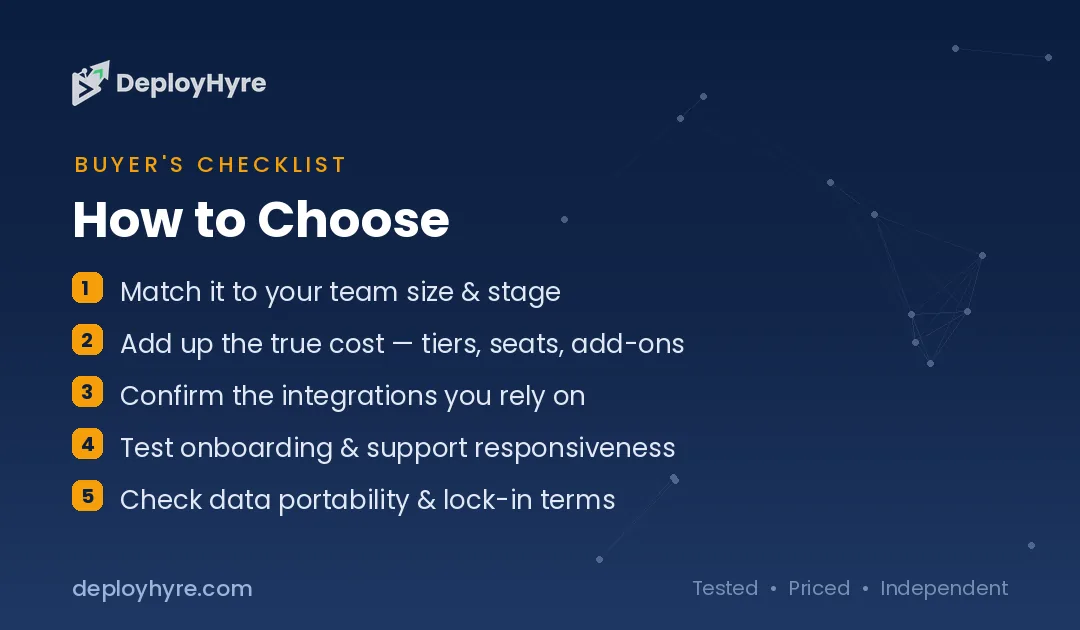
Five questions settle most decisions.
How many technicians will you have in 24 months? A $55 per user platform costs $6,600 a year at 10 technicians and $66,000 at 100. Model the future headcount, not today’s.
Is your bottleneck the schedule or the parts? Missing skills point to Salesforce or Zuper. Missing parts point to Simpro. Diagnosing this wrong buys the wrong category of software.
Do you run projects alongside service? Commercial contractors with construction revenue need BuildOps-style unified records. Residential-only companies do not.
Where does the money leak? If it leaks at the phone, buy call intelligence: Workiz, Housecall Pro, or ServiceTitan. If it leaks at the invoice, prioritize accounting depth and pair the platform with AI invoicing software. If it leaks at technician utilization, start with AI time tracking software before buying a full suite.
How clean is your job history? AI dispatch trains on completed work orders. Companies that skip job codes and close-out notes get generic recommendations for the first year. Fix data hygiene before paying for prediction.
Also check the service side of the house. Field work generates support tickets, and a platform that hands off cleanly to AI customer service software prevents customers from repeating themselves.
How We Evaluated These Platforms
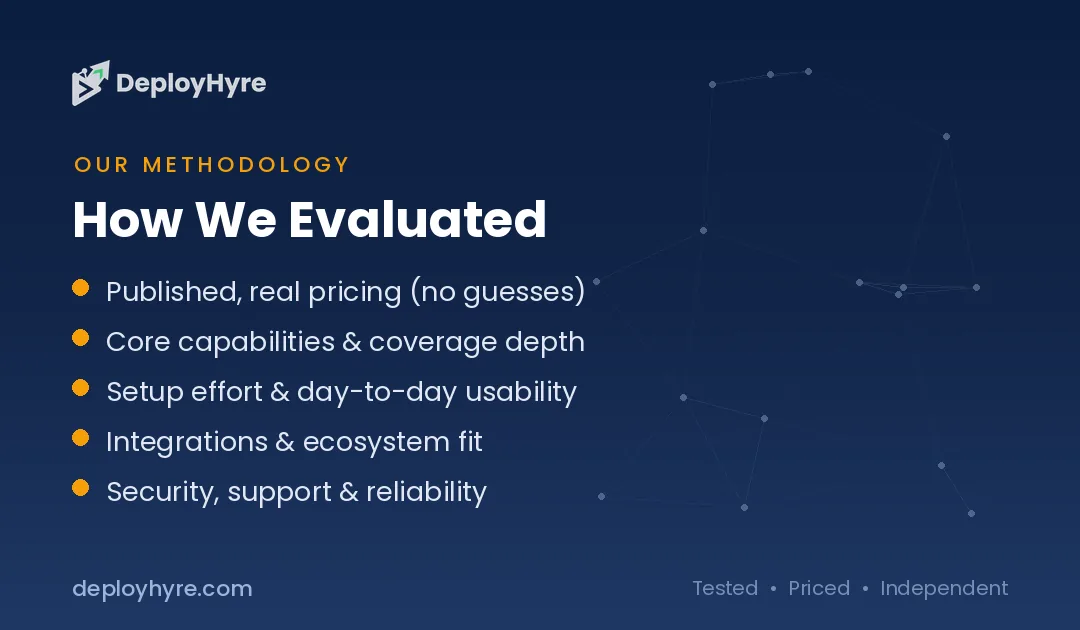
We scored all 9 platforms against the same six criteria, weighted for the buyer who has to justify the spend.
Pricing transparency. Published pricing scored higher than quote-only. Contractors deserve to budget before a sales call.
AI depth. We separated genuine machine learning, such as profit-weighted dispatch and duration prediction, from rebranded rules engines. Marketing language calling a saved filter an AI agent scored zero.
Scheduling and routing. We weighted constraint handling: skills, certifications, parts, territories, and service-level agreements.
Accounting fit. Real-time accounting sync removes a recurring monthly cost that never appears on the license invoice.
Mobile reliability. Technicians work in basements and mechanical rooms. Offline capability mattered more than interface polish.
Fit by company size. Every platform was placed in the band where it wins, not ranked on a single list. ServiceTitan beating Jobber at 60 technicians tells a solo operator nothing.
Pricing figures come from vendor pricing pages and published review databases as of September 2026. Quote-only vendors are labeled as such rather than given an estimated number.
The Bottom Line
Salesforce Field Service wins for enterprises above 100 technicians that need agent-driven scheduling. ServiceTitan wins for high-volume residential trades that can absorb the cost. Jobber and Housecall Pro win for teams under 10, and Zuper wins for mid-market buyers who want a published price.
The honest test is smaller than the feature grids suggest. Count your technicians, name your bottleneck, and pick the platform that fixes it at a price that still works at double the headcount.
Start with a two-week pilot on one crew rather than a company-wide rollout. Load 90 days of real job history, run the dispatch recommendations alongside your existing board, and compare the two. If the AI board does not beat your dispatcher on jobs completed per day, the problem is your data, not the software.
For a wider view of how these tools fit alongside the rest of your stack, read our guide to AI for business.
Frequently Asked Questions
What is the best AI field service management software?
Salesforce Field Service is the best choice for enterprises that need agent-driven scheduling at scale, and ServiceTitan is the best choice for high-volume residential trades. Small teams get better value from Jobber or Housecall Pro, which publish pricing and install in a day.
How much does field service management software cost?
Small-team platforms start at $29 to $79 per month. Mid-market platforms like Zuper start at $55 per user per month. Enterprise platforms including ServiceTitan, BuildOps, FieldEdge, and Simpro are quote only and typically require an annual commitment plus a setup fee.
Does AI actually improve first-time fix rates?
AI improves first-time fix rates by matching technician skills, certifications, and van stock to the job before dispatch. Industry benchmarks put the average first-time fix rate at 77% to 80%, so one job in five currently needs a return visit. Accurate skills and inventory data drive most of the gain.
Which field service software integrates best with QuickBooks?
FieldEdge has the deepest two-way QuickBooks sync in the category, which is why HVAC and plumbing companies choose it over platforms with stronger AI. Jobber and Housecall Pro also sync with QuickBooks, though reconciliation requires more manual review.
Can small contractors use AI field service software?
Yes. Jobber starts at $29 per month billed annually and includes AI-suggested quote line items and route optimization. Housecall Pro starts at $59 per month billed annually and includes an AI receptionist for missed calls. Neither requires an implementation project.

David Austin is a technology writer and software analyst at DeployHyre, where he covers AI tools, SaaS platforms, cloud hosting, and business automation. He focuses on hands-on comparisons of pricing, features, and real-world performance so teams can pick the right software with confidence.
Know AI, SaaS, or cloud tools inside out? Pitch a guest post and get in front of thousands of buyers researching their next tool.