Table of Contents
The best AI product analytics tool for most teams is Amplitude for depth and scale, Mixpanel for simplicity and value, PostHog for technical teams that want an all-in-one open-source stack, and Heap for automatic event capture. Product analytics tools track how users actually behave inside your product, which features they use, where they drop off, what drives retention, so you make product decisions from data rather than guesses.
The cost mechanic to watch: the billing unit differs by tool and flips which is cheaper for your traffic shape. Amplitude bills by monthly tracked users (MTU), Mixpanel and PostHog by events, and Heap by sessions. A product with few users generating many events is cheap on MTU pricing and expensive on event pricing, and vice versa. Add that PostHog self-hosts free for technical teams, and the “cheapest” tool depends entirely on your usage pattern and engineering capacity, not the headline rate.
Every price below is a recent observed figure. Because usage-based pricing scales with users, events, or sessions, treat each as a band.
Quick Comparison: Product Analytics Tools at a Glance
| Tool | Best For | Observed Price | Billing Unit |
|---|---|---|---|
| Amplitude | Depth and scale | Free to 50K MTU; Growth from ~$49/mo ($500–$2,000 at scale) | Monthly tracked users |
| Mixpanel | Simplicity and value | Free (20M events/mo); event-based paid | Events |
| PostHog | Technical teams, all-in-one | Free tier; ~$0.00031/event; free self-host | Events |
| Heap | Automatic event capture | Free (10K sessions); paid quote | Sessions |
| June | B2B SaaS, simple metrics | Free tier; paid tiers | Company/user-based |
What AI Product Analytics Tools Do
Product analytics tools instrument your app to capture user behavior, every click, screen, and action, and turn it into insight about how people actually use your product. They answer the questions product teams live on: which features get adopted, where users drop out of a funnel, what behaviors correlate with retention or churn, and how a new release changed usage. Unlike marketing analytics (which tracks acquisition), product analytics tracks what happens after someone is inside the product.
The AI layer surfaces insights you would not think to query: it flags anomalies in usage, identifies the behaviors that predict retention or churn, auto-generates cohorts, and increasingly answers natural-language questions about your product data. The core analyses, funnels, retention curves, cohort analysis, user paths, are table stakes; the differentiation is increasingly in AI-driven insight surfacing and how much the tool does automatically versus requiring manual instrumentation and querying.
Product analytics is central to data-driven product development. It complements the broader analytics in our best AI data analytics tools guide, pairs with the experimentation in our best AI A/B testing tools guide, and works alongside the customer data in our best AI customer data platforms guide.
The Billing Unit Flips the Cheaper Tool
Product analytics tools bill on different units, so the same product produces very different bills, and you cannot compare them without normalizing to your own usage shape. Amplitude bills by monthly tracked users, so it rewards products with few users generating many events each. Mixpanel and PostHog bill by events, so they reward products with many users generating few events each. Heap bills by sessions and tends to cost more at comparable usage because its automatic capture generates high data volumes. A B2B product with a small, active user base and a consumer app with millions of light users will find opposite tools cheapest.
Concretely, Amplitude is free to 50,000 MTU then scales to $500 to $2,000 a month at higher volumes; Mixpanel’s free tier covers 20 million events a month; PostHog Cloud runs about $1,240 a month at 5 million events (or free self-hosted). So model your monthly users, your events per user, and your sessions, then price each tool on its unit. The cheapest headline tier rarely stays cheapest once mapped to your actual usage, and for technical teams PostHog’s free self-hosting can undercut everything.
Best for Depth and Scale
Amplitude is the best product analytics tool for depth and scale, with the most powerful analysis capabilities, behavioral cohorting, predictive analytics, and enterprise features, free to 50,000 monthly tracked users and scaling to $500 to $2,000 a month at higher volumes. For product teams that want to go deep, sophisticated retention analysis, behavioral prediction, complex segmentation, Amplitude is the category leader, and its MTU-based pricing suits products with a defined, active user base rather than massive light-usage traffic. It is the safe choice when product analytics is a core, strategic function.
Amplitude’s depth is its differentiator: it does more analytically than simpler tools, which is why data-driven product organizations standardize on it. The trade-off is that MTU pricing scales meaningfully with your user count, so high-user-count consumer products should model the cost against event-based alternatives. For teams whose priority is analytical power and who have a manageable MTU count, Amplitude leads, feeding decisions across the analytics stack in our best AI data analytics tools guide.
Best for Simplicity and Value
Mixpanel is the best product analytics tool for simplicity and value, with an intuitive interface that non-technical users can navigate and a genuinely generous free tier of 20 million events a month. Its event-based model and clean UI make it the pick for teams that want powerful-enough analytics without Amplitude’s complexity or a data-team dependency, product managers and marketers can build funnels and retention reports themselves. The 20-million-event free tier covers real usage for many startups and mid-market products, and its event-based pricing suits products with many users generating moderate events each.
Mixpanel hits the sweet spot of capability and accessibility: enough analytical depth for most teams, an interface non-technical users actually use, and pricing that starts genuinely free at meaningful scale. June is a lighter alternative focused on B2B SaaS, offering simple, opinionated metrics and a free tier, good for B2B teams that want product analytics without configuring everything. Both favor simplicity; Mixpanel for broad, accessible product analytics at strong value, June for opinionated B2B SaaS metrics. Choose Mixpanel when usability and a generous free tier matter more than Amplitude’s analytical ceiling.
Best for Technical Teams
PostHog is the best choice for technical teams, an all-in-one product-analytics stack that bundles analytics, session replay, feature flags, and experimentation, with a generous cloud free tier and a fully free self-hosted option. For engineering-led teams, PostHog is uniquely cost-effective: self-hosting gives you the entire stack for the cost of infrastructure, and even on cloud it consolidates tools you would otherwise buy separately (analytics plus session replay plus feature flags). At 5 million events a month, cloud runs about $1,240 (or $1,500 to $2,000 with session replay and flags added), while self-hosted is just your infrastructure.
PostHog’s all-in-one, open-source, developer-friendly design is its differentiator, it is built for teams that want to own their stack and consolidate product tooling. The trade-off is that it suits technical teams: setup and self-hosting require engineering capacity, and its breadth can be more than non-technical product teams need. For engineering-led organizations that value cost control, consolidation, and open-source ownership, PostHog is the standout, and it overlaps directly with the feature-flag and experimentation tools in our best AI feature flag tools guide. Heap rounds out the field with automatic event capture, no manual instrumentation, which speeds setup but generates high data volumes that make it costlier at scale.
How Should You Choose a Product Analytics Tool?
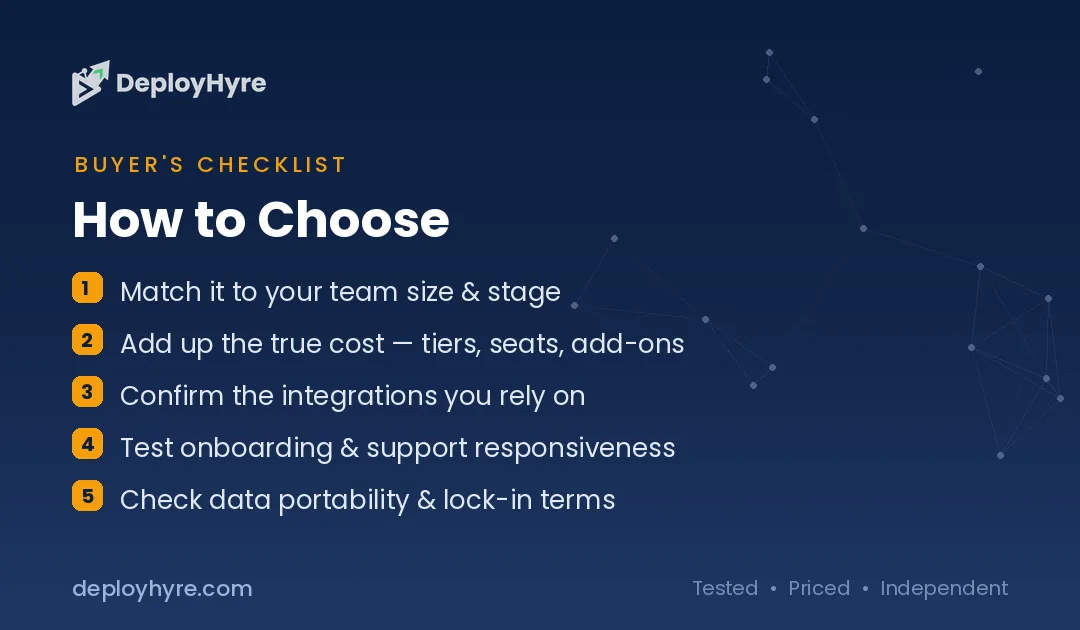
Model your usage shape first, because the billing unit flips the cheaper tool. Few users with many events each favor Amplitude’s MTU pricing; many users with fewer events favor Mixpanel’s or PostHog’s event pricing. Count your monthly users, events per user, and sessions, then price each tool on its unit rather than comparing headline tiers.
Then match the tool to your team. Deep analytical needs and a manageable MTU count point to Amplitude. Simplicity, accessibility, and a generous free tier point to Mixpanel. Technical teams wanting an all-in-one, self-hostable stack point to PostHog. Fast setup via automatic capture points to Heap (mind the higher data volumes). B2B SaaS wanting opinionated metrics points to June.
Finally, weigh consolidation and engineering capacity. PostHog bundles analytics, session replay, and feature flags, which can replace several tools if you have the engineering capacity to run it, potentially free self-hosted. If your team is technical and values owning the stack, that consolidation is a major cost and workflow advantage; if not, a managed, focused tool like Mixpanel or Amplitude is the better fit.
How We Evaluated These Platforms
We evaluated each tool on analytical depth (funnels, retention, cohorts, paths), AI insight surfacing, ease of use for the intended team, self-hosting and consolidation, and pricing model. Figures come from vendor pages and comparison sources. Because tools bill by users, events, or sessions, which flips the cheaper option, we present observed rates and stress modeling your usage shape. We accepted no payment for placement; rankings reflect fit for a stated use case.
The Bottom Line
Amplitude leads on analytical depth and scale, Mixpanel on simplicity, value, and a generous free tier, and PostHog on all-in-one open-source consolidation for technical teams (free self-hosted), with Heap the automatic-capture option. Because tools bill by MTU, events, or sessions, model your own usage shape before comparing, since the billing unit, not the headline rate, decides which is cheapest, and PostHog’s free self-hosting can undercut everything for engineering-led teams.
Frequently Asked Questions
How much do product analytics tools cost?
All have free tiers: Amplitude to 50,000 monthly tracked users, Mixpanel to 20 million events a month, Heap to 10,000 sessions, and PostHog a generous cloud free tier plus free self-hosting. Paid scales by unit: Amplitude reaches $500 to $2,000 a month at higher MTU volumes, and PostHog runs about $1,240 a month at 5 million events on cloud.
What is product analytics?
Product analytics tracks how users behave inside your product, which features they use, where they drop off in funnels, what drives retention, so product teams make decisions from real usage data. Unlike marketing analytics, which measures acquisition, product analytics measures what happens after someone is inside the product.
Amplitude or Mixpanel: which is better?
Amplitude offers deeper analytical power and enterprise features, best for teams that want sophisticated analysis and have a manageable monthly-tracked-user count. Mixpanel is simpler, more accessible to non-technical users, and has a generous 20-million-event free tier. Choose Amplitude for depth, Mixpanel for usability and value, and model your usage shape since they bill on different units (MTU versus events).
Why is PostHog cheaper for technical teams?
PostHog offers a fully free self-hosted option, so engineering teams can run the entire stack, analytics, session replay, and feature flags, for the cost of infrastructure alone. It also consolidates tools you would otherwise buy separately. This makes it one of the most cost-effective options for teams with the engineering capacity to self-host and manage it.
What does the billing unit have to do with cost?
Product analytics tools bill by different units, monthly tracked users (Amplitude), events (Mixpanel, PostHog), or sessions (Heap), so the same product costs different amounts depending on the tool. A product with few users but many events is cheap on MTU pricing and expensive on event pricing, so you must model your own usage against each unit rather than comparing headline prices.
Related Articles


David Austin is a technology writer and software analyst at DeployHyre, where he covers AI tools, SaaS platforms, cloud hosting, and business automation. He focuses on hands-on comparisons of pricing, features, and real-world performance so teams can pick the right software with confidence.