Table of Contents
The best headless CMS for most teams is Sanity for developer flexibility and multilingual content, Contentful for enterprise content operations, Storyblok for visual editing by marketing teams, and Strapi for self-hosted open source. A headless CMS stores and manages content but, unlike WordPress, has no built-in front end, it delivers content via API to any website, app, or device, which lets developers build the front end however they want while editors work in a clean content interface.
The insight that guides the choice: each platform embodies a different philosophy of content. Sanity treats content like data, Contentful like enterprise software, Storyblok like a design system, and Strapi like code. That philosophy, more than the feature list, determines which team the tool fits, and it maps onto pricing that ranges from free (self-hosted Strapi, Sanity’s free tier) to $300 a month (Contentful Team) and beyond. Matching the platform’s worldview to how your team works is the real decision.
Every price below is a recent observed figure. Because usage-based tiers scale with API calls and users, treat each as a band.
Quick Comparison: Headless CMS at a Glance
| Platform | Best For | Observed Price | Philosophy |
|---|---|---|---|
| Sanity | Developer flexibility, multilingual | Free tier; usage-based (API, bandwidth, users) | Content as data |
| Strapi | Self-hosted open source | Free self-host; Cloud from $29/mo | Content as code |
| Storyblok | Visual editing for marketers | Growth from $99/mo (5 users) | Content as design system |
| Contentful | Enterprise content operations | Free tier; Team $300/mo | Content as enterprise software |
| Payload | Developer-owned, self-hosted | Free to self-host | Content as code |
| Hygraph | GraphQL-native content federation | Free tier; paid tiers | Content as API |
What a Headless CMS Does
A traditional CMS like WordPress couples content management with a specific front end, it stores your content and renders your website. A headless CMS decouples the two: it manages content and exposes it through an API (REST or GraphQL), leaving the front end entirely to you. That means the same content can feed a website, a mobile app, a smartwatch, a digital sign, or an AI assistant, and developers can build the presentation layer with any modern framework (Next.js, React, Vue) rather than being locked into the CMS’s templating.
The trade-off is that a headless CMS gives editors a content interface but no visual page rendering by default, which is why platforms differ so much in how much visual-editing help they give non-technical users. The AI layer adds content generation, translation, tagging, and increasingly the structured, API-delivered content that AI assistants and search engines consume, headless architecture is well-suited to feeding content to AI, which is a growing consideration. It is the modern choice for teams that publish to many channels or want front-end freedom.
A headless CMS underpins modern web and content operations. It pairs with the front-end building in our best AI website builders guide, the content creation in our best AI tools for blog writing guide, and the delivery in our best AI DevOps tools guide.
Each Platform Treats Content Differently
The clearest way to choose a headless CMS is by its philosophy of content, because that determines which team it fits better than any feature comparison. Sanity treats content like data, structured, queryable, and flexible, which suits developers who want to model content precisely and query it like a database. Contentful treats it like enterprise software, with governance, roles, and workflows built for large content operations. Storyblok treats it like a design system, with visual editing that lets marketers see and edit content in context. Strapi treats it like code, open-source and self-hosted, owned by your engineers.
These philosophies map onto who is happiest using each tool. Developer-led teams that want flexibility gravitate to Sanity or Payload; enterprise content teams needing governance choose Contentful; marketing teams that want to edit visually prefer Storyblok; engineering teams that want to self-host and own the stack pick Strapi. Pricing follows the same lines, from free self-hosting to Contentful’s $300-a-month enterprise tier, so identify whether developers, marketers, or enterprise content ops are your primary users, and the philosophy that matches them points to the platform.
Best for Developer Flexibility
Sanity is the best headless CMS for developer flexibility and multilingual content, treating content as structured, queryable data with a real-time, highly customizable editing environment, on a generous free tier and usage-based pricing (API calls, bandwidth, users). Its content-as-data model lets developers define exactly the structure they need and query it powerfully, and its customizable Studio means the editing experience can be tailored to the team. For developer-led projects, especially multilingual or structurally complex ones, Sanity’s flexibility and usage-based pricing that starts free make it the standout.
Hygraph is the other strong developer-oriented option, GraphQL-native and built for content federation (combining content from multiple sources through one API), with a free tier and paid plans. It suits teams that want to unify content across systems through a single GraphQL layer. Both favor developers; Sanity for flexible content-as-data and multilingual work, Hygraph for GraphQL-native federation. For teams where developers own the content architecture and value flexibility over out-of-the-box visual editing, these are the leading choices, feeding the front ends in our best AI website builders guide.
Best for Enterprise and Marketing Teams
Contentful is the leading headless CMS for enterprise content operations, treating content as enterprise software with the governance, roles, workflows, and scale that large content teams need, with a limited free tier and a Team plan at $300 a month before enterprise. For organizations running large, multi-team content operations across many brands, regions, and channels, Contentful’s maturity, governance, and ecosystem make it the safe enterprise default. The $300-a-month jump from the free tier signals its positioning: it is built for serious content operations, not small projects, and it is priced accordingly.
Storyblok is the best choice when marketers, not just developers, need to edit content, because it treats content as a design system with a visual editor that lets non-technical users see and edit content in context, with Growth from $99 a month for 5 users (additional users $15, locales $20 each). This visual editing is the differentiator for marketing-led teams that find pure developer-oriented CMSs too abstract. Both serve teams beyond developers; Contentful for enterprise content governance, Storyblok for visual editing by marketers. Choose based on whether enterprise-scale operations or marketer-friendly visual editing is the priority.
Best Self-Hosted and Open-Source
Strapi is the leading self-hosted, open-source headless CMS, treating content as code, free to run on your own infrastructure with a Strapi Cloud option from $29 a month, giving engineering teams full control and ownership of their content stack. For teams that want to avoid per-API-call or per-user SaaS pricing and prefer to own their infrastructure and data, Strapi is the standard, and its open-source core is genuinely capable. The honest caveat is that self-hosting is not free in practice: you run the infrastructure, handle upgrades, manage backups, and own security, so the real total cost of ownership is closer to a managed CMS than the $0 license implies.
Payload is the other developer-owned, self-hosted option, free to self-host and popular with developers who want a code-first, TypeScript-native CMS they fully control. Both suit engineering teams that value ownership and want to avoid SaaS usage pricing; Strapi as the established open-source standard, Payload as the modern code-first alternative. Choose self-hosting when data ownership and avoiding usage-based fees matter and you have the engineering capacity to run it, remembering the real TCO includes the operational work, as with the self-hosted options throughout our best AI DevOps tools guide.
How Should You Choose a Headless CMS?
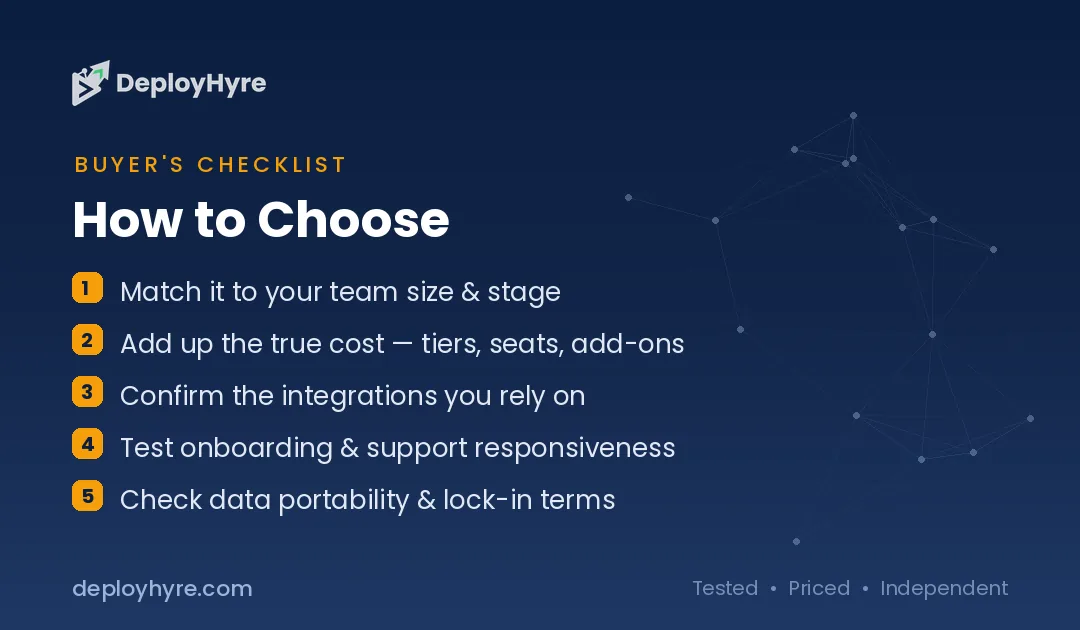
Identify your primary users and match the philosophy. Developer-led teams wanting flexibility point to Sanity (content as data) or Payload. Enterprise content operations needing governance point to Contentful. Marketing teams that want to edit visually point to Storyblok (content as design system). Engineering teams that want to self-host point to Strapi (content as code). The philosophy that matches your users is the best predictor of fit.
Then weigh managed versus self-hosted. SaaS platforms (Sanity, Contentful, Storyblok) handle infrastructure at usage- or tier-based cost; self-hosted options (Strapi, Payload) are free to license but carry real operational TCO, infrastructure, upgrades, backups, security. Match this to your engineering capacity and whether you want to own the stack or offload the operations.
Finally, factor in visual editing and multichannel needs. If non-technical marketers must edit content directly, Storyblok’s visual editor is a major advantage that pure developer CMSs lack. If you publish to many channels or want to feed AI assistants structured content, the API-first, headless architecture of any of these beats a traditional CMS, so weight the front-end freedom and multichannel reach that headless provides.
How We Evaluated These Platforms
We evaluated each platform on content modeling and API flexibility, editing experience (developer versus visual), governance and scale, self-hosting availability, and pricing. Figures come from vendor pages and comparison sources. Because each platform embodies a different content philosophy and pricing model, we present observed rates and stress matching the philosophy to your primary users. We accepted no payment for placement; rankings reflect fit for a stated use case.
The Bottom Line
Sanity is the best for developer flexibility and multilingual content, Contentful for enterprise content operations, Storyblok for visual editing by marketers, and Strapi (or Payload) for self-hosted open source. Each treats content differently, as data, enterprise software, a design system, or code, so match that philosophy to your primary users, and remember self-hosted “free” carries real operational cost. The API-first architecture of all of them beats a traditional CMS for multichannel and AI-fed content.
Frequently Asked Questions
How much does a headless CMS cost?
Pricing ranges from free to enterprise. Sanity and Contentful have free tiers (Contentful jumps to $300 a month for Team), Strapi is free self-hosted with Cloud from $29 a month, and Storyblok Growth starts at $99 a month for 5 users. Usage-based platforms scale with API calls, bandwidth, and users, and self-hosted options carry infrastructure and maintenance costs beyond the free license.
What is a headless CMS?
A headless CMS manages content but has no built-in front end, delivering content via API (REST or GraphQL) to any website, app, or device. This decouples content from presentation, so developers build the front end with any framework and the same content can feed multiple channels, unlike WordPress, which couples content management to a specific website.
Which headless CMS is best for marketing teams?
Storyblok is the strongest for marketing teams because it treats content as a design system with a visual editor that lets non-technical users see and edit content in context. Pure developer-oriented CMSs like Sanity are more abstract, so marketing-led teams that need to edit visually usually prefer Storyblok’s in-context editing.
Is a self-hosted headless CMS like Strapi really free?
The license is free, but the real total cost of ownership is not. When self-hosting Strapi or Payload, you run the infrastructure, handle upgrades, manage backups, and own the security posture, so the practical cost is closer to a managed CMS than the $0 license implies. Self-hosting suits teams with engineering capacity that value data ownership and want to avoid SaaS usage fees.
Is a headless CMS better for AI and multichannel content?
Yes, for both. Because a headless CMS delivers structured content via API, the same content can feed websites, apps, and increasingly AI assistants and search engines that consume structured data. This API-first, channel-agnostic architecture is better suited to multichannel publishing and AI consumption than a traditional CMS tied to a single website front end.
Related Articles

David Austin is a technology writer and software analyst at DeployHyre, where he covers AI tools, SaaS platforms, cloud hosting, and business automation. He focuses on hands-on comparisons of pricing, features, and real-world performance so teams can pick the right software with confidence.