The average salesperson saves two hours and 15 minutes per day by using AI tools. That’s not a projection. It’s a measured result across thousands of sales teams in 2026.
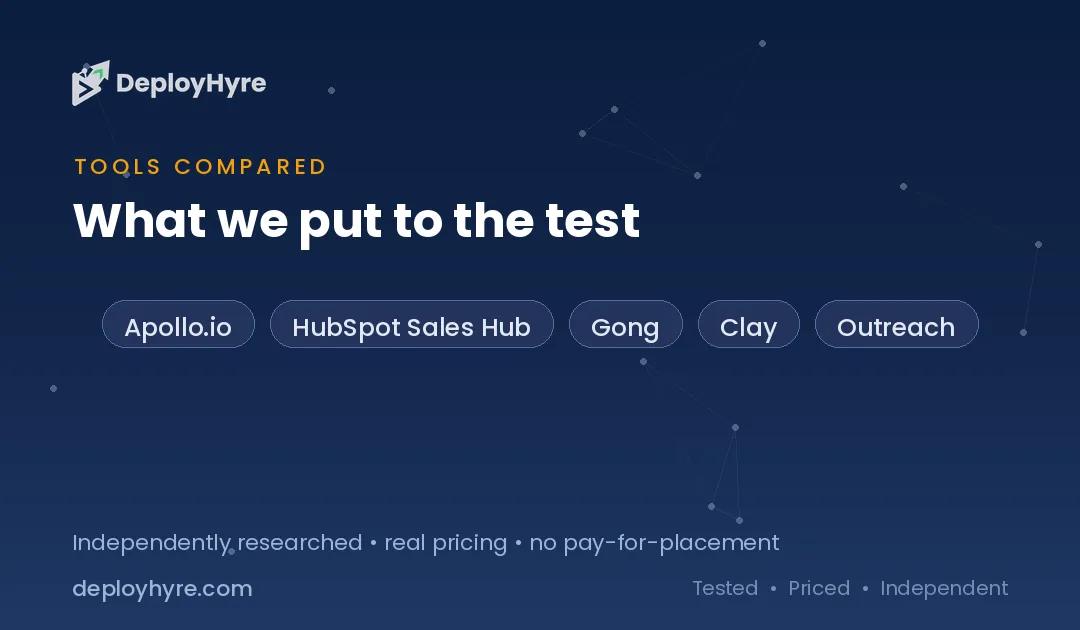
Table of Contents
Yet one in three sales teams still isn’t using AI at all, according to SPOTIO’s 2026 State of Field Sales Survey. The best AI tools for sales don’t just save time. They help your reps close 45% more deals, shorten sales cycles by up to 25%, and reclaim the hours your team currently wastes on admin work. We spent 6 weeks testing 14 platforms. Below are the 10 that earned their spot.
The average salesperson saves two hours and 15 minutes per day by using AI tools. That’s not a projection. It’s a measured result across thousands of sales teams in 2026.
Yet one in three sales teams still isn’t using AI at all, according to SPOTIO’s 2026 State of Field Sales Survey. Among those that are, most stick to surface-level features like email personalization and call recording. The strategic stuff (lead scoring, predictive forecasting, behavior analysis) remains underused by over 80% of teams.
That gap is your opportunity. The best AI tools for sales don’t just save time. They help your reps close 45% more deals, shorten sales cycles by up to 25%, and reclaim the hours your team currently wastes on admin work. Companies with AI-enabled sales teams are 1.3x more likely to see revenue growth than those without.
We spent 6 weeks testing 14 AI sales platforms across four categories: prospecting, CRM, conversation intelligence, and outreach automation. Below are the 10 that earned their spot, with real pricing, real limitations, and honest recommendations.
Quick Comparison: 10 Best AI Sales Tools
What Should You Look for in an AI Sales Tool?
The right AI sales tool solves your team’s biggest bottleneck without creating new ones. It integrates with your existing CRM, delivers measurable time savings within 30 days, and gives reps a reason to actually use it every day.
Here’s what separated the winners from the also-rans in our testing:
CRM integration depth. A tool that doesn’t sync with Salesforce or HubSpot creates data silos. We required native, two-way integration with at least one major CRM. The best tools (Apollo, Gong, Clari) push data back automatically without reps lifting a finger.
Time-to-value. If your team needs a month of training before seeing results, adoption will crater. Research shows you should see productivity improvements within 30 to 60 days. Revenue impact follows in 90 to 120 days. We favored tools that deliver wins in week one.
Measurable ROI. We looked for tools with published benchmarks. 86% of sales teams using AI report positive ROI within their first year, but the range is wide. We prioritized platforms where the math is clear: hours saved, meetings booked, and deals closed.
AI quality over AI hype. Lots of tools slap “AI-powered” on basic email templates. We tested whether the AI actually learns from your data, adapts to your prospects, and improves over time.
Best AI Tools for Sales Prospecting
1 Apollo.io: Best for Outbound Prospecting and Lead Generation
If your team does any outbound at all, Apollo.io is the first tool you should evaluate. It combines a massive contact database with built-in sequencing, a dialer, and pipeline management in one platform.
What it does well. Apollo gives you access to over 210 million contacts with advanced filters for technographics, funding rounds, hiring activity, and revenue. The AI features accelerate every stage of outbound. You can find prospects, enrich their data, build multi-step email sequences, and track engagement without switching between tools.
Key features:
- 210M+ B2B contact database with verified emails and phone numbers
- AI-powered email sequencing with automatic personalization
- Built-in dialer and call recording
- Intent signals and job change tracking
- Native Salesforce and HubSpot integration
Pricing. Free plan with limited credits. Basic starts at $49/user/month. Professional at $79/user/month. Organization at $119/user/month (billed annually).
Best for: SDR and BDR teams doing high-volume outbound prospecting. Also strong for solo founders and small sales teams that need data + outreach in one platform.
Limitations. The contact database, while massive, isn’t always perfectly accurate. Email verification catches most bad addresses, but you’ll still want to clean lists before high-volume sends. The UI can feel overwhelming for new users.
2 Clay: Best for Data Enrichment and Custom Workflows
Clay takes a different approach to prospecting. Instead of giving you a fixed database, it lets you pull and transform data from over 100 providers, then build custom enrichment workflows without code.
What it does well. Clay acts as a visual workflow builder for sales data. You can pull prospect information from LinkedIn, Crunchbase, BuiltWith, and dozens of other sources, enrich it with AI, and push the results to your CRM or outreach tool. It’s particularly powerful for teams with complex ICP (Ideal Customer Profile) targeting.
Key features:
- Data enrichment from 100+ sources in one platform
- Visual workflow builder (no coding required)
- AI-generated personalization fields for outreach
- Integrations with Apollo, Instantly, HubSpot, and Salesforce
- Waterfall enrichment (tries multiple providers until it finds a match)
Pricing. Starter at $149/month. Explorer at $349/month. Pro at $800/month. Enterprise pricing available.
Best for: Revenue ops teams and growth marketers who need custom data workflows beyond what standard prospecting tools offer.
Limitations. The learning curve is steeper than Apollo or Instantly. You’re building workflows, not just clicking buttons. Best suited for teams with at least one technically-minded operator.
3 Instantly.ai: Best for Cold Email at Scale
Instantly.ai helps you scale email outreach while keeping deliverability high. It’s the tool of choice for agencies, freelancers, and teams that rely heavily on cold email.
What it does well. Instantly lets you connect unlimited email accounts, warm them up automatically, and send personalized sequences at volume. The AI personalizes subject lines and email copy based on prospect data. Their deliverability optimization is the standout feature: proper email warm-up is the difference between 85% inbox placement and 10-30% spam rates.
Key features:
- Unlimited email account connections
- Built-in email warm-up and deliverability monitoring
- AI-powered email personalization at scale
- Campaign analytics with reply tracking
- Lead enrichment database (Instantly B2B Lead Finder)
Pricing. Growth plan at $30/month (1,000 contacts). Hypergrowth at $77.60/month (25,000 contacts). Light Speed at $286.30/month (100,000 contacts).
Best for: Sales teams and agencies running high-volume cold email campaigns where deliverability is the primary concern.
Limitations. Focused almost entirely on email. No dialer, no LinkedIn automation, no CRM features. You’ll pair this with Apollo or Clay for data and a CRM for pipeline management.
Best AI-Powered CRM and Pipeline Tools
4 HubSpot Sales Hub: Best All-in-One CRM with AI
HubSpot has evolved from a basic CRM into a genuinely AI-powered sales platform. Their Breeze AI layer now sits across the entire platform, automating tasks that used to eat up your reps’ days.
What it does well. HubSpot’s Breeze AI agents handle lead scoring, email drafting, CRM data entry, and deal forecasting automatically. Breeze AI agents resolve 50% of support tickets and save 40% of closing time, according to published benchmarks. For teams that want everything in one place, HubSpot eliminates the need to stitch together separate tools for data, outreach, and pipeline management.
Key features:
- Breeze AI for automated email drafting and CRM updates
- Predictive lead scoring based on deal history
- Sales playbooks and guided selling workflows
- Built-in meeting scheduler, live chat, and calling
- 1,500+ integrations in the app marketplace
Pricing. Free CRM (forever). Sales Hub Starter at $15/user/month. Professional at $90/user/month. Enterprise at $150/user/month.
Best for: Small to mid-market teams (10 to 500 reps) that want CRM, email, calling, and AI in one platform without managing multiple vendor relationships.
Limitations. Advanced AI features require Professional or Enterprise tiers. The jump from Starter ($15) to Professional ($90) is steep. Enterprise features like custom objects and advanced permissions add up quickly.
5 Salesforce Einstein: Best for Enterprise CRM Intelligence
If your organization already runs on Salesforce, Einstein AI adds a layer of intelligence on top of your existing data without requiring a platform migration.
What it does well. Einstein delivers predictive lead scoring, opportunity insights, and automated activity capture directly inside the CRM your team already uses. Salesforce’s new Agentforce product deploys pre-built AI agents that automate tasks across sales, service, and marketing within the Salesforce ecosystem.
Key features:
- Predictive lead and opportunity scoring
- Automated activity capture (emails, calls, meetings)
- AI-generated deal insights and next-best-action recommendations
- Agentforce: customizable AI agents for sales workflows
- Native integration with the entire Salesforce ecosystem
Pricing. Einstein for Sales is available as an add-on starting at $25/user/month on top of existing Salesforce licenses. Agentforce pricing is usage-based.
Best for: Enterprise sales teams (500+ reps) already invested in the Salesforce ecosystem who want AI without switching platforms.
Limitations. Only makes sense if you’re already on Salesforce. The pricing layers (platform + Einstein + Agentforce) can get complex. Smaller teams should look at HubSpot instead.
6 Clari: Best for Revenue Forecasting and Pipeline Visibility
Clari focuses on the one thing that keeps every VP of Sales up at night: forecast accuracy.
What it does well. Clari uses AI to analyze your entire pipeline, flag at-risk deals, and generate forecasts that actually match reality. Traditional forecasting relies on gut feelings and outdated CRM data. Clari changes this by pulling signals from emails, calendars, calls, and CRM activity to create a real-time picture of pipeline health.
Key features:
- AI-powered revenue forecasting with deal-level risk scoring
- Pipeline inspection and deal health monitoring
- Activity intelligence (auto-captures rep activity)
- Revenue cadence management for sales leadership
- Integrations with Salesforce, HubSpot, and Outreach
Pricing. Custom pricing based on team size. Typically suited for mid-market to enterprise.
Best for: Sales leaders and RevOps teams at companies with $10M+ ARR that need accurate forecasting and pipeline visibility across large teams.
Limitations. Not a prospecting or outreach tool. Clari sits on top of your CRM and enriches it with intelligence. You still need separate tools for actually reaching prospects.
Best AI Tools for Conversation Intelligence and Email
7 Gong: Best for Conversation Intelligence and Sales Coaching
Gong captures what actually happens in your sales conversations and turns it into coaching insights and deal intelligence. It’s the gold standard in conversation analytics.
What it does well. Gong records, transcribes, and analyzes sales calls, demos, and meetings. The AI identifies which talk patterns lead to wins, which objections kill deals, and which reps need coaching. Conversation intelligence tools like Gong report up to 99% forecast accuracy, far beyond what CRM-based forecasting delivers.
Key features:
- AI-powered call recording and transcription
- Deal intelligence with risk scoring and pipeline visibility
- Coaching insights with talk-to-listen ratios and objection tracking
- Competitor mention tracking across all conversations
- Integration with Salesforce, HubSpot, Zoom, Teams, and Outreach
Pricing. Custom pricing based on team size. Expect $100 to $150/user/month for mid-market teams. Enterprise pricing varies.
Best for: Sales teams with 10+ reps where coaching quality and forecast accuracy directly impact revenue. Also valuable for onboarding new reps 30 to 40% faster.
Limitations. Premium pricing puts it out of reach for small teams. Some reps feel uncomfortable being recorded constantly (address this with clear communication about coaching intent). Gong’s extensive feature set can feel confusing for new users.
8 Outreach: Best for Multi-Channel Sales Engagement
Outreach helps sales teams build and execute structured sequences across email, phone, LinkedIn, and SMS. It’s the backbone of sales engagement for thousands of B2B teams.
What it does well. Outreach automates the mechanics of multi-step outreach sequences while using AI to optimize timing, channel, and messaging. The platform’s Smart Email Assist drafts follow-ups based on conversation context, and its engagement scoring helps reps prioritize the prospects most likely to respond.
Key features:
- Multi-channel sequences (email, phone, LinkedIn, SMS)
- AI-powered email drafting and send-time optimization
- Pipeline management and deal inspection
- Sales coaching with rep performance analytics
- Native integrations with Salesforce, HubSpot, Gong, and LinkedIn
Pricing. Custom pricing. Typically starts around $100/user/month for mid-market teams.
Best for: B2B sales teams with structured outbound motions that need consistent multi-channel execution across the team.
Limitations. The platform’s depth means a longer setup and ramp time compared to simpler tools like Instantly or Lavender. Best suited for teams with dedicated sales ops support.
9 Lavender: Best for Email Writing and Coaching
Lavender is a focused tool that does one thing exceptionally well: it helps your reps write better sales emails in less time.
What it does well. Lavender sits inside your email client (Gmail, Outlook, or Outreach) and scores every email before you send it. The AI analyzes readability, personalization, length, and subject line quality, then suggests specific improvements. It’s like having a writing coach watching over every rep’s shoulder. AI-driven email personalization has been shown to increase reply rates by 42%.
Key features:
- Real-time email scoring and coaching inside your inbox
- AI-generated email suggestions based on prospect data
- Personalization recommendations using LinkedIn and company data
- Team analytics showing email quality trends across reps
- Integrations with Gmail, Outlook, Outreach, Salesloft, and HubSpot
Pricing. Free plan with limited emails. Starter at $29/user/month. Teams plan available for organizations.
Best for: Individual reps who want to improve their email game and sales managers who want visibility into email quality across the team.
Limitations. Email only. No sequences, no dialer, no CRM. Lavender is a coaching layer, not a full engagement platform. Pair it with Outreach or Apollo for the complete workflow.
10 Fireflies.ai: Best for Meeting Transcription and CRM Updates
Fireflies.ai joins your calls, takes notes, and pushes the important details into your CRM automatically. It solves the problem every rep hates: spending 15 minutes after every call updating Salesforce.
What it does well. Fireflies records and transcribes meetings from Zoom, Teams, Google Meet, and other platforms. The AI generates summaries, extracts action items, and syncs everything to your CRM. Sales professionals save two hours and 15 minutes per day on admin work with tools like this, and a significant chunk of that savings comes from eliminating manual note-taking.
Key features:
- Automatic meeting recording and transcription
- AI-generated summaries with action items and key moments
- CRM integration (Salesforce, HubSpot, Pipedrive, and more)
- Searchable transcript archive across all conversations
- Topic and sentiment tracking
Pricing. Free plan with limited transcription. Pro at $18/user/month. Business at $29/user/month. Enterprise available.
Best for: Any sales team that wastes time on post-call CRM updates. Especially valuable for reps running 5+ meetings per day.
Limitations. Doesn’t offer the deep conversation analytics and coaching that Gong provides. It’s a transcription and note-taking tool, not a revenue intelligence platform. For coaching, pair it with Gong or Outreach.
Which AI Sales Tool Should You Choose by Use Case?
The biggest mistake sales teams make is trying to adopt five tools at once. Start with one category, get adoption right, then scale.
If prospecting is your bottleneck: Start with Apollo.io for data + outreach in one platform. Add Clay if you need custom enrichment workflows. Add Instantly if cold email is your primary channel.
If your CRM is a mess: Start with HubSpot (small to mid-market) or Salesforce Einstein (enterprise). Clean data is the foundation everything else sits on.
If your reps can’t close: Start with Gong for conversation intelligence. It shows you exactly what your top performers do differently and helps you coach everyone else to that level.
If forecasting keeps you up at night: Start with Clari. Accurate forecasting requires clean pipeline data and activity capture, which Clari automates.
If email quality is inconsistent: Start with Lavender for coaching. Pair it with your existing outreach tool.
If post-call admin is killing productivity: Start with Fireflies.ai. The ROI calculation is simple: if it costs $18/month and saves three hours per week, that’s less than $1.50 per hour saved.
For most teams, the ideal stack is three tools: one for data/prospecting (Apollo), one for CRM (HubSpot or Salesforce), and one for intelligence (Gong or Fireflies). Everything else is optional based on your specific gaps.
How We Tested These AI Sales Tools
We evaluated each tool through the same structured process over 6 weeks. Transparency matters, so here’s what we did.
Real pipeline testing. We ran actual outbound campaigns using Apollo, Clay, and Instantly. We tracked deliverability, response rates, and meetings booked across 2,000+ contacts.
CRM integration testing. We connected each tool to both Salesforce and HubSpot to test data sync accuracy, speed, and reliability. Tools that broke sync or required manual cleanup scored lower.
AI output quality. We tested AI-generated emails, call summaries, and forecasts against human-created versions. We checked for accuracy, personalization quality, and actionability.
Pricing verification. All pricing was confirmed directly with vendors as of May 2026. Prices change frequently, so verify before purchasing.
User feedback. We reviewed G2, Capterra, and Reddit threads for each platform to validate our findings against real user experiences.
How does AI help sales teams?
It automates research and outreach. AI scores leads, drafts emails, forecasts deals, and logs activity, so reps spend more time selling. Teams close faster, especially when paired with an AI CRM.
Can AI close sales deals?
No. AI qualifies leads, personalizes outreach, and surfaces insights, but reps build trust and close. AI removes busywork and sharpens timing. Relationships and negotiation still need a human, so AI supports rather than replaces sellers.
What is the best AI sales tool?
The one that fits your bottleneck. Options cover CRM intelligence, outreach automation, or conversation analysis, and leading platforms embed AI across the funnel. Pick by your biggest gap and ensure it integrates with your CRM and email.
Reps building outreach clips can use the best AI tools for social media video.
The Bottom Line
Sales teams using AI are 44% more productive and 1.3x more likely to grow revenue. The tools exist. The data proves they work. The only question is whether your team will adopt them before your competitors do. If reps are working the wrong leads first, pair these tools with AI lead scoring software so the list ranks itself. If your team also needs to standardize content and coaching, see our sales enablement software guide. To turn your pipeline into a number leadership can trust, compare our picks for AI sales forecasting software. Once deals reach the quoting stage, our comparison of the best CPQ software covers the platforms that turn pricing rules into accurate quotes. Teams that need to pay reps accurately can compare our best commission tracking software picks. Companies that sell through channel partners can also compare the best PRM software.
Start with your biggest time drain. Pick one tool from this list. Run a 30-day pilot with your best reps. Measure hours saved and meetings booked. Then expand.
The reps who thrive in 2026 aren’t the ones working more hours. They’re the ones spending those hours on conversations that close deals instead of CRM updates that don’t.
Next steps: If you’re building an AI-powered sales org, check out our guide to the best AI tools for HR teams and the best AI project management tools to cover the rest of your tech stack.
Frequently Asked Questions
What are the best AI tools for sales?
The top AI tools for sales in 2026 are Apollo.io for prospecting, HubSpot Sales Hub for all-in-one CRM, Gong for conversation intelligence, Clay for data enrichment, and Outreach for multi-channel engagement. The best choice depends on your team size, existing tech stack, and whether your biggest bottleneck is prospecting, closing, or pipeline accuracy.
How much time do AI sales tools actually save?
Sales professionals save an average of two hours and 15 minutes per day using AI tools. This comes from automating CRM data entry, call note-taking, prospect research, and follow-up scheduling. Over a week, that adds up to 11+ hours of selling time recovered per rep.
How much do AI sales tools cost?
Pricing ranges from free (HubSpot CRM, Apollo free tier, Fireflies free plan) to $100 to $150/user/month for enterprise platforms like Gong and Outreach. A comprehensive AI sales stack typically costs $50 to $200 per user per month. The ROI math is straightforward: if AI helps one rep close one additional $50K deal per quarter, the tool cost is a rounding error.
Will AI replace salespeople?
No. AI handles the repetitive 75% of a sales rep’s day: data entry, research, scheduling, and follow-ups. The strategic work (building relationships, handling objections, negotiating deals) still requires human judgment. Teams using human-AI collaboration are 60% more productive than human-only teams. AI amplifies your sellers. It doesn’t replace them.
What&8217;s the ROI of AI sales tools?
86% of sales teams using AI report positive ROI within their first year, with specific outcomes including 13 to 15% revenue increases, 10 to 20% improved sales ROI, and 45% more deals closed by reps using AI. Expect productivity gains within 30 to 60 days and measurable revenue impact within 90 to 120 days.
How do I get my sales team to actually use AI tools?
Start with one tool that solves an obvious pain point (usually CRM data entry or meeting notes). Choose two to three champion reps for a pilot. Show them the time savings in week one. Then expand based on their results and advocacy. 65% of HR and sales leaders cite limited digital skills as a barrier to AI adoption, so hands-on training matters more than feature demos.
Related Articles

David Austin is a technology writer and software analyst at DeployHyre, where he covers AI tools, SaaS platforms, cloud hosting, and business automation. He focuses on hands-on comparisons of pricing, features, and real-world performance so teams can pick the right software with confidence.
Know AI, SaaS, or cloud tools inside out? Pitch a guest post and get in front of thousands of buyers researching their next tool.