Phone support, booking, and outbound calls now run on AI that talks like a person. The global voice AI agents market is set to reach $47.5 billion by 2034, up from $2.4 billion in 2024, a 34.8 percent yearly growth rate. By 2026, 80 percent of businesses plan to use AI-driven voice in customer service.
Table of Contents
For the full picture, see our complete guide to AI agents and automation.
The problem is platform choice. Dozens of tools promise human-like calls, yet they split into clear camps. Some are no-code builders. Some are developer APIs. Some are enterprise contact-center suites. Picking the wrong camp wastes weeks of setup and burns call minutes.
We tested 9 of the best AI voice agents in 2026 against voice quality, latency, integrations, and price. For company-wide context, see our guide to AI for business, and for the broader category read about the best AI agents.
What Is an AI Voice Agent?
An AI voice agent is software that holds spoken phone conversations on its own, using speech recognition, a language model, and voice synthesis. It answers calls, asks and answers questions, books appointments, qualifies leads, and transfers to humans when needed, all in real time and at scale.
A voice agent chains three parts: speech-to-text, an LLM that decides what to say, and text-to-speech that speaks the reply. The best platforms tune latency so replies feel instant. Companies using AI customer service tools report a 20 to 30 percent drop in operational costs, which is why adoption is climbing fast.
Quick Comparison: 9 Best AI Voice Agents in 2026
| Platform | Best For | Starting Price | Type |
|---|---|---|---|
| Synthflow | No-code teams | $29/mo | No-code builder |
| Voiceflow | Designing agent flows | Free / paid | Design platform |
| Vapi | Developers building pipelines | $0.05/min | Developer API |
| Retell AI | Production call automation | From $0.07/min | Developer API |
| Bland AI | Outbound campaigns | $0.09/min | Outbound API |
| ElevenLabs Agents | Best voice quality | ~$0.08/min | Voice-first agent |
| PolyAI | Enterprise customer service | Custom | Enterprise CX |
| Sierra | Enterprise branded agents | Custom | Enterprise CX |
| Lindy | Voice plus workflow automation | From ~$49/mo | All-in-one agent |
What Makes a Great AI Voice Agent?
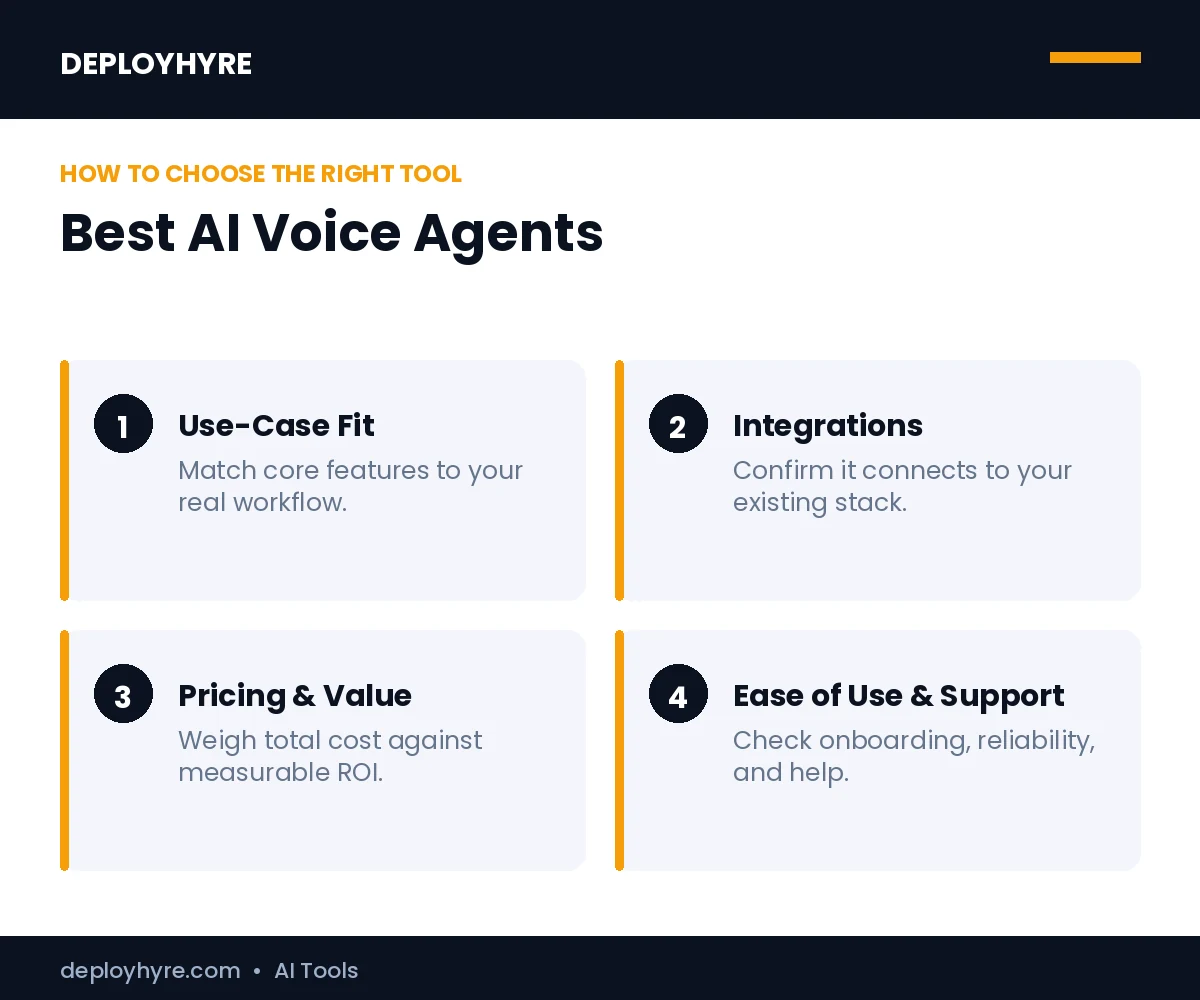
A great AI voice agent sounds natural, replies with low latency, and handles real tasks like booking and transfers without dropping context. The best platforms tune turn-taking so callers do not talk over the bot, integrate with your phone system and CRM, and price predictably per minute.
We weighed five things: voice realism, latency and turn-taking, integrations, build experience, and pricing clarity. Latency decides whether a call feels human. Most platforms cluster between $0.07 and $0.20 per minute before LLM costs, so fit and reliability matter more than the headline rate.
Best No-Code Voice Agent Platforms
1. Synthflow: Best for No-Code Teams
Synthflow lets non-technical teams build and launch voice agents without writing code.
What it does well. Synthflow offers a visual drag-and-drop builder, natural voices, and native actions for booking and transfers. It covers inbound and outbound evenly, with a strong balance of realism and latency.
Key features:
- Visual no-code agent builder
- Inbound and outbound calling
- CRM and calendar integrations
- Predictable minute bundles
Pricing. Synthflow runs from $29 per month for 50 minutes to $1,400 per month for 6,000 minutes, with overages near $0.12 to $0.13 per minute.
Best for: Small and mid-size teams that want to launch fast without engineers.
Limitations. Heavy custom logic still favors a developer API.
2. Voiceflow: Best for Designing Agent Flows
Voiceflow is the design platform for teams that map conversations before they ship.
What it does well. Voiceflow gives a collaborative canvas to design, test, and version voice and chat flows, then deploy across channels. Product and design teams work alongside engineers in one workspace.
Key features:
- Collaborative flow design canvas
- Voice and chat in one project
- Versioning and testing tools
- API and channel deployment
Pricing. Voiceflow offers a free tier, with paid plans for teams that need more seats and runs.
Best for: Teams that prototype and govern conversation design carefully.
Limitations. Telephony and scale rely on connected providers.
Best Developer-First Voice Platforms
3. Vapi: Best for Developers Building Custom Pipelines
Vapi is the strongest developer-first pick for full control over the voice stack.
What it does well. Vapi exposes every knob behind a clean API: model choice across GPT, Claude, and Gemini, voice provider, telephony, and latency tuning. Engineers assemble exactly the pipeline they want.
Key features:
- Model and voice provider choice
- Telephony and latency tuning
- Clean, flexible API
- Custom pipeline orchestration
Best for: Developers building bespoke voice products.
Limitations. You assemble and maintain the stack yourself.
4. Retell AI: Best for Production Call Automation
Retell AI is the best all-around platform for teams putting voice agents into production.
What it does well. Retell AI leads on turn-taking quality for fast conversations, and its call transfer passes full context to the human agent, so callers never repeat themselves. It balances developer control with production reliability.
Key features:
- Strong turn-taking and low latency
- Context-aware human handoff
- Inbound and outbound automation
- Monitoring and analytics
Best for: Teams automating real call volume with some technical capability.
Limitations. Full cost depends on the LLM and telephony you add.
Best for Outbound Calling
5. Bland AI: Best for Outbound Campaigns
Bland AI focuses on developer-controlled outbound calling at scale.
What it does well. Bland AI runs high-volume outbound campaigns with voice cloning, multilingual support, and concurrency controls. It suits sales and reminder workflows that dial out in bulk.
Key features:
- High-concurrency outbound calling
- Voice cloning options
- Multilingual support
- Usage-based scaling
Pricing. Bland AI charges $0.09 per minute for connected calls, with add-ons for advanced features.
Best for: Sales and operations teams running outbound at volume.
Limitations. Setup and tuning assume developer time. Outbound calling must follow consent and dialing laws.
Best Voice Quality
6. ElevenLabs Agents: Best for Natural-Sounding Calls
ElevenLabs offers the best raw voice generation for branded, lifelike calls.
What it does well. ElevenLabs grew from a text-to-speech leader into a full agent platform with Conversational AI 2.0, adding natural turn-taking, batch calling, automatic language detection, and HIPAA compliance.
Key features:
- Best-in-class voice realism
- Natural turn-taking and batch calls
- Automatic language detection
- HIPAA-compliant option
Best for: Brands where voice quality is the deciding factor.
Limitations. LLM costs are billed on top of the per-minute rate.
Best Enterprise Customer Service Voice Agents
7. PolyAI: Best for Enterprise Phone Support
PolyAI builds enterprise voice assistants that handle complex customer service calls.
What it does well. PolyAI deploys resolution-focused voice agents for large contact centers, understanding natural speech across accents and resolving multi-step requests without menus. It is built for regulated, high-volume support.
Key features:
- Resolution-focused call handling
- Robust accent and speech understanding
- Contact-center and CRM integrations
- Enterprise security and compliance
Pricing. Custom enterprise pricing, quote-based.
Best for: Enterprises replacing IVR menus in the contact center.
Limitations. Cost and deployment are heavy for small teams.
8. Sierra: Best for Enterprise Branded Agents
Sierra creates branded conversational agents for large consumer businesses.
What it does well. Sierra builds voice and chat agents that follow brand voice and company policy, taking real actions like order changes and account updates. It targets enterprises that want agents on-brand and accountable.
Key features:
- Brand-aligned voice and tone
- Action-taking across systems
- Policy and guardrail controls
- Enterprise analytics
Pricing. Custom enterprise pricing, quote-based.
Best for: Large consumer brands scaling support and service.
Limitations. Built for enterprise scope, not small operations.
Best All-in-One AI Agent
9. Lindy: Best for Voice Plus Workflow Automation
Lindy pairs voice agents with broader no-code workflow automation.
What it does well. Lindy builds AI agents that answer calls and also run follow-up tasks across email, calendars, and CRMs. One platform handles the conversation and the work that follows it.
Key features:
- Voice agents plus task automation
- No-code agent builder
- CRM, email, and calendar actions
- Multi-step workflow triggers
Pricing. Lindy offers a free tier, with paid plans from roughly $49 per month.
Best for: Teams that want calls and downstream workflows in one tool.
Limitations. Pure call-center depth favors a specialist platform.
How Should You Choose an AI Voice Agent?
Start with your team and use case. Choose Synthflow or Lindy for no-code speed, Vapi or Retell AI for developer control, Bland AI for outbound campaigns, ElevenLabs for top voice quality, and PolyAI or Sierra for enterprise customer service. The right platform depends on whether you need a builder, an API, or a managed enterprise agent.
Next, test latency and integrations. Run a pilot call flow, check how natural turn-taking feels, and confirm the tool connects to your phone system and CRM. Budget $0.15 to $0.35 per minute all-in for a production agent, then scale once quality holds. Align voice with revenue using the best AI tools for sales.
How We Evaluated These AI Voice Agents
We assessed each platform on five criteria: voice realism, latency and turn-taking, integrations, build experience, and pricing transparency. We cross-checked capabilities and current rates against vendor pages and independent 2026 tests, then grouped tools by who should use them. Voice pricing shifts with LLM and telephony choices, so confirm full per-minute cost before you commit.
What is an AI voice agent?
Software that talks on the phone. An AI voice agent answers and makes calls using natural speech, understands intent, and completes tasks like booking or support. Businesses use it to handle calls without staffing every line.
How natural do AI voice agents sound in 2026?
Very natural. Modern voice agents use lifelike speech with proper pacing and tone, and many callers cannot tell quickly. Background handling and interruptions still trip some systems. Test a live demo to judge quality for your use case.
What industries use AI voice agents most?
Service businesses lead adoption. Real estate, healthcare scheduling, customer support, and sales gain the most. Any business with high call volume or after-hours demand benefits. See how an AI voice agent for real estate captures missed calls.
Need a support-specific build? See the AI voice agent for customer service options.
The Bottom Line
AI voice agents have moved from novelty to infrastructure. The market is growing at nearly 35 percent a year toward $47.5 billion by 2034, and the winners pick a platform that fits their team, not the loudest demo.
Match the tool to your build style and scale. No-code teams should start with Synthflow, developers with Vapi or Retell AI, and enterprises with PolyAI or Sierra. Pilot one call flow, measure resolution and cost per call, and expand once the numbers prove out.
Next steps: Explore the wider category in our best AI agents guide, see who is building them in top agentic AI companies, and connect AI to company strategy with AI for business.
Frequently Asked Questions
What is the best AI voice agent in 2026?
There is no single best platform; it depends on your needs. Synthflow leads for no-code teams, Retell AI for production call automation, Vapi for developers, ElevenLabs for voice quality, and PolyAI or Sierra for enterprise customer service. Match the tool to whether you want a builder, an API, or a managed enterprise agent.
How much do AI voice agents cost?
AI voice agents usually bill per minute. Platform fees run about $0.07 to $0.20 per minute before LLM and telephony costs, so a production agent lands near $0.15 to $0.35 per minute all-in. No-code tools like Synthflow start at $29 per month, while enterprise platforms like PolyAI and Sierra use custom pricing.
Can AI voice agents replace call center staff?
AI voice agents handle routine calls like booking, FAQs, and qualification, which cuts operational costs by 20 to 30 percent. They do not replace staff for complex or sensitive cases. The best setups resolve common calls automatically and transfer harder ones to humans with full context.
What is the difference between a no-code and developer voice platform?
A no-code platform like Synthflow lets teams build agents in a visual editor without engineers. A developer platform like Vapi or Retell AI exposes an API for custom model, voice, and telephony choices. No-code wins on speed, while developer APIs win on control and bespoke logic.
Are AI voice agents legal for outbound calls?
AI voice agents are legal for outbound calls when they follow consent, disclosure, and dialing rules in each region. Laws vary, so confirm requirements like prior consent and bot identification before launching campaigns. Tools like Bland AI scale outbound, but compliance remains your responsibility.

David Austin is a technology writer and software analyst at DeployHyre, where he covers AI tools, SaaS platforms, cloud hosting, and business automation. He focuses on hands-on comparisons of pricing, features, and real-world performance so teams can pick the right software with confidence.