Customer service is the first place AI voice is paying off. AI resolutions average $0.62 against $7.40 for a human agent, with voice AI landing near $1.18 per contact. Gartner projects conversational AI will cut contact center labor costs by $80 billion in 2026.
Table of Contents
For the full picture, see our complete guide to AI agents and automation.
The hard part is platform choice. Some tools sell a finished support agent that plugs into your helpdesk. Others sell the voice infrastructure your engineers build on. Pick the wrong layer and you either overpay for features you cannot change or rebuild work a vendor already solved.
We evaluated 9 of the best AI voice agents for customer service in 2026 against resolution quality, helpdesk integration, latency, and pricing model. For the wider category, see our guide to the best AI voice agents, and for company-wide strategy read AI for business.
What Is an AI Voice Agent for Customer Service?
An AI voice agent for customer service is software that answers support calls on its own, using speech recognition, a language model, and voice synthesis. It resolves routine tickets like order status, billing, and password resets, then transfers complex calls to a human agent with full context.
The agent connects to your helpdesk and phone system, reads customer data, and takes real actions like issuing refunds or updating accounts. Companies using AI customer service tools report a 20 to 30 percent drop in operational costs, because the bot clears tier-one volume that once tied up staff.
Quick Comparison: 9 Best AI Voice Agents for Customer Service in 2026
| Platform | Best For | Starting Price | Type |
|---|---|---|---|
| Sierra | Enterprise branded support | Custom | Enterprise CX agent |
| Decagon | Zendesk/Intercom teams | Outcome-based | Enterprise CX agent |
| PolyAI | Large contact centers | Custom | Enterprise CX agent |
| Ada | Automation-first support | Custom | Enterprise CX agent |
| Fin (Intercom) | Pay-per-resolution support | $0.99/resolution | Resolution-priced agent |
| Retell AI | Custom support agents | From $0.07/min | Developer platform |
| Vapi | Developer-built pipelines | $0.05/min | Developer platform |
| Telnyx Voice AI | All-in voice infrastructure | $0.05/min | Infrastructure |
| Synthflow | No-code support teams | $29/mo | No-code builder |
What Makes a Great AI Voice Agent for Customer Service?
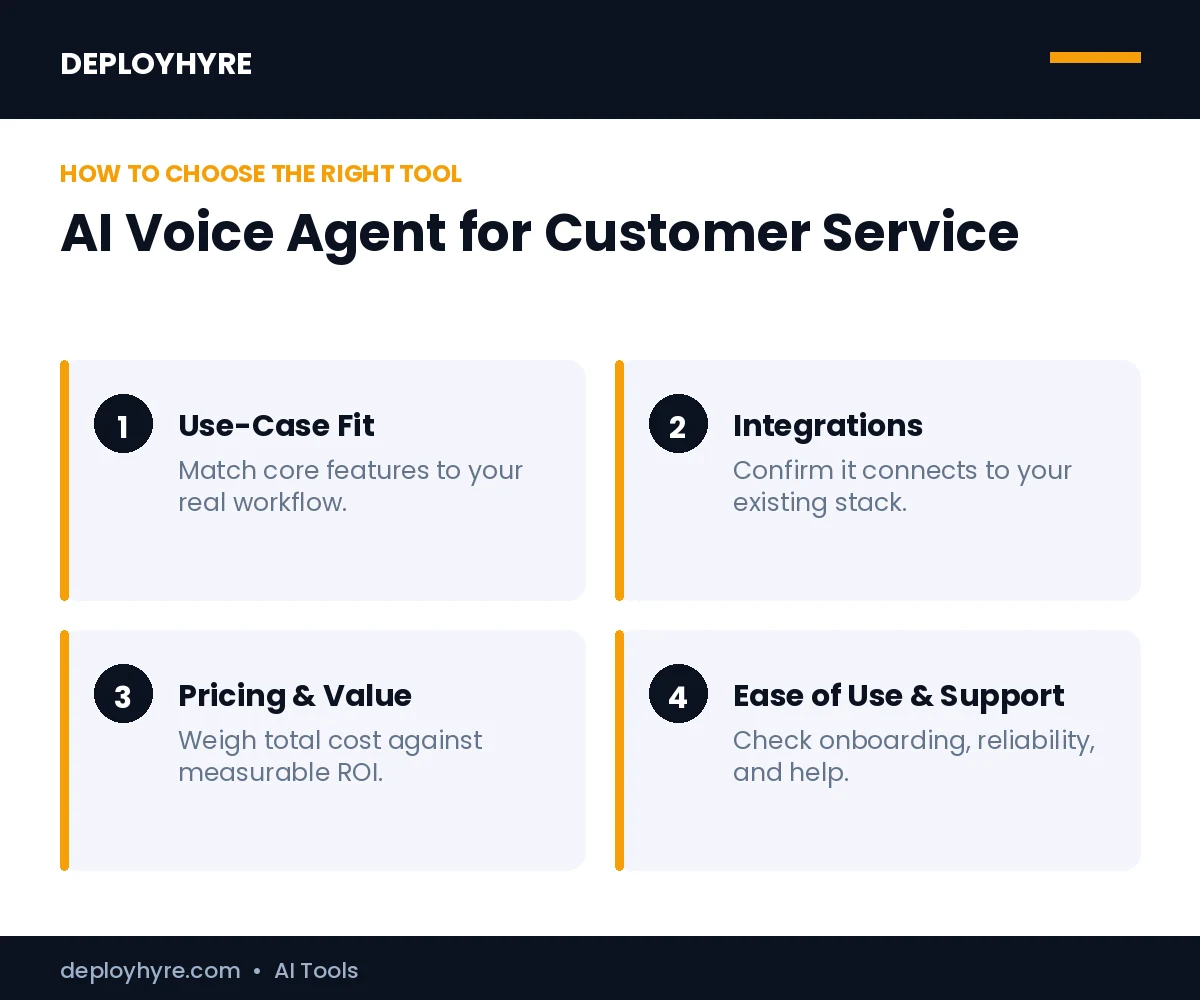
A great customer service voice agent resolves common calls end to end, reads and writes to your helpdesk, and hands off hard cases to humans without losing context. It sounds natural, replies with low latency, and prices in a way that ties cost to outcomes rather than raw minutes.
We weighed five things: resolution rate, helpdesk and CRM integration, latency and turn-taking, escalation quality, and pricing transparency. Resolution rate decides ROI. Median tier-1 deflection sits at 41.2 percent across enterprise programs, with the top quartile reaching 58.7 percent, so containment, not voice realism alone, separates the winners.
Best Enterprise Customer Service Agents
1. Sierra: Best for Enterprise Branded Support
Sierra builds branded conversational agents for large consumer companies that protect brand voice.
What it does well. Sierra creates voice and chat agents that follow brand tone and company policy, then take real actions like order changes and account updates. It targets enterprises that want support agents on-brand and accountable.
Key features:
- Brand-aligned voice and tone
- Action-taking across systems
- Policy and guardrail controls
- Enterprise analytics and QA
Pricing. Sierra uses custom enterprise quotes, typically six-figure annual contracts.
Best for: Large consumer brands scaling support without diluting tone.
Limitations. Built for enterprise scope, not small teams.
2. Decagon: Best for Zendesk and Intercom Teams
Decagon resolves tier-one tickets end to end for support organizations already on a major helpdesk.
What it does well. Decagon plugs into Zendesk, Intercom, and Freshdesk, then resolves routine tickets across voice and chat with outcome-based pricing. Support leaders keep their existing stack and add autonomous resolution on top.
Key features:
- Deep helpdesk integration
- Tier-one ticket resolution
- Voice and chat coverage
- Outcome-based pricing
Pricing. Decagon prices on resolved outcomes under a custom enterprise contract.
Best for: Teams on Zendesk, Intercom, or Freshdesk that want AI to close tickets.
Limitations. Value depends on clean helpdesk data and processes.
3. PolyAI: Best for Large Contact Centers
PolyAI runs natural voice agents for enterprise contact centers where calls go off-script.
What it does well. PolyAI handles open-ended conversations without breaking, staying natural when callers wander from the menu. It suits high-volume centers that need consistent voice resolution across many call types.
Key features:
- Robust off-script handling
- High-volume call automation
- Telephony and CRM integration
- Enterprise reporting
Pricing. PolyAI uses custom enterprise pricing, usually starting at six-figure annual contracts.
Best for: Large contact centers automating complex, varied call flows.
Limitations. Overkill for small support teams.
4. Ada: Best for Automation-First Support
Ada centers its platform on automated resolution across voice, chat, and email.
What it does well. Ada lets support teams build and measure an automation rate target, then route everything else to humans. It frames success around the share of conversations resolved without an agent.
Key features:
- Automation-rate measurement
- Voice, chat, and email channels
- No-code resolution building
- Helpdesk and CRM connectors
Pricing. Custom, tied to automated resolution volume.
Best for: Support orgs that manage to an automation-rate goal.
Limitations. Pricing transparency requires a sales conversation.
Best Pay-Per-Resolution Agent
5. Fin by Intercom: Best for Outcome Pricing
Fin charges only when it resolves a customer issue, aligning cost with results.
What it does well. Fin resolves support questions across voice and chat and bills per resolution, so spend tracks value, not call minutes. It pulls from your help content and Intercom data to answer accurately.
Key features:
- Pay-per-resolution billing
- Voice and chat resolution
- Native Intercom integration
- Knowledge-grounded answers
Pricing. Fin charges $0.99 per resolution.
Best for: Teams that want spend tied directly to resolved tickets.
Limitations. Resolution-based cost climbs with high resolved volume.
Best Developer Platforms for Custom Support Agents
6. Retell AI: Best for Custom Support Agents
Retell AI gives teams full control to build production-grade support voice agents.
What it does well. Retell AI leads on turn-taking quality and passes full context on human handoff, so callers never repeat themselves. It balances developer control with production reliability for support call flows.
Key features:
- Strong turn-taking and low latency
- Context-aware human handoff
- Model, prompt, and infrastructure control
- Monitoring and analytics
Best for: Developer teams building bespoke support agents.
Limitations. You assemble and maintain the stack yourself.
7. Vapi: Best for Developer-Built Pipelines
Vapi exposes every part of the voice stack behind a clean API.
What it does well. Vapi lets engineers choose the model, voice provider, and telephony, then tune latency for support conversations. It suits teams that want a custom pipeline rather than a packaged agent.
Key features:
- Model and voice provider choice
- Telephony and latency tuning
- Flexible orchestration API
- Usage-based billing
Pricing. Vapi charges $0.05 per minute for orchestration, before model and telephony costs.
Best for: Engineering teams building support agents from parts.
Limitations. No packaged helpdesk logic out of the box.
Best Voice Infrastructure
8. Telnyx Voice AI: Best for All-In Infrastructure
Telnyx bundles voice AI and global telephony into one predictable rate.
What it does well. Telnyx owns its network, so it offers voice AI plus carrier-grade telephony at a flat all-in price. It suits teams that want one vendor for both the agent and the phone numbers.
Key features:
- Owned global telephony network
- All-in per-minute pricing
- Programmable voice API
- Low-latency call routing
Pricing. Telnyx Voice AI runs about $0.05 per minute all-in.
Best for: Teams that want voice agents and telephony from one provider.
Limitations. Building the support logic is still on you.
Best No-Code Support Agent
9. Synthflow: Best for No-Code Support Teams
Synthflow lets non-technical support teams launch voice agents without code.
What it does well. Synthflow offers a visual builder, natural voices, and native actions for booking, FAQs, and transfers. It covers inbound support evenly and connects to CRMs and calendars.
Key features:
- Visual no-code builder
- Inbound call handling
- CRM and calendar integrations
- Predictable minute bundles
Pricing. Synthflow starts at $29 per month, scaling with minute bundles.
Best for: Small and mid-size support teams that want speed.
Limitations. Heavy custom logic favors a developer platform.
How Should You Choose a Customer Service Voice Agent?
Start with your stack and scale. Choose Decagon or Ada if you already run a major helpdesk, Sierra or PolyAI for enterprise brand and volume, Fin for outcome pricing, Retell AI or Vapi for custom builds, Telnyx for bundled infrastructure, and Synthflow for no-code speed. The right pick depends on whether you want a packaged agent, an API, or a managed enterprise platform.
Next, test resolution and escalation on real calls. Run a pilot on your top three call types, measure containment and customer satisfaction, and confirm clean handoff to human agents. Track cost per resolved contact, then expand once quality holds. For outbound sales calls, pair this with the best AI tools for sales.
How We Evaluated These AI Voice Agents
We assessed each platform on five criteria: resolution rate, helpdesk and CRM integration, latency and turn-taking, escalation quality, and pricing transparency. We cross-checked features and current rates against vendor pages and independent 2026 tests, then grouped tools by who should buy them. Support pricing shifts with resolution volume and telephony, so confirm full cost per resolved contact before you commit.
Can AI voice agents handle complex support calls?
They handle routine calls well. AI manages FAQs, bookings, and status checks, then escalates complex or emotional issues to humans. The best setups route calls by intent, so customers reach a person when the agent cannot resolve the request.
How much do AI voice agents cost for customer service?
Pricing is usually per minute or per seat. Many platforms charge a few cents per minute plus a monthly base fee. Costs depend on call volume and features like CRM sync. Start with a usage-based plan to control spend.
Do AI voice agents work with my existing phone system?
Most do. Leading platforms integrate with common phone systems, CRMs, and helpdesks through APIs or prebuilt connectors. Confirm support for your stack before buying. Good integration lets the agent read customer data and log calls automatically.
The Bottom Line
AI voice agents have moved customer service from cost center to automated front line. With AI resolutions near $0.62 against $7.40 for a human agent, the savings are real, but only when the agent actually resolves calls.
Match the platform to your stack and call mix. Helpdesk-heavy teams should start with Decagon or Ada, enterprises with Sierra or PolyAI, and builders with Retell AI or Vapi. Pilot your top call types, measure containment and satisfaction, and scale once the numbers prove out.
Next steps: Compare the wider field in our best AI voice agents guide, see a vertical example in AI voice agents for real estate, and explore the broader category in best AI agents.
Frequently Asked Questions
What is the best AI voice agent for customer service in 2026?
There is no single best platform; it depends on your stack. Decagon and Ada lead for teams on a major helpdesk, Sierra and PolyAI for enterprise brands and large contact centers, Fin for pay-per-resolution pricing, and Retell AI or Vapi for custom builds. Match the tool to whether you want a packaged agent, an API, or a managed enterprise platform.
How much does an AI voice agent for customer service cost?
Pricing models vary widely. Developer platforms like Retell AI and Vapi start near $0.05 to $0.07 per minute, Fin charges $0.99 per resolution, no-code Synthflow starts at $29 per month, and enterprise agents like Sierra and PolyAI use custom six-figure contracts. AI resolutions average about $0.62 against $7.40 for a human agent.
Can an AI voice agent replace customer service reps?
AI voice agents resolve routine calls like order status, billing, and password resets, deflecting a median 41 percent of tier-one volume and up to 58 percent in top programs. They do not replace reps for complex or sensitive cases. The best setups resolve common calls automatically and transfer harder ones to humans with full context.
How do AI voice agents integrate with my helpdesk?
Most customer service voice agents connect to helpdesks like Zendesk, Intercom, and Freshdesk through native integrations. The agent reads customer records, follows your knowledge base, and writes updates back, such as ticket notes or refunds. Decagon and Ada specialize in deep helpdesk integration, while developer platforms connect through APIs.
What is the difference between an enterprise agent and a developer platform?
An enterprise agent like Sierra or Decagon ships a packaged support agent with helpdesk integration and outcome pricing. A developer platform like Retell AI or Vapi exposes an API so engineers build a custom agent with their own models and telephony. Enterprise agents win on speed to value, while developer platforms win on control.

David Austin is a technology writer and software analyst at DeployHyre, where he covers AI tools, SaaS platforms, cloud hosting, and business automation. He focuses on hands-on comparisons of pricing, features, and real-world performance so teams can pick the right software with confidence.