The story of 2026 is the shift from single AI assistants to governed, multi-agent systems that execute real work across applications. The market is rapidly shifting from isolated AI assistants toward governed multi-agent systems capable of executing complex enterprise workflows across applications, data systems, and human processes.
Table of Contents
For the full picture, see our complete guide to AI agents and automation.
That shift created clear leaders. This guide ranks the top agentic AI companies in 2026 by where they win, from full enterprise platforms to specialist agents. If you want the tools themselves rather than the companies, see our roundup of the best AI agents, and for strategy, our AI for business guide.
What Are Agentic AI Companies?
Agentic AI companies build software that pursues goals autonomously, planning steps, using tools, and acting across systems with limited human oversight. Unlike vendors that only sell chatbots or models, agentic AI companies provide orchestration, governance, and workflow execution so agents can complete multi-step business processes. In 2026 they range from hyperscale platforms to focused specialists in support, sales, and software engineering.
The leaders combine four things: orchestration, governance, workflow execution, and ecosystem scale, which is why platform giants and sharp specialists both thrive.
Quick Comparison: 10 Top Agentic AI Companies in 2026
| Company | Best For | Category |
|---|---|---|
| Microsoft | Enterprise agents in Microsoft 365 | Platform leader |
| Salesforce | CRM and customer-facing agents | Platform leader |
| ServiceNow | IT and workflow automation agents | Platform leader |
| OpenAI | General-purpose autonomous agents | Model + agent leader |
| Cognition Labs | Autonomous software engineering | Specialist (Devin) |
| Sierra | Customer experience agents | Specialist (CX) |
| Decagon | Customer support automation | Specialist (support) |
| Aisera | Enterprise service desk agents | Specialist (ITSM) |
| Glean | Work assistants over enterprise data | Specialist (search) |
| Cognigy | Conversational and voice agents | Specialist (contact center) |
What Makes a Leading Agentic AI Company?
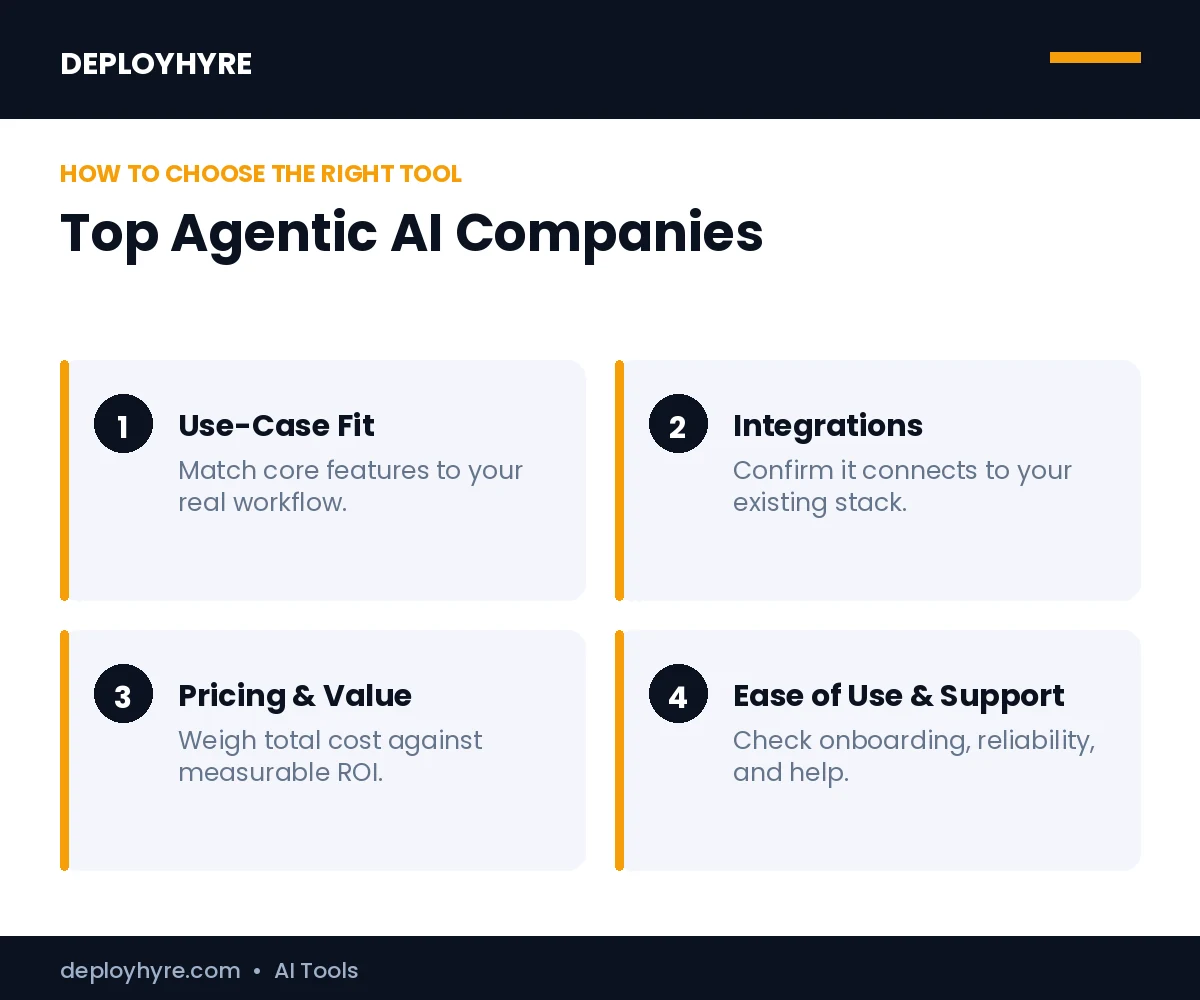
A leading agentic AI company delivers agents that reliably complete multi-step work, with the orchestration to coordinate them, the governance to control them, and the integrations to act across your stack. The strongest vendors pair real autonomy with enterprise-grade security, auditability, and scale, so agents move from pilots to production safely.
We weighed five things: autonomy and reliability, orchestration and multi-agent support, governance and security, integration breadth, and proven enterprise adoption.
Enterprise Platform Leaders
1 Microsoft: Best for Microsoft 365 Enterprises
Microsoft leads enterprise agentic AI by embedding agents across the tools organizations already use.
What it does well. Microsoft combines orchestration, governance, workflow execution, and ecosystem scale into a cohesive operational platform, with Copilot Studio letting teams build governed agents across Teams, Outlook, and the Microsoft stack.
Key features:
- Agents across Microsoft 365 and Teams
- Copilot Studio for custom agents
- Enterprise governance and security
- Massive ecosystem and reach
Best for: Enterprises standardized on Microsoft 365.
Limitations. Value is tied to the Microsoft ecosystem; credit-based pricing gets complex at scale.
2 Salesforce: Best for CRM and Customer-Facing Agents
Salesforce leads where agents act on customer and CRM data.
What it does well. Salesforce embeds agents directly into its CRM through Agentforce, grounding them in customer data with actions, guardrails, and analytics for service and sales.
Key features:
- Agents grounded in CRM data
- Service and sales actions
- Governance and analytics
- Deep Salesforce integration
Best for: Enterprises running Salesforce that want agents on their CRM.
Limitations. Total cost climbs once data and implementation are included.
3 ServiceNow: Best for IT and Workflow Automation
ServiceNow leads agentic automation across enterprise workflows and IT service management.
What it does well. ServiceNow combines orchestration and workflow execution at scale, deploying agents that automate IT, HR, and operational processes across the enterprise.
Key features:
- Workflow and IT automation agents
- Enterprise orchestration
- Governance and audit
- Broad process coverage
Best for: Enterprises automating IT and cross-department workflows.
Limitations. Best value requires being on the ServiceNow platform.
Specialist Agentic AI Leaders
4 OpenAI: Best for General-Purpose Autonomous Agents
OpenAI leads general-purpose agents that browse, reason, and act.
What it does well. OpenAI’s agent products combine frontier models with autonomous browsing and tool use, setting the pace for general agent capability.
Key features:
- Frontier models powering agents
- Autonomous browsing and tool use
- Broad developer ecosystem
- Rapid capability gains
Best for: Teams wanting cutting-edge general-purpose agents.
Limitations. Top-tier agent access sits behind premium plans.
5 Cognition Labs: Best for Autonomous Software Engineering
Cognition Labs leads autonomous coding with its agent Devin.
What it does well. Cognition Labs builds autonomous AI agents for software engineering, and its agent Devin can plan tasks, write code, run tests, debug, and deploy with minimal oversight.
Key features:
- Autonomous, end-to-end engineering
- Plans, codes, tests, and deploys
- Enterprise performance and security
- Minimal-oversight workflows
Best for: Engineering teams automating well-scoped tickets.
Limitations. Complex work still needs human review.
6 through 10: Sierra, Decagon, Aisera, Glean, and Cognigy
Five specialists round out the leaders, each owning a workflow.
What they do well. Sierra, Decagon, Aisera, Glean, and Cognigy are among the best agentic platforms in 2026: Sierra and Decagon lead customer experience and support automation, Aisera leads enterprise service desk and ITSM agents, Glean leads work assistants over enterprise data, and Cognigy leads conversational and voice agents for contact centers.
Key features:
- Customer support and CX automation (Sierra, Decagon)
- Enterprise service desk agents (Aisera)
- Enterprise search and work assistants (Glean)
- Conversational and voice agents (Cognigy)
Best for: Teams with a specific workflow to automate (support, ITSM, search, or contact center).
Limitations. Each is strongest in its niche rather than as a general platform.
How Should You Choose an Agentic AI Company?
Start with your priority. If you want agents inside your existing stack, pick the platform leader you already use: Microsoft, Salesforce, or ServiceNow. If you have a specific workflow to automate, choose the specialist that owns it, Sierra or Decagon for support, Aisera for IT, Glean for knowledge work, Cognition Labs for engineering.
Then evaluate governance and integration. In 2026 the differentiator is governed multi-agent execution, so confirm the vendor offers auditability, security, and the integrations your processes need. Pilot on one workflow with human oversight before scaling.
How We Evaluated These Agentic AI Companies
We assessed each company on five criteria: autonomy and reliability, orchestration and multi-agent support, governance and security, integration breadth, and proven enterprise adoption. We prioritized vendors with documented enterprise traction in 2026 and cross-checked positioning against independent market analyses. The space moves fast, so confirm current capabilities directly with each vendor.
What is an agentic AI company?
One that builds autonomous AI. An agentic AI company creates AI that plans and completes multi-step tasks with little human input, using tools and making decisions. Explore the leaders behind these AI agents.
How is agentic AI different from chatbots?
Agents act; chatbots answer. Chatbots respond one turn at a time, while agentic AI plans, takes actions, uses tools, and works toward a goal across many steps. Agents can browse, code, or book tasks autonomously.
Which companies lead in agentic AI?
Major labs and fast-moving startups. They build agent platforms and frameworks, and leadership shifts quickly as capabilities improve. Evaluate companies by real deployed agents and reliability, not demos, before committing to a platform.
Many of these vendors also ship the best AI automation tools for no-code workflows.
The Bottom Line
Agentic AI in 2026 is led by platform giants and sharp specialists. Microsoft, Salesforce, and ServiceNow win on scale and governance, while OpenAI, Cognition Labs, Sierra, Decagon, Aisera, Glean, and Cognigy win specific workflows.
Choose by where you need agents to act, prioritize governed execution, and pilot before scaling. The winners will be teams that deploy agents into one workflow well, then expand.
Next steps: Compare the tools in our best AI agents guide and see the strategy in our AI for business guide.
Frequently Asked Questions
What are the top agentic AI companies in 2026?
The top agentic AI companies in 2026 are platform leaders Microsoft, Salesforce, and ServiceNow, plus specialists OpenAI (general agents), Cognition Labs (software engineering), Sierra and Decagon (customer support), Aisera (IT service), Glean (enterprise search), and Cognigy (conversational agents). The leaders combine orchestration, governance, and workflow execution at enterprise scale.
What is the difference between an agentic AI company and an AI agent tool?
An agentic AI company is the vendor that builds and sells agent technology, while an AI agent tool is the product itself. Companies like Microsoft or Cognition Labs provide platforms and governance, whereas tools like ChatGPT Agent or Devin are the agents you deploy. Choosing a company means choosing a partner; choosing a tool means choosing a specific capability.
Which agentic AI company is best for enterprise?
For most enterprises, the best agentic AI company is the platform leader they already run: Microsoft for Microsoft 365 shops, Salesforce for CRM-centric teams, and ServiceNow for IT and workflow automation. These vendors offer the governance and integration enterprises need. Specialists are better when you have one specific workflow, like support or engineering, to automate.
Are agentic AI companies safe for enterprise deployment?
The leading vendors emphasize governance, security, and auditability, which is why platform leaders dominate enterprise adoption in 2026. Safety still depends on your controls: deploy agents with human oversight on high-stakes actions, confirm the vendor’s security posture and audit trails, and pilot on low-risk workflows before scaling to production.
How fast is agentic AI adoption growing?
Adoption is accelerating sharply, with the market shifting from isolated assistants to governed multi-agent systems running in production across enterprises in 2026. Most large organizations now run at least one agent in production, and investment continues to rise as vendors prove ROI in support, IT, sales, and software engineering workflows.

David Austin is a technology writer and software analyst at DeployHyre, where he covers AI tools, SaaS platforms, cloud hosting, and business automation. He focuses on hands-on comparisons of pricing, features, and real-world performance so teams can pick the right software with confidence.