Annual reviews are losing ground fast. Demand for better tools keeps climbing, with the employee performance management software market valued at $4.19 billion in 2025 and projected to reach $10.52 billion by 2033, a 12.3 percent yearly growth rate. Companies want continuous feedback, not once-a-year forms.
Table of Contents
AI performance management software changes how teams set goals, run reviews, and coach people. It drafts review summaries, surfaces feedback themes, tracks goals against outcomes, and flags employees at risk of disengagement. The result is fairer reviews and faster manager decisions.
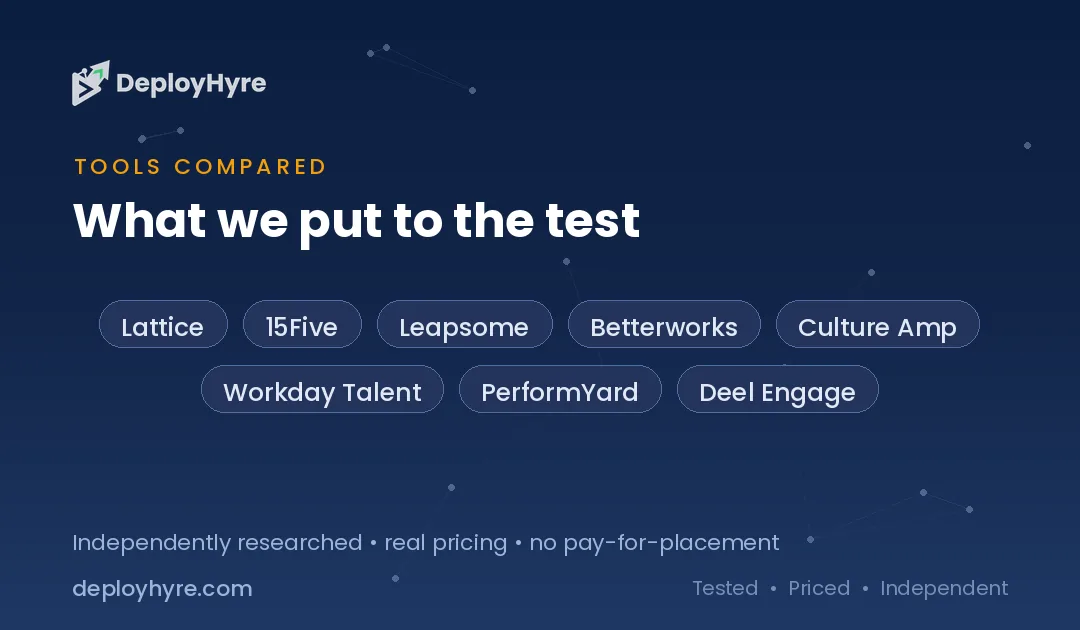
We tested 9 AI performance management platforms across reviews, goals, feedback, engagement, and price. This guide groups them by company size and need. For the wider stack, see our pillar on AI for business and our guide to AI tools for HR.
Quick Comparison: Top 9 AI Performance Management Tools
| Tool | Best For | Starting Price | AI Standout |
|---|---|---|---|
| Lattice | Mid-market all-in-one | ~$8/user/mo | AI review summaries |
| 15Five | Manager coaching | $11/user/mo | AI-assisted check-ins |
| Leapsome | Performance plus learning | $8/user/mo | AI feedback and goals |
| Betterworks | Enterprise OKRs | ~$15/user/mo | AI goal alignment |
| Culture Amp | Engagement-led performance | Quote-based | AI comment analysis |
| Workday Talent | Large HCM suites | ~$100/user/yr | Skills intelligence |
| PerformYard | Flexible review cycles | ~$5/user/mo | AI review drafting |
| Deel Engage | Distributed teams | Quote-based | AI growth plans |
| Trakstar | SMB appraisals | Quote-based | AI feedback assist |
What Is AI Performance Management Software?
AI performance management software runs goals, reviews, and feedback using machine learning to cut bias and manual work. It drafts review text, summarizes peer feedback, tracks goal progress, and spots disengagement, so managers coach with data instead of memory.
Older tools were digital forms with static rating scales. Modern platforms add AI that writes first-draft summaries, detects themes across hundreds of comments, and links goals to outcomes. That matters because reviews built only on recent memory favor loud performers and miss steady ones.
What Makes the Best AI Performance Management Software?
The best AI performance management software combines continuous feedback, clear goal tracking, fair reviews, and engagement insight in one place. Continuous feedback matters most, since it replaces the once-a-year scramble with steady coaching.
We ranked each tool on five factors. First, review and feedback quality, including AI drafting and bias checks. Second, goal and OKR tracking. Third, engagement and survey tools. Fourth, integrations with HRIS and payroll. Fifth, pricing and time to value, since enterprise suites take months to deploy while focused tools go live in weeks. Strong onboarding feeds this cycle, so pair your choice with AI employee onboarding software.
Best AI Performance Management Software for Mid-Market Teams
Lattice, 15Five, and Leapsome lead for growing companies that want reviews, goals, and engagement in one platform. Each balances depth with fast setup.
1 Lattice: Best for mid-market all-in-one
Lattice connects reviews, goals, engagement, and growth in a single people platform.
What it does well. Lattice drafts review summaries from feedback and goal data, runs flexible review cycles, and ties one-on-ones to goals. Its modular design lets teams add engagement or HRIS later.
Key features:
- AI review summaries
- Goals and OKR tracking
- Engagement surveys
- One-on-one agendas
Pricing. Lattice uses modular pricing, with performance starting near $8 per user per month and added modules raising the total.
Best for: Mid-to-large teams with HR resources to manage modules.
Limitations. Costs climb as you stack modules.
2 15Five: Best for manager coaching
15Five centers on weekly check-ins and manager enablement.
What it does well. 15Five pairs short weekly check-ins with one-on-one agendas and AI prompts that help managers respond and coach. It keeps managers close to teams between formal reviews.
Key features:
- Weekly check-ins
- AI-assisted manager prompts
- Engagement and OKRs
- Manager training paths
Pricing. 15Five Engage starts at $4 per user per month, Perform at $11 per user per month, and Total Platform at $16 per user per month, billed annually.
Best for: Teams that prioritize coaching and weekly rhythm.
Limitations. Full value needs consistent manager habits.
3 Leapsome: Best for performance plus learning
Leapsome combines performance, engagement, and learning in one suite.
What it does well. Leapsome runs reviews, goals, and surveys, then adds learning paths so growth plans connect to development. AI drafts feedback and summarizes survey themes.
Key features:
- Reviews and 360 feedback
- Goals and OKRs
- Learning modules
- AI feedback drafting
Pricing. Leapsome runs about $8 to $14 per user per month, with simpler setup than many rivals.
Best for: Teams that want development alongside reviews.
Limitations. Broad feature set takes time to configure.
Best AI Performance Management Software for Enterprise
Betterworks, Culture Amp, and Workday Talent fit large organizations that need scale, alignment, and deep analytics. Each connects performance to wider talent strategy.
4 Betterworks: Best for enterprise OKRs
Betterworks focuses on goal alignment across large, complex organizations.
What it does well. Betterworks cascades OKRs from company to team to individual, then uses AI to suggest goals and summarize progress. It suits enterprises that run on disciplined goal setting.
Key features:
- OKR alignment
- AI goal assistance
- Continuous feedback
- Calibration tools
Pricing. Betterworks runs about $15 to $25 per user per month, reflecting its enterprise focus.
Best for: Large teams that live by OKRs.
Limitations. Overkill for small teams.
5 Culture Amp: Best for engagement-led performance
Culture Amp leads with engagement data, then layers performance on top.
What it does well. Culture Amp analyzes survey comments at scale, spotting themes and risk across the workforce. It links engagement signals to performance and development for a people-science approach.
Key features:
- AI comment analysis
- Engagement surveys
- Performance reviews
- Benchmarking data
Pricing. Culture Amp uses custom pricing based on headcount and modules, billed annually.
Best for: Companies that put engagement at the center.
Limitations. Performance module is less deep than dedicated rivals.
6 Workday Talent: Best for large HCM suites
Workday Talent runs inside the broader Workday HCM platform.
What it does well. Workday connects performance to skills, succession, and workforce analytics in one system. Its skills intelligence maps capabilities across the organization for talent planning.
Key features:
- Skills intelligence
- Reviews and goals
- Succession planning
- Workforce analytics
Pricing. Workday costs upward of $100 per employee per year and needs significant implementation.
Best for: Enterprises of 1,000-plus running full HCM.
Limitations. Heavy setup and cost for performance alone.
Best AI Performance Management Software for Small Business
PerformYard, Deel Engage, and Trakstar suit smaller teams that want flexible reviews without enterprise overhead. Each keeps setup light and price low.
7 PerformYard: Best for flexible review cycles
PerformYard adapts to almost any review process a company already uses.
What it does well. PerformYard configures custom review cycles, goals, and feedback, then uses AI to draft review text from notes. It pairs flexible software with hands-on support.
Key features:
- Custom review cycles
- AI review drafting
- Goal tracking
- Continuous feedback
Pricing. PerformYard runs about $5 to $10 per user per month, among the lowest in this list.
Best for: Teams that want their own process kept intact.
Limitations. Lighter engagement analytics than rivals.
8 Deel Engage: Best for distributed teams
Deel Engage extends Deel’s global HR platform into performance and growth.
What it does well. Deel Engage runs reviews, goals, and growth plans alongside global payroll and compliance. AI drafts development plans, which helps managers of remote, cross-border teams.
Key features:
- AI growth plans
- Reviews and goals
- Learning paths
- Payroll integration
Pricing. Deel Engage uses custom quotes, often bundled with Deel HR and payroll.
Best for: Distributed and international teams.
Limitations. Best value when used with the wider Deel suite. To connect pay and performance, see our guide to AI payroll software.
9 Trakstar: Best for SMB appraisals
Trakstar offers straightforward appraisals and goal tracking for smaller firms.
What it does well. Trakstar runs structured reviews, goals, and 360 feedback with AI help for writing feedback. It keeps the process simple for HR teams without dedicated analysts.
Key features:
- Structured appraisals
- 360 feedback
- Goal tracking
- AI feedback assist
Pricing. Trakstar uses custom quotes based on headcount.
Best for: Small and mid-size firms wanting simple reviews.
Limitations. Fewer engagement and learning features.
How Should You Choose the Right Performance Tool?
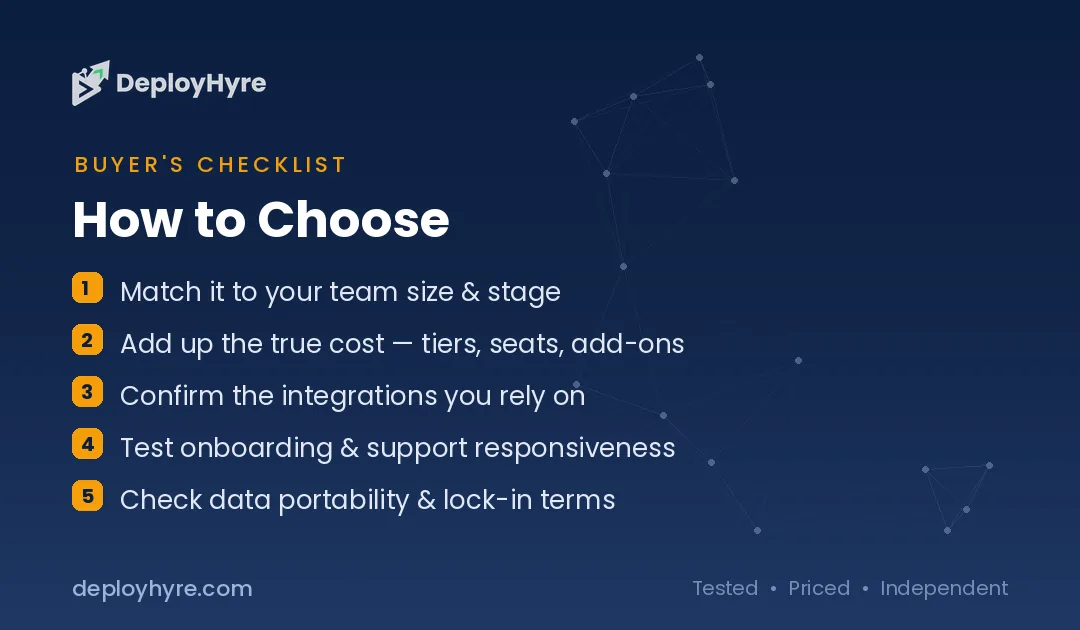
Choose based on company size, review style, and how much engagement and learning you need. Mid-market teams fit Lattice or 15Five. Enterprises fit Betterworks or Workday. Small teams fit PerformYard or Trakstar.
Start with company size and process. A growing team is served well by Lattice, 15Five, or Leapsome, while a 1,000-person company needs Workday or Betterworks. Next, decide whether engagement leads, which points to Culture Amp, or whether flexible cycles matter most, which points to PerformYard. Then confirm HRIS and payroll integration. Finally, weigh time to value, since focused tools deploy in weeks against months for full suites. Strong reviews also depend on good hiring, so see our guide to AI recruiting software.
How We Evaluated These Performance Tools
We assessed each platform on review and feedback quality, goal tracking, engagement tools, integrations, and price. We reviewed vendor documentation, published pricing where available, independent comparisons, and market data from Grand View Research. We weighted continuous feedback and time to value most heavily. We did not accept marketing claims without a source. Pricing reflects publicly listed ranges as of June 2026 and can change.
The Bottom Line
Lattice wins for mid-market all-in-one, Betterworks for enterprise OKRs, and PerformYard for flexible, low-cost reviews. The right pick depends on company size, review style, and your need for engagement and learning.
With the market on track to more than double by 2033, AI is making reviews fairer and faster. Run a pilot, measure review quality and manager adoption, then scale. To round out your people stack, read our guides to AI tools for HR and AI employee onboarding software.
Frequently Asked Questions
What is the best AI performance management software?
Lattice leads for mid-market all-in-one needs, Betterworks for enterprise OKRs, and PerformYard for flexible, low-cost reviews. The best choice depends on company size, review style, and how much engagement and learning you need.
How much does AI performance management software cost?
Pricing ranges widely. Focused tools like PerformYard start near $5 per user per month, mid-market platforms like Lattice and 15Five run $8 to $16, and enterprise suites like Workday cost upward of $100 per employee per year.
How does AI improve performance reviews?
AI drafts review summaries from feedback and goal data, detects themes across many comments, and flags disengagement risk. This cuts manual writing, reduces recency bias, and gives managers data to coach with instead of relying on memory.
Does AI performance software replace managers?
No. AI drafts summaries, surfaces patterns, and tracks goals, but managers still make decisions, give feedback, and coach. The software removes busywork so managers spend more time on people and less on paperwork.
Does performance software integrate with HR and payroll systems?
Yes. Tools like Lattice, Deel Engage, and Workday integrate with HRIS and payroll so review, goal, and compensation data stays connected. Native integration keeps performance tied to pay and headcount across HR.
Related Articles
David Austin is a technology writer and software analyst at DeployHyre, where he covers AI tools, SaaS platforms, cloud hosting, and business automation. He focuses on hands-on comparisons of pricing, features, and real-world performance so teams can pick the right software with confidence.
Know AI, SaaS, or cloud tools inside out? Pitch a guest post and get in front of thousands of buyers researching their next tool.