Table of Contents
The best digital adoption platform depends on your audience: WalkMe or Whatfix for enterprise IT driving adoption of internal software, and Userpilot, Appcues, or Pendo for SaaS product teams onboarding users. Digital adoption platforms (DAPs) layer guidance, tooltips, walkthroughs, and in-app help, over software so users learn features in context, reducing training, support tickets, and the abandonment that comes from confusing interfaces.
The fork that determines everything: DAPs serve two very different audiences at a roughly 30x price gap. Enterprise DAPs (WalkMe averaging about $79,000 a year, Whatfix) help IT drive employee adoption of internal enterprise software, Salesforce, SAP, custom apps. SaaS product-team tools (Userpilot at $249 a month, Appcues) help product teams onboard and activate customers in their own product. They overlap technically but solve different problems for different buyers, and buying the wrong category means paying enterprise prices for a product need, or vice versa.
Every price below is a recent observed figure. Because enterprise DAPs quote per deployment, treat each as a band.
Quick Comparison: Digital Adoption Platforms at a Glance
| Platform | Best For | Observed Price | Audience |
|---|---|---|---|
| WalkMe | Enterprise internal-software adoption | From ~$9,000/yr; avg ~$78,817/yr | Enterprise IT |
| Whatfix | Enterprise, flexible setup | Quote ($10K–$100K+/yr) | Enterprise IT |
| Pendo | Product analytics + adoption | Free to 500 MAU; custom above | SaaS product teams |
| Userpilot | Mid-market SaaS onboarding | From $249/mo | SaaS product teams |
| Appcues | No-code SaaS onboarding | ~$249–$399/mo | SaaS product teams |
| UserGuiding | Budget onboarding | From ~$69–$89/mo | SMB / SaaS |
What AI Digital Adoption Platforms Do
A digital adoption platform overlays interactive guidance on top of software without changing the underlying application. It shows new users step-by-step walkthroughs, contextual tooltips, checklists, and in-app help exactly when and where they need it, so people learn features by doing rather than reading documentation or sitting through training. The goal is to close the gap between buying software and actually using it well, reducing time-to-value, support load, and the feature underutilization that plagues both internal enterprise tools and SaaS products.
The AI layer personalizes and targets guidance: it identifies where users struggle, triggers the right help based on behavior, segments users to show relevant onboarding, and increasingly generates guidance content automatically. Combined with in-app analytics (which features get used, where users drop off), a DAP becomes both a teaching layer and a measurement layer, showing you not just how to guide users but where guidance is needed most.
DAPs sit at the intersection of onboarding, product analytics, and adoption. They complement the usage data in our best AI product analytics tools guide, the retention focus of our best AI customer success software guide, and, for internal software, the support automation in our best AI HR chatbots guide.
Enterprise IT vs SaaS Product Teams
DAPs split into two categories serving different buyers, and the roughly 30x price gap between them tracks that split, not a difference in raw capability. Enterprise DAPs (WalkMe, Whatfix, Apty) are bought by IT and L&D teams to drive employee adoption of internal enterprise software, guiding staff through Salesforce, SAP, Workday, or custom apps, and priced at $10,000 to $100,000-plus a year (WalkMe averages about $79,000). SaaS product-team tools (Userpilot, Appcues, Pendo) are bought by product teams to onboard and activate their own customers, priced at $69 to $399 a month for most.
The two overlap technically, both show in-app guidance, but the buyer, the use case, and the price are different. An enterprise driving adoption of purchased software across thousands of employees needs the enterprise DAP’s scale, cross-application reach, and IT controls. A SaaS company onboarding trial users into its own product needs the product-tool’s fast setup, product analytics, and affordability. Identify which problem you are solving, internal-software adoption or SaaS user onboarding, before you shop, because it determines your category and a 30x price difference.
Best for Enterprise IT
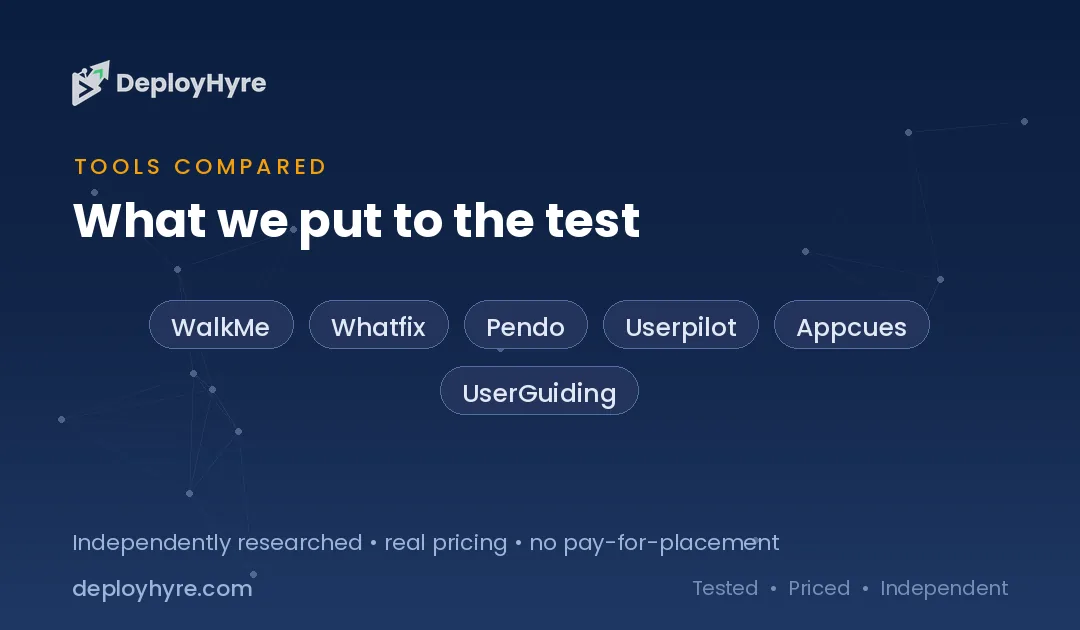
WalkMe is the enterprise standard for driving adoption of internal software, guiding employees through complex enterprise applications across the organization, with plans from around $9,000 a year and typical enterprise contracts averaging about $78,817 annually. For large organizations rolling out or trying to increase usage of Salesforce, SAP, Workday, or custom internal apps, WalkMe’s scale, cross-application overlay, and IT-grade controls make it the leader. It is the choice when the problem is employee adoption of purchased or built enterprise software at scale, and the ROI comes from reduced training and support plus higher software utilization.
Whatfix is the other enterprise leader, offering similar cross-application adoption guidance with a reputation for more flexible, faster setup, also on premium quote-based pricing. Both are enterprise DAPs bought by IT and L&D; WalkMe for maximum enterprise scale and maturity, Whatfix for flexibility and easier implementation. Choose them when you need to drive employee adoption of internal enterprise software across a large workforce, and budget for the five-figure-plus annual commitment that the enterprise category commands.
Best for SaaS Product Teams
Userpilot is a top choice for mid-market SaaS product teams, delivering in-app onboarding, walkthroughs, and built-in analytics and A/B testing at a published $249 a month, without the enterprise DAP price or complexity. For SaaS companies onboarding and activating their own users, Userpilot hits the sweet spot: it drives product adoption, measures it, and lets non-engineers build flows, at a price a growth-stage company can afford. Its combination of guidance and analytics makes it a strong all-around product-adoption tool for teams focused on customer onboarding and activation.
Appcues is the other strong SaaS product-team pick, a no-code onboarding platform (roughly $249 to $399 a month) favored for ease of building flows without engineering. Pendo combines product analytics with adoption guidance and is free up to 500 monthly active users, with custom pricing above, appealing to product teams that want analytics and in-app guidance in one platform. All three serve SaaS product teams; Userpilot for onboarding-plus-analytics value, Appcues for no-code ease, Pendo for combined analytics and guidance. They pair with the metrics in our best AI product analytics tools guide.
Best Value and Entry Options
UserGuiding is the budget standout, delivering user onboarding, tooltips, and checklists from around $69 to $89 a month, making in-app guidance accessible to SMBs and early-stage SaaS companies. For small teams that want to add onboarding guidance to their product without a mid-market or enterprise commitment, UserGuiding (along with ProductFruits in the same budget tier) provides the core capability affordably. It is the pragmatic entry point when you want to improve user onboarding but cannot justify Userpilot or Appcues pricing yet.
Pendo’s free tier (up to 500 monthly active users) is the other strong entry option, letting early-stage product teams start with combined analytics and guidance at no cost and upgrade as they grow. Both are the pragmatic picks for smaller teams and tight budgets; UserGuiding for low-cost onboarding guidance, Pendo’s free tier for combined analytics-plus-guidance at no cost. Start here when you are adding product-adoption tooling for the first time, and step up to Userpilot, Appcues, or an enterprise DAP as your scale and needs grow.
How Should You Choose a DAP?
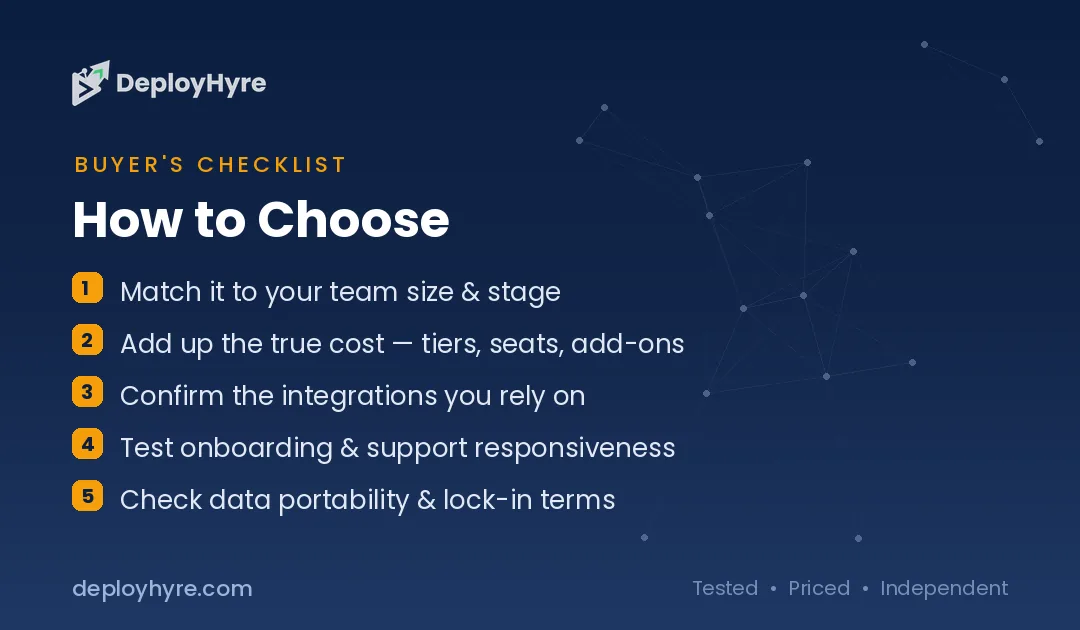
Identify your audience first, because it splits the category and a 30x price gap. If you are enterprise IT driving adoption of internal software across employees, WalkMe or Whatfix are the field, at $10,000-plus a year. If you are a SaaS product team onboarding your own users, Userpilot, Appcues, or Pendo are the fit, at $69 to $399 a month. Buying the wrong category is expensive.
Then match the tool to your stage and needs. Budget or first-time adoption tooling points to UserGuiding or Pendo’s free tier. Growth-stage SaaS wanting onboarding plus analytics points to Userpilot. No-code ease points to Appcues. Large-scale internal-software adoption points to the enterprise DAPs. Match capability and price to where you are.
Finally, weigh analytics integration. Some DAPs (Pendo, Userpilot) bundle product analytics with guidance, which lets you both find where users struggle and fix it in one platform, a real advantage over guidance-only tools. If measuring adoption alongside driving it matters, favor the platforms that combine both, and use the AI targeting features to focus guidance where behavior shows users need it.
How We Evaluated These Platforms
We evaluated each platform on in-app guidance capability, analytics integration, ease of building flows, scale and cross-application reach, target audience, and pricing. Figures come from vendor pages and comparison sources. Because DAPs split into enterprise-IT and SaaS-product categories with a large price gap, we present observed rates and stress matching the tool to your audience. We accepted no payment for placement; rankings reflect fit for a stated use case.
The Bottom Line
WalkMe and Whatfix lead the enterprise-IT category for driving employee adoption of internal software (at $10,000-plus a year), while Userpilot, Appcues, and Pendo lead for SaaS product teams onboarding their own users (at $69 to $399 a month), with UserGuiding the budget entry. Identify whether your problem is internal-software adoption or SaaS user onboarding first, because that splits the category and a roughly 30x price gap.
Frequently Asked Questions
How much do digital adoption platforms cost?
It depends on the category. Enterprise DAPs like WalkMe and Whatfix run $10,000 to $100,000-plus a year (WalkMe averages about $79,000). SaaS product-team tools are far cheaper: Userpilot from $249 a month, Appcues $249 to $399, UserGuiding $69 to $89, and Pendo free up to 500 monthly active users. The audience you serve determines the price tier.
What is a digital adoption platform?
A digital adoption platform (DAP) overlays interactive guidance, walkthroughs, tooltips, checklists, and in-app help, on software so users learn features in context without training or documentation. It reduces support tickets, training time, and feature underutilization, and is used both by enterprises driving adoption of internal software and by SaaS teams onboarding their own users.
What is the difference between WalkMe and Userpilot?
They serve different audiences. WalkMe is an enterprise DAP bought by IT to drive employee adoption of internal enterprise software (Salesforce, SAP), at $10,000-plus a year. Userpilot is a SaaS product-team tool for onboarding your own customers into your product, at $249 a month. They overlap technically but solve different problems at very different prices.
What is the best DAP for a SaaS startup?
For SaaS product teams, Userpilot ($249 a month) offers strong onboarding plus built-in analytics, Appcues is great for no-code flow building, and Pendo is free up to 500 monthly active users. Budget-conscious early-stage teams can start with UserGuiding ($69 to $89 a month) or Pendo’s free tier, then scale up.
Do digital adoption platforms include analytics?
Some do. Pendo and Userpilot combine product analytics with in-app guidance, so you can find where users struggle and address it in one platform. Guidance-only tools require a separate analytics tool. If measuring adoption alongside driving it matters to you, favor a DAP that bundles both capabilities.
Related Articles

David Austin is a technology writer and software analyst at DeployHyre, where he covers AI tools, SaaS platforms, cloud hosting, and business automation. He focuses on hands-on comparisons of pricing, features, and real-world performance so teams can pick the right software with confidence.