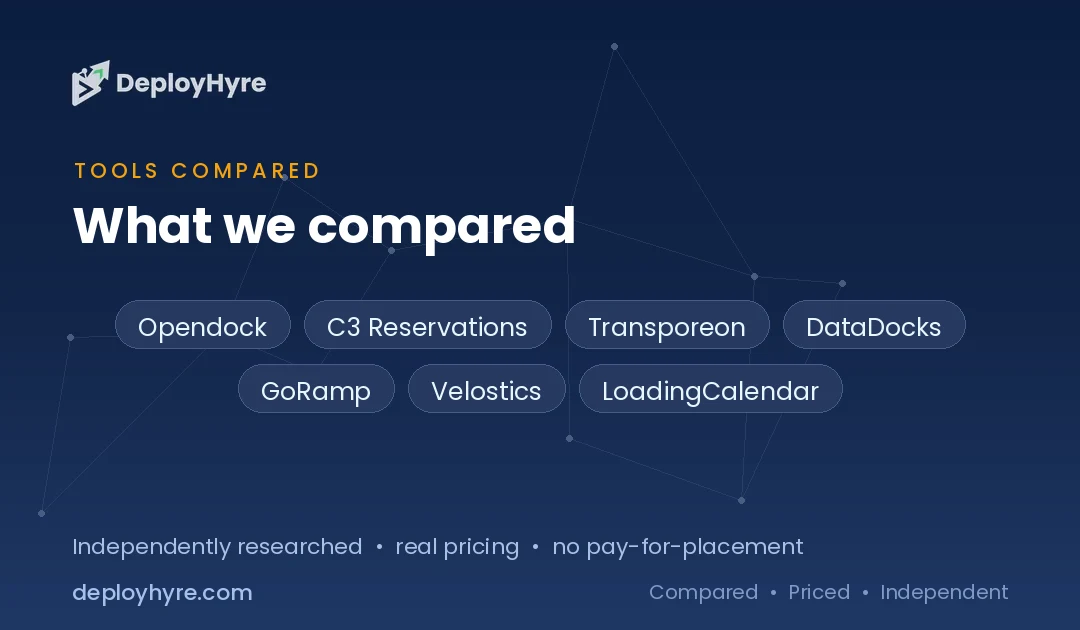
The best dock scheduling software is Opendock for high-volume North American distribution centers, C3 Reservations for rules-heavy grocery and retail DCs, and DataDocks for small and mid-size warehouses that want fast self-serve setup. GoRamp suits multi-site European operations, Velostics suits shippers that need three-way scheduling, Transporeon suits global shippers, and LoadingCalendar is the lowest-cost option.
Unscheduled arrivals are expensive. ATRI research found truck drivers were detained at 39.3 percent of all stops in 2023, costing the industry $3.6 billion in direct expenses and $11.5 billion in lost productivity. Fewer than half of the detention invoices fleets sent were paid.
Long waits also affect safety. The FMCSA summary of a DOT Inspector General study reports that a 15-minute increase in average dwell time raises the expected crash rate by 6.2 percent.
This guide compares 7 dock scheduling platforms on carrier self-booking, appointment rules, check-in, integrations, and price. Dock scheduling is one layer of the operations stack covered in our guide to AI for business. Prices come from vendor pages where published, and third-party or quote-only figures are labeled.
Quick Comparison: Best Dock Scheduling Software
| Platform | Best For | Starting Price | Pricing Basis | Free Trial |
|---|---|---|---|---|
| Opendock | High-volume North American DCs | About $6,000/year per facility (vendor estimate) | Per facility | No |
| C3 Reservations | Rules-heavy grocery, retail, and 3PL DCs | Quote-only | Usage-based | Demo |
| DataDocks | Small and mid-size warehouses | $249/month (third-party listing) | Flat monthly | Yes (third-party listing) |
| GoRamp | Multi-site dock plus yard in Europe | About $175 to $250/month (vendor pages differ) | Docks, sites, modules | Yes |
| Velostics | Three-way shipper, carrier, consignee scheduling | $4,500/year (vendor-supplied G2 data) | Facilities and users | For 5+ facilities |
| Transporeon Time Slot Management | Global shippers on Transporeon’s network | Quote-only | Custom | Demo |
| LoadingCalendar | Lowest-cost dock booking | $99/month flat | Flat, unlimited docks and users | 14 days |
What Is Dock Scheduling Software?
Dock scheduling software assigns inbound and outbound trucks to set time slots and dock doors, usually through a portal where carriers book their own appointments. It replaces phone calls and email threads with rules that match each load to the right door, duration, and labor plan.
A typical appointment flows in five steps:
- A carrier opens the warehouse’s booking link and enters a PO or reference number.
- The software checks rules for load type, door capacity, and duration.
- The carrier picks an open slot and gets a confirmation.
- The driver checks in at the gate or a kiosk on arrival.
- Arrival, start, and finish times are recorded for reports and detention disputes.
Carriers usually pay nothing. Opendock, GoRamp, and LoadingCalendar all state that carrier access is free, so adoption depends on making the booking link simple.
How Is Dock Scheduling Different From Yard Management?
Dock scheduling controls when a truck arrives and which door it gets, while yard management controls what happens to trailers once they are on site. Scheduling is the appointment layer. Yard management covers trailer locations, jockey moves, and gate security.
Many vendors sell both. Opendock, GoRamp, DataDocks, and Velostics add yard features to their scheduling core. Facilities with crowded yards and drop trailers should also read our yard management software guide. Facilities that only need appointments can start with the scheduling tools below.
Best Dock Scheduling Software for Large Distribution Centers
1. Opendock: Best for high-volume North American DCs
Opendock is a dock scheduling platform owned by Loadsmart, which acquired Opendock in November 2021. At the time, Opendock served more than 2,000 US warehouses.
What it does well. Opendock has a large existing carrier network, so many drivers already know the booking flow. Its self-service portal lets carriers, brokers, and dispatchers book and reschedule. SmartGate AI cameras capture plates, USDOT numbers, and trailer IDs at the gate.
Key features:
- Carrier, broker, and dispatcher self-service booking
- Driver check-in kiosks and gate management
- SmartGate AI camera capture at the gate
- Carrier scorecards for on-time rate, no-shows, and reschedules
- Open API for TMS, WMS, and ERP
Pricing. Opendock does not publish a price list. Opendock’s own site file states pricing starts at approximately $6,000 per year per facility, with unlimited users, docks, and appointments. Carrier access is free. No free trial is listed.
Best for: high-volume DCs with many different carriers booking each week.
Limitations. There is no trial before an annual per-site commitment, and exact pricing requires a sales call.
2. C3 Reservations: Best for rules-heavy grocery, retail, and 3PL DCs
C3 Reservations is a dock appointment system from C3 Solutions, a Montreal-based supply chain software company.
What it does well. C3 Reservations sets appointment durations through rules written in plain language. Out-of-plan requests become tasks for staff instead of silent double bookings. It runs with or without a WMS and holds ISO 27001 certification.
Key features:
- 24/7 carrier and supplier self-serve portal
- Rule-based appointment durations and door assignment
- Automated email alerts and task routing for exceptions
- Dashboards and carrier scorecards
- APIs to TMS and WMS, with standalone use supported
Pricing. Quote-only. C3 states it uses usage-based pricing. No free trial is listed.
Best for: DCs with 10 or more dock doors and 100 or more appointments per day, the scale C3 targets.
Limitations. C3 is positioned for large sites, so small warehouses pay for depth they do not need.
3. Transporeon Time Slot Management: Best for global shippers on Transporeon’s network
Transporeon is a European logistics platform that Trimble acquired in April 2023. At that time, Transporeon booked more than 100,000 dock appointments per day.
What it does well. Transporeon Time Slot Management maps docks and handling resources such as forklifts and ramps. It calculates slot length from shipment data, so a full truckload gets more time than a partial. Every party sees one shared status record.
Key features:
- Digital mapping of docks, bays, and handling equipment
- Slot length calculated from transport data
- Shared status and audit-proof records for all parties
- KPI reports on waiting and processing times
- Real-time yard add-on
Pricing. Quote-only, with a demo on request. No free trial is listed.
Best for: global manufacturers and retailers that already tender freight through Transporeon.
Limitations. Buying is enterprise and sales-led, with no published price or trial.
Best Dock Scheduling Software for Mid-Size Warehouses and 3PLs
4. DataDocks: Best for small and mid-size warehouses
DataDocks is a dock scheduling platform founded in 2013 and based in Bolton, Ontario, according to DataDocks’ about page.
What it does well. DataDocks is quick to launch. Warehouses set capacity limits and approval rules, share a booking link, and watch arrivals on a live dock dashboard. Native iOS and Android apps let floor staff update status from the dock.
Key features:
- Carrier self-scheduling portal
- Capacity limits, custom rules, and approvals
- Live dock dashboard and efficiency analytics
- Yard visibility and jockey orders
- SOC 2 certification and native mobile apps
Pricing. DataDocks does not publish pricing on its site. Capterra lists a Start plan at $249 per month flat, plus a free trial and a free version. Confirm current pricing with DataDocks.
Best for: single-site and small multi-site warehouses that want self-serve scheduling running in days.
Limitations. Pricing is not published by the vendor, so the third-party figure needs confirmation.
5. GoRamp: Best for multi-site dock plus yard in Europe
GoRamp is a dock and yard scheduling platform based in Vilnius, Lithuania.
What it does well. GoRamp verifies bookings against confirmed purchase order numbers, which blocks phantom appointments. Carriers join through a single link, and drivers check themselves in at the gate. A live yard map shows trailer locations across sites.
Key features:
- Carrier sign-up through one shared link
- PO validation before a slot is confirmed
- Driver self check-in at the gate
- Live yard map and dwell and turnaround KPIs
- API and connectors for WMS, TMS, and ERP
Pricing. GoRamp’s own pages list different starting prices. Its Opendock comparison page says plans start from $250, while its blog says $175 per month. Pricing scales with docks, sites, and modules. Plans include a free trial, no user limits, and free carrier access.
Best for: mid-market shippers and 3PLs running several sites, especially in Europe.
Limitations. GoRamp states its carrier network in North America is less developed than Opendock’s, and the full yard module needs guided onboarding.
6. Velostics: Best for three-way shipper, carrier, and consignee scheduling
Velostics is a dock and yard scheduling platform that coordinates appointments between shippers, carriers, and receivers in one booking.
What it does well. Velostics ties scheduling to the shipper’s TMS. Its integrations include Oracle, MercuryGate, and Blue Yonder, so appointments are set when loads are planned. Velostics Pass gives drivers a QR code for digital gate check-in.
Key features:
- Unified appointment scheduling across pickup and delivery
- Dock and yard scheduling
- Digital gate in and out
- Velostics Pass QR check-in for drivers
- TMS integrations with Oracle, MercuryGate, and Blue Yonder
Pricing. Vendor-supplied G2 data lists a Standard Package at $4,500 per year, scaling with facilities, users, and integrations. G2 notes a free trial for companies with 5 or more facilities.
Best for: shippers and 3PLs that schedule both pickups and deliveries from their TMS.
Limitations. Velostics has a smaller footprint and fewer public reviews than Opendock or C3.
Best Budget Dock Scheduling Software
7. LoadingCalendar: Best for lowest-cost dock booking
LoadingCalendar is a focused dock appointment tool with flat pricing for unlimited docks and users.
What it does well. LoadingCalendar has the simplest published price in this guide. Carriers book free without creating an account, which removes the biggest adoption hurdle for small warehouses.
Key features:
- Carrier booking without an account
- Unlimited warehouses, docks, and users
- Calendar view of all dock appointments
- Booking confirmations for carriers
- Enterprise plan for larger rollouts
Pricing. LoadingCalendar pricing is $99 per month flat for unlimited warehouses, docks, and users. Enterprise is quote-only. The free trial lasts 14 days with no card.
Best for: small warehouses that want to stop booking trucks by phone at the lowest cost.
Limitations. LoadingCalendar handles dock scheduling only, with no yard management or carrier scorecards.
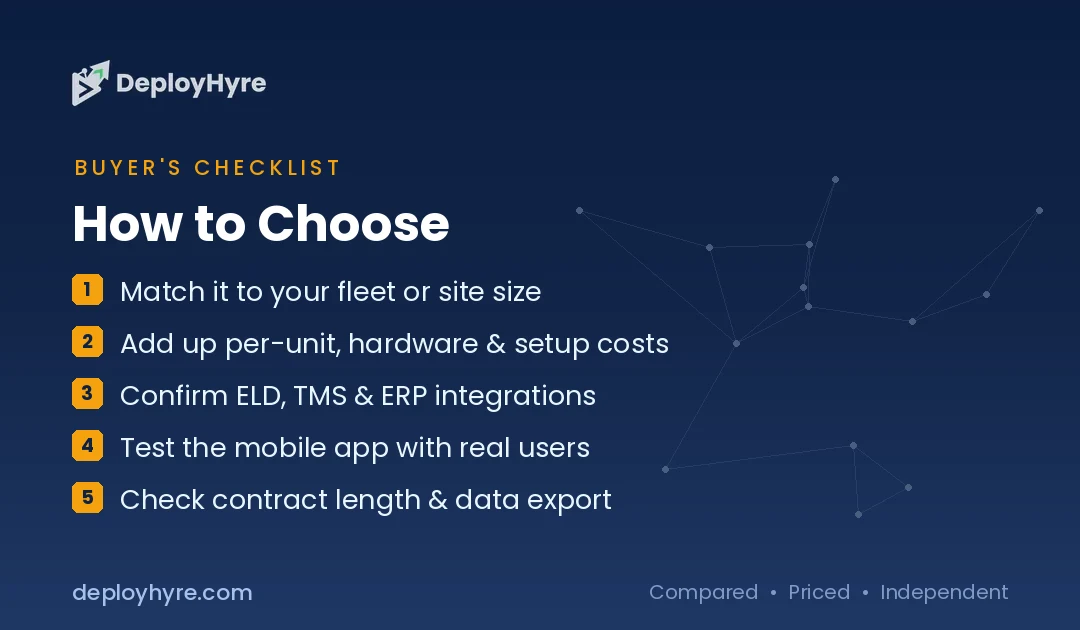
How Should You Choose Dock Scheduling Software?
Choose dock scheduling software by matching appointment volume, carrier mix, and existing systems. High-volume DCs with many carriers need a large carrier network and strong rules, mid-size sites need fast setup, and small warehouses need a low flat price.
- Count daily appointments. Sites above 100 appointments per day fit C3 or Opendock. Smaller sites fit DataDocks, GoRamp, or LoadingCalendar.
- Check carrier adoption. Free carrier access and no-account booking raise adoption. Ask vendors how many of your carriers already use the portal.
- Map integrations. Confirm links to your WMS and TMS. Warehouse teams can compare WMS options in our warehouse management software guide.
- Decide on yard scope. Buy a combined dock and yard platform only when trailers sit on site for hours.
- Use timestamps for detention. Check-in and departure records settle detention disputes with carriers. Carriers on the other side of that dispute use tools in our trucking dispatch software guide.
How We Evaluated These Platforms
We compared each platform using vendor product and pricing pages, vendor-supplied listing data, and named industry research, not hands-on warehouse testing. Several vendors do not publish prices, so we labeled every figure by source: vendor page, vendor estimate, vendor-supplied G2 data, or third-party listing.
We scored platforms on five criteria:
- Carrier experience: booking portal, account requirements, and cost to carriers.
- Scheduling rules: durations, door capacity, and exception handling.
- Check-in and timestamps: gate tools and detention evidence.
- Integrations: WMS, TMS, and ERP connections.
- Pricing transparency: published prices, trials, and contract terms.
The Bottom Line
Opendock is the best dock scheduling software for high-volume North American DCs, C3 Reservations is best for rules-heavy grocery and retail DCs, and DataDocks is best for small and mid-size warehouses. GoRamp suits multi-site European operations, Velostics suits three-way scheduling, Transporeon suits global shippers, and LoadingCalendar is the budget pick.
Pilot one dock with your top 10 carriers before rolling out site-wide. Shippers planning the full inbound flow can also compare our freight management software picks. Carriers running their own trucks can also compare fleet maintenance software to cut downtime between loads.
Frequently Asked Questions
What is the best dock scheduling software?
Opendock is the best dock scheduling software for high-volume North American DCs, starting at about $6,000 per year per facility. C3 Reservations is best for rules-heavy grocery and retail DCs. DataDocks is best for small and mid-size warehouses that want fast self-serve setup.
How much does dock scheduling software cost?
Dock scheduling software costs $99 per month flat on LoadingCalendar, about $175 to $250 per month on GoRamp, and $249 per month on DataDocks per third-party listings. Annual contracts run about $4,500 for Velostics and about $6,000 per facility for Opendock. C3 and Transporeon are quote-only.
Do carriers pay to use dock scheduling software?
No, carriers usually book for free. Opendock, GoRamp, and LoadingCalendar all state that carrier access costs nothing, and LoadingCalendar does not require carriers to create an account. The warehouse or shipper pays the subscription.
Does dock scheduling software need a WMS?
No. C3 Reservations and DataDocks both run as standalone systems. Most platforms also connect to a WMS, TMS, or ERP through an API, which lets appointments sync with purchase orders and labor plans once the site is ready.
What is the difference between dock scheduling and yard management?
Dock scheduling books the time slot and door for each truck before it arrives. Yard management tracks trailers after arrival, including parking spots, jockey moves, and gate security. Opendock, GoRamp, DataDocks, and Velostics sell both functions in one platform.
Related Articles

David Austin is a technology writer and software analyst at DeployHyre, where he covers AI tools, SaaS platforms, cloud hosting, and business automation. He focuses on hands-on comparisons of pricing, features, and real-world performance so teams can pick the right software with confidence.