AI recruiting software sources, screens, and schedules candidates so your team hires faster and fairer. We tested 9 of the best AI recruiting tools in 2026. Affordable platforms start near $15 per user each month, while enterprise suites run into five and six figures a year. This guide shows which tool fits small teams, high-volume hiring, sourcing, and enterprise talent intelligence, with real pricing and honest limits.
Table of Contents
Hiring is now an AI race. Nearly half of organizations, 43 percent, used AI in HR tasks in 2025, up from 26 percent in 2024. Resume review leads the way, with 82 percent of AI-using companies applying it to screen resumes.
The problem is choice. Dozens of tools claim to use AI, yet they solve different bottlenecks. Some source passive candidates. Some screen high volumes. Some automate scheduling and chat. Picking the wrong one wastes budget and slows hiring.
We tested 9 of the best AI recruiting platforms in 2026 against features, pricing, and fit. For the wider category, see our guide to the best AI tools for HR, and for company-wide context read how teams use AI for business.
What Is AI Recruiting Software?
AI recruiting software uses machine learning to source, screen, rank, and engage job candidates automatically. It parses resumes, matches applicants to roles, scores fit, schedules interviews, and answers candidate questions through chat. The result is faster shortlists and less manual work for recruiters, who then spend their time on human judgment and final hiring decisions.
Most tools sit on top of an applicant tracking system, or ATS, which stores candidates and manages the pipeline. Pricing typically spans $500 to $15,000 per month depending on candidate volume and feature scope, so fit to your hiring size matters more than raw feature counts.
Quick Comparison: 9 Best AI Recruiting Tools in 2026
| Tool | Best For | Starting Price | Core Strength |
|---|---|---|---|
| Manatal | Affordable all-in-one ATS | $15/user/mo | AI candidate matching |
| Workable | Fast-growing companies | $149/mo | Sourcing plus ATS |
| Paradox | High-volume hiring | ~$1,000/mo | Conversational automation |
| HireVue | Enterprise interviews | $35,000+/yr | Structured video screening |
| Eightfold AI | Enterprise talent intelligence | Custom | Skills-based matching |
| Gem | Outbound sourcing | Custom | Sourcing plus CRM |
| hireEZ | AI sourcing | Custom | Passive candidate search |
| Skima AI | Explainable screening | Mid-tier | Transparent resume scoring |
| Truffle | High-volume screening | Mid-tier | AI match scores |
What Makes Great AI Recruiting Software?
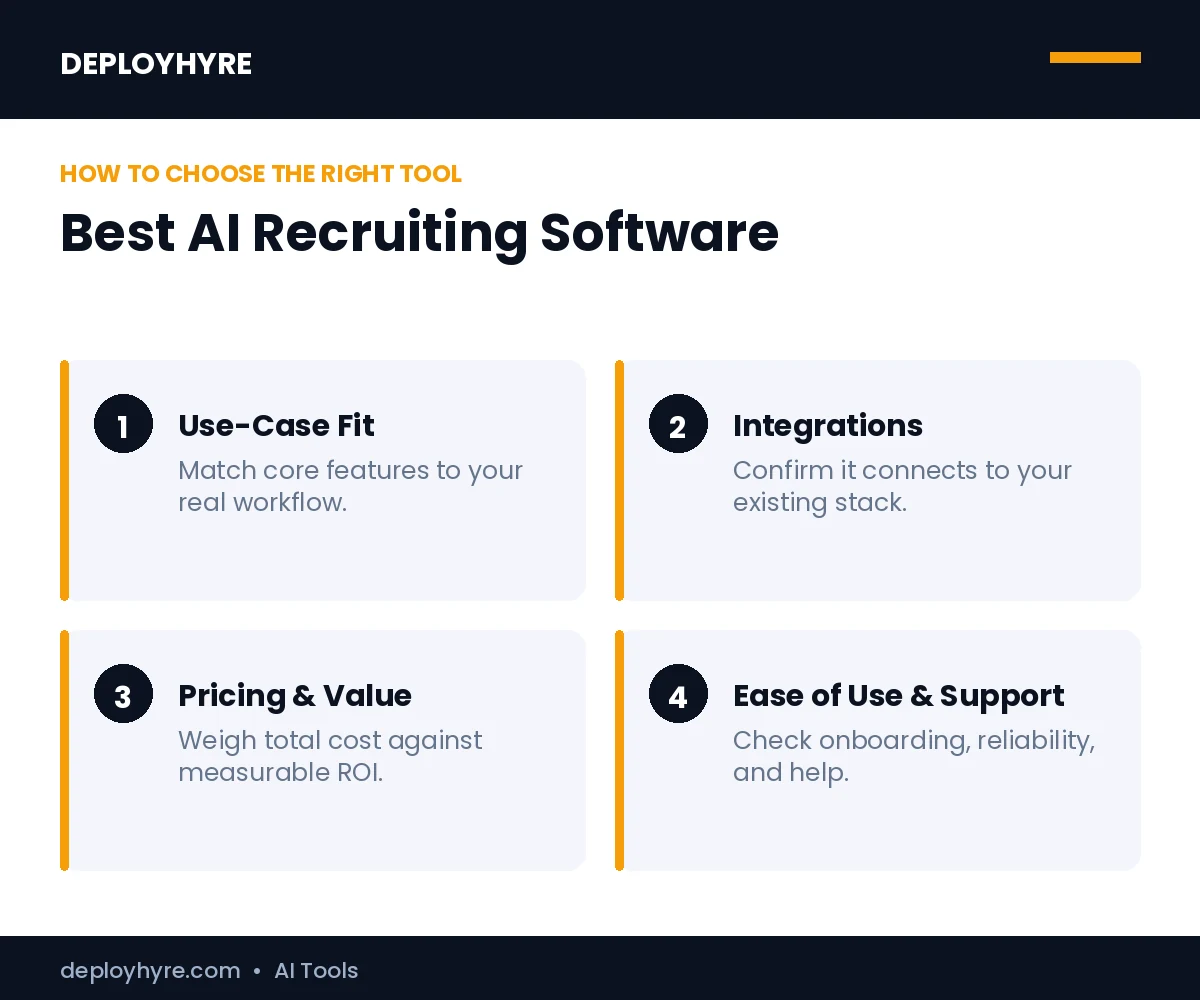
Great AI recruiting software fixes your specific bottleneck, integrates with your existing stack, and keeps a human in the loop for final decisions. The best tools show why a candidate scored well, comply with hiring laws, and reduce time-to-hire without hiding their logic. Transparency and fairness matter as much as speed.
We weighed five things: the bottleneck each tool solves, AI screening and matching quality, integrations with ATS and calendars, pricing clarity, and bias controls. Technology companies lead AI recruitment adoption at 89 percent, so proven, audited tools carry real weight.
Best Affordable AI Recruiting Software
1. Manatal: Best for Affordable All-in-One ATS
Manatal is the easiest entry point for small and mid-size teams that want an AI ATS without enterprise cost.
What it does well. Manatal combines an applicant tracking system with AI candidate recommendations, resume parsing, and social media enrichment. It scores applicants against each role and suggests strong matches, so small teams shortlist faster.
Key features:
-
AI candidate matching and scoring
-
Resume parsing and enrichment
-
Pipeline and ATS management
-
Reporting and team collaboration
Best for: Small and mid-size recruiting teams and agencies on a budget.
Limitations. Sourcing reach is narrower than dedicated sourcing suites, and very large enterprises will want deeper governance.
2. Workable: Best for Fast-Growing Companies
Workable pairs broad job sourcing with a clean ATS, which suits companies scaling their headcount.
What it does well. Workable posts to many job boards, sources passive candidates, and adds AI screening and recommendations. Its interface is friendly for hiring managers, not just recruiters, so the whole team can move candidates forward.
Key features:
-
One-click posting to job boards
-
AI sourcing and candidate recommendations
-
Structured interview kits and scorecards
-
Reporting and compliance tools
Pricing. Plans start around $149 per month, with higher tiers for more jobs and features.
Best for: Growing companies that hire across several roles at once.
Limitations. Per-job pricing on some tiers adds up, and advanced AI features sit on higher plans.
Best AI Recruiting Software for High-Volume Hiring
3. Paradox: Best for Conversational Hiring Automation
Paradox and its assistant Olivia automate the repetitive parts of high-volume hiring through chat.
What it does well. Paradox screens applicants, answers questions, and schedules interviews through conversational AI. It shines in retail, healthcare, and hourly hiring, where speed and candidate response time decide who you land.
Key features:
-
Conversational candidate screening
-
Automated interview scheduling
-
Text and chat candidate engagement
-
High-volume pipeline automation
Pricing. Pricing starts around $1,000 per month and scales with size, with no free trial. Teams contact sales for a quote.
Best for: High-volume and hourly hiring teams that need speed.
Limitations. Cost and setup are heavy for small teams, and it is built for scale, not boutique hiring.
4. HireVue: Best for Enterprise Structured Interviews
HireVue helps large organizations standardize interviews with video and assessments.
What it does well. HireVue runs structured video interviews and game-based assessments, then scores responses against consistent criteria. Standardization reduces interviewer drift and helps large teams compare candidates fairly across regions.
Key features:
-
Structured video interviews
-
Skills and game-based assessments
-
Interview scoring and analytics
-
Enterprise integrations
Pricing. Enterprise pricing starts at $35,000 per year for 2,500-plus employees. Quote-based for all tiers.
Best for: Enterprises that interview at scale and need consistency.
Limitations. Out of reach for small budgets, and video assessment requires careful, lawful design.
Best AI Sourcing Tools
5. Gem and #6 hireEZ: Best for Outbound Sourcing
Two specialists lead when your bottleneck is finding passive candidates, not screening applicants.
What they do well. Gem combines AI sourcing with a recruiting CRM, so you find candidates and nurture them with sequenced outreach. hireEZ searches across the open web and surfaces passive talent with contact data and AI matching. Both pull qualified people into your pipeline who never apply on their own.
Key features:
-
AI sourcing across web and profiles
-
Recruiting CRM and outreach sequences (Gem)
-
Passive candidate contact data (hireEZ)
-
Diversity and pipeline analytics
Pricing. Both are quote-based and aimed at teams with active sourcing needs.
Best for: Recruiting teams that compete for passive, in-demand talent.
Limitations. Sourcing tools assume you already run outreach, and they are heavier than a simple ATS needs.
Best Enterprise AI Talent Intelligence
7. Eightfold AI: Best for Skills-Based Talent Intelligence
Eightfold targets large enterprises that want to match people to roles by skills, not keywords.
What it does well. Eightfold builds a talent intelligence layer that matches candidates and employees to roles by inferred skills and potential. It supports internal mobility, so you fill roles from your existing workforce, not just outside hires.
Key features:
-
Skills-based candidate matching
-
Internal mobility and talent pools
-
Diversity and bias controls
-
Enterprise analytics and governance
Pricing. Custom enterprise pricing, quote-based.
Best for: Large enterprises running talent strategy as a core function.
Limitations. Complex to deploy, and overkill for teams under a few hundred employees.
Best AI Resume Screening
8. Skima AI and #9 Truffle: Best for Transparent, High-Volume Screening
When your pile of resumes is the problem, these tools rank applicants fast and explain why.
What they do well. Skima AI focuses on explainable resume screening, scoring candidates against a role and showing the reasons behind each score. Truffle reviews resumes and produces AI match scores built for high-volume roles. Both cut hours of manual reading into minutes while keeping the logic visible to recruiters.
Key features:
-
AI resume parsing and ranking
-
Explainable match scores (Skima AI)
-
High-volume screening (Truffle)
-
Recruiter-facing reasons and filters
Pricing. Mid-tier monthly plans for both; confirm current rates with each vendor.
Best for: Teams drowning in applications who want fast, defensible shortlists.
Limitations. Screening tools work best alongside an ATS, and you must still review edge cases by hand.
How Should You Choose AI Recruiting Software?
Start with your bottleneck. Choose Manatal or Workable for an affordable all-in-one ATS, Paradox or HireVue for high-volume and enterprise interviews, Gem or hireEZ for sourcing passive talent, and Skima AI or Truffle for fast resume screening. The right tool depends on whether you struggle most with sourcing, screening, scheduling, or scale.
Next, check integrations and compliance. Confirm the tool connects to your ATS and calendar, and ask how it audits for bias. 99 percent of Fortune 500 firms now use AI in hiring, so candidate experience and fairness are competitive issues. Run a short pilot on one role before you commit.
How We Evaluated These AI Recruiting Tools
We assessed each tool on five criteria: the bottleneck it solves, AI screening and matching quality, integrations with ATS and calendars, pricing transparency, and bias and compliance controls. We prioritized tools with published capabilities and real 2026 usage, then cross-checked features and pricing against vendor pages and independent reviews. Recruiting software pricing changes often, so confirm current rates and candidate limits before buying.
Does AI recruiting software introduce hiring bias?
It can, if trained on biased data. Choose tools with bias audits and transparency. Used carefully, AI reduces some human bias by standardizing screening. Review AI decisions and keep humans in final hiring choices, as covered in our AI tools for HR guide.
Can AI screen resumes accurately?
Yes. AI screens resumes fast, matching skills and experience to job criteria far quicker than manual review. It can miss context and nonlinear careers. Use AI to shortlist, then have recruiters review candidates before decisions.
How much does AI recruiting software cost?
It varies by features and seats. Many AI-enabled ATS tools start near $30 to $100 per user monthly, with enterprise plans higher. Cost depends on hiring volume. Start with a plan matched to your open roles.
Candidates applying through these systems can use the best AI for cover letters.
The Bottom Line
AI recruiting software no longer signals the future of hiring. It is the present, with adoption climbing fast across company sizes. The winners pick a tool that fixes their real bottleneck and keep recruiters in charge of final calls.
Match the tool to your size and pain point. Small teams should start with Manatal or Workable, high-volume teams with Paradox, and enterprises with HireVue or Eightfold. Pilot one role, measure time-to-hire, and expand once the data proves out.
Next steps: Compare the wider stack in our best AI tools for HR guide, speed up post-hire workflows with the best AI meeting assistants, and align hiring with revenue using the best AI tools for sales.
Frequently Asked Questions
What is the best AI recruiting software in 2026?
There is no single best tool; it depends on your bottleneck. Manatal is best for an affordable all-in-one ATS from $15 per user each month, Paradox suits high-volume hiring, HireVue fits enterprise interviews, and Gem or hireEZ lead for sourcing passive candidates. Match the tool to whether you struggle with sourcing, screening, scheduling, or scale.
How much does AI recruiting software cost?
AI recruiting software ranges from about $15 per user each month for small-team ATS platforms to $15,000 or more per month for enterprise suites. Sourcing and enterprise tools like Gem, HireVue, and Eightfold are usually quote-based and can run tens of thousands of dollars a year. Pricing scales with candidate volume, users, and feature scope.
Does AI recruiting software reduce bias?
AI recruiting software can reduce bias by scoring candidates on consistent, skills-based criteria, but it can also repeat bias in its training data. The safest tools offer explainable scores, audit logs, and bias controls. Keep a human in the loop for final decisions and review the system regularly for fairness and legal compliance.
What is the difference between an ATS and AI recruiting software?
An applicant tracking system, or ATS, stores candidates and manages the hiring pipeline. AI recruiting software adds intelligence on top, such as resume scoring, candidate matching, sourcing, and automated scheduling. Many modern platforms like Manatal and Workable combine both, giving you tracking and AI features in one tool.
Can small businesses use AI recruiting software?
Yes. Small businesses can use affordable AI recruiting tools like Manatal from $15 per user each month or Workable from around $149 per month. These platforms include AI candidate matching, resume parsing, and an ATS without enterprise pricing. Start with one role, confirm the integrations you need, and scale your plan as hiring grows.

David Austin is a technology writer and software analyst at DeployHyre, where he covers AI tools, SaaS platforms, cloud hosting, and business automation. He focuses on hands-on comparisons of pricing, features, and real-world performance so teams can pick the right software with confidence.