
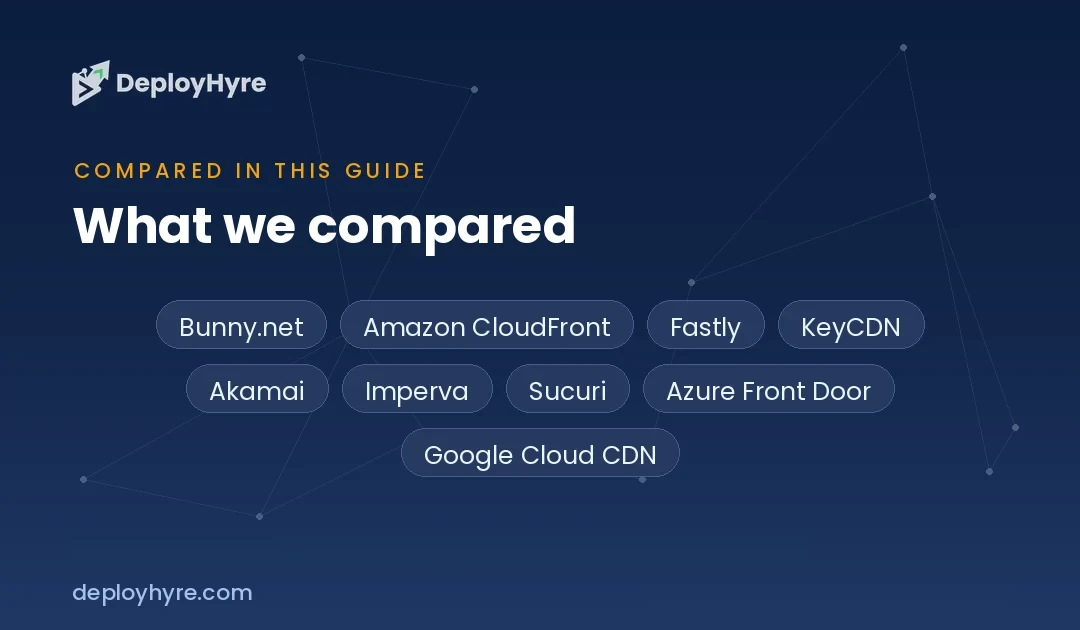
The best Cloudflare alternatives in 2026 are Bunny.net for low-cost CDN delivery, Amazon CloudFront for AWS users, and Fastly for developers who want edge control. Akamai and Imperva suit enterprises with heavy security needs. Sucuri suits WordPress site owners. KeyCDN, Azure Front Door and Google Cloud CDN fit simple CDN setups or teams already on those clouds.
Table of Contents
Cloudflare sits in front of a huge share of the web. Per W3Techs data for November 2026, Cloudflare is used by 28.9% of all websites and holds an 86.3% share of the known reverse proxy market. That reach makes it the default choice for CDN, DNS and DDoS protection.
It also makes it a single point of failure. On November 18, 2025, a Cloudflare outage took down large parts of the web for several hours. Cloudflare’s own post mortem says the cause was an internal configuration error, not an attack. Many teams began looking for a backup or a second provider.
This guide compares nine Cloudflare alternatives by use case, verified pricing and real limits. For the security side, see our guide to the best AI DDoS protection services.
Quick Comparison: Cloudflare Alternatives at a Glance
| Tool | Best For | Starting Price | Key Strength |
|---|---|---|---|
| Bunny.net | Low-cost CDN | $0.01/GB (NA, EU); $1 minimum | Simple pay-as-you-go pricing |
| Amazon CloudFront | AWS users | Free plan; Pro $15/month | Flat-rate plans with WAF |
| Fastly | Developer edge control | Free tier; $0.12/GB after | Real-time config and edge compute |
| Akamai | Large enterprises | Sales quote | Huge global network |
| Imperva | Enterprise app security | Check the current price | WAF and bot protection |
| Sucuri | WordPress site owners | $9.99/month | Firewall plus malware cleanup |
| KeyCDN | Simple CDN setups | $0.04/GB (NA, EU) | Easy CDN-only service |
| Azure Front Door | Microsoft Azure users | $35/month base | CDN and WAF on Azure |
| Google Cloud CDN | Google Cloud users | $0.08/GiB (NA) | Native GCP load balancing |
What Makes a Great Cloudflare Alternative?
A great Cloudflare alternative delivers content fast from a wide global network. It protects your site from DDoS attacks and common web threats. Its pricing is clear and predictable at your traffic level. It should also make migration easy, with simple DNS changes, good caching controls and clear docs. The right pick depends on whether you need a CDN, security or both.
Cloudflare bundles many services in one plan. Most alternatives focus on one or two of them. So decide first which parts you are replacing: CDN, DNS, WAF, DDoS protection or edge compute.
Why Do Teams Switch From Cloudflare?
Concentration risk is a big reason. The November 2025 outage showed what happens when one provider fronts so much traffic. Some teams now add a second CDN instead of fully leaving.
Pricing at higher tiers is another. Per the Cloudflare plans page, Free costs $0, Pro is $20 per month billed annually or $25 monthly, and Business is $200 per month annually or $250 monthly. Enterprise is a custom annual contract. The jump from Business to Enterprise is where many teams start shopping.
Finally, some teams want a specific feature. A review by security writer Deepak Gupta notes that buyers often leave for deeper enterprise security, tighter AWS ties or performance-focused edge compute. It also says Cloudflare remains an excellent platform, so switching is about fit.
Best Cloudflare Alternatives for CDN and Performance
1. Bunny.net: Best for Low-Cost CDN Delivery
Bunny.net is a fast, low-cost CDN with simple per-GB pricing and no long contracts.
What it does well. Bunny.net is easy to set up and very cheap for traffic in Europe and North America. It also offers storage, video delivery and image optimization. It appears on most Cloudflare alternatives lists we reviewed.
Key features:
- Standard network with 119 points of presence
- Cheaper volume network for large files
- Edge storage and video streaming
- Bunny Shield for WAF and DDoS protection
Pricing. Per the Bunny.net pricing page, the standard network costs $0.01 per GB in Europe and North America, $0.03 in Asia and Oceania, and up to $0.06 in the Middle East and Africa. The minimum charge is $1 per month. There is a 14-day free trial with no credit card. Shield prices were not listed on that page, so check the current price.
Best for: Small sites, indie developers and media sites that want cheap, fast delivery.
Limitations. There is no free plan like Cloudflare’s. Security tools are newer and less deep than Cloudflare’s or Akamai’s.
2. Amazon CloudFront: Best for AWS Users
Amazon CloudFront is AWS’s global CDN, now sold with flat-rate plans that bundle security.
What it does well. CloudFront works natively with S3, EC2, Lambda and AWS Shield. Its newer flat-rate plans bundle CDN, DNS, DDoS protection and WAF with no overage charges. That makes it a close match to Cloudflare’s plan model.
Key features:
- Flat-rate plans with no overage charges
- Always-on DDoS protection and WAF
- Edge compute with CloudFront Functions and Lambda@Edge
- Deep AWS integration
Pricing. Per the CloudFront pricing page, the Free plan includes 1 million requests and 100GB of transfer per month. Pro is $15 per month and Business is $200 per month, each per distribution. Premium is $1,000 per month. A pay-as-you-go option is also available.
Best for: Teams already hosting on AWS.
Limitations. The Free plan excludes logging, bot management and an uptime SLA. AWS billing and setup can feel complex for small teams.
3. Fastly: Best for Developer Edge Control
Fastly is a developer-focused edge cloud known for instant cache purges and programmable delivery.
What it does well. Fastly lets engineers push config changes and purge cache in near real time. Its Compute platform runs code at the edge. Large media and ecommerce sites use it for fine control over caching.
Key features:
- Instant purge and real-time logs
- Edge compute with WebAssembly
- Next-Gen WAF and bot management
- Free tier for testing
Pricing. Per the Fastly pricing page, the free tier includes 100GB of bandwidth and 1 million requests per month. After that, North America and Europe cost $0.12 per GB for the first 10TB, plus request fees. Fixed CDN packages start at $1,500 per month. WAF and bot tools are quote only.
Best for: Engineering teams that want deep control over caching and edge logic.
Limitations. Per-GB rates are much higher than Bunny.net’s. It takes more technical skill to configure.
4. KeyCDN: Best for Simple CDN Setups
KeyCDN is a straightforward, CDN-only service with pay-as-you-go pricing.
What it does well. KeyCDN does one job and keeps it simple. It supports HTTP/2, free TLS certificates, image processing and a clean dashboard. It is popular with WordPress users who only want faster asset delivery.
Key features:
- Pull and push zones
- Image processing on the fly
- Free Let’s Encrypt certificates
- Real-time analytics
Pricing. Per the KeyCDN pricing page, the first 10TB costs $0.04 per GB in North America and Europe, $0.08 in Asia and Oceania, and $0.10 in Africa and Latin America. The page lists both a $4 monthly minimum usage charge and a $49 minimum payment, so check the current terms.
Best for: Site owners who want a simple CDN without security bundles.
Limitations. It has no DDoS-focused WAF like Cloudflare’s. The page lists no free trial.
Best Cloudflare Alternatives for Security and Enterprise
5. Akamai: Best for Large Enterprises
Akamai is one of the oldest and largest CDN and security providers in the world.
What it does well. Akamai offers a massive edge network plus WAF, bot management, API security and DDoS defense. Banks, governments and global media firms use it. Every list we reviewed named it as the top enterprise pick.
Key features:
- Large global edge network
- App and API protection with WAF
- Bot management and DDoS defense
- Akamai Cloud compute for apps
Pricing. The Akamai pricing page lists prices only for Akamai Cloud compute. Security and delivery products are sold through sales, so expect a custom quote.
Best for: Large enterprises with strict security and uptime needs.
Limitations. No public CDN prices and no self-serve plan. It is overkill for small sites.
6. Imperva: Best for Enterprise App Security
Imperva, now part of Thales, focuses on web app, API and data security with a built-in CDN.
What it does well. Imperva’s cloud WAF, bot protection and DDoS mitigation are its core. It suits teams that care more about security than raw delivery speed. Reviewers often pair it with Akamai as an enterprise security choice.
Key features:
- Cloud WAF and API security
- Advanced bot protection
- DDoS protection for sites and networks
- Built-in CDN
Pricing. Imperva does not show a simple public plan list. Check the current price on the Imperva plans page or ask sales for a quote.
Best for: Security-led enterprises and regulated industries.
Limitations. Pricing is not transparent. Small teams will find it complex.
7. Sucuri: Best for WordPress Site Owners
Sucuri combines a website firewall and CDN with malware scanning and cleanup.
What it does well. Sucuri is built for site owners, not network engineers. Its firewall blocks attacks and its team can clean up a hacked site. That pairing is rare among CDN providers.
Key features:
- Cloud WAF with virtual patching
- CDN for faster page loads
- Malware scanning and removal
- DDoS mitigation
Pricing. Per the Sucuri signup page, Basic Firewall is $9.99 per month and Pro Firewall is $19.98 per month. Multi-site plans are priced on request. Sucuri mentions up to 30% off for multi-year terms.
Best for: WordPress and small business sites that want security and cleanup in one place. Pair it with one of the hosts in our best managed WordPress hosting guide.
Limitations. It is not a full edge platform. There is no free plan.
Best Cloudflare Alternatives for Cloud-Native Teams
8. Azure Front Door: Best for Microsoft Azure Users
Azure Front Door is Microsoft’s global CDN, load balancer and WAF in one service.
What it does well. It routes traffic to the closest healthy Azure backend and adds WAF rules at the edge. Premium adds managed rules and bot protection. It fits naturally for teams already on Azure.
Key features:
- Global load balancing and CDN
- WAF with managed rule sets on Premium
- Private Link to Azure origins
- Built-in analytics
Pricing. Per the Azure Front Door pricing page, Standard has a $35 monthly base fee and Premium has a $330 monthly base fee. Data transfer in North America costs $0.083 per GB for the first 10TB. Microsoft calls these estimates.
Best for: Companies running workloads on Azure.
Limitations. Base fees add up across many sites. It is less useful if your apps live outside Azure.
9. Google Cloud CDN: Best for Google Cloud Users
Google Cloud CDN caches content on Google’s edge network behind its cloud load balancer.
What it does well. It plugs straight into Google Cloud load balancing, storage and Cloud Armor for security. Billing is simple usage-based pricing on your existing Google Cloud account.
Key features:
- Runs on Google’s global edge
- Works with Cloud Load Balancing
- Cloud Armor for WAF and DDoS
- Signed URLs and cookies
Pricing. Per the Google Cloud CDN pricing page, cache egress in North America costs $0.08 per GiB for the first 10TiB. Cache lookups cost $0.0075 per 10,000 requests. Cache fill is billed separately.
Best for: Teams already building on Google Cloud.
Limitations. Security features cost extra through Cloud Armor. There is no flat-rate plan.
How Should You Choose the Right Cloudflare Alternative?
Start by naming what you need to replace. If you only need a CDN, Bunny.net or KeyCDN is cheaper and simpler. If you need security first, look at Akamai, Imperva or Sucuri. If you run on a big cloud, use its native CDN: CloudFront, Azure Front Door or Google Cloud CDN.
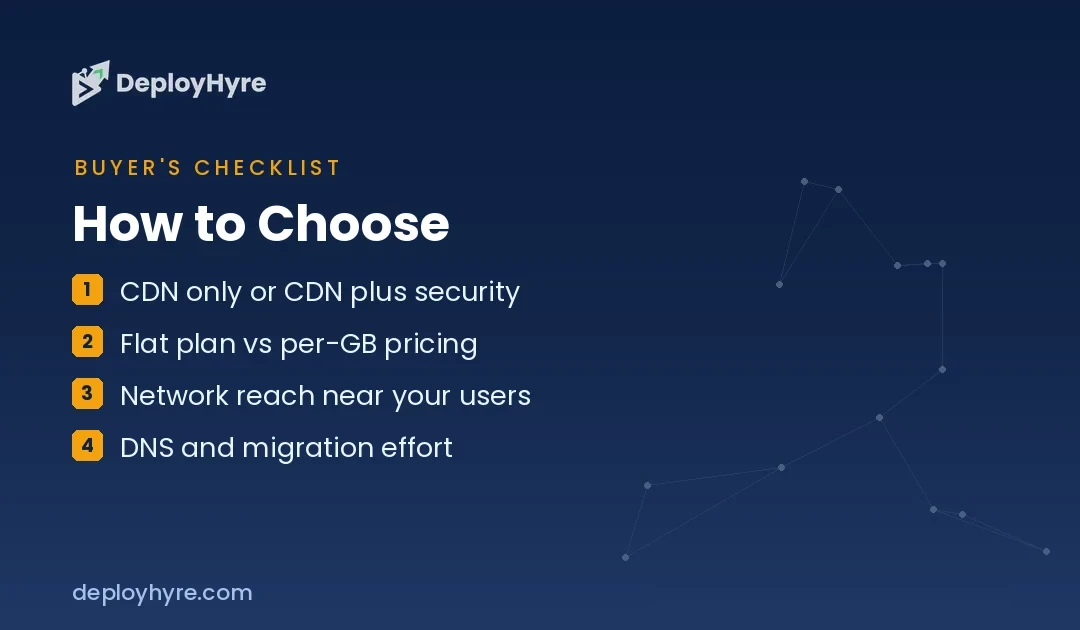
Then check these four points:
- Pricing model. Flat plan or per GB. Model your real monthly traffic.
- Security depth. WAF rules, bot management and DDoS limits.
- Network reach. Points of presence near your users.
- Migration effort. DNS cutover, cache rules and SSL setup.
You do not have to pick only one. Many teams now run a second CDN as a fallback, so one outage does not take their site down. If you host on platforms like Vercel or Netlify, their built-in edge networks may cover your needs too. Our Vercel alternatives and Netlify alternatives guides cover those options.
How We Evaluated These Tools
We did not run our own speed or load tests. Instead, we compared these tools using public information. Here is exactly what we checked:
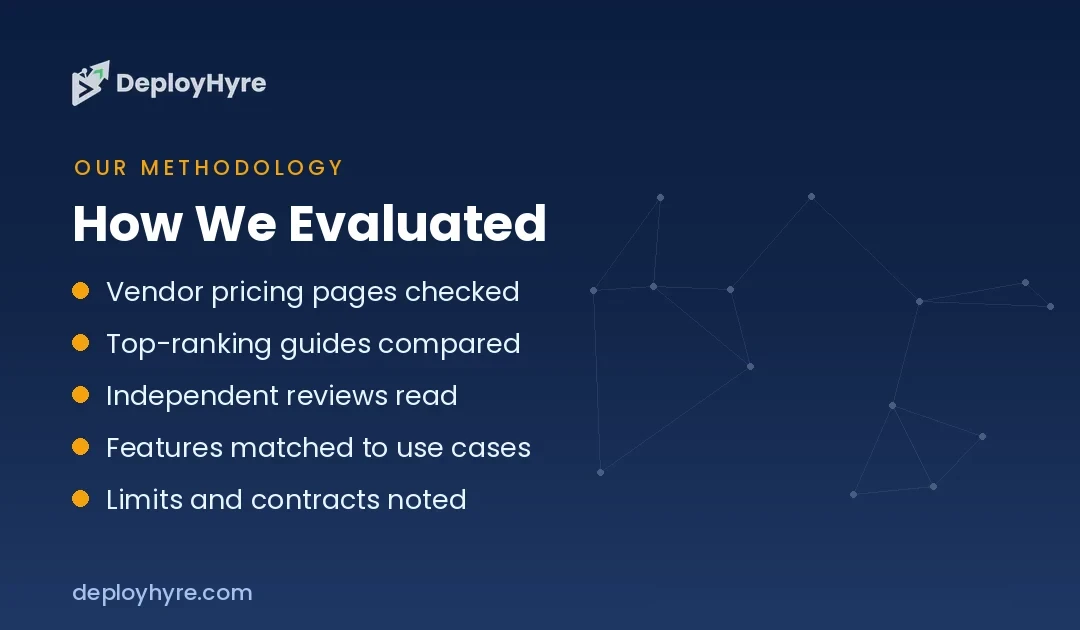
- Ranking pages. We read the top pages ranking for “Cloudflare alternatives” in November 2026, including Blogging Wizard, CDNsun, IO River, Deepak Gupta and a DEV Community guide. We included tools named on three or more of them, plus two security picks.
- Pricing. We opened each vendor’s own pricing page in November 2026. Where prices were quote only or unclear, we say so.
- Features and limits. We checked free tiers, minimum charges, security features and plan limits.
- Market data. We used W3Techs for usage share and Cloudflare’s own post mortem for the outage details.
Performance claims come from the vendors unless we say otherwise. Prices change often, so confirm them before you buy.
The Bottom Line
Cloudflare is still a great default, but it is not the only good option. Bunny.net is the best value for most sites that just need a fast CDN. Amazon CloudFront is the closest all-in-one match now that it sells flat-rate plans with WAF and DDoS protection. Fastly suits developers who want edge control. Akamai and Imperva lead for enterprise security, and Sucuri is the easy pick for WordPress owners.
If outages are your main worry, consider adding a second provider rather than leaving entirely. For hosting choices that pair well with any CDN, see our guide to the best cloud hosting providers.
Frequently Asked Questions
What is the best alternative to Cloudflare?
Bunny.net is the best Cloudflare alternative for most small and mid-size sites. It costs $0.01 per GB in Europe and North America with a $1 monthly minimum. Amazon CloudFront is the best all-in-one alternative, since its flat-rate plans bundle CDN, DNS, WAF and DDoS protection, and Akamai is the top enterprise pick.
Is there a free Cloudflare alternative?
Yes. Amazon CloudFront has a Free flat-rate plan with 1 million requests and 100GB of transfer per month. Fastly’s free tier also includes 100GB of bandwidth and 1 million requests. Bunny.net offers a 14-day free trial, then costs as little as $1 per month for light traffic.
Why would you stop using Cloudflare?
Common reasons include concentration risk after the November 18, 2025 outage, high costs at the Enterprise tier, and a need for features like tighter AWS integration or deeper enterprise security. Many teams do not leave fully. Instead, they add a second CDN as a fallback.
Can I use two CDNs at the same time?
Yes. A multi-CDN setup sends traffic through two or more providers, often using DNS-based routing. If one provider fails, traffic shifts to the other. It adds cost and setup work, so it makes most sense for sites where downtime directly costs revenue.
Which Cloudflare alternative is best for WordPress?
Sucuri is the best Cloudflare alternative for most WordPress sites. It combines a firewall, CDN and malware cleanup, starting at $9.99 per month. If you only need faster asset delivery, KeyCDN and Bunny.net both work well with popular WordPress caching plugins.
Related Articles




The DeployHyre Editorial Team writes buyer guides on AI tools, SaaS, cloud hosting and proxies. We compare tools using published pricing, official documentation and third-party reviews. All content is for educational and informational purposes only.