BrandVerity, owned by Partnerize since 2020, monitors paid search ads and partner compliance, but it sells on custom quotes. The best BrandVerity alternatives in 2026 are The Search Monitor and Adthena for enterprise brand bidding protection, Bluepear for affiliate brand bidding on a budget, Red Points, BrandShield, Corsearch, and MarkMonitor for wider brand protection, and Semrush or SpyFu for do it yourself ad checks.
Table of Contents
Adthena says its brand protection helped Eurostar cut cost per click on brand terms by 45%. That vendor case study shows why brand bidding matters. When a rival or a rogue affiliate bids on your trademark, you pay more for clicks you should own.
BrandVerity has been a standard tool for catching those ads. Partnerize acquired BrandVerity in May 2020, folding it into a partnership platform. BrandVerity’s site lists paid search monitoring, web compliance, and managed services, but no public prices. On G2, it holds a 4.4 out of 5 rating from just 19 reviews.
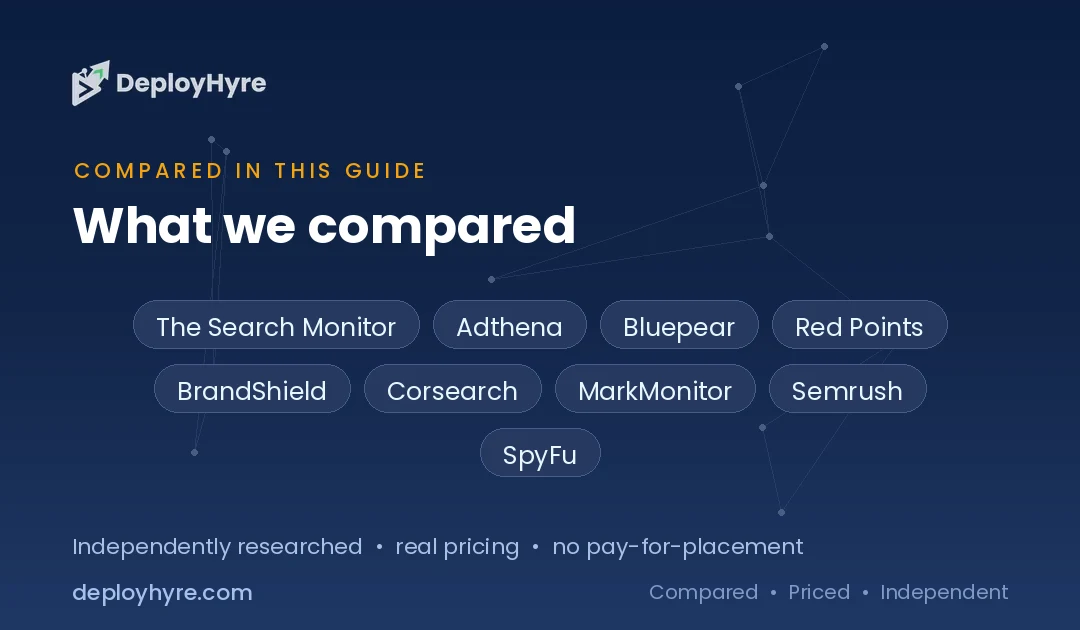
This guide covers nine alternatives grouped by job. If you also fight wider fraud, see our guide to the best AI fraud detection software.
Quick Comparison: Top BrandVerity Alternatives in 2026
| Tool | Best For | Starting Price | Key Strength |
|---|---|---|---|
| The Search Monitor | Multi engine brand bidding | Custom quote | 10 search engines covered |
| Adthena | Google Ads auto takedown | Custom quote | Search competitive intelligence |
| Bluepear | Affiliate brand bidding | $199/mo (per Capterra) | Screenshots and redirect evidence |
| Red Points | Counterfeits plus fake ads | Custom quote | 5,000+ marketplaces |
| BrandShield | Phishing and impersonation | Custom quote | Lookalike domain takedowns |
| Corsearch | Trademark clearance and watch | Custom quote | Trademark plus brand protection |
| MarkMonitor | Corporate domain portfolios | Custom quote | Domain management |
| Semrush | DIY competitor ad research | Check the current price | Broad SEO and PPC data |
| SpyFu | Budget ad history checks | $33/mo (annual) | Low cost PPC history |
What Makes a Great BrandVerity Alternative?
A great BrandVerity alternative finds ads that bid on your brand terms, proves the violation with screenshots, and helps you get the ads removed. It should cover the search engines and countries where you sell. It should also catch affiliates who hide behind redirects. Clear pricing and fast alerts are a strong bonus.
Why Do Teams Switch From BrandVerity?
Pricing is the first reason. BrandVerity does not list prices on its site, so small teams must go through sales. The second is scope. BrandVerity centers on paid search and partner compliance. Brands that also fight counterfeits, phishing, or fake social accounts often want one wider tool.
The third is ownership. Since the Partnerize deal, BrandVerity sits inside a partnership platform. Some advertisers prefer a neutral, standalone vendor for compliance. Review volume is also thin, with 19 reviews on G2, so buyers often compare options before signing.
Which BrandVerity Alternatives Are Best for Paid Search Brand Bidding?
The Search Monitor, Adthena, and Bluepear are the best BrandVerity alternatives for paid search brand bidding. All three watch branded search results and flag ads from rivals or affiliates. The Search Monitor covers the most engines. Adthena adds competitor intelligence and Google Ads auto takedown. Bluepear is the most budget friendly, with prices listed on Capterra.
1. The Search Monitor: Best for multi engine brand bidding protection
The Search Monitor is the closest direct competitor to BrandVerity’s paid search product.
What it does well. Its Brand Protection product detects unauthorized brand use in PPC ads and automates trademark complaints to search engines, per the vendor. It says it covers 10 search engines on desktop and mobile.
Key features:
- Brand bidding detection and takedown complaints
- Google, Bing, Yahoo, Amazon, Baidu, Yandex, Naver, and more
- Affiliate compliance monitoring
- Ad Armor for brand keyword budget control
Pricing. The Search Monitor does not show prices on its homepage. Check the current price.
Best for: Brands that sell in many countries and need coverage beyond Google.
Limitations. Quote based pricing, like BrandVerity. Smaller advertisers may not need 10 engines.
2. Adthena: Best for Google Ads brand protection with auto takedown
Adthena is a search intelligence platform with a dedicated brand protection module.
What it does well. Adthena says its tools offer auto takedown for trademark infringements on Google Ads, with round the clock monitoring and an expert team. It also shows who competes on your terms, which helps you set brand bids.
Key features:
- Auto takedown for Google Ads trademark abuse
- 24/7 brand term monitoring
- Competitive search intelligence
- Expert support for brands and agencies
Pricing. Adthena does not publish prices. Check the current price.
Best for: Large Google Ads spenders who want brand protection and competitor insight in one tool.
Limitations. Its brand protection page focuses on Google Ads. It is priced for mid market and enterprise budgets.
3. Bluepear: Best for affiliate brand bidding on a budget
Bluepear is a focused tool for catching affiliates and rivals who bid on your brand.
What it does well. According to its Capterra listing, Bluepear monitors branded searches on Google, Bing, Yahoo, and Yandex. It captures SERP and landing page screenshots plus redirect chains as evidence. Alerts go to Slack, Telegram, or email.
Key features:
- Brand bidding and ad hijacking detection
- Coupon code abuse and cloaked link detection
- Screenshot and redirect chain evidence
- 7 day free trial with no card, per Capterra
Pricing. Bluepear’s own site blocked our access, so this comes from Capterra. It lists a Lite plan at $199 per month with 20 keywords and a Business plan at $599 per month. Check the current price.
Best for: Affiliate managers at small and mid size brands.
Limitations. It has only a handful of reviews. One reviewer found tracking link setup confusing for non technical users.
Which BrandVerity Alternatives Cover Wider Brand Protection?
Red Points, BrandShield, Corsearch, and MarkMonitor cover threats beyond search ads. Red Points fights counterfeits on marketplaces and fake ads. BrandShield targets phishing sites and lookalike domains. Corsearch serves trademark and legal teams. MarkMonitor manages and secures corporate domain portfolios. Most brands pair one of these with a search focused tool rather than replacing it.
4. Red Points: Best for counterfeits plus fraudulent ads
Red Points covers ads, marketplaces, social media, and domains in one platform.
What it does well. Red Points says it finds and removes infringing listings on more than 5,000 marketplaces. It also says it takes down fraudulent ads in more than 240 countries and territories.
Key features:
- Marketplace counterfeit removal
- Fake social profile enforcement
- Domain and fake website takedowns
- Fraudulent ad detection and removal
Pricing. Red Points does not list prices and directs buyers to sales. Check the current price.
Best for: Ecommerce and consumer brands fighting counterfeits as well as ad abuse.
Limitations. It is not built around affiliate compliance like BrandVerity. Brands that only need search ad checks may pay for unused features.
5. BrandShield: Best for phishing and impersonation
BrandShield focuses on online threats that copy your brand to trick customers.
What it does well. BrandShield says it detects and removes phishing sites, lookalike domains, and copycat websites. It also lists marketplace protection and a paid ad scams solution.
Key features:
- Phishing site detection and removal
- Lookalike domain takedowns
- Marketplace brand protection
- Paid ad scam detection
Pricing. BrandShield offers demos only. Check the current price.
Best for: Banks, travel, and retail brands targeted by scam sites.
Limitations. Its site gives little detail on its paid ad product. Search ad monitoring is not its main focus. For more security tools, see our best AI cybersecurity tools guide.
6. Corsearch: Best for trademark clearance and watching
Corsearch pairs trademark services with brand and content protection.
What it does well. Corsearch covers trademark screening, clearance, and watching for infringing filings worldwide. It also handles counterfeits, impersonation, gray market sales, and domain protection.
Key features:
- Trademark screening, clearance, and watch
- Investigations and revenue recovery
- Domain and distribution control
- Pirated content removal
Pricing. Corsearch does not publish prices. Check the current price.
Best for: Legal and IP teams that manage trademarks across many markets.
Limitations. Its homepage does not mention paid search ad monitoring. You may still need a search tool for brand bidding.
7. MarkMonitor: Best for corporate domain portfolios
MarkMonitor is a corporate domain registrar and domain security service.
What it does well. It manages large domain portfolios and watches for domain threats through its DomainWatch service. It also offers domain recovery, dotBrand services, and DNS security.
Key features:
- Corporate domain portfolio management
- DomainWatch threat monitoring
- Domain recovery and dotBrand services
- Global DNS and security services
Pricing. MarkMonitor does not list prices. Check the current price.
Best for: Large companies that own hundreds of domains.
Limitations. It does not monitor search ads. Pair it with a brand bidding tool if that is your main problem.
What Are the Best DIY BrandVerity Alternatives for Small Advertisers?
Semrush and SpyFu are the best do it yourself options for small advertisers. Neither is a dedicated brand protection tool. Both let you look up your brand terms and see which domains have run ads on them. That is enough for spot checks. You will not get real time alerts, screenshot evidence, or takedown support.
8. Semrush: Best for DIY competitor ad research
Semrush is a broad SEO and PPC suite, not a dedicated brand protection tool.
What it does well. Its advertising research shows which domains run ads on your keywords and what their ad copy says. That lets small teams spot brand bidders by hand.
Key features:
- Advertising research by keyword and domain
- Ad copy history
- Position tracking for brand terms
- SEO and content tools in the same account
Pricing. The Semrush pricing page blocked our access during review. Check the current price.
Best for: Small advertisers who already pay for Semrush.
Limitations. It samples data rather than scanning around the clock. It does not file takedowns. Compare it with its main rival in our Semrush vs Ahrefs breakdown.
9. SpyFu: Best for budget ad history checks
SpyFu is a low cost tool for seeing who has bid on a keyword over time.
What it does well. SpyFu is known for its PPC history. You can look up your brand terms and see which domains have bought ads on them.
Key features:
- Keyword ad history
- Competitor PPC keyword lists
- Ad copy samples
- SEO research tools
Pricing. SpyFu lists Basic at $33 per month billed annually or $39 monthly. Professional is $58 per month billed annually or $79 monthly.
Best for: Small businesses that want a cheap way to check for brand bidders.
Limitations. It offers no real time alerts, evidence capture, or takedown help.
How Should You Choose the Right BrandVerity Alternative?
Start with the threat. If affiliates and rivals bid on your brand, choose a search focused tool such as The Search Monitor, Adthena, or Bluepear. If counterfeits, phishing, or fake accounts are the bigger risk, choose Red Points or BrandShield.
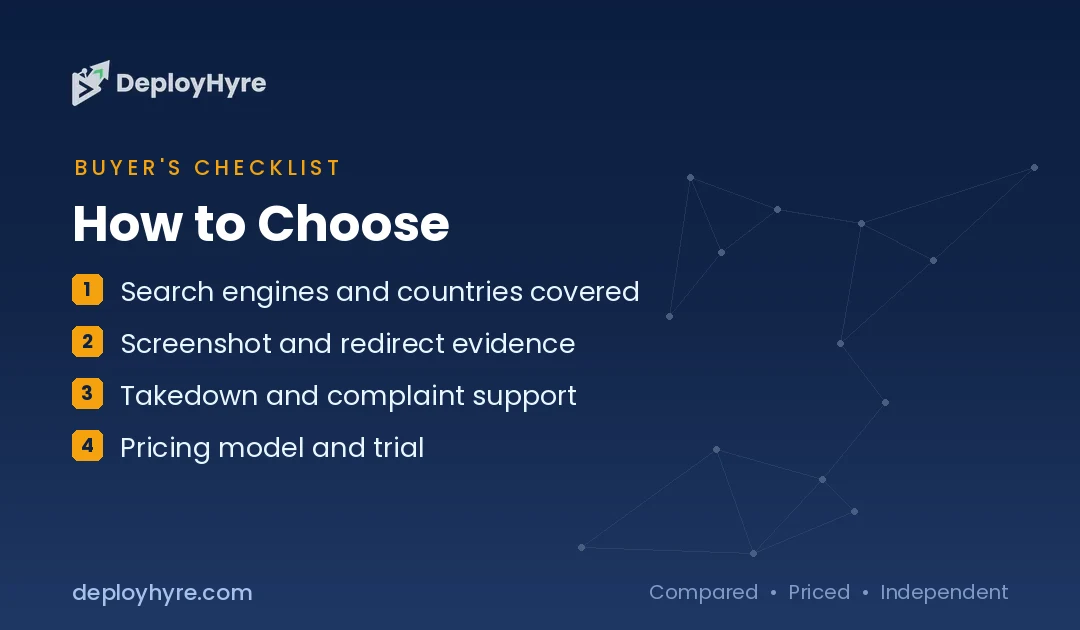
Next, check coverage. List the engines, countries, and devices that matter. A US retailer may only need Google and Bing. A global travel brand may need Baidu, Naver, and Yandex too.
Then look at evidence and enforcement. Good tools capture screenshots and redirect chains, which you need to act on affiliate terms. Ask whether the vendor files takedown complaints for you. Finally, test with a trial or pilot on your top brand terms before you sign an annual deal.
One more tip: check your own affiliate terms. Most programs ban brand bidding, but the ban only helps if your terms spell it out and your monitoring tool can prove a breach. Clear terms plus good evidence make it far easier to claw back commissions from affiliates who break the rules.
How We Evaluated These Tools
We compared and reviewed these tools. We did not run hands on tests. Here is exactly what we checked:
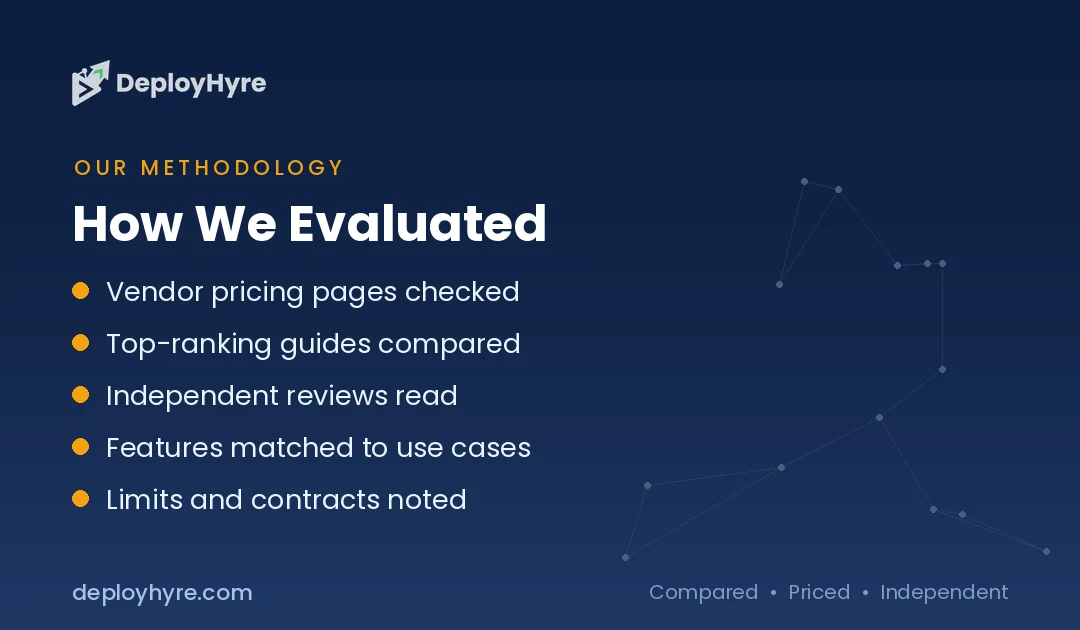
- Each vendor’s own product and pricing pages in November 2026
- BrandVerity’s site for its current product list
- The top ranking BrandVerity alternatives pages, to find tools listed on three or more
- Independent listings on G2 and Capterra
- Press coverage of the Partnerize acquisition of BrandVerity
Where a vendor page was blocked or showed no price, we say so and name any third party source. Feature claims are the vendor’s own unless stated otherwise.
The Bottom Line
BrandVerity is still a solid paid search compliance tool, but it is not the only option. For direct replacement, The Search Monitor offers the widest engine coverage, and Adthena suits big Google Ads spenders who also want competitor data. Bluepear is the most budget friendly focused option, based on its Capterra listed prices.
If your risk goes beyond search ads, Red Points and BrandShield cover counterfeits and scams, while Corsearch and MarkMonitor serve legal and domain teams. Small advertisers can start with SpyFu or Semrush checks. For more ad tooling, see our list of AI ad creative tools.
Frequently Asked Questions
What is brand bidding?
Brand bidding is when a competitor or affiliate buys search ads on your brand name or trademark. Their ad shows when people search for you, so you may pay more per click to stay on top. Many affiliate programs ban it in their terms. Tools like BrandVerity and its alternatives detect these ads and help remove them.
Who owns BrandVerity?
Partnerize owns BrandVerity. Partnerize, a partnership automation platform, announced the deal in May 2020, according to Business Wire. BrandVerity still runs its own site and sells paid search monitoring, web compliance monitoring, and managed services. Its site lists no public prices, so buyers request a quote.
What is the cheapest BrandVerity alternative?
SpyFu is the cheapest option we found, starting at $33 per month on annual billing, but it only shows ad history. For real brand bidding alerts with evidence, Bluepear is the lowest cost focused tool, with a Lite plan listed at $199 per month on Capterra. Most enterprise tools use custom quotes.
Can Google remove ads that use my trademark?
Yes, in many cases. Google lets trademark owners file complaints about ads that use their trademark in ad text. Rules differ by country and by whether the trademark appears in the keyword or the ad copy. Tools such as The Search Monitor and Adthena say they automate or speed up these complaints.
Is Adthena better than BrandVerity?
It depends on your goal. Adthena pairs brand protection with search competitive intelligence and says it offers auto takedown on Google Ads. BrandVerity focuses on paid search and partner compliance, including affiliate monitoring. If you want competitor insight too, Adthena may fit better. For affiliate compliance, BrandVerity or Bluepear may fit better.
Related Articles

David Austin is a technology writer and software analyst at DeployHyre, where he covers AI tools, SaaS platforms, cloud hosting, and business automation. He compares tools on published pricing, official documentation and independent reviews so teams can pick the right software with confidence.
Know AI, SaaS, or cloud tools inside out? Pitch a guest post and get in front of thousands of buyers researching their next tool.