The platform as a service market is worth $140.63 billion in 2026, up from $127.4 billion in 2025. The category is growing. Heroku, the product that defined it, is not.
In February 2026 Salesforce moved Heroku into what it calls a sustaining engineering model. Heroku now receives security patches and stability fixes but no new features, and Salesforce stopped selling Enterprise contracts to new customers. SiliconANGLE reported the change on February 6, 2026, and DevOps.com confirmed the feature freeze shortly after.
Nothing breaks tomorrow. Existing credit card customers keep their pricing, their billing, and their support. But sustaining engineering is the phase that comes before end of life, and a platform that has stopped evolving is a poor place to put a five year bet.
We compared seven Heroku alternatives on published 2026 pricing, free tier reality, database costs, and migration effort. Every figure below links to the vendor documentation it came from. This guide sits inside our wider comparison of the best PaaS platforms and our cloud hosting coverage.
Table of Contents
Quick Comparison: Top 7 Heroku Alternatives
| Platform | Best For | Entry Price | Managed Postgres |
|---|---|---|---|
| Railway | The closest feel to classic Heroku | $5 per month Hobby | Yes, one click |
| Render | Flat plans that ignore team size | $0 Hobby, $25 Pro workspace | Yes, included tiers |
| Northflank | An always on free sandbox | Free, then $0.01667 per vCPU hour | Yes, one in the free tier |
| Google Cloud Run | Scale to zero and no idle bill | Free tier, then per request | Via Cloud SQL, billed separately |
| DigitalOcean App Platform | Flat container pricing | $5 per month | Yes, from $7 per month |
| Fly.io | Running close to users worldwide | Usage based, no plan fee | Yes, unmanaged option |
| Coolify | Zero lock in and full cost control | Free self hosted | Yes, self managed |
What Actually Changed at Heroku?
Salesforce placed Heroku into sustaining engineering mode in February 2026, which limits the platform to security and stability work. New Enterprise contracts are no longer sold. Existing Enterprise customers can renew. Self serve credit card accounts continue unchanged. Salesforce redirected its engineering investment toward Agentforce and other AI products.
Three practical consequences follow from that decision.
The roadmap is now defensive. DevClass described the move as putting Heroku's future in doubt. Features you want in 2028 will not arrive. Competitors shipped autoscaling, preview environments, and per second billing while Heroku was already slowing down.
The platform is mid migration and frozen there. Heroku runs two generations side by side. Per Heroku generations documentation, stacks Heroku-20 and Heroku-22 run only on Cedar, while Heroku-24 and Heroku-26 run on either Cedar or Fir. Moving to Fir is a manual job because Fir uses Cloud Native Buildpacks, ARM infrastructure, and IPv6 by default.
Vendor risk becomes a board conversation. Explaining why core infrastructure sits on a frozen product is a discussion most engineering leads would rather avoid during a funding round or a security review.
What Does Heroku Cost?
Heroku dynos cost $5 per month for the Eco plan, $7 for Basic, $25 for Standard-1X, and $250 for Performance-M. Those figures are the maximum charge for running a dyno every hour of the month. Heroku bills wall clock time rather than CPU time, so a dyno scaled above zero accrues charges whether or not anyone visits your app.
These are the Common Runtime rates from the Heroku usage and billing documentation.
| Dyno Type | Price Per Hour | Max Price Per Month |
|---|---|---|
| Eco | ~$0.005 | $5 for 1,000 pooled dyno hours |
| Basic | ~$0.01 | $7 |
| Standard-1X | ~$0.03 | $25 |
| Standard-2X | ~$0.06 | $50 |
| Performance-M | ~$0.34 | $250 |
| Performance-L | ~$0.69 | $500 |
| Performance-XL | ~$1.04 | $750 |
| Performance-2XL | ~$2.08 | $1,500 |
The dyno is rarely the whole bill. Heroku Postgres starts at $5 per month for Essential-0 and reaches $50 for Standard-0. Add a key value store, a logging add-on, and a second dyno for background jobs, and a modest production app lands between $50 and $80 per month before traffic costs.
The free tier is long gone. Heroku removed free dynos, free Postgres, and free Key-Value Store on November 28, 2022 and converted existing free dynos to Eco dynos scaled to zero. Every platform below except Heroku itself gives you some way to run something for nothing.
Best Heroku Alternatives for Small Apps and Side Projects
These platforms suit one developer, a handful of services, and a budget measured in single digit dollars.
1 Railway: Best for the closest feel to classic Heroku
Railway is what most people mean when they say they want Heroku but modern.
What it does well. Git push deploys, a service graph you can read at a glance, and one click Postgres, Redis, and MySQL. The developer experience is the closest thing on the market to Heroku in its prime, and Railway ships new features regularly.
Key features:
- Free plan at $0 per month with $1 of monthly credit for very small apps
- Hobby plan at $5 per month with $5 of usage credit included
- RAM billed at $10 per GB per month and CPU at $20 per vCPU per month
- Network egress at $0.05 per GB and volume storage at $0.15 per GB per month
- Pro raises the ceiling to 1 TB RAM and 1,000 vCPU per service
Pricing. Free $0, Hobby $5, Pro $20 per month with unlimited seats, per the Railway pricing plans documentation. The subscription fee is credited toward usage rather than charged on top, so a Hobby app consuming $3 of resources costs $5 in total, and one consuming $7 costs $7.
Best for: Solo developers and small teams migrating off Heroku who want the same workflow.
Limitations. The plan fee is a minimum spend, not a ceiling. Railway sets no hard spending cap, only alerts, so a traffic spike bills automatically. Pro costs $20 per month with unlimited workspace seats, so team size does not raise the fee.
2 Render: Best for flat pricing that ignores headcount
Render replaced per seat billing with flat workspace fees in April 2026.
What it does well. The change removed the seat tax that made Render expensive for growing teams. A Pro workspace costs $25 per month no matter how many people you invite. Managed Postgres includes point in time recovery on paid instances.
Key features:
- Hobby workspace at $0 per month with 5 GB bandwidth and up to 25 services
- Pro workspace at $25 per month with 25 GB bandwidth and unlimited team members
- Scale workspace at $499 per month with 1 TB bandwidth and SAML SSO
- Bandwidth beyond the allowance billed at $0.15 per GB
- SOC 2 and ISO 27001 compliance reports available from the Pro tier
Pricing. A workspace fee plus instance costs. Per the Render new workspace plans documentation, the April 23, 2026 change removed seat fees and moved bandwidth and custom domains to usage billing. Instances run from a free tier through Starter and Standard up to Pro Ultra.
Best for: Teams of three or more who want one predictable line item instead of a per head charge.
Limitations. That same repricing cut bandwidth to 5 GB on Hobby and 25 GB on Pro. Free web services spin down after 15 minutes of inactivity and take about a minute to wake, which rules them out for anything user facing.
3 Northflank: Best for an always on free tier with no expiry
Northflank runs the most generous free sandbox in the category.
What it does well. The free tier stays on rather than expiring after a trial window, and it includes a real database rather than a toy one. Billing uses published per unit rates charged per second instead of opaque credits, which makes cost modelling straightforward.
Key features:
- Free sandbox with two services, one database, and two cron jobs, with no expiry date
- Compute billed at $0.01667 per vCPU hour and $0.00833 per GB memory hour
- Per second billing rather than per minute or per hour rounding
- Managed Postgres, Redis, MySQL, and MongoDB
- Bring your own cloud deployment available on Enterprise
Pricing. Free sandbox, then pay as you go at the rates above, per the Northflank pricing page. That vCPU rate is the lowest published figure among the managed platforms in this guide.
Best for: Developers who want a permanent free environment for staging or a side project.
Limitations. A smaller community than Render or Railway means fewer tutorials and fewer Stack Overflow answers. The interface exposes more infrastructure concepts than Heroku ever did, which makes for a longer first day.
Best Heroku Alternatives for Production Teams
These platforms handle production traffic, compliance questions, and teams that need to share access.
4 Google Cloud Run: Best for scale to zero without an idle bill
Cloud Run is the only platform here that charges nothing while your app sits idle.
What it does well. Containers scale to zero between requests, so a low traffic internal tool costs cents per month rather than the $7 minimum a Heroku Basic dyno charges to do nothing. It is also the natural on ramp if you expect to need the rest of Google Cloud later.
Key features:
- Free tier of 2 million requests, 180,000 vCPU seconds, and 360,000 GiB seconds per month
- Billing rounded up to the nearest 100 milliseconds of actual use
- Requests beyond the free tier at roughly $0.40 per million in most regions
- Deploys any container image with no proprietary buildpack requirement
- Integrates with Cloud SQL, Secret Manager, and Google Cloud IAM
Pricing. Free tier as above, then metered per vCPU second and GiB second, per the Google Cloud Run pricing page. Outbound data transfer is billed separately at Google Cloud networking rates, with 1 GiB free within North America each month.
Best for: Bursty or low traffic workloads, internal tools, and teams already inside Google Cloud.
Limitations. You assemble the platform yourself. Cloud Run includes no managed Postgres, so a database means Cloud SQL and a second bill. Cold starts affect the first request after an idle period.
5 DigitalOcean App Platform: Best for flat container pricing you can predict
App Platform trades flexibility for a price you can read off a page.
What it does well. Container sizes carry fixed monthly prices with bandwidth included, so the bill stays still until you cross a clearly marked line. Static sites are genuinely free, which makes it a sensible home for a marketing site sitting next to an app.
Key features:
- Up to three apps built only from static site components hosted free
- Basic container with 1 shared vCPU and 512 MiB RAM at $5 per month
- 1 shared vCPU with 1 GiB RAM at $10 or $12 per month depending on scaling
- Development databases from $7 per month per 512 MB
- Billed per second with a one minute minimum
Pricing. Free for static sites, then from $5 per month per container, per the DigitalOcean App Platform pricing documentation. Outbound data beyond the included allowance costs $0.02 per GiB, among the cheapest egress rates in this comparison.
Best for: Teams that want a fixed monthly number and already use DigitalOcean droplets or databases.
Limitations. Fewer regions than Fly.io or Cloud Run. The build system is less flexible than Render or Railway, and complex monorepos need more configuration here than elsewhere. Our DigitalOcean alternatives guide covers the wider platform.
Best Heroku Alternatives for Scale and Cost Control
These options suit apps with global users, or teams that want to remove platform margin from the bill entirely.
6 Fly.io: Best for running close to users in many regions
Fly.io puts your containers in the cities your users are actually in.
What it does well. Anycast routing across more than 18 regions means a request from Singapore reaches a machine in Singapore. Billing runs per second with no plan fee, so an app that serves traffic six hours a day costs a quarter of one that runs around the clock.
Key features:
- Per second billing with no monthly platform fee
- A shared-cpu-1x machine with 256 MB costs roughly $1.94 per month if run continuously
- Anycast networking across 18 or more regions
- Egress at $0.02 per GB in North America and Europe
- Machines auto stop and auto start with traffic
Pricing. Usage based only. Per the Fly.io pricing documentation there is no subscription floor, but support stays community only unless you buy a Standard plan at $29 per month.
Best for: Apps with users on more than one continent, and teams comfortable with Docker.
Limitations. New signups get a trial worth two machine hours or seven days, whichever ends first, per the Fly.io free trial documentation. Stopped machines still bill for their root filesystem, and volumes bill whether or not a machine is attached to them.
7 Coolify: Best for removing platform margin entirely
Coolify is open source software that turns a plain server into your own platform.
What it does well. You run it on a cheap virtual machine and get git deploys, databases, SSL certificates, and preview environments with no per service pricing. Because you own the server, going from one app to twenty changes nothing about what you pay.
Key features:
- Free and open source under the Apache 2.0 licence
- Deploys to any server you control, including a budget VPS or bare metal
- Built in Postgres, MySQL, MongoDB, and Redis provisioning
- Automatic Let's Encrypt certificates and preview deployments
- A managed Cloud option for people who prefer not to host the controller
Pricing. Free when self hosted. Coolify Cloud starts at $5 per month for two servers. Your real cost is the server itself, which our VPS hosting guide covers in detail.
Best for: Teams with basic Linux skills who want zero vendor lock in and a fixed infrastructure bill.
Limitations. You become the on call engineer. Patching, backups, monitoring, and uptime all move to you. No support contract exists to escalate to at 2am, which makes this a poor fit for a team without operations experience.
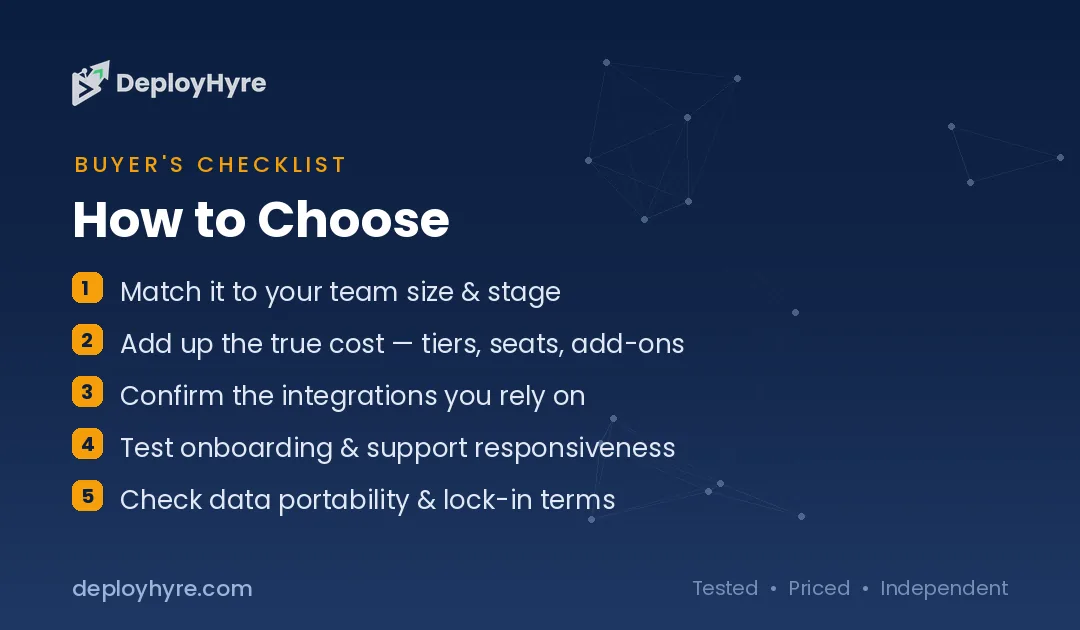
How Should You Choose a Heroku Alternative?
Choose the platform that matches your traffic shape rather than the one with the lowest headline price. An always on app wants flat pricing from Render or DigitalOcean. A bursty app wants scale to zero from Cloud Run. A global app wants Fly.io. A team chasing the old Heroku workflow wants Railway.
Four questions settle most decisions.
Does your app idle? Low or spiky traffic rewards per second and scale to zero billing. Constant traffic makes a fixed monthly instance cheaper and far easier to forecast.
How many people need access? Per seat pricing punishes growing teams. Render removed seat fees in April 2026. Railway Pro also includes unlimited seats. That single difference outweighs every other line item once you pass three developers.
What does the database cost? Compute comparisons hide the real bill. Heroku Postgres Essential-0 costs $5 and Standard-0 costs $50. Cloud Run ships no database at all, so budget Cloud SQL separately. Northflank includes one in its free tier.
How much egress do you send? Render allows 5 GB on Hobby and 25 GB on Pro, then charges $0.15 per GB. DigitalOcean charges $0.02 per GiB. That is a seven fold difference on identical traffic.
How We Evaluated These Platforms
We built this comparison from vendor documentation rather than review aggregators, because PaaS pricing changed repeatedly through 2026 and most third party pages are stale.
Pricing came from primary sources. Every dollar figure links to the vendor pricing or docs page it came from, checked in August 2026. Where a third party number conflicted with the vendor, we used the vendor.
We separated plan fees from usage. Railway and Render bundle or credit usage differently from how their headline prices read. We describe what actually lands on an invoice.
We checked free tiers for traps. A free tier that expires after seven days, spins down after 15 minutes, or covers static files only is not the same as one that runs a service indefinitely. The comparison table records which is which.
We excluded platforms in transition. Koyeb was acquired by Mistral AI in February 2026 and its entry tier is being withdrawn for new users, so we left it out rather than quote a plan you may not be able to buy.
We noted the limits of what is knowable. Salesforce has announced no end of life date for Heroku, and we make no claim that one exists. Sustaining engineering is a statement about investment, not a shutdown notice.
The Bottom Line
Railway is the best Heroku replacement for most individual developers, and Render is the better choice once your team passes three people. Railway reproduces the Heroku workflow for $5 per month. Render charges $25 for a workspace and stops billing by the head, which keeps the bill flat as the team grows.
Choose Cloud Run if your app idles and you want to pay nothing while it does. Choose Fly.io if your users span continents. Choose Northflank if you want a free environment that never expires. Choose Coolify if you have Linux skills and want your infrastructure bill to stop growing with your app count.
Leaving Heroku is not urgent. Building new things on Heroku is the decision worth revisiting. Migrate your next service rather than your existing one, and let the old app stay put until a renewal or a price change forces the question.
Our full ranking of PaaS platforms puts these seven in context. For the wider picture, read our guides to Vercel alternatives and Netlify alternatives if your workload is frontend heavy, or Node.js hosting if you run a single runtime. Teams reviewing deployment tooling alongside their platform should also see our roundup of AI coding assistants.
Frequently Asked Questions
Is Heroku shutting down?
No. Salesforce placed Heroku into a sustaining engineering model in February 2026, which means security and stability work continues while new features stop. Existing customers keep their pricing, billing, and support. No end of life date has been announced. Sustaining engineering normally precedes end of life by years rather than months.
What is the cheapest Heroku alternative?
Coolify costs nothing for the software, though you pay for the server it runs on. Among managed platforms, Northflank offers a free sandbox with two services and one database and no expiry date. Google Cloud Run stays free up to 2 million requests per month, which covers many small applications entirely.
Can I migrate from Heroku without rewriting my app?
Usually yes. Railway, Render, Northflank, and DigitalOcean App Platform all deploy from a Dockerfile or detect a standard buildpack project. The work is normally environment variables, database migration, and DNS rather than application code. Apps that lean on Heroku specific add-ons need replacement services.
Which Heroku alternative is best for a team?
Render, because it removed per seat billing on April 23, 2026. A Pro workspace costs $25 per month regardless of team size. Railway Pro costs $20 per month with unlimited workspace seats, so neither platform bills per developer.
Does Heroku still have a free tier?
No. Heroku removed free dynos, free Postgres, and free Key-Value Store on November 28, 2022, and converted existing free dynos to Eco dynos scaled to zero. The cheapest way to run a Heroku app now is the Eco plan at $5 per month for 1,000 dyno hours pooled across your account.
Related Articles

David Austin is a technology writer and software analyst at DeployHyre, where he covers AI tools, SaaS platforms, cloud hosting, and business automation. He focuses on hands-on comparisons of pricing, features, and real-world performance so teams can pick the right software with confidence.
Know AI, SaaS, or cloud tools inside out? Pitch a guest post and get in front of thousands of buyers researching their next tool.
Pitch your idea →