Hetzner Cloud is the best DigitalOcean alternative for most workloads in 2026. Its entry shared plan bundles 2 vCPUs, 4 GB of RAM, and 40 GB of NVMe storage from €3.79 per month, with 20 TB of included traffic. Vultr is the best pick for global reach, and Cloudways is the best managed option for teams that skip server admin.
The price gap is the reason to shop around. A 4 GB, 2 vCPU cloud server runs about $4.50 per month at Hetzner versus $24 for a DigitalOcean General Purpose droplet, a 3 to 5x difference at the same spec. DigitalOcean also bills powered-off droplets at full rate because the resources stay reserved, and automated backups add 20 to 30 percent on top of the droplet cost.
DigitalOcean did improve billing mechanics. Droplets moved to per-second billing on January 1, 2026, with charges capped at 672 hours per month. That helps short-lived instances, not always-on servers. We tested seven DigitalOcean competitors on price, performance, network, and ease of use. For the full market picture, start with our guide to the best cloud hosting providers, then use this list to cut your compute bill.
Table of Contents
Quick Comparison: Top 7 DigitalOcean Alternatives
| Provider | Best For | Starting Price | Standout Spec |
|---|---|---|---|
| Hetzner Cloud | Best price-performance overall | €3.79/mo (2 vCPU, 4 GB RAM) | 20 TB included traffic |
| Vultr | Global regions | $5/mo (1 vCPU, 1 GB RAM) | 30+ locations worldwide |
| Linode (Akamai) | Like-for-like replacement | $5/mo (1 vCPU, 1 GB RAM) | 1 TB transfer on entry plan |
| Cloudways | Managed cloud hosting | $14/mo flat | Managed stack on DO, Vultr, AWS |
| AWS Lightsail | Bridge into AWS | $3.50/mo (IPv6-only nano) | Fixed-price AWS bundles |
| Kamatera | Custom configurations | $4/mo (1 vCPU, 1 GB RAM) | Slider-based custom specs |
| Contabo | Maximum resources per dollar | $3.96/mo (4 vCPU, 8 GB RAM) | 8 GB RAM at entry price |
Why Switch From DigitalOcean?
Developers switch from DigitalOcean because equivalent compute costs 3 to 5 times less at Hetzner, Contabo, and Kamatera, and because backups, bandwidth overages, and reserved billing on stopped droplets inflate the real monthly bill. DigitalOcean stays a solid product. The value math is what changed.
Three costs surprise DigitalOcean users most. First, powering off a droplet does not stop charges. You pay full price until you destroy it. Second, automated backups add 20 percent for weekly and 30 percent for daily on top of every droplet. Third, resource ratios lag rivals. The $24 General Purpose tier buys 4 GB of RAM, while Contabo sells 8 GB with 4 vCPUs for under $5 on a yearly term, according to Cybernews pricing research.
Reviewers reach the same verdict. A 2026 pricing roundup lists Contabo, Hetzner Cloud, OVHcloud, and Vultr as cheaper DigitalOcean alternatives that deliver more RAM, CPU, and disk for less money. If your droplet mostly runs WordPress, compare the managed route too. Our Cloudways vs DigitalOcean breakdown shows what the managed layer adds.
The 7 Best DigitalOcean Alternatives
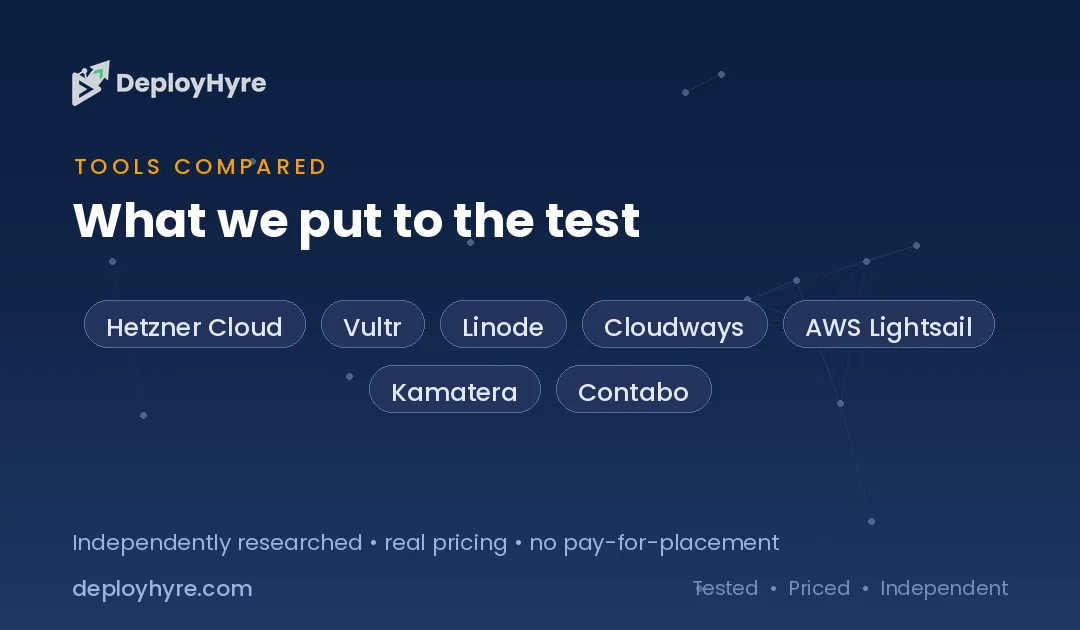
Hetzner Cloud wins on raw price-performance, Vultr wins on global coverage, and Cloudways wins for teams that want servers managed for them. Linode is the easiest like-for-like migration. Lightsail fits AWS-bound teams. Kamatera and Contabo serve custom and resource-heavy needs.
1 Hetzner Cloud: Best Price-Performance Overall
Hetzner is a German provider that undercuts every US-headquartered cloud on compute cost.
What it does well. Hetzner's shared vCPU plans deliver the strongest specs per euro in the market. The entry CX-series plan includes 2 vCPUs, 4 GB of RAM, and 40 GB of NVMe storage from €3.79 per month. Every cloud server includes 20 TB of traffic, an allowance no major rival matches. The control panel, API, and CLI feel familiar to DigitalOcean users.
Key features:
- Shared and dedicated vCPU instances with NVMe storage
- 20 TB included traffic on EU cloud servers
- Load balancers, volumes, firewalls, private networks, and snapshots
- Hourly billing with monthly price caps
- US (Ashburn, Hillsboro) and Singapore regions alongside EU data centers
Pricing. Entry cloud servers start at €3.79 per month. A 4 GB, 2 vCPU instance costs about $4.50 versus $24 for DigitalOcean's General Purpose equivalent, per 2026 cloud cost comparisons. Visit hetzner.com for current rates.
Best for: Developers and startups that want the lowest cost per GB of RAM without giving up a modern cloud panel.
Limitations. US and Singapore regions carry smaller traffic allowances than EU locations. There are fewer one-click marketplace apps than DigitalOcean, and identity verification at signup blocks some new accounts.
2 Vultr: Best for Global Regions
Vultr runs the widest location footprint in this price class, with 30+ data centers.
What it does well. Vultr mirrors DigitalOcean's product line closely: cloud compute, high-frequency instances, bare metal, managed Kubernetes, and block storage. Its edge is geography. You deploy the same $5 instance in Johannesburg, Sao Paulo, Mumbai, or Osaka, which cuts latency for users DigitalOcean's 15 regions do not reach as well.
Key features:
- 30+ global locations across 6 continents
- High Frequency plans with NVMe and faster clocks
- Bare metal and GPU instances on the same panel
- Hourly billing and a DigitalOcean-style API
- One-click apps and container registry
Pricing. Regular cloud compute starts at $5 per month for 1 vCPU and 1 GB of RAM. High Frequency plans start at $6 per month. See vultr.com for the full grid.
Best for: Apps with users in regions DigitalOcean serves poorly, and teams that want bare metal or GPUs next to standard instances.
Limitations. Bandwidth allowances vary by region and sit below Hetzner's 20 TB. Support on the base tier is ticket-only, and per-GB overage charges apply once you pass the included transfer.
3 Linode (Akamai): Best Like-for-Like Replacement
Linode, now Akamai Cloud, is the closest one-to-one substitute for DigitalOcean's core droplet experience.
What it does well. Linode matches DigitalOcean's simplicity: flat plans, a clean panel, predictable bandwidth pools, and strong docs. Since the Akamai acquisition, instances sit in front of Akamai's global network, which improves edge delivery. Migration is simple because plan shapes and tooling map almost exactly to droplet equivalents.
Key features:
- Shared, dedicated, high-memory, and GPU plans
- 1 TB of transfer on the $5 entry plan
- Managed Kubernetes (LKE) and object storage
- Akamai edge network integration
- Free bundled DDoS protection
Pricing. The entry plan costs $5 per month for 1 vCPU, 1 GB of RAM, 25 GB of SSD, and 1 TB of transfer. A 4 GB shared plan runs $24 per month. Current pricing is at linode.com.
Best for: Teams that want to leave DigitalOcean without changing how they work. Scripts, plan sizes, and mental models carry over.
Limitations. Prices sit near DigitalOcean's, so the savings are small compared with Hetzner or Contabo. Some longtime users report slower support since the Akamai transition.
4 Cloudways: Best Managed Alternative
Cloudways sells managed hosting on top of DigitalOcean, Vultr, and AWS infrastructure.
What it does well. Cloudways removes the server admin work that raw droplets require. Patching, firewalls, caching, staging, and backups come configured. You still pick the underlying cloud and size, but you manage applications instead of Linux. For agencies running client WordPress sites on droplets, this trade usually pays for itself in saved hours. Our Cloudways vs DigitalOcean comparison covers the exact differences.
Key features:
- Managed stack (Nginx, Varnish, Redis) on your chosen cloud
- Free SSL, staging environments, and automated backups
- 24/7 support on every plan
- Cloudflare Enterprise add-on
- Pay-as-you-go monthly billing, no contracts
Pricing. Plans start at $14 per month flat for a 1 GB DigitalOcean-based server. See cloudways.com for tiers.
Best for: WordPress, WooCommerce, and PHP teams that want droplet-class performance without SSH-level maintenance.
Limitations. You pay roughly double the raw infrastructure cost for the management layer. Root access is restricted, and non-PHP workloads fit poorly.
5 AWS Lightsail: Best Bridge Into AWS
Lightsail is Amazon's fixed-price VPS product, built to feel like DigitalOcean inside AWS.
What it does well. Lightsail bundles compute, storage, and transfer into flat monthly prices, then lets you graduate into full AWS services when you outgrow it. The cheapest plan costs $3.50 per month for an IPv6-only nano instance with 512 MB RAM, 2 vCPUs, 20 GB SSD, and 1 TB of transfer. Dual-stack plans with a public IPv4 address start at $5.
Key features:
- Fixed-price bundles including transfer
- Managed databases, containers, and load balancers
- One-click blueprints for WordPress, LAMP, and Node.js
- Direct upgrade path to EC2 and the wider AWS catalog
- AWS-grade network and regions
Pricing. Linux bundles run from $3.50 (IPv6-only) or $5 (IPv4) up to large memory-optimized tiers. Full tables are at aws.amazon.com.
Best for: Teams that expect to need S3, RDS, or Lambda later and want their VPS already inside the AWS account.
Limitations. Transfer overages bill at EC2 rates, which climb fast. The AWS console around Lightsail adds complexity DigitalOcean users notice immediately, and IPv4 now costs extra.
6 Kamatera: Best for Custom Configurations
Kamatera sells cloud servers with slider-based specs instead of fixed plan shapes.
What it does well. Most clouds force you into preset plans where you overpay for one resource to get enough of another. Kamatera lets you set vCPU, RAM, and storage independently, so an 8 GB RAM, 1 vCPU cache box costs what that exact shape is worth. Entry pricing starts at $4 per month for 1 vCPU and 1 GB of RAM, and every new account gets a 30-day free trial.
Key features:
- Independent sliders for vCPU, RAM, and SSD
- Four vCPU types (General, Burstable, Availability, Dedicated)
- 21 global data centers
- Hourly or monthly billing
- Optional fully managed service add-on
Pricing. Entry servers cost $4 per month, with published tiers running to about $57.60 per month before custom builds.
Best for: Workloads with lopsided resource needs, like memory-heavy caches or CPU-light queue workers, where preset plans waste money.
Limitations. The panel looks dated next to DigitalOcean's, the managed service costs extra, and there is no bundled marketplace ecosystem.
7 Contabo: Best for Maximum Resources per Dollar
Contabo is the budget king: it sells more RAM and CPU per dollar than any provider on this list.
What it does well. Contabo's entry Cloud VPS ships 4 vCPU cores and 8 GB of RAM from $3.96 per month on a yearly term. That is double the RAM of DigitalOcean's $24 tier for about a sixth of the price. For dev servers, staging boxes, game servers, and self-hosted apps where raw capacity beats premium network polish, the value is unmatched.
Key features:
- 4 vCPU and 8 GB RAM at the entry tier
- NVMe or larger SSD storage options
- Data centers across EU, US, Asia, and Australia
- Snapshot and backup options
- Monthly or discounted yearly terms
Pricing. Cloud VPS plans start at $3.96 per month on yearly billing. Setup fees apply on monthly terms. Current offers are at contabo.com.
Best for: Budget-driven projects that need lots of RAM and CPU and tolerate a less polished panel and network.
Limitations. Network performance and peering trail Hetzner and Vultr. Support is slower, the interface is basic, and the lowest advertised prices require yearly commitments.
How Should You Choose the Right DigitalOcean Alternative?
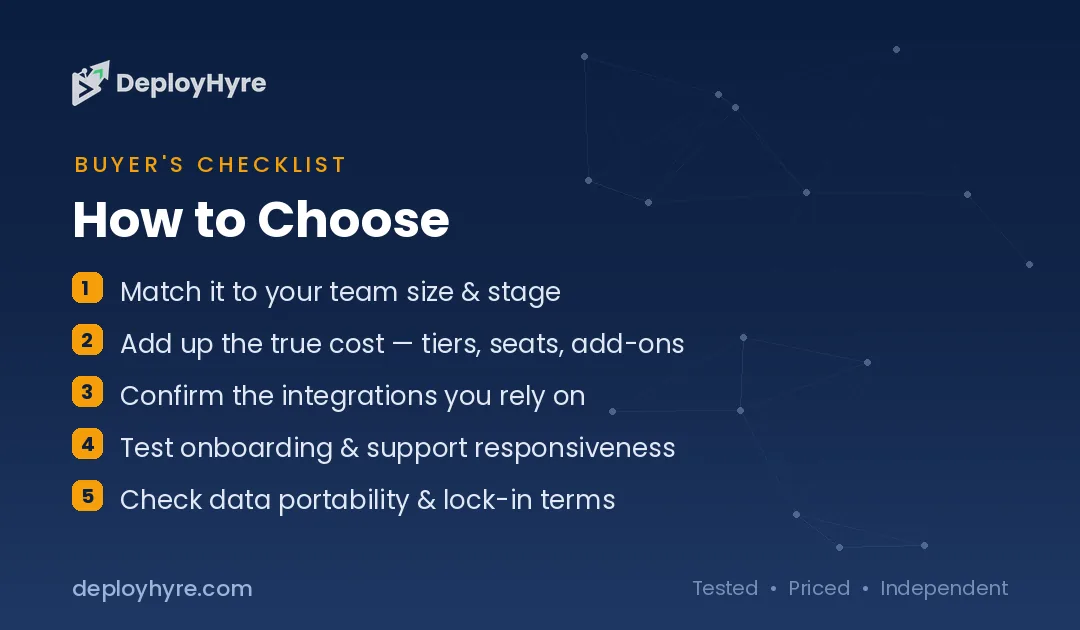
Match the provider to your constraint: pick Hetzner for cost, Vultr for locations, Linode for zero-friction migration, Cloudways for managed operations, Lightsail for AWS plans, Kamatera for odd resource shapes, and Contabo for maximum capacity. Price the real bill, not the sticker.
Work through four checks before you migrate:
- Total monthly cost. Add backups, snapshots, extra IPv4, and bandwidth overages to the base price. DigitalOcean backups alone add 20 to 30 percent, and rivals charge differently for each item.
- Region latency. Test ping from your user base. A cheaper server that adds 80 ms of latency costs you conversions. Vultr and Kamatera cover the most locations.
- Migration effort. Linode and Vultr accept droplet-style workflows nearly unchanged. Hetzner and Contabo need minor tooling changes. Cloudways replaces the workflow entirely.
- Management time. If patching and hardening eat your week, a managed layer beats a cheaper raw server. Our best VPS hosting guide maps the unmanaged options, and our Hostinger alternatives roundup covers the shared-hosting end of the market.
How We Evaluated These Providers
We compared each provider on published entry pricing, specs per dollar, included bandwidth, region count, billing mechanics, and management burden, using vendor price sheets and independent 2026 cost comparisons as sources.
We weighted price-performance most heavily because cost is the top reason developers leave DigitalOcean. We verified every figure against the provider's own pricing page or a dated third-party analysis, including CloudMart's 2026 VPS comparison and Cybernews pricing reviews. We excluded providers with unclear renewal pricing or no published price sheet. Prices reflect August 2026 rates and change without notice, so confirm on the vendor site before you commit.
The Bottom Line
Hetzner Cloud replaces DigitalOcean for most workloads at a third of the cost or less. Choose Vultr when your users sit outside Hetzner's regions, Linode when you want the least migration friction, and Contabo when raw capacity per dollar is the whole decision. Teams also weighing an independent cloud can compare options in our Vultr alternatives guide.
Go managed if server admin is not your job. Cloudways delivers droplet-class hosting with the operations handled, and our SiteGround alternatives guide covers more managed picks. Whichever route you take, benchmark your real workload during the trial period. A week of testing beats a year of overpaying.
Frequently Asked Questions
What is the best DigitalOcean alternative?
Hetzner Cloud is the best DigitalOcean alternative in 2026. It delivers 2 vCPUs, 4 GB of RAM, and 40 GB of NVMe storage from €3.79 per month with 20 TB of included traffic, roughly 3 to 5 times cheaper than equivalent DigitalOcean droplets.
What is cheaper than DigitalOcean?
Hetzner Cloud, Contabo, Kamatera, and AWS Lightsail all undercut DigitalOcean at entry level. Contabo offers the most extreme value with 4 vCPUs and 8 GB of RAM from $3.96 per month on a yearly term, versus $24 for 4 GB on DigitalOcean's General Purpose tier.
Does DigitalOcean charge for powered-off droplets?
Yes. DigitalOcean bills powered-off droplets at the full rate because CPU, RAM, and storage stay reserved for you. To stop charges, snapshot the droplet and destroy it. Several rivals, including AWS-based options, handle stopped-instance billing differently.
Is Vultr better than DigitalOcean?
Vultr is better than DigitalOcean for global coverage. It operates 30+ data centers versus DigitalOcean's 15 regions, at matching $5 entry pricing. DigitalOcean keeps an edge in marketplace apps, documentation depth, and its managed app platform.
What is the easiest migration from DigitalOcean?
Linode (Akamai) is the easiest migration from DigitalOcean. Its plan shapes, control panel, API design, and bandwidth pooling map almost one-to-one to droplets, so existing deployment scripts and workflows transfer with minimal changes. Cloudways is easiest if you want to stop managing servers entirely.

David Austin is a technology writer and software analyst at DeployHyre, where he covers AI tools, SaaS platforms, cloud hosting, and business automation. He focuses on hands-on comparisons of pricing, features, and real-world performance so teams can pick the right software with confidence.
Know AI, SaaS, or cloud tools inside out? Pitch a guest post and get in front of thousands of buyers researching their next tool.
Pitch your idea →