Pipedrive built its name on a clean sales pipeline. But the CRM market moved fast around it. Grand View Research values the global CRM market at $86.4 billion in 2026, on its way to $161.3 billion by 2033. That growth funds rivals that now beat Pipedrive on price, AI features, or built-in marketing.
Pipedrive also restructured its plans. The lineup now runs from Lite at $14 to Ultimate at $79 per seat per month on annual billing, and popular features like lead capture and email campaigns sit in paid add-ons. Many teams do the math and start shopping.
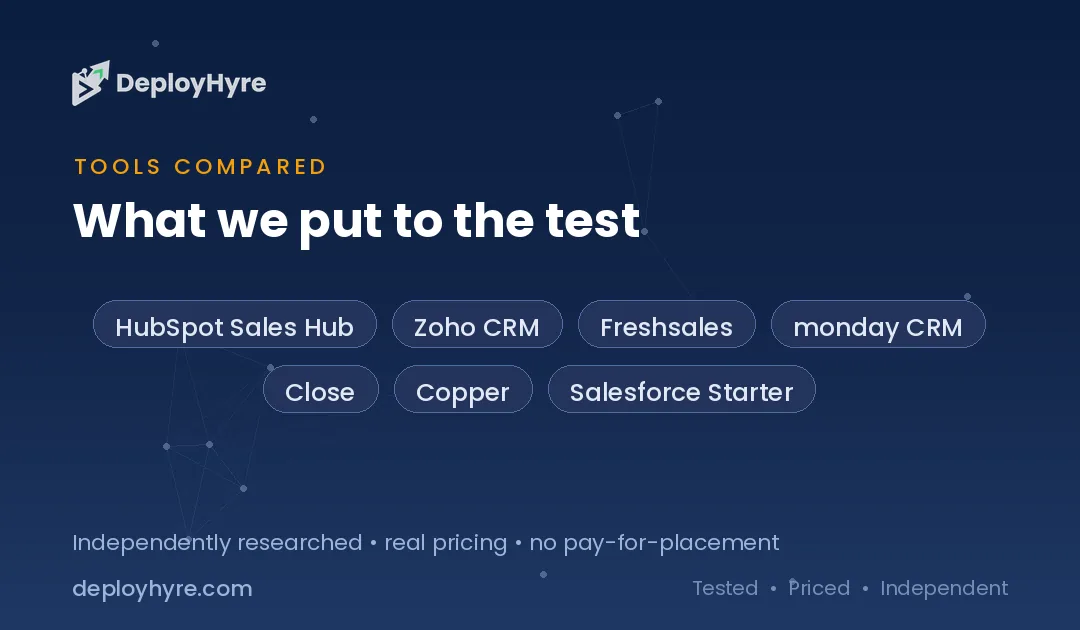
We compared the leading Pipedrive competitors on pricing, AI capability, ease of use, and fit for real sales teams. Several picks below also appear in our full guide to the best AI CRM software. Here are the 7 alternatives worth switching to.
Quick Comparison: Pipedrive Alternatives
| CRM | Best For | Starting Price | Key strength |
|---|---|---|---|
| HubSpot Sales Hub | Free start, all-in-one growth | Free; $15/seat/mo | Free CRM plus marketing suite |
| Zoho CRM | Feature depth on a budget | $14/user/mo (annual) | Most features per dollar |
| Freshsales | AI scoring at low cost | Free; $9/user/mo | Freddy AI on cheap plans |
| monday CRM | Visual teams and workflows | $12/seat/mo (annual) | Flexible boards and automations |
| Close | Outbound calling teams | $9 Solo; $35/user/mo | Built-in dialer and sequences |
| Copper | Google Workspace users | $12/user/mo (annual) | Lives inside Gmail |
| Salesforce Starter | Teams headed upmarket | $25/user/mo | Grows into full Salesforce |
Why Switch From Pipedrive?
Most teams leave Pipedrive for one of three reasons: there is no free plan, core features hide in paid add-ons, and marketing tools are thin. Pipedrive remains a strong pipeline tracker. It is weaker as a full revenue platform.
The add-on math stings the most. LeadBooster, Web Visitors, Campaigns, and Projects each cost extra on top of the seat price. A 5-person team on Growth with two add-ons pays more than several full-suite rivals. Forbes Advisor’s Pipedrive pricing review breaks down how the extras add up.
Feature gaps matter too. Pipedrive ships light native marketing, basic reporting on lower tiers, and no free entry point. Every alternative below fixes at least one of those gaps. Pipedrive’s own AI assistant improved in 2025 and 2026, but rivals like Freshsales and HubSpot bundle deeper AI at similar or lower prices. For the wider AI stack around your CRM, see our guide to the best AI tools for sales.
1 HubSpot Sales Hub: Best for starting free and scaling all-in-one
HubSpot is the most complete Pipedrive alternative because it starts free and grows into a full revenue platform.
What it does well. HubSpot’s free CRM covers contact management, deal pipelines, email tracking, and meeting scheduling for up to 5 users. Paid tiers add automation, AI tools, and a native marketing suite, so sales and marketing finally share one database. The interface stays friendly at every tier.
Key features:
- Free CRM with contacts, deals, and email tracking
- Two deal pipelines and 500 calling minutes on Starter
- Breeze AI assistants for emails, notes, and forecasts
- Native marketing, service, and content hubs
- 1,700-plus app integrations
Pricing. The free plan supports up to 5 users. Sales Hub Starter costs $15 per seat per month on annual billing, or $20 month to month. Professional jumps to $100 per seat.
Best for: Teams that want a free start today and one platform for sales and marketing tomorrow.
Limitations. Costs climb steeply at the Professional tier. Advanced reporting sits behind higher plans.
2 Zoho CRM: Best for feature depth on a budget
Zoho CRM delivers the most functionality per dollar of any Pipedrive alternative.
What it does well. Zoho packs workflow automation, scoring rules, sales forecasting, and its Zia AI assistant into plans that undercut Pipedrive’s mid tiers. It customizes deeply, from modules to layouts to blueprints that enforce your sales process. It also plugs into 50-plus other Zoho apps.
Key features:
- Workflow automation on every paid plan
- Zia AI for predictions, anomaly alerts, and email drafting
- Blueprint process builder to standardize deal stages
- Omnichannel inbox for email, phone, and social
- Deep integration with the Zoho suite
Pricing. Standard costs $14 per user per month billed annually, and Professional runs $23. Monthly billing raises Standard to $20.
Best for: Budget-conscious teams that still want automation, AI, and customization.
Limitations. The interface feels dated next to HubSpot and monday. Setup takes longer because there is more to configure.
3 Freshsales: Best for AI lead scoring at low cost
Freshsales gives small teams real AI features at the lowest paid entry price on this list.
What it does well. Freddy AI scores leads, drafts emails, and summarizes contacts, and it shows up far down the pricing ladder. The free plan supports 3 users with contact and account management. Built-in phone, email, and chat keep outreach inside the CRM instead of five separate tools.
Key features:
- Free plan for up to 3 users
- Freddy AI lead scoring and email writing
- Built-in phone with call recording
- Sales sequences and multiple pipelines on Pro
- Kanban and table views for contacts and deals
Pricing. Growth costs $9 per user per month billed annually, Pro costs $39, and Enterprise costs $59. Monthly billing adds roughly 20%.
Best for: Small B2B teams that want AI scoring without a HubSpot Professional budget.
Limitations. The best automation features, like sequences and territory management, start at the Pro tier. Reporting depth trails Zoho.
4 monday CRM: Best for visual teams and custom workflows
monday CRM turns the pipeline into flexible boards that non-sales teams actually enjoy using.
What it does well. monday treats your sales process like customizable work boards. Drag deals between stages, automate handoffs, and build dashboards without code. Teams that already run projects on monday get sales in the same workspace, which kills the copy-paste between tools.
Key features:
- Board-based pipelines with drag-and-drop stages
- No-code automations for follow-ups and handoffs
- Email sync and tracking
- Dashboards that blend sales and project data
- AI assistant for emails and summaries
Pricing. Basic costs $12 per seat per month billed annually, Standard $17, and Pro $28. Plans start at 3 seats, so budget for the minimum.
Best for: Visual teams and companies that already use monday for project work.
Limitations. The 3-seat minimum raises the real entry cost. Deep sales reporting trails dedicated CRMs.
5 Close: Best for outbound calling teams
Close is built for teams that live on the phone and measure reps by dials and conversations.
What it does well. Calling, SMS, and email sequences are native, not bolted on. The Power Dialer rips through call lists, records conversations, and logs everything automatically. Pipedrive needs third-party telephony to match what Close ships out of the box.
Key features:
- Built-in calling with recording and voicemail drop
- Power Dialer on Growth and above
- Multichannel sequences across call, SMS, and email
- AI call summaries and coaching insights
- Fast, keyboard-friendly interface reps like
Pricing. Plans run from a $9 single-user Solo seat to $139 per user per month, with Essentials at $35 per user per month on annual billing. Call minutes and SMS bill separately.
Best for: Inside sales and SDR teams doing high-volume outbound calls.
Limitations. Usage fees for calls and texts grow with volume. It is lean on marketing features by design.
6 Copper: Best for Google Workspace teams
Copper is the Pipedrive alternative that lives inside Gmail instead of another browser tab.
What it does well. Copper embeds the CRM in Gmail and Google Calendar, scrapes contact details automatically, and files emails to the right deal without manual logging. For teams that run entirely on Google Workspace, adoption is nearly instant because nobody leaves their inbox.
Key features:
- Native Gmail and Google Calendar sidebar
- Automatic contact and activity capture
- Pipelines with drag-and-drop stages
- Workflow automation and email sequences on Professional
- Google Sheets and Looker Studio reporting
Pricing. Starter costs $12 per user per month billed annually, Basic $29, and Professional $69. Starter caps at 3 users and 1,000 contacts.
Best for: Small teams that run sales from Gmail and want zero data entry.
Limitations. It only makes sense inside Google Workspace. Contact caps on lower tiers force upgrades as you grow.
7 Salesforce Starter: Best for teams headed upmarket
Salesforce Starter gives small teams a simplified on-ramp to the biggest CRM platform in the world.
What it does well. Starter bundles sales, service, and email marketing basics in one guided setup, minus the admin overhead Salesforce is famous for. The pitch is the upgrade path: when you outgrow it, you move up inside Salesforce instead of migrating CRMs again.
Key features:
- Guided setup with no admin required
- Sales, service, and marketing in one app
- Einstein AI activity capture
- Prebuilt dashboards and reports
- Direct upgrade path to full Salesforce clouds
Pricing. Starter Suite costs $25 per user per month, billed monthly or annually. Pro Suite, the next step, runs $100.
Best for: Startups that expect to be on full Salesforce within a few years.
Limitations. Customization is intentionally limited at this tier. Per-user costs rise sharply as you move up the Salesforce ladder.
How Should You Choose a Pipedrive Alternative?
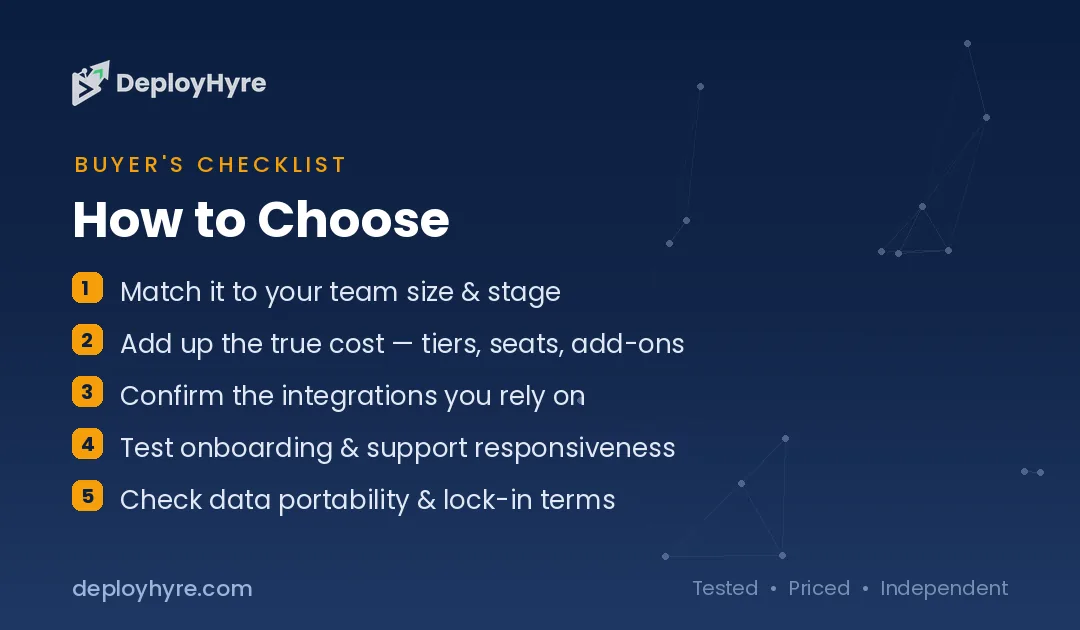
Match the CRM to your team’s main motion: HubSpot for inbound and marketing alignment, Close for outbound calling, Copper for Gmail-first workflows, and Zoho or Freshsales when budget rules. Everything else is detail.
Work through four questions:
- What does your team do all day? Calling teams need Close. Inbound teams need HubSpot’s marketing tie-in. Gmail-first teams need Copper.
- What is your real per-seat budget? Add up seats, minimums, and add-ons. monday’s 3-seat floor and Close’s usage fees change the math.
- Which AI features earn their keep? Lead scoring and email drafting save real hours. Freshsales and Zoho price those features lowest. Our best AI tools for sales guide ranks the standalone options.
- Where will you be in three years? If the answer is enterprise, Salesforce Starter saves a future migration.
Test two finalists with your live pipeline for two weeks. Import real deals, run real follow-ups, and let the reps vote.
How We Evaluated These CRMs
We scored each Pipedrive alternative on five factors: pricing transparency, pipeline and automation depth, AI capability, ease of adoption, and integration breadth. Pricing comes from vendor pages and current published rate cards, verified in July 2026. We weighted real switching triggers most heavily, meaning free entry points, add-on costs, and calling or marketing features Pipedrive lacks. We also favored tools with credible AI roadmaps, since AI automation now drives most CRM buying decisions we track across the category.
The Bottom Line
HubSpot Sales Hub is the best Pipedrive alternative for most teams. It starts free, scales into marketing, and its Starter tier costs about the same as Pipedrive Lite while including more. Zoho CRM and Freshsales win on budget depth and cheap AI. Close wins for outbound calling, Copper for Gmail loyalists, monday for visual teams, and Salesforce Starter for companies with enterprise plans.
Before you switch, list the three features that pushed you off Pipedrive and demo only the tools that fix all three. For the full category picture, start with our ranked guide to the best AI CRM software, then map the rest of your stack with AI for business.
Frequently Asked Questions
What is the best Pipedrive alternative?
HubSpot Sales Hub is the best Pipedrive alternative for most teams. It offers a genuinely free CRM, a $15 per seat Starter tier, and built-in marketing tools Pipedrive lacks. For outbound calling teams, Close is the stronger pick.
Is there a free alternative to Pipedrive?
Yes. HubSpot’s free CRM supports up to 5 users with contacts, deals, and email tracking. Freshsales offers a free plan for up to 3 users. Zoho CRM also has a free edition for 3 users. Pipedrive itself has no free plan, only a 14-day trial.
Which Pipedrive alternative is cheapest?
Freshsales Growth is the cheapest serious option at $9 per user per month billed annually. Zoho CRM Standard and monday CRM Basic follow at $14 and $12. Watch minimum seat counts: monday requires 3 seats, so its real floor is $36 per month.
Is HubSpot better than Pipedrive?
For most growing teams, yes. HubSpot starts free, includes marketing tools, and matches Pipedrive’s pipeline features at the Starter tier. Pipedrive stays the better pick for teams that want a simple, sales-only pipeline with minimal setup and no platform overhead.
Which CRM is best for outbound sales calls?
Close is the best CRM for outbound calling. It ships a built-in dialer, call recording, voicemail drop, and multichannel sequences without third-party telephony. Its Power Dialer tier lets one rep work through hundreds of dials per day directly inside the CRM.

David Austin is a technology writer and software analyst at DeployHyre, where he covers AI tools, SaaS platforms, cloud hosting, and business automation. He focuses on hands-on comparisons of pricing, features, and real-world performance so teams can pick the right software with confidence.
Know AI, SaaS, or cloud tools inside out? Pitch a guest post and get in front of thousands of buyers researching their next tool.