
AI accounting software categorizes transactions, reconciles bank feeds, and flags anomalies so your books stay clean with less manual work. We tested 9 of the best AI accounting tools in 2026. Software-only platforms start near $25 per month, while full-service AI bookkeeping runs from about $200 to $549 per month. This guide shows which tool fits small businesses, startups, and multi-entity firms, with real pricing and honest limits.
Table of Contents
Accountants are adopting AI faster than almost anyone. The 2025 Intuit QuickBooks survey found 81 percent of accountants say AI boosts productivity, and 46 percent use it every day. The payoff is real time: purpose-built tools cut transaction processing time by 80 percent and manual data entry by 90 percent.
The challenge is sorting software from service. Some tools are accounting platforms with AI features. Others are full bookkeeping services where AI plus humans keep your books. Pricing varies widely, so the right pick depends on whether you want a tool or a done-for-you team.
We tested 9 of the best AI accounting platforms in 2026 against automation, features, and price. For the bigger question of where this leaves the profession, read will AI replace accountants, and for company-wide context see our guide to AI for business.
What Is AI Accounting Software?
AI accounting software uses machine learning to automate bookkeeping tasks like transaction categorization, bank reconciliation, anomaly detection, and reporting. It learns your patterns, codes transactions for you, and surfaces issues before they become problems. The goal is clean books with less manual entry, freeing owners and accountants for analysis and advice.
The tools split into two groups. Platforms like QuickBooks and Xero add AI to do-it-yourself accounting, while services like Bench and Zeni pair AI with human bookkeepers. Bank reconciliation is more than 90 percent automatable, and routine bookkeeping is about 80 percent automatable, which is where these tools save the most time.
Quick Comparison: 9 Best AI Accounting Tools in 2026
| Tool | Best For | Starting Price | Core Strength |
|---|---|---|---|
| QuickBooks Online | US small businesses | $38/mo | Intuit Assist AI agents |
| Xero | Clean, global workflows | $25/mo | JAX AI assistant |
| Bench | Done-for-you bookkeeping | $249/mo | AI plus human team |
| Zeni | Funded startups | $549/mo | Full-service finance |
| Puzzle | Startup founders | $200/mo | AI-native ledger |
| Digits | Solo and small firms | $100/business | AI bookkeeping |
| Docyt | Multi-entity businesses | $299/entity | Automation workflows |
| Botkeeper | Accounting firms | Custom | Firm-scale automation |
| Ramp | Spend management | Free tier | AI expense automation |
What Makes Great AI Accounting Software?
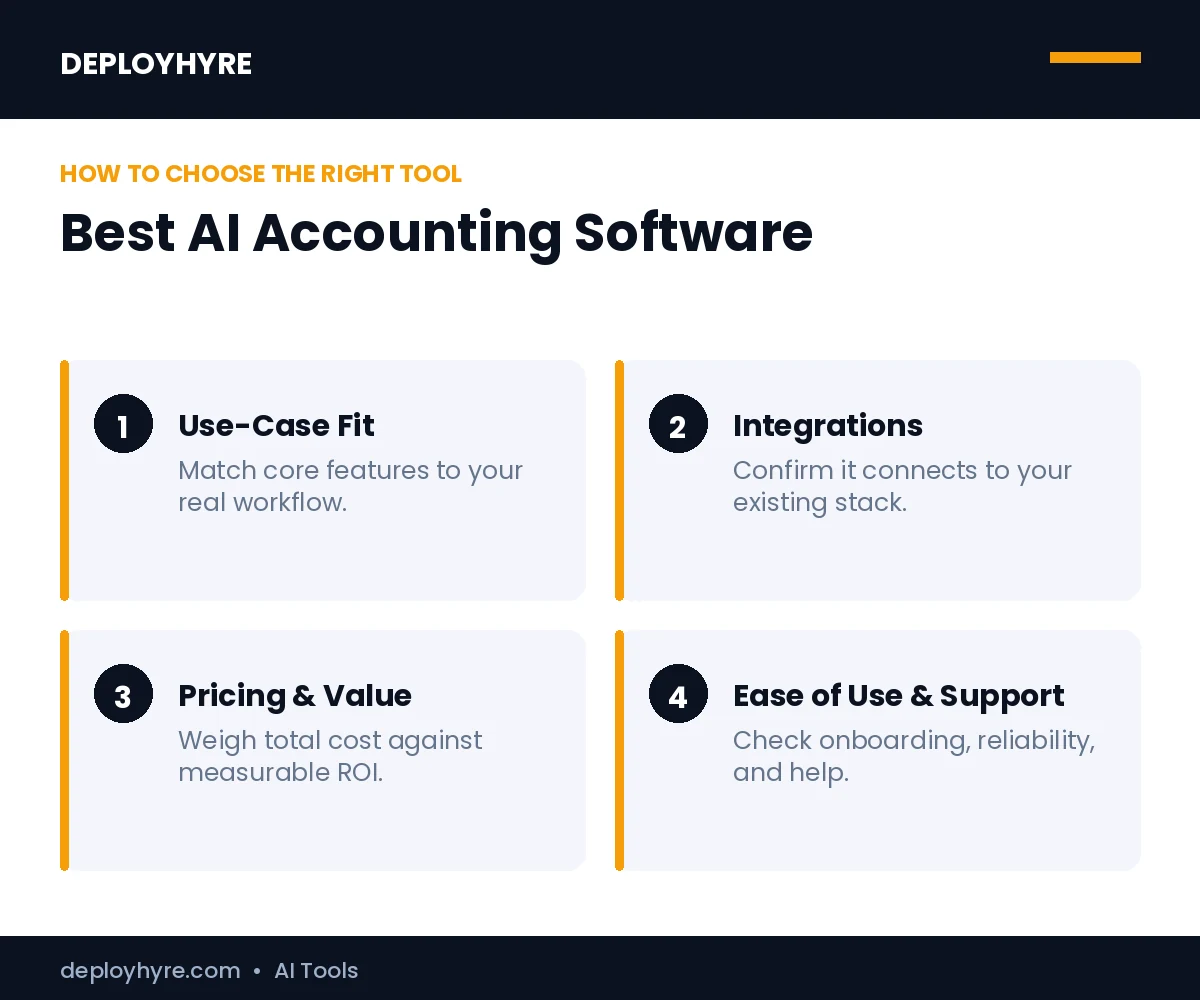
Great AI accounting software automates the boring work accurately, integrates with your bank and tools, and keeps an audit trail you can trust. The best platforms categorize transactions correctly, reconcile feeds automatically, and let a human review exceptions. Accuracy and clean records matter far more than the number of AI features advertised.
We weighed five things: automation accuracy, integrations with banks and apps, reporting depth, pricing clarity, and whether human support is included. Accountants expect AI to save about 240 hours a year per professional, roughly 5 hours a week, so reliable automation pays for itself quickly.
Best All-in-One AI Accounting Software
1. QuickBooks Online: Best for US Small Businesses
QuickBooks Online is the default choice for most US small businesses that want accounting and AI in one place.
What it does well. QuickBooks uses Intuit Assist and specialized AI agents to categorize transactions, flag anomalies, and streamline payroll. It bundles invoicing, payroll, tax prep, and reporting, and connects to a huge network of apps, so most small business workflows live in one tool.
Key features:
-
Intuit Assist AI for categorization and anomalies
-
Invoicing, payroll, and tax prep
-
Deep app integration network
-
Inventory and employee workflows
Pricing. Plans start at $38 per month, with tiers at $75, $115, and $275 per month.
Best for: US small businesses that want one platform for everything.
Limitations. It can feel heavy for very simple needs, and higher tiers get pricey.
2. Xero: Best for Clean, Global Workflows
Xero is the strongest QuickBooks alternative, known for a clean interface and strong international support.
What it does well. Xero offers AI-driven bank matching and a conversational assistant called JAX that automates routine workflows. With more than 1,000 integrations, it moves financial data across CRM, inventory, and payroll, which suits clean workflows and global teams.
Key features:
-
AI bank matching and reconciliation
-
JAX conversational assistant
-
1,000-plus integrations
-
Multi-currency and global support
Pricing. Plans start at $25 per month, with tiers at $55 and $90 per month.
Best for: Small businesses wanting clean workflows or international operations.
Limitations. US payroll is less mature than QuickBooks, and some features need add-ons.
Best AI Bookkeeping Services
3. Bench and #4 Zeni: Best for Done-for-You Books
When you would rather hand off bookkeeping entirely, these services pair AI with human teams.
What they do well. Bench combines AI automation with a dedicated human bookkeeper and offers tax add-ons, which suits owners who never want to touch the ledger. Zeni delivers full-service finance for funded startups, blending AI bookkeeping with reporting and bill pay. Both give you finished books, not just software.
Key features:
-
AI plus human bookkeeping
-
Monthly financial statements
-
Tax support (Bench)
-
Startup finance operations (Zeni)
Pricing. Bench starts at $249 per month, with higher tiers at $399 and $599; Zeni starts around $549 per month.
Best for: Owners and startups that want bookkeeping fully handled.
Limitations. Service pricing costs more than software alone, and you depend on their team.
Best for Startups
5. Puzzle and #6 Digits: Best for Founders and Solo Firms
Two AI-native tools fit startups and small firms that want modern, automated books.
What they do well. Puzzle is an AI-native general ledger built for startups, automating accounting in real time with founder-friendly reporting. Digits offers AI bookkeeping that automates categorization and produces clear financials for solo operators and small businesses. Both feel modern and fast compared with legacy software.
Key features:
-
AI-native real-time ledger (Puzzle)
-
Automated categorization (Digits)
-
Founder-friendly reporting
-
Clean, modern interfaces
Pricing. Puzzle’s Plus tier is $200 per month; Digits is about $100 per business.
Best for: Startups and solo firms that want AI-native books.
Limitations. Younger platforms have smaller integration networks than QuickBooks or Xero.
Best for Multi-Entity and Firms
7. Docyt and #8 Botkeeper: Best for Complex and Firm-Scale Books
Two tools target businesses with many entities and the accounting firms that serve them.
What they do well. Docyt automates bookkeeping workflows across multiple entities, handling receipts, reconciliation, and reporting at scale. Botkeeper gives accounting firms a platform to automate client books with AI plus oversight. Both fit organizations whose complexity overwhelms single-entity tools.
Key features:
-
Multi-entity automation (Docyt)
-
Firm-scale client automation (Botkeeper)
-
Receipt and document processing
-
Workflow and reconciliation tools
Pricing. Docyt Core is about $299 per entity; Botkeeper is custom and quote-based.
Best for: Multi-entity businesses and accounting firms.
Limitations. More setup than single-business tools, and overkill for one simple entity.
Best for Spend Management
9. Ramp: Best for AI Expense Automation
Ramp is not a full ledger, but it automates spend and pairs with your accounting software.
What it does well. Ramp uses AI to categorize expenses, enforce policy, and close the books faster, syncing with QuickBooks, Xero, and others. It is a useful companion to the best AI tools for HR when payroll and spend overlap. It pairs corporate cards with automated expense workflows, which removes much of the manual coding that slows month-end.
Key features:
-
AI expense categorization
-
Corporate cards and policy controls
-
Sync with major accounting platforms
-
Faster month-end close
Pricing. Free core tier, with paid plans for advanced finance features.
Best for: Teams that want to automate expenses alongside their ledger.
Limitations. It complements, rather than replaces, full accounting software.
How Should You Choose AI Accounting Software?
Start with tool versus service. Choose QuickBooks or Xero if you want a platform your team runs, Bench or Zeni if you want books done for you, and Puzzle or Digits if you are a startup wanting AI-native ledgers. Docyt and Botkeeper fit multi-entity and firm needs, while Ramp automates spend on top.
Next, check integrations and accuracy. Confirm the tool connects to your bank, payroll, and apps, and test how well it categorizes your real transactions. Always run a short trial on one month of data, review the automation for errors, and keep a human eye on tax and compliance.
How We Evaluated These AI Accounting Tools
We assessed each tool on five criteria: automation accuracy, integrations with banks and apps, reporting depth, pricing transparency, and whether human support is included. We prioritized tools with published capabilities and real 2026 usage, then cross-checked features and pricing against vendor pages and independent reviews. Accounting software pricing changes often, so confirm current rates and entity limits before buying.
Can AI accounting software file my taxes?
It prepares, but does not file. AI accounting tools organize tax data, categorize transactions, and flag deductions, yet filing still needs a tax professional or dedicated tax software. Confirm tax features before relying on any tool, and see whether AI will replace accountants.
Is AI accounting software accurate?
Yes, for routine work. AI is highly accurate at categorization and reconciliation and improves over time. It still errs on unusual transactions. Review AI entries regularly. The tool speeds bookkeeping, but a human keeps the books audit-ready.
Does AI accounting software replace an accountant?
No. AI handles data entry, reconciliation, and reports, but accountants provide advice, tax strategy, and compliance judgment. Small businesses save hours with automation, then use an accountant for planning and decisions that require professional judgment.
Professional services firms can also review the best AI legal software.
The Bottom Line
AI accounting software now handles the bulk of routine bookkeeping, with reconciliation and data entry mostly automatable and accountants reclaiming hundreds of hours a year. The winners pick a tool or service that matches how hands-on they want to be, then keep a human on tax and judgment calls.
Match the choice to your situation. Small businesses should start with QuickBooks or Xero, busy owners with Bench, startups with Puzzle or Digits, and firms with Botkeeper. Trial one month of data, check the automation, and scale once the books stay clean.
Next steps: Read our take on whether AI will replace accountants, connect finance to operations with our AI for business guide, and streamline back-office hiring with the best AI recruiting software.
Frequently Asked Questions
What is the best AI accounting software in 2026?
There is no single best tool; it depends on your needs. QuickBooks Online is best for US small businesses, Xero for clean and global workflows, Bench for done-for-you bookkeeping, and Puzzle or Digits for startups wanting AI-native ledgers. Docyt and Botkeeper fit multi-entity firms. Match the tool to whether you want software or a full service.
How much does AI accounting software cost?
AI accounting software ranges from about $25 per month for Xero and $38 per month for QuickBooks to $200 to $549 per month for full-service AI bookkeeping like Puzzle, Bench, and Zeni. Multi-entity tools like Docyt charge around $299 per entity. Software-only plans cost less, while done-for-you services that include human bookkeepers cost more.
Can AI accounting software replace an accountant?
No. AI accounting software automates routine tasks like categorization and reconciliation, but it does not replace an accountant’s judgment on tax strategy, compliance, and advice. Surveys show accountants adopting AI to save time, not lose jobs. The best setup pairs AI automation with a human who reviews exceptions and handles complex decisions.
How accurate is AI bookkeeping?
AI bookkeeping is highly accurate on routine work, automating more than 90 percent of bank reconciliation and about 80 percent of data entry. Accuracy depends on clean bank feeds and consistent transactions. Errors still happen with unusual items, so review exceptions monthly and keep a human check on tax-sensitive entries before filing.
Is QuickBooks or Xero better for AI accounting?
Both are strong. QuickBooks Online leads for US small businesses with Intuit Assist AI, deep payroll, and the widest app network. Xero wins for clean workflows, international operations, and its JAX assistant with more than 1,000 integrations. Choose QuickBooks for US payroll-heavy needs and Xero for global, multi-currency, or integration-driven workflows.

David Austin is a technology writer and software analyst at DeployHyre, where he covers AI tools, SaaS platforms, cloud hosting, and business automation. He focuses on hands-on comparisons of pricing, features, and real-world performance so teams can pick the right software with confidence.