AI moved into production faster than most companies built controls for it. This AI governance guide closes that gap. AI governance is the set of policies, processes, and tools that keep AI systems safe, compliant, and accountable without grinding innovation to a halt.
Table of Contents
It is also now a legal requirement in places. Three frameworks are driving AI governance adoption in 2026: the EU AI Act (mandatory, with enforceable penalties), the NIST AI Risk Management Framework (voluntary, widely adopted), and ISO/IEC 42001 (a certifiable management standard).
This guide explains AI governance for 2026: the frameworks, what to document, and how to operationalize it. For related risk topics, see our upcoming guides on AI in cybersecurity and our AI for business guide. This is general information, not legal advice; consult counsel for your situation.
What Is AI Governance?
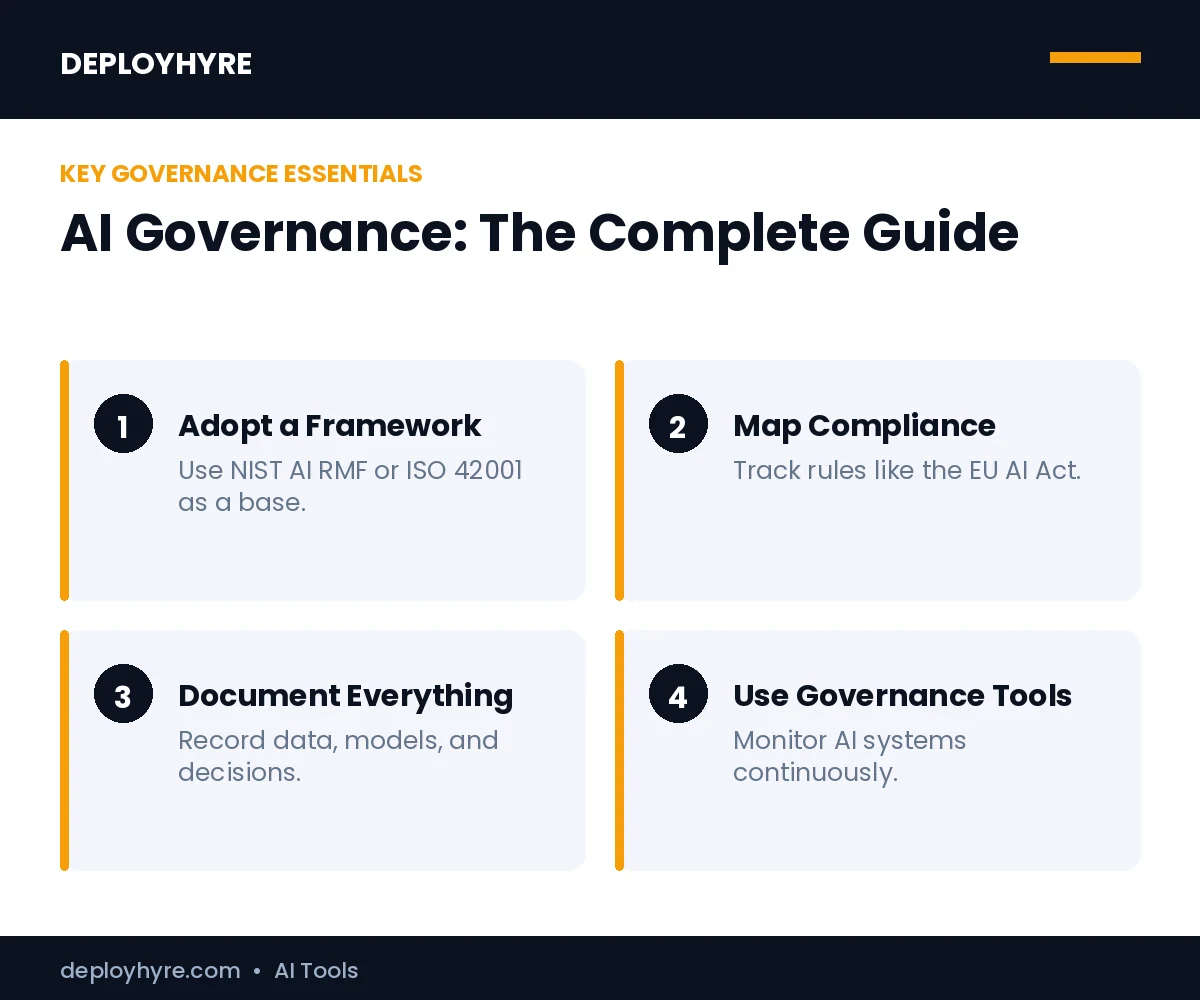
AI governance is the system of policies, roles, processes, and tools an organization uses to manage the risks of building and using AI, while staying compliant with regulation. It covers what AI you have, how risky each system is, how it is monitored, and who is accountable. Done well, governance lets a company deploy AI confidently rather than slowly, because risks are identified and controlled rather than ignored.
The practical core is small. Most enterprises need an AI inventory, a per-system risk classification, and an audit trail, which together satisfy the bulk of compliance demands.
The 3 Frameworks That Define AI Governance in 2026
Three frameworks shape nearly every AI governance program today, and the strongest organizations use them together rather than separately.
The EU AI Act: Binding Law With Penalties
The EU AI Act is the world’s first comprehensive AI law, and it has teeth. It is binding law with enforcement beginning in August 2026, classifying AI systems into risk tiers: prohibited, high-risk, general-purpose AI models, and limited or minimal risk. If you serve EU users, you must classify each system and meet the obligations for its tier.
The NIST AI Risk Management Framework: The US Standard
The NIST AI RMF is voluntary but expected. It is the de facto US governance standard that federal agencies, procurement teams, and enterprise customers increasingly expect. Its functions (Govern, Map, Measure, Manage) give you a practical structure even without a legal mandate.
ISO/IEC 42001: The Certifiable Standard
ISO/IEC 42001 is the first certifiable international standard for AI management systems. Certification signals to customers and regulators that you run a real, audited AI management system, much like ISO 27001 does for information security.
How to Build an AI Governance Program
You do not need eight separate programs. The most effective organizations adopt a single integrated operating model that combines NIST CSF and ISO 27001 for governance, NIST AI RMF and ISO 42001 for AI decision governance, with regulatory overlays like the EU AI Act.
Start with three artifacts that cover most compliance. For most enterprises, three documents do the heavy lifting: an AI inventory (NIST Govern), a per-system risk classification (EU AI Act tier), and an AIMS audit trail (ISO 42001).
The steps in order: inventory every AI system in use, classify each by risk tier, assign owners and controls, monitor performance and incidents, and keep an audit trail. Review on a set cadence as models and regulations change.
AI Governance Tools to Automate Compliance
Manual spreadsheets do not scale to AI governance. Dedicated platforms turn requirements into workflows.
Policy and compliance platforms. Credo AI provides pre-built policy packs for the EU AI Act, NIST AI RMF, ISO 42001, and SOC 2, turning regulatory requirements into automated workflows instead of spreadsheet checklists. Similar governance tools manage AI inventories, risk classification, and evidence collection.
What to look for. Choose tools that map to the frameworks you must meet, maintain a living AI inventory, automate risk classification, and produce audit-ready evidence. Integration with your existing security and GRC stack matters more than feature count.
How Should You Choose an AI Governance Approach?
Start with your exposure. If you serve EU users or build high-risk systems, the EU AI Act is mandatory and sets your floor. If you sell to US enterprises or government, expect NIST AI RMF alignment. If you want a certifiable badge of trust, pursue ISO/IEC 42001.
Then integrate rather than silo. Build one operating model that layers AI-specific frameworks on top of your existing security and risk programs, start with the three core artifacts, and adopt a governance tool once your AI inventory outgrows a spreadsheet. Always involve legal and security leadership.
How We Approached This Guide
We synthesized the dominant 2026 AI governance frameworks (EU AI Act, NIST AI RMF, ISO/IEC 42001) and the integrated operating model that leading organizations use, drawing on current regulatory analyses and vendor documentation. We focused on what enterprises actually implement: inventory, risk classification, and audit trails. This guide is informational and not a substitute for legal or compliance advice tailored to your organization.
What is AI governance?
The rules that guide responsible AI. AI governance is the set of policies, roles, and controls for how an organization builds and uses AI. It covers risk, compliance, transparency, and accountability, reducing legal and operational risk as AI scales.
Why does AI governance matter for businesses?
It controls real risk. AI creates legal, privacy, and reputational exposure. Governance sets guardrails so teams use AI safely and meet regulations. Companies with clear policies move faster with confidence, while gaps invite fines and trust damage.
How do I start an AI governance program?
Inventory, assign, and set policy. List your AI uses, assign ownership, and set clear rules on data, risk, and approval, then add monitoring and training. Begin with high-risk uses, then expand as adoption grows across the organization.
Regulated fields adopt AI carefully; healthcare teams can review the best AI medical scribe tools.
Strong programs pair governance with the best AI cybersecurity tools.
The Bottom Line
AI governance in 2026 is no longer optional. The EU AI Act makes parts of it law, NIST AI RMF sets the US expectation, and ISO/IEC 42001 offers certifiable proof. The practical path is an integrated program built on three artifacts: an AI inventory, per-system risk classification, and an audit trail.
Start small and concrete, layer AI frameworks onto your existing security and risk programs, and adopt automation as you scale. Governance done right is what lets you deploy AI fast and safely.
Next steps: See how to deploy AI responsibly in our AI for business guide and explore automation in our best AI agents guide.
Frequently Asked Questions
What is AI governance?
AI governance is the system of policies, roles, processes, and tools an organization uses to manage AI risk and stay compliant with regulation. It covers what AI systems you have, how risky each is, how they are monitored, and who is accountable. Effective governance lets companies deploy AI confidently rather than slowly, because risks are controlled rather than ignored.
What are the main AI governance frameworks in 2026?
The three main AI governance frameworks in 2026 are the EU AI Act (binding law with enforcement from August 2026 and risk-tier classification), the NIST AI Risk Management Framework (the voluntary but widely expected US standard), and ISO/IEC 42001 (the first certifiable international standard for AI management systems). Leading organizations use them together in one integrated program.
Is the EU AI Act mandatory?
Yes. The EU AI Act is binding law with enforcement beginning in August 2026 and enforceable penalties. It classifies AI systems into tiers, prohibited, high-risk, general-purpose AI models, and limited or minimal risk, each with different obligations. If your organization offers AI systems to users in the EU, you must classify your systems and meet the requirements for their risk tier.
What documents do I need for AI governance compliance?
For most enterprises, three documents cover the bulk of AI governance compliance: an AI inventory listing every AI system (aligned to NIST Govern), a per-system risk classification (aligned to the EU AI Act tiers), and an AI management system audit trail (aligned to ISO/IEC 42001). Together these demonstrate that you know your AI, have assessed its risk, and can prove ongoing oversight.
What tools help with AI governance?
Dedicated AI governance platforms automate compliance by turning regulatory requirements into workflows. Credo AI, for example, offers pre-built policy packs for the EU AI Act, NIST AI RMF, ISO 42001, and SOC 2. Look for tools that maintain a living AI inventory, automate risk classification, produce audit-ready evidence, and integrate with your existing security and GRC stack.

David Austin is a technology writer and software analyst at DeployHyre, where he covers AI tools, SaaS platforms, cloud hosting, and business automation. He focuses on hands-on comparisons of pricing, features, and real-world performance so teams can pick the right software with confidence.