Notes used to sit in folders and gather dust. AI changed that. A note app without AI now looks like a filing cabinet, while one with AI works like a thinking partner that links ideas and answers questions about your own writing. Demand is climbing fast. The note-taking app market is projected to grow at double-digit annual rates through the next decade as AI features become standard.
Table of Contents
The catch is choice overload. Dozens of apps now claim AI powers, from full team workspaces to local-first personal vaults. They solve different problems. Some auto-organize your notes. Some research across your sources. Some capture meetings.
We tested 8 AI note-taking apps across personal knowledge, automatic organization, research, and meeting capture. This guide ranks them by AI quality, organization, price, and fit. To see how AI reshapes daily work, start with our AI for business guide.
Quick Comparison: Top AI Note-Taking Apps
| App | Best For | Starting Price | Key Strength |
|---|---|---|---|
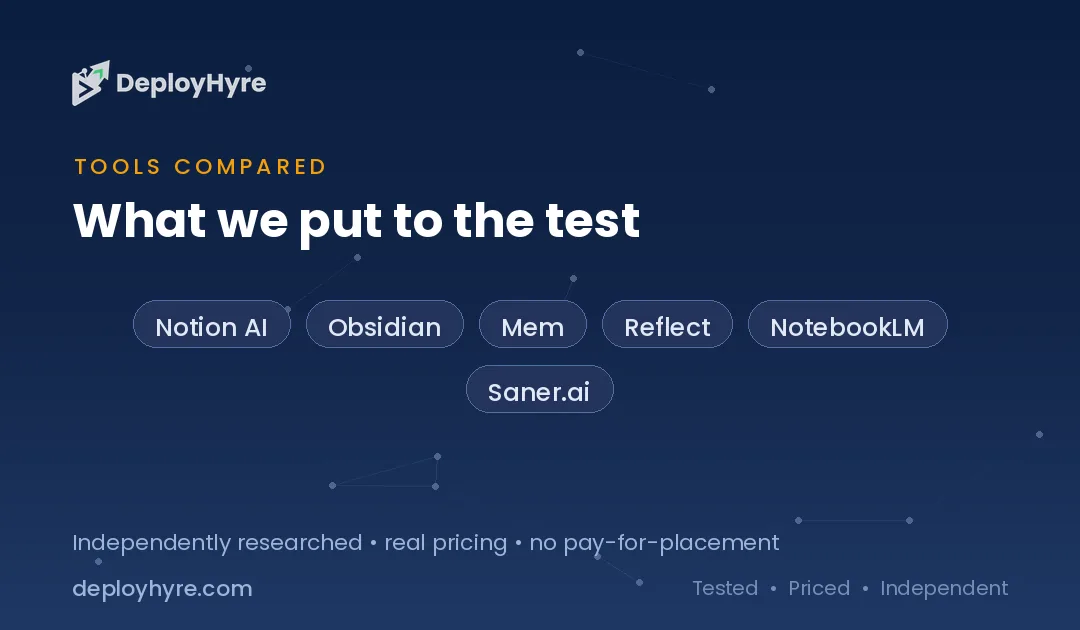
| Notion AI | All-in-one team workspaces | Plus from $10/member/mo | Docs, databases, and agents |
| Obsidian | Local-first private notes | Free for personal use | Offline vault, 2,500+ plugins |
| Mem | Notes that self-organize | Free; Pro ~$12-15/mo | Automatic linking and tagging |
| Reflect | Networked thinking | $10/month flat | GPT and Claude backends |
| NotebookLM | Source-grounded research | Free | Audio overviews from sources |
| Saner.ai | Capture and focus | Paid mid-teens/mo | Assistant for notes and tasks |
| Granola | Meeting notes | ~$14/user/mo | Augments your own notes |
| Otter.ai | Automatic transcripts | Free; Pro ~$17/mo | Live meeting transcription |
What Is an AI Note-Taking App?
An AI note-taking app captures your notes, then uses machine learning to organize, link, summarize, and answer questions about them. It turns a passive archive into an active tool. Instead of searching folders, you ask the app a question and it pulls the answer from your own writing. Many also auto-tag notes and surface related ideas as you type.
The shift in 2026 is that AI made the gap visible. A plain notes app stores text. An AI notes app connects it. The best tools auto-link related notes, draft summaries, and let you chat with your knowledge base. This matters most for people who take many notes and struggle to find them later.
What Makes a Great AI Note-Taking App?
The best apps combine three strengths. First, fast and frictionless capture, since a note you do not write helps no one. Second, smart organization, so notes link and surface without manual filing. Third, useful AI, meaning summaries and answers grounded in your own content rather than generic text.
Privacy and price also shape the choice. Local-first apps like Obsidian keep data on your device, which suits sensitive work. Cloud apps like Notion add team features and sync. According to Capterra’s 2026 data cited by Alfred, Notion holds about 25% of the note-taking and knowledge management market, up from 20% a year earlier, showing how fast the category is consolidating around AI-rich workspaces.
Best AI Note-Taking Apps for Personal Knowledge Management
1 Notion AI: Best for all-in-one team workspaces
Notion blends notes, databases, and AI agents into a single flexible workspace.
What it does well. Notion AI writes, summarizes, and now runs custom agents that work across Notion, Slack, Mail, and Calendar. The Notion 3.3 release in February 2026 added agents that run on schedules. Teams use Notion for notes, wikis, projects, and docs in one place, which removes tool sprawl. Its database model makes notes structured and searchable.
Key features:
-
AI writing, summaries, and Q&A across your workspace
-
Custom agents that run on schedules
-
Databases, wikis, and project boards
-
Deep team collaboration and permissions
Pricing. Notion Plus starts at $10 per member per month billed annually, with full AI on the Business plan near $20 per member per month, per Lindy’s 2026 review.
Best for: Teams that want notes, docs, and projects in one workspace.
Limitations. The blank canvas overwhelms some users, and full AI sits on higher tiers.
2 Obsidian: Best for local-first private knowledge graphs
Obsidian stores notes as plain files on your device and links them into a visual graph.
What it does well. Obsidian keeps every note local, so your data never leaves your machine unless you choose to sync. Its graph view shows how ideas connect. AI arrives through community plugins like Smart Connections and Copilot for Obsidian, which often use your own API key. The plugin ecosystem crossed 2,500 plugins, with AI plugin downloads up 300%.
Key features:
-
Local-first plain-text storage
-
Visual graph of linked notes
-
2,500+ community plugins
-
AI via Smart Connections and Copilot plugins
Pricing. Obsidian is free for personal use. Optional Sync and Publish add-ons cost a few dollars per month, and most AI plugins are free but need your own model key.
Best for: Privacy-focused users who want full control over their notes.
Limitations. AI is not built in, so setup takes more effort than cloud apps.
Best AI Note-Taking Apps for Automatic Organization
3 Mem: Best for notes that organize themselves
Mem auto-links and auto-tags notes so you never file anything by hand.
What it does well. Mem rebuilt around AI and shipped Mem 2.0 in 2026. You type, and the app links related notes, tags them, and surfaces connections as you write. This removes the busywork of folders. Its AI chat answers questions across everything you have captured. The Mem It extension grabs content from anywhere fast.
Key features:
-
Automatic linking and tagging
-
AI chat across all notes
-
Mem It web capture extension
-
Related-note surfacing as you write
Pricing. Mem offers a free tier with 25 notes and 25 AI chats per month. Pro runs about $12 to $15 per month billed annually, per Lindy’s testing, with unlimited notes and chats.
Best for: People who hate manual organization and want it automated.
Limitations. Less structured than Notion, so it suits personal notes over team projects.
4 Reflect: Best for networked thinking with a fixed price
Reflect connects daily notes into a backlinked network with a single flat price.
What it does well. Reflect builds a graph of backlinked notes, like a personal wiki for your thoughts. It offers GPT and Claude as user-selectable AI backends for summarizing and linking. Its pricing is refreshingly simple: one plan, one price, the full feature set. The design favors clarity over feature bloat, which appeals to focused knowledge workers.
Key features:
-
Backlinked daily notes and graph view
-
Choice of GPT or Claude AI backends
-
Calendar and contact integrations
-
End-to-end encryption
Pricing. Reflect costs $10 per month on a single flat plan with no tiers.
Best for: Solo knowledge workers who want networked notes and simple pricing.
Limitations. No free tier, and it lacks deep team collaboration features.
Best AI Note-Taking Apps for Research and Study
5 NotebookLM: Best for source-grounded research
NotebookLM answers questions using only the sources you upload, with citations.
What it does well. Google NotebookLM grounds every answer in your documents, so it cites sources and avoids made-up facts. It reads PDFs, YouTube videos, and EPUBs, then generates audio and video overviews that explain your material. The free tier is generous. This makes it ideal for students and researchers digesting heavy reading.
Key features:
-
Answers grounded in your uploaded sources
-
Audio and video overviews
-
YouTube and EPUB support
-
Source citations on every response
Pricing. NotebookLM is free with 100 notebooks, 50 sources per notebook, and 50 chat queries per day. Google One AI Premium at $19.99 per month raises limits fivefold.
Best for: Students and researchers who need source-grounded answers.
Limitations. It centers on research over freeform note capture, so it is not a daily journal.
6 Saner.ai: Best for capture and focus
Saner.ai pairs note capture with an AI assistant for tasks and email.
What it does well. Saner.ai acts as a personal assistant that captures notes, manages tasks, and connects to email in one place. It surfaces what matters and hides the rest, which suits people who feel scattered across apps. Its AI summarizes and retrieves notes on demand. The design leans toward focus, reducing the overwhelm of busy tools.
Key features:
-
Unified notes, tasks, and email
-
AI assistant for retrieval and summaries
-
Distraction-reducing interface
-
Smart reminders and follow-ups
Pricing. Saner.ai runs on paid plans in the mid-teens per month, with a trial to test the assistant.
Best for: People who want notes, tasks, and email in one focused assistant.
Limitations. It is a newer tool, so its ecosystem and integrations are still growing.
Best AI Note-Taking Apps for Meetings and Capture
7 Granola: Best for augmenting your own meeting notes
Granola enhances the notes you type during a meeting instead of sending a bot.
What it does well. Granola listens in the background and augments your own rough notes into clean, structured summaries after the call. No meeting bot joins the room, which feels less intrusive. It is also the most affordable dedicated meeting notetaker. Granola suits people who like to type a little and let AI fill the gaps.
Key features:
-
Augments your typed notes, no bot
-
Clean post-meeting summaries
-
Works across video platforms
-
Searchable meeting archive
Pricing. Granola starts near $14 per user per month, the cheapest among the main AI meeting notetakers.
Best for: Professionals who take their own notes but want AI cleanup.
Limitations. It focuses on meetings, so it is not a full knowledge base.
8 Otter.ai: Best for automatic meeting transcription notes
Otter.ai records and transcribes meetings live, then summarizes the key points.
What it does well. Otter joins calls, transcribes speech in real time, and generates summaries with action items. Its automatic capture means you can stay present in the conversation. Otter integrates with Zoom, Google Meet, and Microsoft Teams. For teams comparing dedicated options, see our guides to the best AI meeting assistants and best AI transcription software.
Key features:
-
Live meeting transcription
-
Automatic summaries and action items
-
Zoom, Meet, and Teams integration
-
Speaker identification
Pricing. Otter offers a free tier with limited monthly minutes, and Pro runs about $17 per month for more capacity and features.
Best for: Teams that want hands-off meeting transcripts and summaries.
Limitations. It centers on transcription, so it does not organize personal notes like Mem or Obsidian.
How Should You Choose the Right AI Note-Taking App?
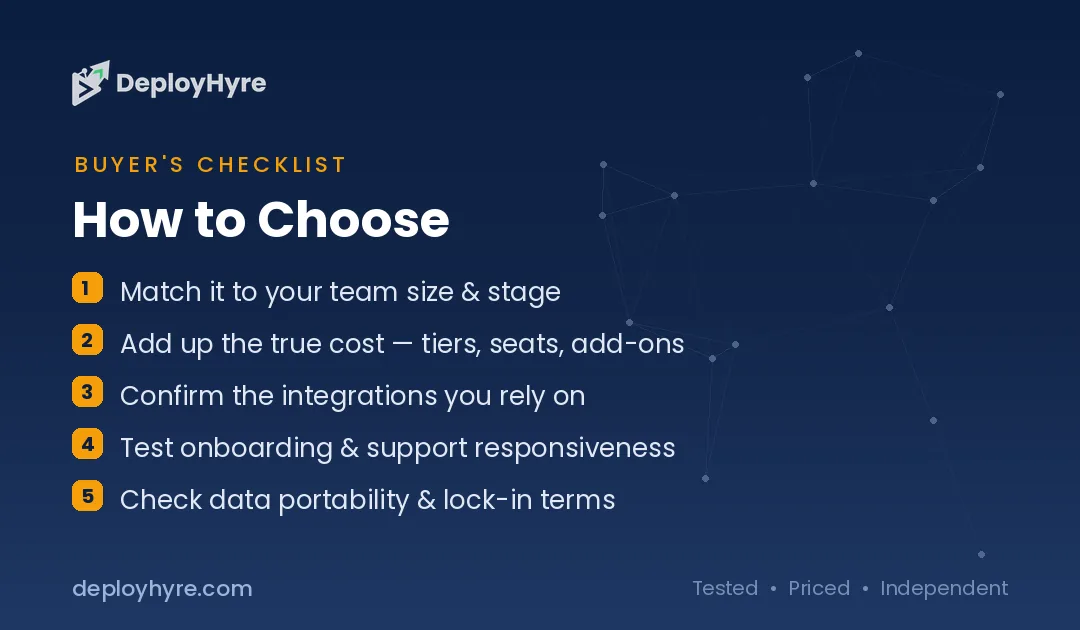
Choose based on what you capture and how private it must be. Teams need Notion. Privacy-focused users want Obsidian. People who hate filing should pick Mem. Researchers gain most from NotebookLM, and meeting-heavy roles need Granola or Otter. Match the app to your main use case, not its longest feature list.
Test three things before committing. First, capture speed: open the app and write a note in seconds. Second, AI usefulness: ask it to summarize or find something and judge the answer. Third, data control: decide whether you need local storage or accept cloud sync. Most apps offer free tiers or trials, so try two before you settle.
How We Evaluated These Apps
We assessed each app across five criteria: capture speed, AI quality, organization, privacy, and price. We reviewed 2026 hands-on tests, vendor documentation, and published pricing. We weighted AI usefulness and organization most heavily, since those are what separate a modern notes app from a plain text editor.
We did not crown one universal winner. Each pick leads a clear use case, because note-taking is personal. A researcher and a sales manager need different tools. This use-case approach mirrors how people actually choose, matching the app to their workflow rather than chasing a single best.
The Bottom Line
AI turned note-taking from storage into thinking. The market is growing at double-digit rates, and AI features are now table stakes. The right app depends on your work.
Teams should test Notion AI. Privacy-minded users will prefer Obsidian. Mem and Reflect suit personal knowledge, NotebookLM fits research, and Granola or Otter handle meetings. Start with a free tier, capture real notes for a week, then judge which app actually helps you think. To extend AI into your wider workflow, explore the best free AI tools for marketing and the best AI tools for blog writing.
Frequently Asked Questions
What is the best AI note-taking app?
The best app depends on your use case. Notion AI leads for teams, Obsidian for private local notes, Mem for automatic organization, NotebookLM for research, and Granola for meetings. Most offer free tiers, so testing two against your real workflow is the fastest way to decide.
Are AI note-taking apps free?
Several are. NotebookLM is free with generous limits, and Obsidian is free for personal use. Mem and Otter offer free tiers with caps. Paid plans like Notion, Reflect, and Granola range from about $10 to $20 per month and add unlimited notes, advanced AI, or team features.
Which AI note-taking app is most private?
Obsidian is the most private because it stores notes as plain files on your own device by default. Reflect adds end-to-end encryption in the cloud. Apps that run AI through your own API key, like some Obsidian plugins, keep more control over what data leaves your machine.
Can AI note apps summarize meetings?
Yes. Granola and Otter.ai specialize in meetings. Granola augments your own typed notes into clean summaries, while Otter transcribes the full conversation live and generates action items. For dedicated options, compare the best AI meeting assistants and transcription tools.
What is the difference between a note app and a transcription tool?
A note app captures and organizes ideas you write or save, then uses AI to link and answer questions about them. A transcription tool converts spoken audio into text. Some apps, like Otter, do both, but pure note apps like Mem and Obsidian focus on written knowledge.

David Austin is a technology writer and software analyst at DeployHyre, where he covers AI tools, SaaS platforms, cloud hosting, and business automation. He focuses on hands-on comparisons of pricing, features, and real-world performance so teams can pick the right software with confidence.
Know AI, SaaS, or cloud tools inside out? Pitch a guest post and get in front of thousands of buyers researching their next tool.