The AI in ecommerce market will grow from $9.16 billion in 2025 to $19.38 billion by 2030, a 16.2% yearly growth rate. AI now touches every part of an online store, from the product page to the warehouse. The right tools write your copy, predict demand, set prices, and recommend products that lift average order value.
Table of Contents
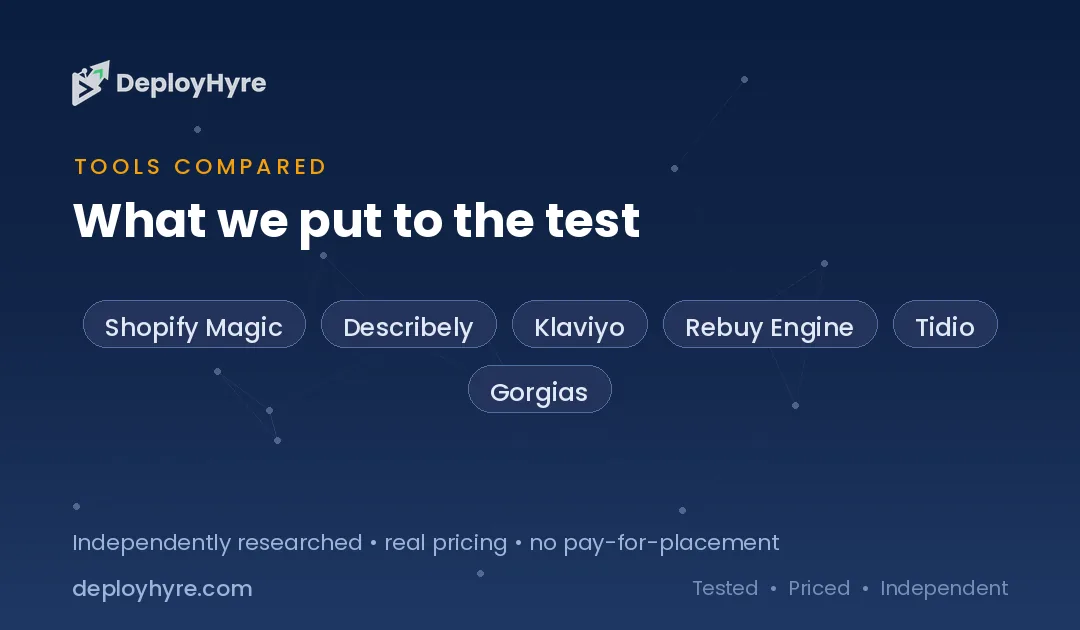
We tested 9 AI tools for ecommerce across the jobs that move revenue: content, marketing, support, inventory, and pricing. This guide is the hub for our ecommerce cluster, and each section links to a deeper guide. For the wider view of AI across your company, start with our pillar on AI for business.
Quick Comparison: Top AI Tools for Ecommerce
| Tool | Best For | Starting Price | Job |
|---|---|---|---|
| Shopify Magic | Built-in store AI | Free with Shopify | Content + assistant |
| Describely | Bulk product descriptions | ~$0.75/description | Catalog copy |
| Klaviyo | Email and SMS marketing | Free to ~$45/mo | Retention |
| Rebuy Engine | Product recommendations | ~$99/mo | Upsell + AOV |
| Tidio | Support for smaller stores | ~$29/mo | Chat support |
| Gorgias | Support for busy stores | ~$10/mo | Helpdesk |
| Prediko | Inventory forecasting | Free tier + paid | Stock planning |
| Triple Whale | Analytics and attribution | ~$129/mo | Data |
| Octane AI | Quizzes and personalization | ~$50/mo | Zero-party data |
What Are AI Tools for Ecommerce?
AI tools for ecommerce use machine learning to automate and improve the tasks that run an online store. They write product copy, personalize offers, answer shoppers, forecast inventory, and set prices from live data. The goal is simple: more revenue per visitor and less manual work, so a small team can run a store that feels much larger.
These tools fall into five jobs. Content tools write descriptions and emails. Marketing tools personalize campaigns. Support tools answer shoppers day and night. Inventory tools predict demand and reorder stock. Pricing tools adjust prices to protect margin. A strong stack uses one tool per job and connects them through your store platform.
Best AI Ecommerce Tools for Content and Catalog
Content tools turn a blank product page into ready-to-publish copy. They suit stores adding many SKUs.
1 Shopify Magic: Best built-in store AI
Shopify Magic is the free AI suite inside Shopify.
What it does well. It writes product descriptions, drafts email subject lines, removes photo backgrounds, and powers Sidekick, the merchant assistant. It is included free on every Shopify plan, so most stores start here before buying add-ons.
Key features:
- AI product descriptions and blog drafts
- Sidekick admin assistant
- Image background removal
- Email and FAQ generation
Pricing. Free with any Shopify plan.
Best for: Shopify merchants who want AI without extra cost.
Limitations. Output is generic, and it only works inside Shopify.
2 Describely: Best for bulk product descriptions
Describely is built for catalog operations, not generic copy.
What it does well. It imports your catalog, enriches product data, and generates descriptions in bulk with a set brand voice, then publishes back to your store. That makes it a fit for stores with hundreds or thousands of SKUs. See our full guide to the best AI product description generators.
Key features:
- Bulk description generation
- Product data enrichment
- Brand voice controls
- Shopify and WooCommerce connectors
Pricing. Pay as you go, about $0.75 per description, with credits for enrichment and images.
Best for: large catalogs that need consistent copy fast.
Limitations. Per-item pricing adds up for very large stores.
Best AI Ecommerce Tools for Marketing and Personalization
These tools turn store data into personalized offers that raise repeat purchases and order value.
3 Klaviyo: Best for email and SMS marketing
Klaviyo is the dominant retention platform for online stores.
What it does well. It uses predictive analytics to forecast a shopper’s next order date and churn risk, then sends targeted email and SMS. Deep Shopify integration makes setup fast. Compare it with the field in our roundup of the best AI email marketing software.
Key features:
- Predictive next-order and churn scores
- Email and SMS automation
- Segmentation from store data
- Prebuilt ecommerce flows
Pricing. A free tier covers up to 250 contacts, with paid plans from about $45 per month as your list grows.
Best for: stores that want to grow repeat revenue.
Limitations. Costs rise quickly with large contact lists.
4 Rebuy Engine: Best for product recommendations
Rebuy personalizes what each shopper sees.
What it does well. It powers AI product recommendations, upsells, and cross-sells across the store and cart, which lifts average order value. It is a leading recommendation app in the Shopify ecosystem.
Key features:
- AI recommendations and upsells
- Smart cart and checkout offers
- A/B testing of offers
- Shopify-native setup
Pricing. Plans start around $99 per month, scaling with order volume.
Best for: stores focused on raising order value.
Limitations. The price suits stores with steady sales, not brand-new shops.
5 Octane AI: Best for quizzes and personalization
Octane AI collects zero-party data through quizzes.
What it does well. It builds product-finder quizzes that ask shoppers what they want, then uses those answers to personalize products and marketing. That data also feeds Klaviyo and other tools.
Key features:
- Product recommendation quizzes
- Zero-party data capture
- Personalized follow-up flows
- Klaviyo and Shopify integrations
Pricing. Plans start around $50 per month.
Best for: stores with many options that need a guided buying path.
Limitations. Quizzes take time to design well.
Best AI Ecommerce Tools for Support, Inventory, and Data
These tools handle the operations behind the storefront, from answering shoppers to planning stock.
6 Tidio: Best support for smaller stores
Tidio handles chat and email support with AI.
What it does well. Its Lyro AI assistant learns your catalog, FAQs, and order history to resolve 60 to 70% of common questions on its own. Setup is simple, which suits smaller teams.
Key features:
- Lyro AI chat resolution
- Live chat and email in one inbox
- Order lookups from chat
- Shopify integration
Pricing. Plans start around $29 per month, with the Lyro add-on priced separately.
Best for: stores under $2M in yearly sales.
Limitations. Heavy support volume can outgrow it.
7 Gorgias: Best support for busy stores
Gorgias is the helpdesk for high-volume stores.
What it does well. It connects directly to Shopify orders, auto-tags tickets, and uses AI to draft replies that agents review. It scales support for stores above $2M in sales. For a wider view, see the best AI customer service software.
Key features:
- Shopify order actions inside tickets
- AI reply drafting and resolution
- Ticket auto-tagging and rules
- Multichannel inbox
Pricing. Plans start around $10 per month, with usage-based AI fees.
Best for: larger stores with heavy support volume.
Limitations. AI resolution fees add up at scale.
8 Prediko: Best for inventory forecasting
Prediko predicts demand and plans purchase orders.
What it does well. It forecasts demand for seasonal products from historical trends, then auto-generates purchase order recommendations with quantities and timing you can send to suppliers. That prevents stockouts and overbuying.
Key features:
- SKU-level demand forecasts
- Auto purchase order suggestions
- Stock alerts and reports
- Shopify-native data
Pricing. A free tier exists, with paid plans for larger catalogs.
Best for: stores that hold inventory across many SKUs.
Limitations. Forecasts need clean sales history to be accurate.
9 Triple Whale: Best for analytics and attribution
Triple Whale centralizes store and ad data.
What it does well. It pulls Shopify, Meta, Google, and other data into one dashboard with AI insights, so you see true profit and ad attribution in real time. It guides where to spend next. Pair it with our guide to the best AI data analytics tools.
Key features:
- Unified profit dashboard
- AI attribution across channels
- Real-time metrics and alerts
- Creative and product analytics
Pricing. Plans start around $129 per month.
Best for: stores spending on ads that need clear attribution.
Limitations. The cost suits stores with real ad budgets.
How Should You Build Your AI Ecommerce Stack?
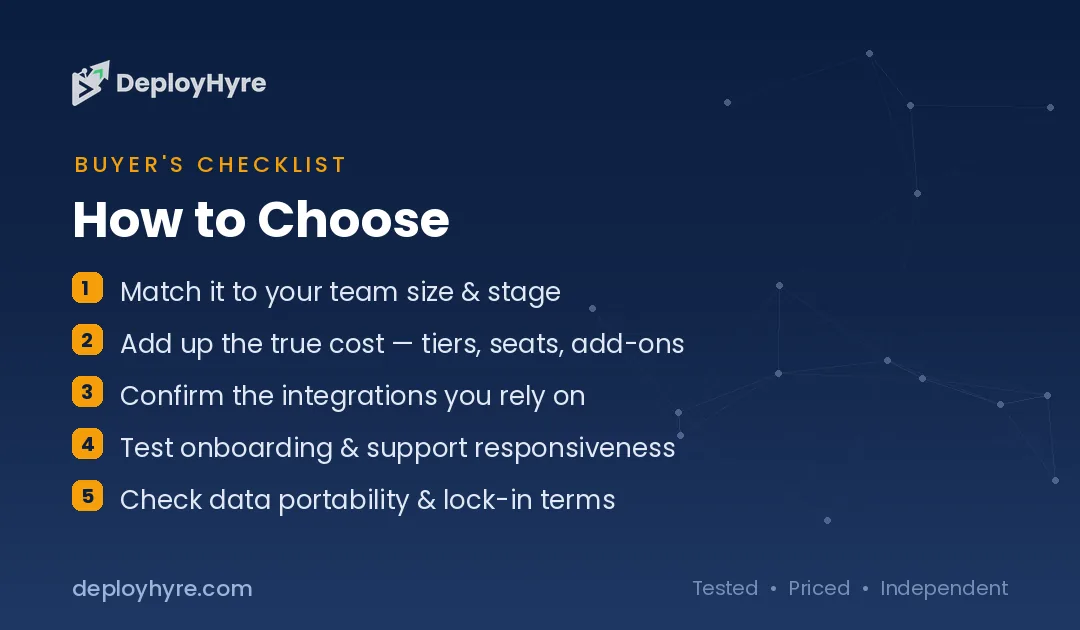
Build your stack one job at a time, starting with the task that costs you the most. Add a content tool if product pages slow you down, a support tool if tickets pile up, and an inventory tool if stockouts hurt sales. Connect each tool through your store platform so data flows between them.
Start with what Shopify gives you free, then add specialists. A new store may only need Shopify Magic and Klaviyo. A growing store adds Rebuy for upsells and Tidio for support. A large store adds Gorgias, Prediko, and Triple Whale. Match each tool to your sales volume so you do not overpay early. A fast, well-built storefront matters too, so review the best AI website builders if you are still choosing a platform.
How We Evaluated These AI Ecommerce Tools
We scored each tool on four factors: revenue impact, ease of setup, integration depth, and cost. We weighted revenue impact and integration most, since a tool that does not connect to your store creates more work than it saves. We reviewed vendor documentation, current pricing pages, and ecommerce market research. We flagged pricing to verify before purchase, since ecommerce apps change plans often.
The Bottom Line
The best AI ecommerce stack matches tools to jobs, not hype. Start with Shopify Magic and Klaviyo, add Rebuy and a support tool as you grow, and layer in Prediko and Triple Whale when volume demands it. Each guide in this cluster goes deeper, including the best AI product description generators and the best AI tools for Shopify.
Frequently Asked Questions
What are the best AI tools for ecommerce?
The best AI tools for ecommerce include Shopify Magic for built-in content, Describely for bulk product descriptions, Klaviyo for email and SMS, Rebuy for recommendations, Tidio and Gorgias for support, and Prediko and Triple Whale for inventory and analytics. The right mix depends on your store size and main bottleneck.
Does AI actually increase ecommerce sales?
Yes, when it targets a clear job. AI recommendations raise average order value, predictive email lifts repeat purchases, and AI support cuts response time, which protects sales. The AI ecommerce market is forecast to more than double from $9.16 billion in 2025 to $19.38 billion by 2030, reflecting that measured impact.
What is the best free AI tool for ecommerce?
Shopify Magic is the best free option for Shopify stores, since it is included on every plan and covers product descriptions, email drafts, and the Sidekick assistant. Klaviyo and Prediko also offer free tiers, so a new store can build a basic AI stack at no cost before upgrading.
Which AI ecommerce tool is best for a small store?
A small store should start with Shopify Magic for content, Klaviyo’s free tier for email, and Tidio for support. This stack is low cost and easy to set up, and it covers the jobs that matter most early: copy, retention, and answering shoppers quickly.
How do AI ecommerce tools connect to my store?
Most connect through your platform’s app store or API, with Shopify and WooCommerce having the widest support. Once connected, the tool reads your products, orders, and customer data to personalize output. Always check the integration before buying, since depth varies by tool.

David Austin is a technology writer and software analyst at DeployHyre, where he covers AI tools, SaaS platforms, cloud hosting, and business automation. He focuses on hands-on comparisons of pricing, features, and real-world performance so teams can pick the right software with confidence.
Know AI, SaaS, or cloud tools inside out? Pitch a guest post and get in front of thousands of buyers researching their next tool.