The endpoint security market reached USD 27.46 billion in 2025 and is on track for USD 38.28 billion by 2030, growing 6.9% a year. That spending shift has one driver: laptops, servers, and phones are now the front door attackers use most.
Table of Contents
AI changed how that door gets defended. The IBM 2025 Cost of a Data Breach Report put the global average breach at $4.44 million, down 9% from the prior year, with organizations now identifying and containing breaches in a mean of 241 days, the fastest in nine years. AI-powered defenses drove that gain. The same report warned that shadow AI added $670,000 to the average breach, so the tool you pick matters.
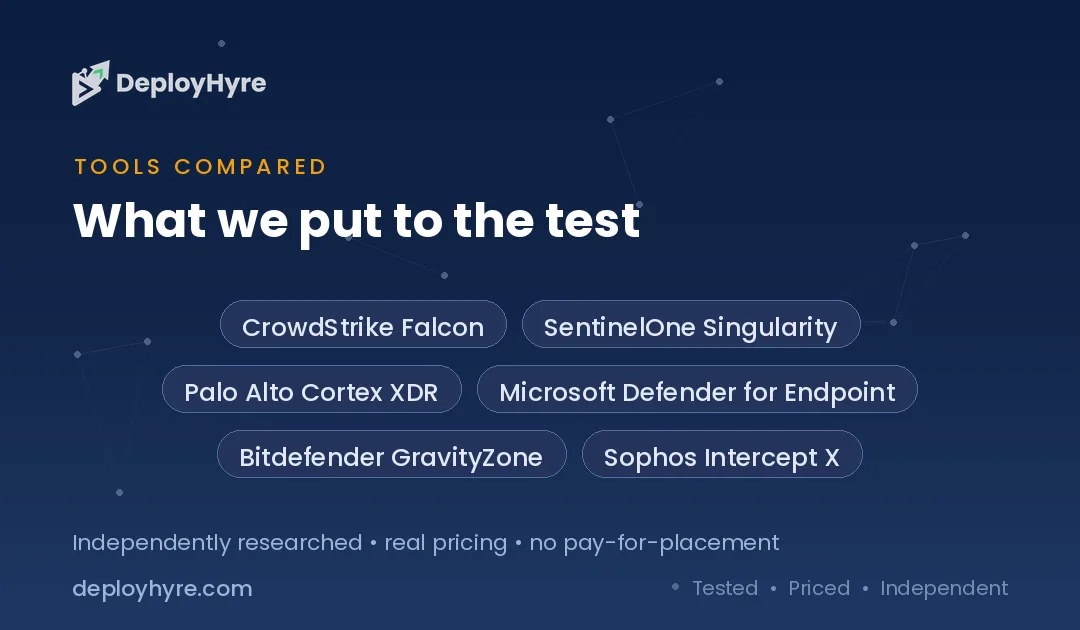
We reviewed eight AI endpoint security platforms against detection accuracy, response speed, pricing, and management overhead. This guide groups them by who they fit best, so you can match a tool to your team instead of reading marketing claims. For the wider stack, start with our pillar on best AI cybersecurity tools.
Quick Comparison: Top 8 AI Endpoint Security Tools
| Tool | Best For | Starting Price | AI Strength |
|---|---|---|---|
| CrowdStrike Falcon | Enterprise EDR/XDR | $59.99/device/yr | Cloud threat graph, behavioral AI |
| SentinelOne Singularity | Autonomous response | $5.83/endpoint/mo | On-device AI, one-click rollback |
| Palo Alto Cortex XDR | SOC consolidation | Custom quote | Cross-data analytics |
| Microsoft Defender for Endpoint | Microsoft 365 shops | $2.50/user/mo | Native Windows telemetry |
| Bitdefender GravityZone | Small and midsize business | $57/device/yr | HyperDetect machine learning |
| Sophos Intercept X | Ransomware defense | ~$28/device/yr | Deep learning, CryptoGuard |
| Cybereason | Threat hunting and forensics | Custom quote | MalOp attack-story engine |
| Trend Micro Vision One | Hybrid cloud workloads | Custom quote | Risk-based attack surface AI |
What Makes AI Endpoint Security Different?
AI endpoint security uses machine learning to spot threats by behavior, not by matching known virus signatures. It watches how a process acts, flags unusual file or memory activity, and can isolate a device on its own. This stops new malware and fileless attacks that signature antivirus misses.
Traditional antivirus checks files against a list of known bad code. That list never covers brand-new attacks. AI models learn what normal looks like on each machine, then catch the small deviations that signal an intruder. They also cut alert noise by ranking events, which helps small teams focus. The IBM data shows why speed counts: faster containment directly lowered breach costs in 2025.
Best AI Endpoint Security for Enterprise Teams
Large teams need cloud-scale detection, cross-platform coverage, and managed options. These three platforms protect tens of thousands of endpoints and feed a central analytics engine that links events across the network. They cost more, yet they replace several point tools at once.
1 CrowdStrike Falcon: Best for enterprise EDR and XDR
CrowdStrike Falcon runs a lightweight agent that streams telemetry to a cloud threat graph shared across its customer base.
What it does well. Falcon correlates activity from millions of endpoints to spot attack patterns within seconds. Its behavioral AI blocks fileless and living-off-the-land attacks, and the Falcon Complete tier adds a fully managed detection-and-response team. The single agent extends to identity and cloud, which turns it into a full XDR platform.
Key features:
- Cloud-native threat graph and behavioral AI
- Managed detection (Falcon Complete) option
- Identity and cloud workload protection from one agent
- Threat intelligence and proactive hunting
Pricing. Falcon Go starts at $59.99 per device per year, Falcon Pro runs $99.99, and Falcon Enterprise reaches $184.99 per device per year. A managed Falcon Complete deployment at 1,000 endpoints runs $200 to $400 per endpoint per year.
Best for: enterprises that want top-tier detection and an optional managed SOC.
Limitations. The price climbs fast as you add modules, and full value needs the cloud-delivered platform rather than a stripped-down tier.
2 SentinelOne Singularity: Best for autonomous response
SentinelOne Singularity puts the AI model on the device, so detection and response continue even when a machine is offline.
What it does well. Its on-agent AI maps each attack into a single storyline and can kill, quarantine, and roll back changes with one click. The one-click ransomware rollback restores files to their pre-attack state, which shortens recovery from hours to minutes. Storyline gives analysts a clear chain of events without manual log stitching.
Key features:
- On-device behavioral AI that works offline
- One-click rollback after ransomware
- Storyline attack visualization
- Ranger network discovery for unmanaged devices
Pricing. Singularity Core starts at $5.83 per endpoint per month, Control runs $6.67, and Complete sits at $8.25 per endpoint per month, with Complete listing near $179.99 per endpoint per year before discounts.
Best for: teams that want automated containment with minimal analyst clicks.
Limitations. Tuning the autonomous actions takes care early on, since aggressive auto-kill can disrupt legitimate software.
3 Palo Alto Cortex XDR: Best for SOC consolidation
Palo Alto Cortex XDR blends endpoint, network, and cloud data into one analytics engine for security operations centers.
What it does well. Cortex XDR stitches signals from many sources to reduce false positives and group related alerts into incidents. Its behavioral analytics catch insider misuse and stealthy lateral movement. Teams already running Palo Alto firewalls gain shared context across the stack, which speeds investigation.
Key features:
- Cross-data analytics across endpoint, network, and cloud
- Behavioral threat detection and incident grouping
- Tight integration with Palo Alto firewalls
- Managed threat hunting add-on
Pricing. Palo Alto sells Cortex XDR through custom quotes based on endpoint count and modules. Expect enterprise-tier pricing aligned with the major platforms above.
Best for: SOC teams consolidating several detection tools into one console.
Limitations. Full value depends on feeding it broad data, so smaller environments may not use its range.
Best AI Endpoint Security for Microsoft Environments
Organizations standardized on Microsoft 365 gain the most from native tooling. Defender ships inside many license tiers and reads Windows signals other vendors cannot. It removes a separate agent and bills through an existing Microsoft agreement.
4 Microsoft Defender for Endpoint: Best for Microsoft 365 shops
Microsoft Defender for Endpoint protects Windows, macOS, Linux, iOS, and Android from the Microsoft security cloud.
What it does well. Defender uses deep Windows telemetry and cloud machine learning to detect and auto-remediate threats. It links to the wider Defender XDR suite for email, identity, and cloud, giving one view across Microsoft assets. Automated investigation handles routine alerts so analysts focus on real incidents.
Key features:
- Native Windows telemetry and cloud AI
- Automated investigation and remediation
- Threat and vulnerability management built in
- Integration with Defender XDR and Sentinel
Pricing. Plan 1 runs about $2.50 per user per month and Plan 2 about $5.20 per user per month, and Plan 2 is included in Microsoft 365 E5. Microsoft notes price updates taking effect in 2026, so confirm current rates.
Best for: Windows-heavy organizations already on Microsoft 365 E5 or E3.
Limitations. Coverage and reporting feel strongest on Windows, and mixed-OS fleets may want broader third-party depth.
Best AI Endpoint Security for Small and Midsize Business
Smaller teams need strong protection without a dedicated security staff. These two platforms deliver machine-learning detection, simple cloud consoles, and per-device pricing that fits tight budgets. Both block ransomware well and require little day-to-day tuning.
5 Bitdefender GravityZone: Best for value and simplicity
Bitdefender GravityZone pairs a proven detection engine with a single cloud console built for lean teams.
What it does well. GravityZone uses HyperDetect machine learning and a tunable sandbox to catch threats before they run. It scores consistently high in independent lab tests for protection and low false positives. Patch management and risk analytics sit in the same console, which removes extra tools.
Key features:
- HyperDetect machine learning and sandbox analysis
- Patch management and risk scoring
- Single cloud console for all endpoints
- Optional managed detection and response
Pricing. GravityZone starts near $57 per device per year for small business, with Business Security Premium adding EDR at about $95.89 per device per year.
Best for: small and midsize firms that want strong detection at a fair price.
Limitations. Advanced threat hunting is lighter than the enterprise XDR platforms above.
6 Sophos Intercept X: Best for ransomware defense
Sophos Intercept X combines deep-learning malware detection with dedicated anti-ransomware technology.
What it does well. Its CryptoGuard feature watches for the file-encryption behavior ransomware uses, then stops and reverses it. Deep-learning models block never-seen malware, and the Sophos Central console links endpoint, firewall, and email under one roof. Managed MDR is available for teams without a SOC.
Key features:
- CryptoGuard anti-ransomware rollback
- Deep-learning malware prevention
- Sophos Central unified console
- 24/7 managed detection option
Pricing. Intercept X starts around $28 to $79 per device per year depending on tier and region.
Best for: teams that rank ransomware as their top risk.
Limitations. The broad feature set means new admins spend time learning the console.
Best AI Endpoint Security for Threat Hunting
Mature teams that hunt threats need rich attack context and forensic depth. These platforms reconstruct full attack stories and expose the data analysts need to chase intruders. They reward teams with the staff to use them.
7 Cybereason: Best for attack-story forensics
Cybereason centers on its MalOp engine, which assembles related events into a single malicious operation view.
What it does well. Instead of thousands of alerts, Cybereason shows one attack story with the root cause, affected machines, and timeline. That cuts investigation time and gives hunters a clear path to the source. Its behavioral AI flags subtle lateral movement that point alerts miss.
Key features:
- MalOp attack-story correlation
- Behavioral detection of lateral movement
- Guided remediation across affected hosts
- Managed detection and response option
Pricing. Cybereason uses custom quotes based on endpoint count and service level.
Best for: teams that prioritize forensic investigation and root-cause analysis.
Limitations. The platform shines with skilled analysts, so very small teams may not tap its depth.
8 Trend Micro Vision One: Best for hybrid cloud workloads
Trend Micro Vision One extends endpoint protection across servers, containers, and cloud workloads with risk-based AI.
What it does well. Vision One scores attack surface risk and links endpoint, email, and cloud signals into one console. Its AI prioritizes the exposures most likely to be exploited, which helps teams patch the right things first. Strong server and container coverage fits hybrid data centers.
Key features:
- Attack surface risk scoring
- Endpoint, server, and cloud workload coverage
- Cross-layer XDR correlation
- Managed XDR service option
Pricing. Trend Micro sells Vision One through custom quotes tied to workload count and modules.
Best for: organizations protecting mixed on-premise and cloud workloads.
Limitations. The breadth of modules can feel complex for a pure endpoint use case.
How Should You Choose the Right AI Endpoint Security Tool?
Match the platform to your team size, operating systems, and in-house skill, not to the longest feature list. A 20-person firm and a 5,000-seat enterprise need very different tools, and paying for unused depth wastes budget.
Start with your fleet. Windows-only shops on Microsoft 365 E5 already own Defender for Endpoint, so test it first. Mixed-OS or high-risk environments gain from CrowdStrike Falcon or SentinelOne. Small teams without security staff fit Bitdefender or Sophos, which run well with light tuning.
Weigh response automation next. SentinelOne and Sophos lean toward automatic containment and rollback, which suits teams that cannot watch alerts all day. Cybereason and Cortex XDR reward teams that hunt. If you lack a SOC, choose a platform with a managed detection option so experts watch your endpoints around the clock. Pair the choice with continuous testing from AI penetration testing tools and broader AI threat detection tools.
How We Evaluated These AI Endpoint Security Tools
We scored each platform on four weighted criteria: detection and prevention quality, response and remediation speed, management overhead, and total cost. We reviewed independent lab results, vendor documentation, and verified 2026 pricing from public sources rather than relying on vendor claims.
We favored tools with behavioral AI that catches fileless attacks, automated response that shortens dwell time, and consoles that small teams can run. Pricing reflects published list rates as of June 2026 and changes with volume and contract length. Governance and audit needs sit alongside tooling, which we cover in our AI governance guide.
The Bottom Line
CrowdStrike Falcon and SentinelOne Singularity lead for enterprises, Microsoft Defender for Endpoint wins for Microsoft 365 shops, and Bitdefender GravityZone offers the best value for smaller teams. The right pick depends on your operating systems, staff, and budget more than any single benchmark.
Run a 30-day trial on your real endpoints before you commit, and confirm pricing for your seat count. To round out your defenses, explore our best AI cybersecurity tools guide and see how AI fits a wider strategy in AI for business.
Frequently Asked Questions
What is AI endpoint security software?
AI endpoint security software protects laptops, servers, and mobile devices by using machine learning to detect threats based on behavior instead of known signatures. It can spot new malware, isolate an infected device, and reverse damage automatically, which signature antivirus cannot do.
Is AI endpoint security better than traditional antivirus?
AI endpoint security catches threats traditional antivirus misses, including fileless and brand-new attacks, because it learns normal behavior and flags deviations. The IBM 2025 report tied faster, AI-driven containment to lower breach costs, which favors behavioral tools over signature-only antivirus.
How much does AI endpoint security cost?
Prices range widely in 2026. CrowdStrike Falcon starts at $59.99 per device per year, SentinelOne Core at $5.83 per endpoint per month, Microsoft Defender for Endpoint near $2.50 per user per month, and Bitdefender GravityZone around $57 per device per year. Volume and contract length lower these rates.
Which AI endpoint tool is best for small business?
Bitdefender GravityZone and Sophos Intercept X fit small and midsize business best. Both deliver strong machine-learning detection, simple cloud consoles, and low per-device pricing, and they run well without a dedicated security team.
Can AI endpoint security stop ransomware?
Yes. Tools like Sophos Intercept X and SentinelOne watch for the file-encryption behavior ransomware uses, block it, and roll affected files back to their pre-attack state. This behavioral approach stops ransomware variants that have no known signature.

David Austin is a technology writer and software analyst at DeployHyre, where he covers AI tools, SaaS platforms, cloud hosting, and business automation. He focuses on hands-on comparisons of pricing, features, and real-world performance so teams can pick the right software with confidence.
Know AI, SaaS, or cloud tools inside out? Pitch a guest post and get in front of thousands of buyers researching their next tool.