The strongest Zapier alternatives in 2026 are Make for visual builders who want more automation per dollar, n8n for developers who want to self-host, and Pabbly Connect for teams that need high task volume on a flat budget. Zapier remains the most connected automation platform on the market, but its task-based billing gets expensive fast, and its Professional plan starts at $29.99/month for just 750 tasks (or $19.99/month billed annually). If you run multi-step workflows at scale, want to own your infrastructure, or need AI-native orchestration, one of the eight tools below will usually fit your budget and technical comfort level better. We compare each on real entry pricing, billing model, and who it suits. Pricing here reflects each vendor’s published rates at the time of writing and should be treated as starting bands; automation pricing shifts often, so confirm the live number on the vendor’s page before you commit.
Quick Comparison: Zapier Alternatives at a Glance
| Tool | Entry Price | Billing Model | Self-Host? | Best For |
|---|---|---|---|---|
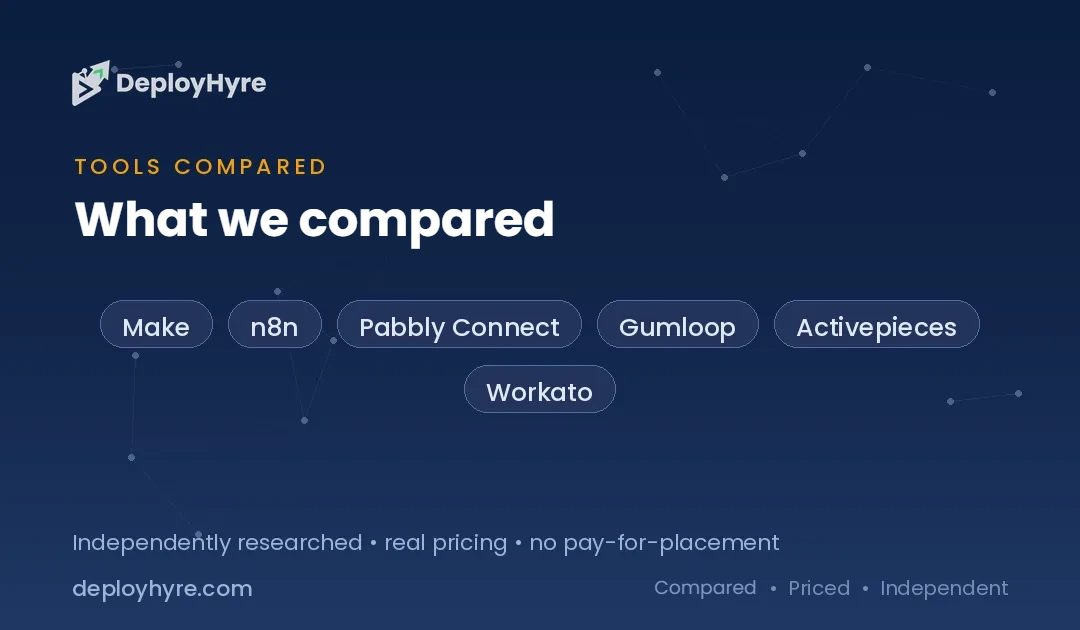
| Make | From ~$9/mo (Core, billed annually) | Per operation | No | Visual builders wanting more runs per dollar |
| n8n | Free self-hosted; Cloud from €20/mo (annual) | Per workflow execution | Yes | Developers and technical teams |
| Pabbly Connect | From $16/mo (Standard, annual, 12,000 tasks) | Per task | No | Budget-conscious high-volume users |
| Gumloop | Free tier; Pro $37/mo (20,000 credits) | Per credit | No | AI-native workflows and agents |
| Activepieces | Free up to 10 flows; then $5/active flow/mo | Per active flow | Yes | Open-source fans avoiding per-task metering |
| Workato | Custom; typically from ~$10,000/yr | Per task (enterprise contract) | No | Enterprise iPaaS and governance |
| Tray.io | Custom; Pro reported from ~$595/mo | Task/workflow (enterprise) | No | Enterprise integration teams |
| IFTTT | Free; Pro $3.49/mo, Pro+ $14.99/mo | Per applet | No | Simple personal and smart-home automations |
Why Look for a Zapier Alternative
Zapier popularized no-code automation and still connects to more apps than anyone, but three friction points push people to look elsewhere. The first is cost at scale: because Zapier bills per task, a workflow with several action steps burns several tasks every time it fires, so a busy account can blow through its allowance well before month-end and hit overage rates of 1.25x. The second is ownership and data control, which matters to teams handling sensitive records who would rather run automations on their own servers. The third is the shift toward AI: buyers increasingly want tools that treat large language models and autonomous agents as first-class building blocks rather than bolt-ons.
If you are still mapping the wider landscape before committing to a switch, our roundup of the best AI automation tools covers the category end to end and is a good companion to this comparison. Below, we focus specifically on tools that can replace Zapier for connecting apps and moving data between them.
The Real Divide: Task vs. Operation vs. Execution vs. Self-Hosted Pricing
The single most important thing to understand before switching is that these tools do not bill the same way, and the billing model matters far more than the sticker price. Zapier and Pabbly charge per task (one action step = one task). Make charges per operation, which is similar but priced so you get many more per dollar. n8n charges per workflow execution, meaning one full run counts once no matter how many steps it contains. Self-hosted tools like n8n Community Edition and Activepieces shift the cost from per-run fees to your own server bill. The table below shows how the same busy account can land in wildly different price bands depending on the model.
| Model | What counts as billable | Tools | Who it favors |
|---|---|---|---|
| Per task | Each action step in a workflow | Zapier, Pabbly Connect, Workato | Simple, low-step workflows |
| Per operation | Each module run (cheaper per unit than tasks) | Make | Multi-step visual workflows |
| Per execution | One full workflow run, any number of steps | n8n | Complex, data-heavy workflows |
| Per active flow / applet | Each live automation, unlimited runs | Activepieces, IFTTT | Few workflows, high run frequency |
| Per credit | AI and compute usage | Gumloop | AI-heavy, agentic workflows |
| Self-hosted (infra only) | Your server cost, no per-run fee | n8n CE, Activepieces | Technical teams at volume |
The practical takeaway: a workflow that runs constantly but has few steps is cheapest on a per-flow model like Activepieces or IFTTT. A workflow with many steps that runs occasionally is cheapest on a per-execution model like n8n. And if you have engineering resources, self-hosting removes the per-run meter entirely in exchange for maintaining a server.
Best for Developers & Self-Hosting
n8n is the standout for technical teams. Its self-hosted Community Edition is free and open source with unlimited executions, so you only pay for the server it runs on, typically a $5-$10/month VPS for moderate workloads. If you would rather not manage infrastructure, n8n Cloud starts at €20/month billed annually for the Starter plan with 2,500 workflow executions, unlimited users, and unlimited workflows. The key advantage is its execution-based billing: one workflow run counts once regardless of how many steps it contains, which is far more predictable than per-task metering. n8n also ships native code steps (JavaScript and Python), custom HTTP requests, and strong support for building AI agents, making it a natural home if you are also exploring the best AI agents and want them wired into real workflows. Verdict: the best Zapier alternative for anyone comfortable with a bit of code or a Docker container.
Activepieces is the other open-source option worth serious attention. Its cloud tier is free for up to 10 active flows with unlimited runs, then $5 per additional active flow per month, and the software is fully free to self-host. Because it bills per active flow rather than per task, a small set of high-frequency automations can run at essentially no marginal cost, which undercuts every metered entry plan on this list. It is younger and has fewer connectors than n8n, but its per-flow model and MIT-friendly licensing make it a compelling pick for teams that want to avoid task counting altogether. Verdict: best for lean teams running a handful of busy workflows who want open-source control.
Best for Budget & High Volume
Pabbly Connect is the value leader for teams that need a lot of automation without a lot of spend. Its Standard plan is $16/month billed annually for 12,000 tasks, with Pro at $33/month for 24,000 tasks and Ultimate at $67/month for up to 300,000 tasks. Crucially, internal steps like filters and routers do not consume tasks, so real-world throughput is higher than the headline number suggests. Pabbly also runs frequent lifetime-deal promotions, though those prices move around during sales. Verdict: the best pick when raw task volume per dollar is the priority.
Make (formerly Integromat) is the strongest all-round Zapier replacement for visual builders. Its Core plan starts at roughly $9/month billed annually for about 10,000 operations, and because it charges per operation rather than per task, you generally get far more automation per dollar than Zapier. Its drag-and-drop canvas handles branching, iteration, and error handling more gracefully than Zapier’s linear editor, and it now includes AI modules for text and image tasks. Make is also a common backbone for teams building automated support flows, pairing well with the best AI customer service software to route and enrich tickets. Verdict: the best balance of power, price, and approachability for non-developers.
IFTTT sits at the simple, ultra-cheap end. Its free plan covers 2 applets, Pro is $3.49/month for up to 20 applets with multi-action support, and Pro+ is $14.99/month for unlimited applets. IFTTT is not built for complex business logic; it shines for personal productivity, smart-home and IoT triggers, and one-step “if this, then that” automations. Verdict: best for individuals and smart-home users who need cheap, single-purpose automations rather than a business iPaaS.
Best for Enterprise & AI Orchestration
Workato is the enterprise-grade iPaaS most often chosen when Zapier is outgrown at the organizational level. Pricing is custom and not published, but industry data consistently puts entry contracts around $10,000/year and up, based on task consumption, connectors, and platform capabilities. In return you get robust governance, recipe versioning, on-premise connectivity, and increasingly, agentic orchestration for AI-driven processes. Verdict: best for large organizations that need security, compliance, and a dedicated integration platform, and have the budget to match.
Tray.io (now often branded Tray.ai) is a similarly positioned low-code enterprise platform. Pricing is quote-based; third-party trackers report Pro tiers starting around $595/month, with Team and Enterprise custom-quoted. Tray emphasizes a flexible visual builder, a large connector library, and AI-augmented workflow building for technical and semi-technical teams inside bigger companies. Verdict: best for enterprise integration teams that want more builder flexibility than a pure task tool but still need managed, governed infrastructure.
Gumloop represents the AI-native end of the spectrum. It has a free tier, and its Pro plan is $37/month for 20,000 monthly credits, 5 concurrent workflow runs, and multiple concurrent agent chats. Rather than treating AI as an add-on, Gumloop is built around chaining LLM steps, document processing, and scraping into automated pipelines, with credit-based billing tied to compute. It is a natural fit if your automations are AI-first, and it slots in alongside tools like the best AI voice agents when you are orchestrating conversational or generative workloads. Verdict: best for teams whose workflows are primarily AI reasoning and generation rather than simple app-to-app triggers.
How Should You Choose a Zapier Alternative?
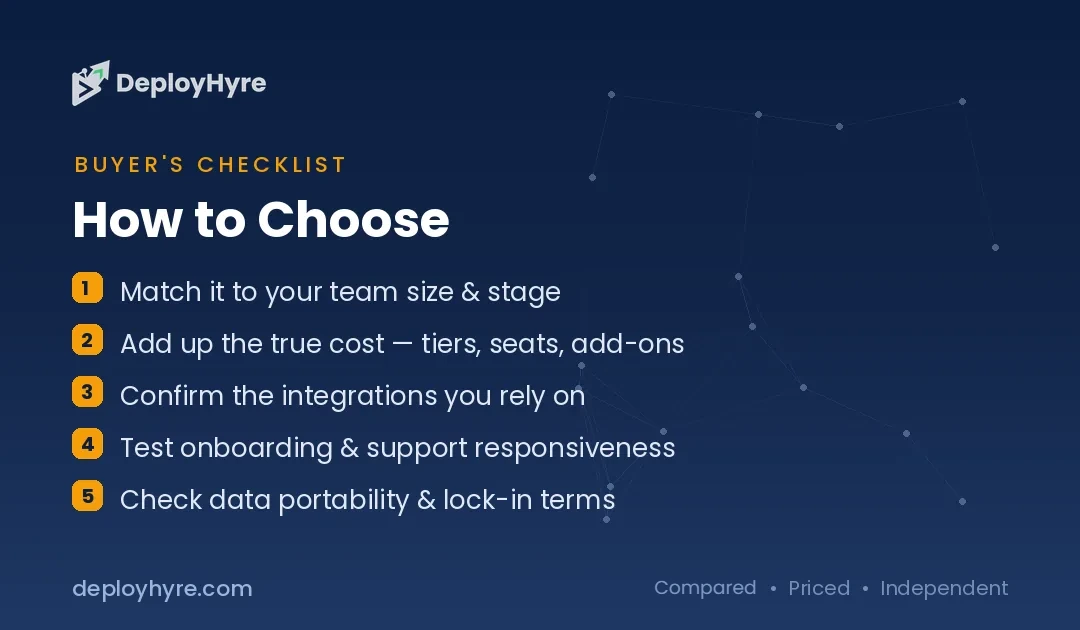
Start with your billing model, not the sticker price. Count the average number of steps in your typical workflow and how often it runs. If your workflows have many steps, a per-execution tool like n8n or a per-operation tool like Make will almost always beat per-task pricing. If you run a small number of workflows very frequently, a per-flow model like Activepieces or IFTTT wins because runs are effectively unlimited. If your steps are few and volume is high, Pabbly’s flat task bundles are hard to beat.
Next, be honest about your technical capacity. Self-hosting n8n or Activepieces can drop your per-run cost to near zero, but someone has to maintain the server, handle updates, and own security. If no one on the team wants that responsibility, a managed cloud plan is worth the premium. Teams with engineers who already run Docker will find self-hosting straightforward; teams without them should not talk themselves into it.
Finally, match the tool to the work. Simple personal or smart-home automations belong on IFTTT. Broad app-to-app business automation is Make or Pabbly territory. AI-first pipelines lean toward Gumloop or n8n. And organization-wide integration with governance and compliance requirements points to Workato or Tray.io. There is no single best Zapier alternative, only the one that matches your workflow shape, budget model, and technical comfort.
How We Evaluated These Tools
We selected these eight tools because each is a live, actively maintained platform that a real team could adopt today as a Zapier replacement, and because together they span the full range of billing models and buyer types, from a $3.49/month consumer applet tool to a five-figure enterprise iPaaS. For every tool we confirmed the entry price and billing model against the vendor’s published pricing at the time of writing, and we treat every figure as a starting band rather than a fixed quote, because automation pricing changes frequently and enterprise deals are negotiated. We did not run head-to-head performance benchmarks; our assessment is based on published pricing, billing structure, self-hosting availability, and documented feature sets. Where a vendor does not publish prices, we say so and cite the widely reported ranges rather than presenting them as official.
The Bottom Line
Zapier is still the most connected automation tool, but it is rarely the cheapest or the most flexible. For most teams switching to save money while keeping a friendly visual builder, Make is the natural first stop thanks to operation-based pricing that stretches further than tasks. Developers and technical teams should look hard at n8n, whose execution-based billing and free self-hosted edition make it the most cost-predictable option at scale. Budget-focused, high-volume users get the most tasks per dollar from Pabbly Connect. If your automations are AI-first, Gumloop is purpose-built for it; if you need enterprise governance, Workato and Tray.io are the serious contenders; and if you just want simple personal automations, IFTTT costs almost nothing. Pick by billing model and workflow shape first, then confirm the current price on the vendor’s page before you commit.
Frequently Asked Questions
What is the best free alternative to Zapier?
For unlimited runs at no software cost, self-hosted n8n Community Edition and self-hosted Activepieces are the strongest free options, though you pay for a server. Among managed cloud tools, Activepieces is free for up to 10 active flows with unlimited runs, and Make offers a free tier with a limited monthly operation allowance. IFTTT’s free plan covers 2 applets for simple personal automations.
Which Zapier alternative is cheapest for high task volume?
Pabbly Connect offers the most tasks per dollar among managed tools, starting at $16/month billed annually for 12,000 tasks and scaling to 300,000 tasks on its $67/month Ultimate plan. For very high volume with engineering support, self-hosting n8n or Activepieces removes per-run fees entirely, leaving only your server cost, typically $5-$10/month for moderate workloads.
Can I self-host a Zapier alternative?
Yes. n8n and Activepieces are both open source and free to self-host, which is their main advantage over Zapier. n8n’s Community Edition runs on your own server with unlimited executions, and Activepieces is likewise free to deploy. You take on server maintenance, updates, and security in exchange for eliminating per-task or per-run billing, which suits technical teams running automations at scale.
Is Make cheaper than Zapier?
Generally yes. Make’s Core plan starts at roughly $9/month billed annually for around 10,000 operations, while Zapier’s Professional plan starts at $29.99/month for 750 tasks ($19.99 billed annually). Because Make bills per operation rather than per task and priced so you get many more per dollar, most multi-step workflows cost less to run on Make. Confirm current rates on each vendor’s pricing page before deciding.
What is the best Zapier alternative for AI workflows?
Gumloop is built specifically for AI-first automation, with a free tier and a Pro plan at $37/month for 20,000 credits, using credit-based billing tied to compute and LLM usage. n8n is also strong for AI because it supports building agents natively and integrates language models into execution-based workflows, making it a flexible choice for teams combining app automation with AI reasoning.
Related Articles



The DeployHyre Editorial Team writes buyer guides on AI tools, SaaS, cloud hosting and proxies. We compare tools using published pricing, official documentation and third-party reviews. All content is for educational and informational purposes only.