LMArena, now branded Arena AI, ranks models by blind human votes. That shows which answers people prefer, not which model is cheapest, fastest or most accurate on your task. Artificial Analysis is the best all-round alternative for quality, speed and price. OpenRouter shows real usage. Scale Labs, LiveBench and Epoch AI add harder, contamination-resistant benchmarks. Use two or three together.
Table of Contents
A 2025 study called The Leaderboard Illusion found that Google and OpenAI received an estimated 19.2% and 20.4% of all Chatbot Arena data. By contrast, 83 open-weight models shared about 29.7%. The authors also found Meta tested 27 private model variants before the Llama 4 release.
That does not make the arena useless. It means one leaderboard should never decide which model you build on. LMArena itself has also changed. The old lmarena.ai address now redirects to arena.ai, which calls itself Arena AI.
This guide covers eight live alternatives and what each one measures. If you are choosing models to power a product, pair it with our guide to AI for business.
Quick Comparison: The Best LMArena Alternatives
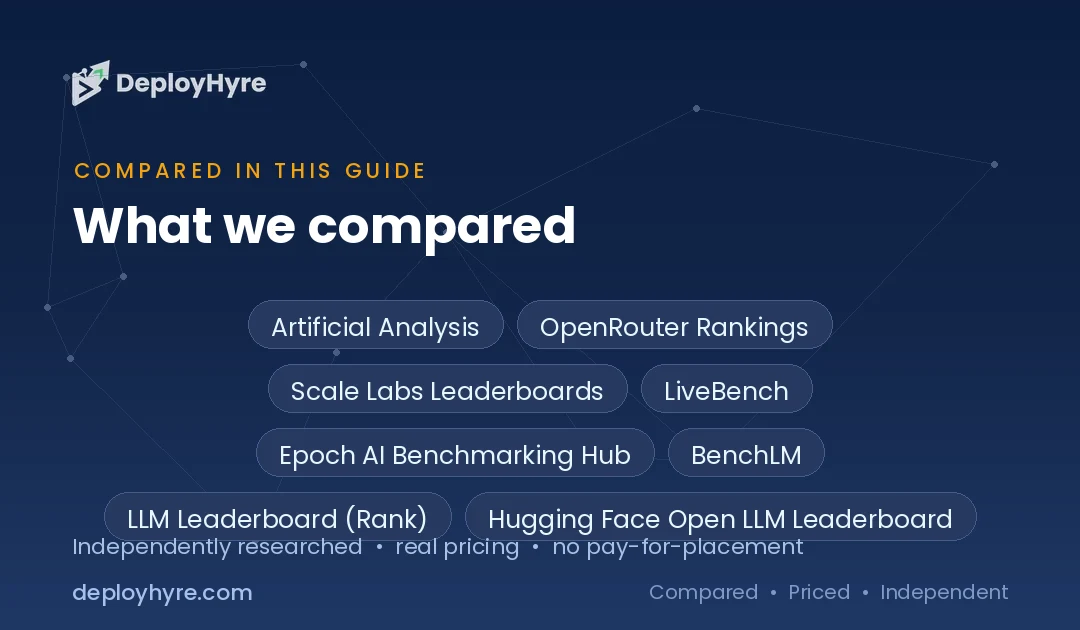
| Tool | Best For | Starting Price | Key Strength |
|---|---|---|---|
| Artificial Analysis | Quality, speed and price in one view | Free to browse | Independent Intelligence Index plus API speed data |
| OpenRouter Rankings | Real-world usage trends | Free to browse | Ranks models by tokens processed |
| Scale Labs Leaderboards | Expert, private benchmarks | Free to browse | Private datasets limit overfitting |
| LiveBench | Contamination-resistant scoring | Free to browse | Fresh questions, objective grading |
| Epoch AI Benchmarking Hub | Research and raw data | Free (CC-BY 4.0 data) | CSV downloads and Python client |
| BenchLM | Benchmark history in one place | Free to browse | Charts arena Elo history over time |
| LLM Leaderboard (Rank) | Quick model shortlists | Free to browse | Benchmarks plus price, latency and speed |
| Hugging Face Open LLM Leaderboard | Historical open-model scores | Free to browse | Reproducible open benchmarks |
What Makes a Great LMArena Alternative?
A great LMArena alternative measures something the arena does not. That means objective accuracy on fresh or private questions, real API speed and cost, or actual usage by developers. It should show its method, date its results and update often. The best choice adds a signal you can act on, rather than repeating the same human preference vote.
LMArena’s strength is real prompts from real users, voted on blind. That makes it hard to game with leaked test data, as BenchLM notes. But teams switch for clear reasons:
- Preference is not accuracy. Tech Insider notes that voters tend to reward longer, confident answers, even when they are less accurate.
- Uneven sampling. The Leaderboard Illusion paper found big providers get far more battles than open models.
- No cost or speed data. The arena ranks answers. It does not tell you price per token or latency.
- Audit limits. Votes are anonymous, so single matchups cannot be checked by outsiders.
- A commercial shift. Tech Insider reports the project grew from a UC Berkeley research effort into a venture-backed company.
Which Leaderboard Signal Do You Actually Need?
Most teams need three signals, not one. Quality tells you if a model can do the task. Cost and speed tell you if you can afford to run it at scale. Usage tells you what other builders trust in production. LMArena only covers part of the first signal, so pair it with tools that fill the other two.
Here is how the eight picks below map to those signals:
- Human preference. Arena AI itself. Good for chat tone and helpfulness.
- Objective quality. Scale Labs, LiveBench and Epoch AI. These grade answers against a known result.
- Cost and speed. Artificial Analysis and Rank. These show price per token and latency.
- Real usage. OpenRouter Rankings. This counts tokens that developers actually send.
- History. BenchLM and the Hugging Face board. These help you see how ranks changed over time.
A simple rule works well. If a model ranks near the top on one quality board and one usage board, add it to your shortlist. Then run your own prompts. Ten real tasks from your product will tell you more than any public chart. Keep the prompts, the outputs and the date, so you can rerun the same test when a new model ships.
Best All-Round LMArena Alternatives
1. Artificial Analysis: Best for quality, speed and price together
Artificial Analysis benchmarks AI models and the API providers that host them.
What it does well. It answers the questions the arena skips. You can compare a model’s intelligence score with its price, output speed and latency on one chart. It also compares the same model across different hosting providers. Per its methodology page, it covers LLMs, speech, image, video and music.
Key features:
- Artificial Analysis Intelligence Index, built from several graded evaluations
- Output speed, latency and price per token
- Provider comparisons for the same model
- Arenas for image, video and speech models
- A separate Coding Index
Pricing. The public leaderboards are free to browse. For any paid data or API access, check the current price on its site.
Best for: Product teams picking a model and a provider for production.
Limitations. The index blends many tests into one number, which can hide weak spots. Index versions change, so scores from different months may not match.
2. OpenRouter Rankings: Best for real-world usage trends
OpenRouter ranks models by how many tokens developers actually send through its API.
What it does well. It shows what builders pick with their own money. That is a useful reality check against any test score. Per its rankings page, you can view top models, top apps and market share by model author.
Key features:
- Top models by tokens processed
- Views by task, programming, language and context length
- Top apps using each model
- Open versus closed weight split
- Daily, weekly, monthly and trending windows
Pricing. The rankings are public to browse. Using models through OpenRouter is billed per token at each model’s listed rate.
Best for: Developers who want to know which models peers really ship with.
Limitations. Usage reflects price and habit, not only quality. It only counts traffic that runs through OpenRouter.
Best LMArena Alternatives for Objective Benchmarks
3. Scale Labs Leaderboards: Best for expert, private benchmarks
Scale AI’s leaderboards, first launched as SEAL, now live under Scale Labs.
What it does well. Scale says it combines private datasets, to prevent overfitting, with open datasets for comparison. Private tests are harder for labs to train on. Its leaderboard page covers coding, reasoning, audio and professional tasks.
Key features:
- Humanity’s Last Exam
- SWE-Bench Pro and SWE Atlas for coding
- MultiChallenge for multi-turn chat
- MCP Atlas for tool use
- Professional reasoning tests for finance and law
Pricing. The leaderboards are free to view. Scale sells evaluation services to companies, so check the current price with its sales team.
Best for: Teams that need hard, expert-built tests for coding or agent work.
Limitations. Private data means you cannot rerun the tests yourself. Not every model appears on every board.
4. LiveBench: Best for contamination-resistant scoring
LiveBench refreshes its questions over time and grades answers against known ground truth.
What it does well. Per its GitHub project, it pulls questions from recent datasets, arXiv papers and news, and scores them without an LLM judge. That avoids the style bias of human or model judges. Its site now presents LiveBench 2.0, which grades longer real tasks such as reports, decks and bug fixes.
Key features:
- Regularly released new question sets
- Objective, automatic scoring
- Categories such as math, coding, reasoning and data analysis
- Open code to run evaluations
- Long-horizon tasks in version 2.0
Pricing. Free to view. The code is public on GitHub.
Best for: Engineers who want scores that are hard to inflate with leaked data.
Limitations. Some recent questions stay private until later, so full reruns are not always possible. Fewer models are listed than on the arena.
5. Epoch AI Benchmarking Hub: Best for research and raw data
Epoch AI is a research group that tracks AI progress, and its hub publishes benchmark results.
What it does well. It is the best pick if you want the data, not just a chart. Per its hub page, Epoch runs tests such as GPQA Diamond, FrontierMath and SWE-bench Verified itself. It also collects outside results.
Key features:
- Internally run benchmarks like FrontierMath
- External benchmark results in one database
- Trends over time, by benchmark or model
- CSV downloads
- Python client (pip install epochai)
Pricing. Free. Epoch licenses its data under CC-BY 4.0.
Best for: Analysts, researchers and writers who need citable numbers.
Limitations. It focuses on capability tests, not price or speed. New models can take time to appear.
Best LMArena Alternatives for Quick Model Shortlists
6. BenchLM: Best for benchmark history in one place
BenchLM gathers published benchmark scores into one ranked view.
What it does well. It pulls many scores together and charts LMArena’s published Elo history from 2023 onward. That lets you see how arena ranks compare with test scores over time.
Key features:
- Combined rankings from public benchmarks
- Arena Elo history charts
- Head-to-head model pages
- Regular leaderboard updates
- Explainers on why rankings differ
Pricing. Free to browse, per the vendor.
Best for: Readers who want one page that compares many signals.
Limitations. It is an aggregator, so it relies on scores others publish. Check the source of any single number.
7. LLM Leaderboard (Rank): Best for fast shortlists with cost data
This leaderboard, once hosted by Vellum, now lives at llmleaderboard.com under the name Rank.
What it does well. It compares models using publicly reported benchmark results, plus pricing, latency and speed. It is quick to scan when you need a shortlist for reasoning, coding or tool use.
Key features:
- Benchmark tables by task
- Price, latency and speed columns
- Filters for reasoning, coding and tool use
- Simple model comparisons
- Clean, fast pages
Pricing. Free to browse.
Best for: Busy teams that need a short list in minutes.
Limitations. It uses scores reported by others, often by the model makers. It does not run its own tests.
8. Hugging Face Open LLM Leaderboard: Best for historical open-model scores
This was the main public scoreboard for open-weight models, and it remains viewable.
What it does well. It scored open models on the same open tests, including IFEval, BBH, MATH, GPQA, MUSR and MMLU-PRO. That makes results easy to reproduce.
Key features:
- Six standard open benchmarks
- Filters by size, type and precision
- Thousands of open models scored
- Public result datasets
- Free and open method
Pricing. Free.
Best for: Looking up older open models and fine-tunes.
Limitations. Tech Insider reports the leaderboard has been archived, so treat it as a historical record. It will not show the newest frontier models.
How Should You Choose the Right LMArena Alternative?
Choose by the decision you need to make. To pick a model for production, start with Artificial Analysis for quality, speed and price. To check hard skills like coding, add Scale Labs or LiveBench. To see what other builders really use, check OpenRouter. Then test your top two models on your own prompts before you commit.
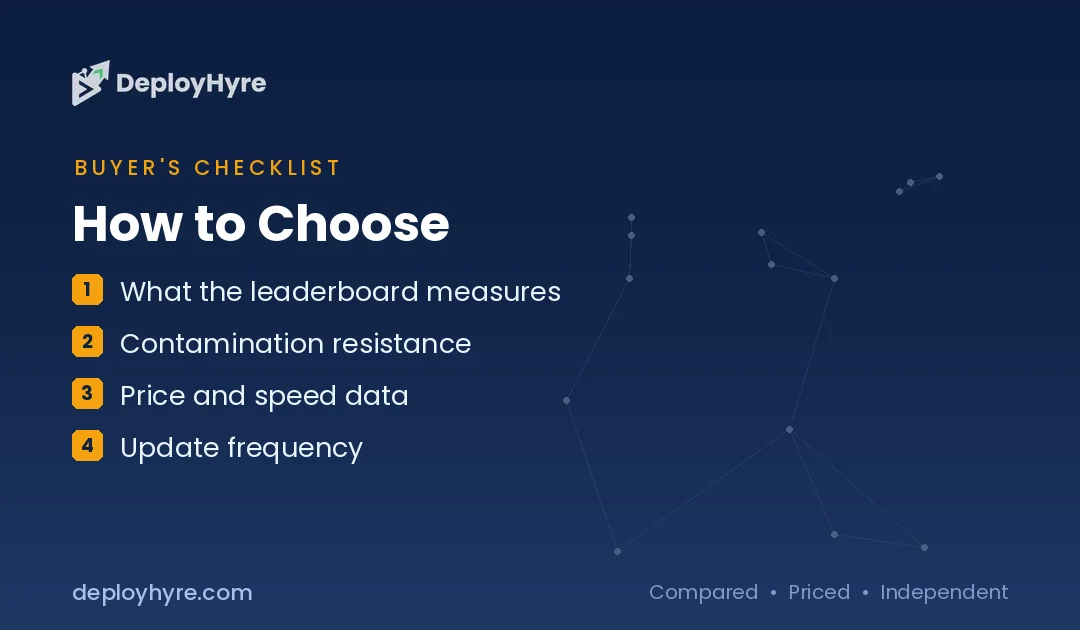
- Match the test to the task. A coding agent needs SWE-style scores. A chat bot may suit arena votes. See our best AI coding assistants guide for tool picks.
- Check cost and limits. A top model can cost more or cap usage. Our guide to ChatGPT usage limits shows how caps affect work.
- Look for dates. Scores shift as indexes change. Only compare numbers from the same version.
- Use more than one. If a model ranks high on two different methods, you can trust it more.
How We Evaluated These Tools
We reviewed these leaderboards in November 2026. We did not run our own model tests. Here is exactly what we checked:
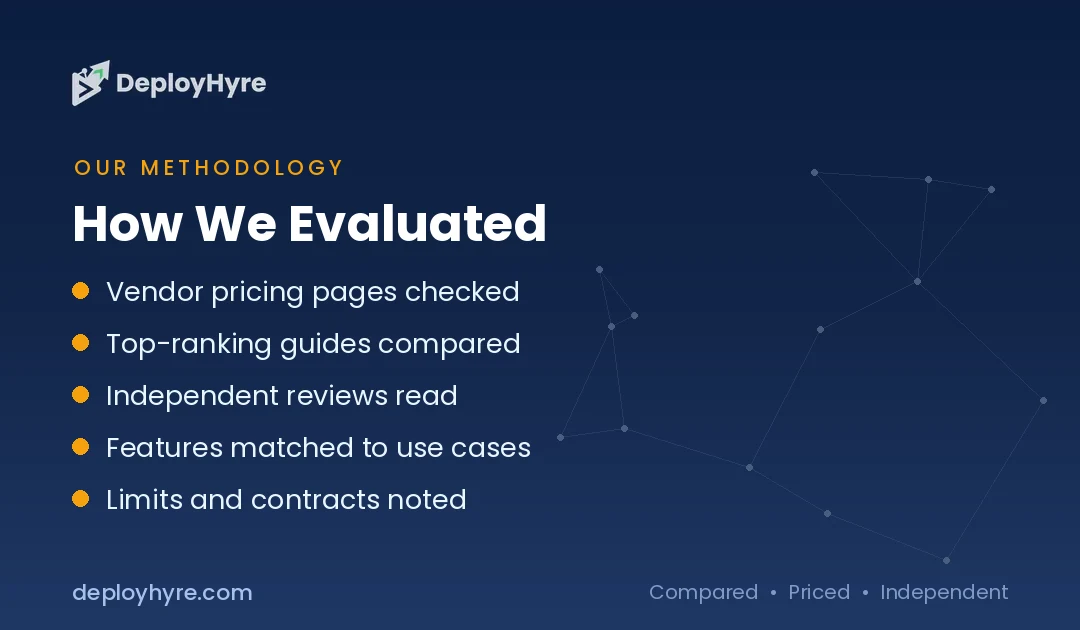
- Live status. We opened each site to confirm it loads and is still updated. We noted renames, such as LMArena to Arena AI and Vellum’s board to Rank.
- Method. We read each site’s own method notes, such as Scale’s private datasets and LiveBench’s ground-truth scoring.
- Ranking pages. We read the top pages for “LMArena alternatives,” including BenchLM, Tech Insider and AlternativeTo.
- Independent research. We used The Leaderboard Illusion paper for data on arena sampling.
Method details come from each provider. We skipped general chatbots, which some lists include, because they are not leaderboards.
The Bottom Line
LMArena, now Arena AI, is still a useful gauge of which answers people like. It is not a full guide to which model you should pay for. For most teams, Artificial Analysis is the best single alternative, because it puts quality, speed and price side by side. Add OpenRouter to see real usage, and Scale Labs or LiveBench for hard, contamination-resistant tests. Researchers should bookmark Epoch AI for its free data. Then run your own short test on real prompts. If you are choosing models for agents, read our best AI agents guide. For coding picks, see Claude Code vs Codex.
Frequently Asked Questions
Is LMArena still available?
Yes, under a new name. The old lmarena.ai address now redirects to arena.ai, which brands itself Arena AI. It still lets you chat with two anonymous models, vote for the better answer and view public leaderboards for text, image and code models. The method still relies on crowd votes.
What is the best alternative to LMArena?
Artificial Analysis is the best all-round alternative for most teams. It scores model intelligence with its own index and adds price, output speed and latency. It also compares API providers that host the same model. That makes it more useful than preference votes when you are choosing a model for a real product.
Why do LLM leaderboards disagree?
They measure different things. LMArena tracks human preference. LiveBench and Scale Labs grade correct answers on set tasks. OpenRouter counts usage. Artificial Analysis blends many tests with cost and speed. Each also updates on its own schedule, so the same model can rank first on one board and lower on another.
Are LMArena rankings reliable?
They are useful but limited. The Leaderboard Illusion paper found big labs received far more arena data than open models and could test private variants before release. Voters may also favor longer answers. Treat arena ranks as one signal, and check them against objective benchmarks and your own tests.
Which leaderboard is best for coding models?
For coding, use leaderboards built on real software tasks. Scale Labs lists SWE-Bench Pro and SWE Atlas results. Epoch AI tracks SWE-bench Verified. LiveBench includes coding categories with objective scoring. OpenRouter’s programming view shows which models developers actually use for code.
Related Articles

The DeployHyre Editorial Team writes buyer guides on AI tools, SaaS, cloud hosting and proxies. We compare tools using published pricing, official documentation and third-party reviews. All content is for educational and informational purposes only.