Table of Contents
The best LLM observability tool for most teams is LangSmith for teams building with LangChain, Langfuse for open-source tracing and evaluation, Arize Phoenix for model drift, and Helicone for the fastest cost-tracking setup. These tools watch your AI application in production, tracing every LLM call and agent step, measuring quality and cost, and catching the failures, hallucinations, latency spikes, cost blowouts, that plague generative-AI apps once real users hit them.
What sets this category apart: the open-source escape hatch is genuinely available, unlike most observability markets. Langfuse, Arize Phoenix, and Helicone all let you self-host for free, so you can run production-grade LLM monitoring at zero licensing cost, paying only for infrastructure. That is unusual, most observability categories force you into paid managed tiers at scale, and it makes LLM observability accessible to any team building AI features, from a solo developer to an enterprise.
Every price below is a recent observed figure. Because usage-based tiers scale with traces and observations, treat each as a band.
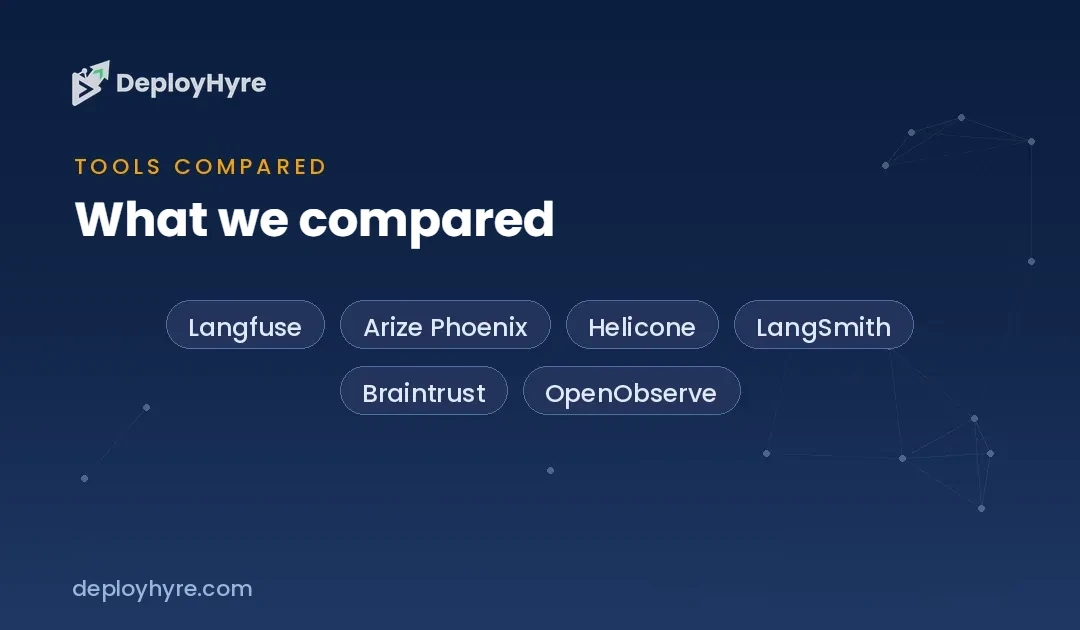
Quick Comparison: LLM Observability Tools at a Glance
| Tool | Best For | Observed Price | Self-Host? |
|---|---|---|---|
| Langfuse | Open-source tracing + evaluation | Free Hobby (50K units); Core $29/mo; Pro $199/mo | Yes (free) |
| Arize Phoenix | Model drift and evaluation | Free self-host (Elastic License 2.0) | Yes (free) |
| Helicone | Fast cost tracking, gateway | Free (10K requests); zero LLM markup | Yes (free) |
| LangSmith | LangChain / LangGraph teams | $39/user/mo; $2.50 per 1K traces (Plus) | Enterprise self-host |
| Braintrust | Evaluation-first workflows | Free tier + paid | Managed |
| OpenObserve | Unified observability + LLM | Open-source core | Yes |
What LLM Observability Tools Do
An AI application built on an LLM is hard to debug because it is non-deterministic: the same input can produce different outputs, quality is subjective, and failures are subtle (a plausible but wrong answer, a retrieval that missed the right document). LLM observability tools instrument your app to capture every step, the prompt, the retrieved context, the model call, the tokens, the latency, the cost, and the output, so you can see exactly what happened when a user got a bad answer, and measure quality and spend across all requests.
The core capabilities are tracing (the full path of a request through your prompts, retrievals, and agent steps), evaluation (scoring output quality, automatically or with human review), and monitoring (cost, latency, and drift over time). As applications move from demos to production and from single prompts to multi-step agents, this visibility becomes essential, you cannot improve or trust what you cannot see, and generic application observability does not understand prompts, tokens, and model outputs.
LLM observability watches the AI pipelines that vector databases and models feed. It monitors the retrieval from the stores in our best vector databases guide, parallels the system monitoring in our best AI observability tools guide, and supports the AI features built with our best AI coding tools.
The Open-Source Escape Hatch Is Real Here
Unlike most observability categories, LLM observability offers genuinely free self-hosting for production use, because Langfuse, Arize Phoenix, and Helicone all let you self-host at no licensing cost. Langfuse, now part of ClickHouse, is free to self-host with no limits, Phoenix is free under the Elastic License 2.0, and Helicone can be self-hosted with zero markup on your LLM costs. This means a team can run real production LLM monitoring, tracing, evaluation, cost tracking, paying only for the infrastructure it runs on, which is unusual in a field where most tools push you to paid managed tiers as you scale.
The practical consequence is that budget should rarely be the barrier to adopting LLM observability. Even the managed tiers are generous, LangSmith gives 5,000 free traces, Langfuse 50,000 free observations a month, Helicone 10,000 free requests, enough to cover development and early production for most teams. So the decision is less about cost and more about fit: which tool matches your framework, your evaluation needs, and whether you prefer managed convenience or self-hosted control. Given the free options, every team building AI features should be running observability.
Best for Tracing and Debugging
LangSmith is the natural choice for teams building with LangChain or LangGraph, offering deep, native tracing and debugging of agent workflows, priced at $39 per user a month with 5,000 free traces and $2.50 per 1,000 traces beyond that on Plus. Because it comes from the LangChain team, its integration with those frameworks is the tightest available, making it the default for the large number of teams building on LangChain. It excels at visualizing the full path of a complex agent run, which is exactly what you need to debug multi-step LLM applications.
Langfuse is the strongest open-source tracing-and-debugging platform, free to self-host with generous managed tiers (Hobby free for 50,000 units, Core $29 a month, Pro $199), and framework-agnostic so it works regardless of how you built your app. For teams that want deep tracing without being tied to LangChain, or that want to self-host, Langfuse is the leading choice. Both are strong for tracing and debugging agent workflows; LangSmith for LangChain-native depth, Langfuse for open-source flexibility, monitoring the retrieval from our best vector databases guide.
Best for Evaluation and Drift
Arize Phoenix is the best choice for tracking model output drift and evaluation over time, free to self-host under the Elastic License 2.0, and built to monitor how model behavior changes as inputs and the world shift. Evaluation, systematically measuring whether your LLM outputs are actually good, is one of the hardest parts of running AI in production, and Phoenix’s focus on drift and evaluation makes it the specialist for teams that need to prove and maintain quality rather than just trace requests. Its free self-hosting removes cost as a barrier for this critical capability.
Braintrust is the other evaluation-first option, purpose-built for the eval workflows, running test suites against prompts, comparing versions, scoring outputs, that teams use to systematically improve LLM quality, with a free tier and paid plans. For teams whose primary need is rigorous, repeatable evaluation of prompts and models rather than production tracing alone, Braintrust is the specialist. Both center on evaluation; Phoenix on drift and free self-hosting, Braintrust on structured eval workflows. Evaluation is essential as AI features move into user-facing production, and increasingly relevant to being cited by AI search engines, as covered in our best generative engine optimization tools guide.
Best Gateway and Cost Tracking
Helicone offers the fastest setup and the cleanest cost tracking, working as a gateway that automatically logs every LLM call with zero markup on your model costs, and a free tier of 10,000 requests. Its one-line integration, route your API calls through Helicone, means you get automatic logging, cost tracking, and caching with minimal code changes, which is why it is the quickest way to get visibility into an existing app. For teams whose priority is understanding and controlling LLM spend without a heavy instrumentation effort, Helicone’s gateway model is the most frictionless.
Gateway tools like Helicone are especially valuable for cost control, since LLM bills can escalate quickly as usage grows, and Helicone’s zero-markup model means you pay only for the monitoring, not a surcharge on your tokens. It can also be self-hosted for free. For teams that want to start observing an existing LLM application in minutes, capturing cost, latency, and requests, Helicone is the low-effort entry point, complementing the deeper tracing of LangSmith or Langfuse for teams that later need full agent debugging.
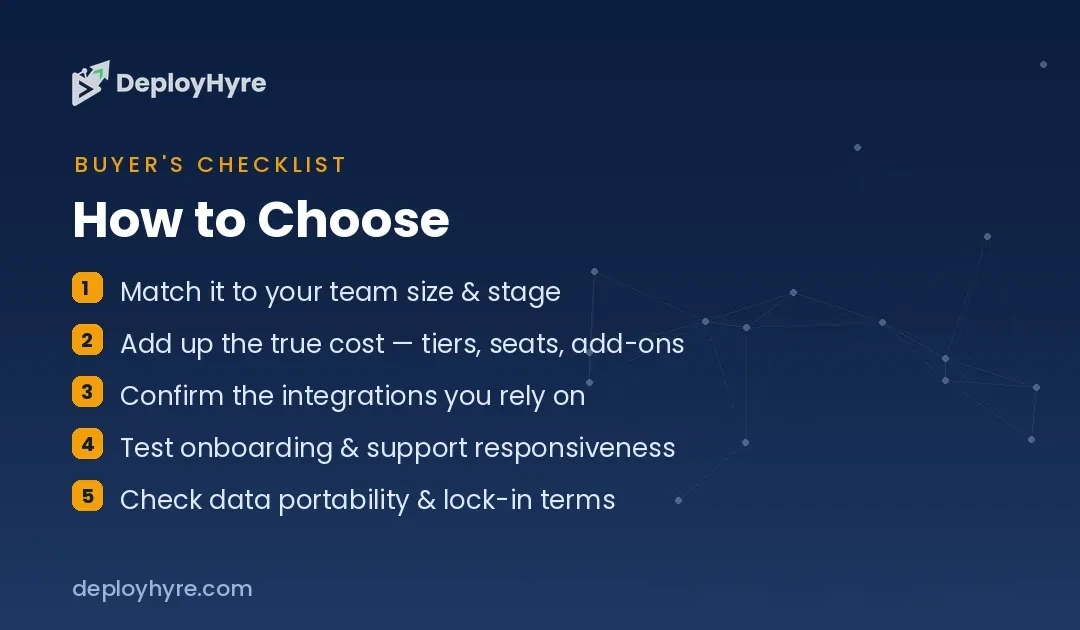
How Should You Choose an LLM Observability Tool?
Since cost is rarely the barrier here, start with fit. If you build on LangChain or LangGraph, LangSmith’s native integration is the natural default. If you want framework-agnostic tracing or to self-host, Langfuse leads. If your priority is evaluation and drift, Phoenix or Braintrust specialize there. If you want the fastest cost-tracking setup, Helicone’s gateway is the quickest.
Then decide managed versus self-hosted. Because Langfuse, Phoenix, and Helicone all self-host free, teams that want data control or zero licensing cost can run production observability on their own infrastructure. Teams that prefer zero-ops convenience can use the generous managed tiers. This is a genuine choice here, not a forced upgrade.
Finally, match the capability to your stage. Early development mainly needs tracing to debug (LangSmith, Langfuse, Helicone). Production at scale needs evaluation and drift monitoring to maintain quality (Phoenix, Braintrust) plus cost tracking (Helicone). Many teams combine a tracing tool with an evaluation tool, so plan for both as your AI features mature.
How We Evaluated These Tools
We evaluated each tool on tracing depth, evaluation and drift capabilities, cost tracking, framework integration, self-hosting availability, and pricing. Figures come from vendor pages and comparison sources. Because the category offers real free self-hosting, we present observed rates and free-tier limits and stress that fit, not cost, usually drives the decision. Rankings reflect fit for a stated use case.
The Bottom Line
LangSmith is the pick for LangChain teams, Langfuse for open-source tracing and evaluation, Arize Phoenix for drift and evaluation, and Helicone for the fastest cost-tracking setup, with Braintrust the evaluation-first specialist. Because Langfuse, Phoenix, and Helicone all self-host free, budget is rarely the barrier, so choose on framework fit and whether you need tracing, evaluation, or cost tracking most, and plan to combine tools as your AI features move into production.
Frequently Asked Questions
How much do LLM observability tools cost?
Many are free to self-host, Langfuse, Arize Phoenix, and Helicone all offer free self-hosting. Managed tiers are generous: LangSmith is $39 per user a month with 5,000 free traces, Langfuse has a free Hobby tier (50,000 units) then $29 to $199 a month, and Helicone is free for 10,000 requests. Cost is rarely the barrier in this category.
What is LLM observability?
LLM observability instruments AI applications to capture every step of a request, the prompt, retrieved context, model call, tokens, latency, cost, and output, so you can debug failures, measure quality, and control spend. Because LLM apps are non-deterministic and failures are subtle, this visibility is essential for running generative AI reliably in production.
Can I run LLM observability for free?
Yes. Langfuse, Arize Phoenix, and Helicone all self-host for free, letting you run production-grade LLM monitoring at zero licensing cost, paying only for infrastructure. This is unusual among observability categories and means any team building AI features can adopt observability regardless of budget.
Which LLM observability tool is best for LangChain?
LangSmith, because it comes from the LangChain team and integrates natively with LangChain and LangGraph, giving the tightest tracing and debugging for apps built on those frameworks. Teams not on LangChain, or wanting to self-host, often prefer the framework-agnostic Langfuse instead.
What is the difference between tracing and evaluation in LLM observability?
Tracing captures the full path of a request, prompts, retrievals, model calls, so you can debug what happened. Evaluation measures whether the outputs are actually good, scoring quality automatically or with human review and tracking drift over time. Tracing tools (LangSmith, Langfuse) debug behavior; evaluation tools (Phoenix, Braintrust) maintain quality. Production teams typically need both.
Related Articles

The DeployHyre Editorial Team writes buyer guides on AI tools, SaaS, cloud hosting and proxies. We compare tools using published pricing, official documentation and third-party reviews. All content is for educational and informational purposes only.