TL;DR: AI marketing tools are software that uses machine learning and generative AI to plan, create, and optimize marketing work. They write content, personalize emails, schedule social posts, build ad creative, design landing pages, and read analytics. This guide explains how each type works across the marketing stack, weighs free versus paid options, and shows you how to choose tools without losing your brand voice.
AI marketing has moved from experiment to standard practice. The global artificial intelligence in marketing market was valued at USD 20.44 billion in 2024 and is projected to reach USD 82.23 billion by 2030, growing at a 25% compound annual rate. That growth reflects a simple shift. Marketers now expect software to do the heavy lifting.
The adoption numbers back this up. HubSpot reports that about 94% of marketers plan to use AI in their content creation in 2026. AI touches nearly every channel now, not just writing.
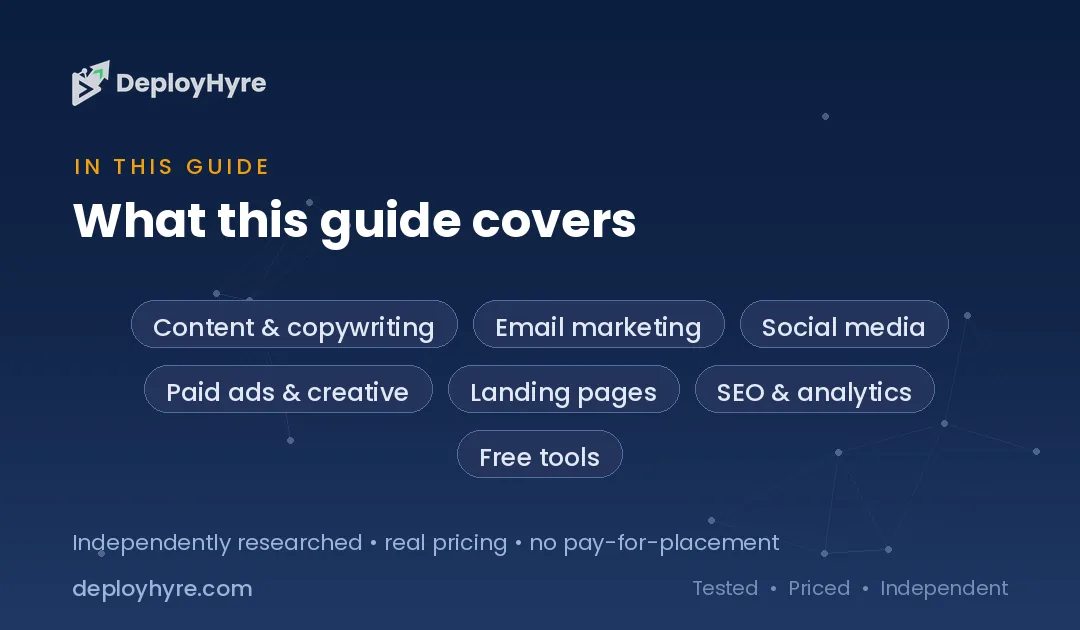
This guide is a map, not a product list. It covers what AI marketing tools are, how they work in each channel, and where humans still matter most. It links down to our detailed reviews so you can go deep on any category. For the wider context, start with our AI for business pillar.
What Are AI Marketing Tools and How Do They Work?
AI marketing tools are software platforms that use machine learning and generative AI to automate and improve marketing tasks. They analyze data, predict outcomes, and create content. The goal is faster output and smarter decisions across content, email, social, ads, and analytics.
These tools work in two broad ways. Predictive AI studies past data to forecast what will happen next. It scores leads, predicts churn, and picks the best send time. Generative AI creates new material, like blog drafts, ad images, and email copy.
Most modern platforms blend both. A single tool might predict which audience to target, then generate the ad to reach them. Salesforce found that 76% of marketers now use at least one form of AI, whether predictive, generative, or agentic.
The newest layer is agentic AI. These tools act on their own toward a goal. An AI agent can plan a campaign, draft the assets, launch it, and adjust the budget without a human clicking each step. Adoption here is early but rising fast.
How Do Marketers Use AI for Content and Copywriting?
AI content tools generate blog posts, product descriptions, and ad copy from short prompts, then help refine tone and structure. They cut first-draft time sharply. Marketers still edit for accuracy and voice, but the blank page problem is mostly solved.
Content is the top use case for AI in marketing. HubSpot reports that 80% of marketers currently use AI for content creation. These tools draft outlines, suggest headlines, and repurpose one article into ten formats.
The workflow is simple. You give the tool a topic, keywords, and a tone. It returns a draft in seconds. You then fact-check, add real examples, and rewrite weak sections.
There is a catch. Speed creates sameness. HubSpot found that 53% of marketers struggle to make their content stand out in an AI-saturated market. The winning move is to add original data, expert quotes, and a clear point of view.
For long-form work, see our guide to the best AI blog writing tools. It compares the platforms that handle research, drafting, and SEO in one place.
How Does AI Improve Email Marketing?
AI email tools personalize subject lines, segment audiences, and pick send times based on each subscriber’s behavior. They also trigger automated journeys that react to what people do. The result is more relevant email and higher revenue per send.
Email remains the highest-ROI channel in marketing. Litmus reports that email drives an average return of $36 for every dollar spent, more than any other channel. AI raises that ceiling further.
Here is how AI helps. It writes and tests subject lines. It groups subscribers by likely intent. It decides who gets which message and when. Predictive send-time optimization alone lifts open rates.
Automation is the biggest lever. AI builds behavioral triggers, so a cart abandonment or a signup fires the right follow-up automatically. These flows run around the clock without manual work.
To pick a platform, read our comparison of the best AI email marketing software. It ranks tools by personalization depth, automation, and price.
How Do AI Tools Help With Social Media Management?
AI social media tools schedule posts, generate captions, suggest hashtags, and analyze which content performs best. They also spot trends and flag comments that need a reply. This turns a scattered, time-heavy task into a steady system.
Social media eats hours. AI gives them back. These tools plan a full content calendar, write platform-specific captions, and recommend the best posting times for each network.
The analytics side is just as useful. AI reads engagement data and tells you what to make more of. It groups your audience by behavior and surfaces the topics that drive shares and saves.
Some tools now draft entire post series from a single brief. You approve, tweak, and schedule in one sitting. That frees your team to focus on strategy and community.
For scheduling and analytics platforms, see the best AI social media management tools. If you focus on Reels, TikTok, and Shorts, our guide to AI social media video tools covers editing and clip generation.
How Is AI Changing Paid Ads and Ad Creative?
AI ad tools generate images, video, and copy variations, then let platform algorithms test and optimize them automatically. They also target audiences and adjust budgets in real time. This lifts return on ad spend while cutting production time.
Paid advertising is where AI shows the clearest wins. Meta reports that its Advantage+ Sales campaigns deliver an average 22% lift in return on ad spend compared to manual setups. Over 4 million advertisers now use Meta’s generative AI ad tools.
Creative generation is the fast-moving part. AI produces dozens of ad variations from one product photo or brief. You test them at scale and keep the winners.
Targeting has changed too. The platform decides who sees each ad, when, and at what bid. Your job shifts from manual settings to feeding the system strong creative and clear goals.
To build assets that convert, see our guide to the best AI ad creative tools. It covers static ads, video, and copy generation for paid social and search.
How Do AI Tools Build Landing Pages and Boost Conversion?
AI landing page tools generate full page layouts, copy, and images from a prompt, then run tests to improve conversion. They remove the need for a designer or developer on simple pages. You launch faster and iterate on data, not guesses.
Landing pages decide whether ad clicks turn into customers. AI speeds up the build. You describe your offer, and the tool returns a complete page with headlines, sections, and a call to action.
Optimization is where AI adds lasting value. It runs A/B tests, reads the results, and suggests changes. Some tools even personalize the page based on where the visitor came from.
This matters because generic pages leak revenue. AI lets small teams test as fast as large ones. You ship variants in minutes instead of weeks.
Compare builders in our guide to the best AI landing page builders. It ranks tools by ease of use, template quality, and testing features.
How Do AI Tools Handle SEO and Analytics?
AI SEO and analytics tools find keywords, audit pages, cluster topics, and turn raw data into plain-language insights. They also predict which content will rank and spot trends before they peak. This makes technical work accessible to non-experts.
SEO once demanded deep technical skill. AI lowers that bar. These tools scan your site, find broken links and weak pages, and suggest fixes in priority order.
On the content side, AI groups keywords into topic clusters. It shows the gaps your competitors have filled and you have not. It drafts optimized briefs your writers can follow.
Analytics is the other half. AI reads your traffic and revenue data, then explains what happened in words. It flags anomalies, like a sudden traffic drop, and points to the likely cause.
For platforms built for search, see our review of the best AI SEO tools. It covers keyword research, technical audits, and content optimization.
Are Free AI Marketing Tools Good Enough?
Free AI marketing tools work well for small teams, testing, and single tasks, but they cap usage and hold back advanced features. Paid plans add automation, higher limits, and team access. Most businesses start free and upgrade as they scale.
Free tools are a real starting point. Many strong platforms offer generous free tiers for content, design, and scheduling. You can run a small brand on them for months.
The limits show up as you grow. Free plans cap monthly generations, hide analytics, and block automation. They rarely allow multiple users or brand controls.
The math is simple. Free tools save cash but cost time. Paid tools cost cash but save time. Pick based on which resource is tighter right now.
If budget is your constraint, start with our roundup of the best free AI marketing tools. It lists genuinely useful no-cost options by category.
What Are the Risks of AI Marketing Tools?
The main risks are generic content, factual errors, lost brand voice, and over-reliance that weakens strategy. AI drafts fast, but it does not understand your customer or your goals. Human judgment stays essential.
The biggest risk is sameness. When everyone uses the same tools with the same prompts, output blends together. HubSpot found that 52% of marketers believe AI has made content so easy to create that it has become less effective. Standing out takes real thought.
Accuracy is the next risk. AI invents facts and cites sources that do not exist. Every claim needs a human check before it goes live. This is not optional.
Brand voice is fragile too. Left alone, AI drifts toward a flat, average tone. Feed it your style guide, examples, and rules. Then edit the output so it sounds like you.
The human role is clear. People set strategy, add real insight, and make the final call. AI handles volume. You handle meaning. The best teams use AI to do more of what matters, not to think less.
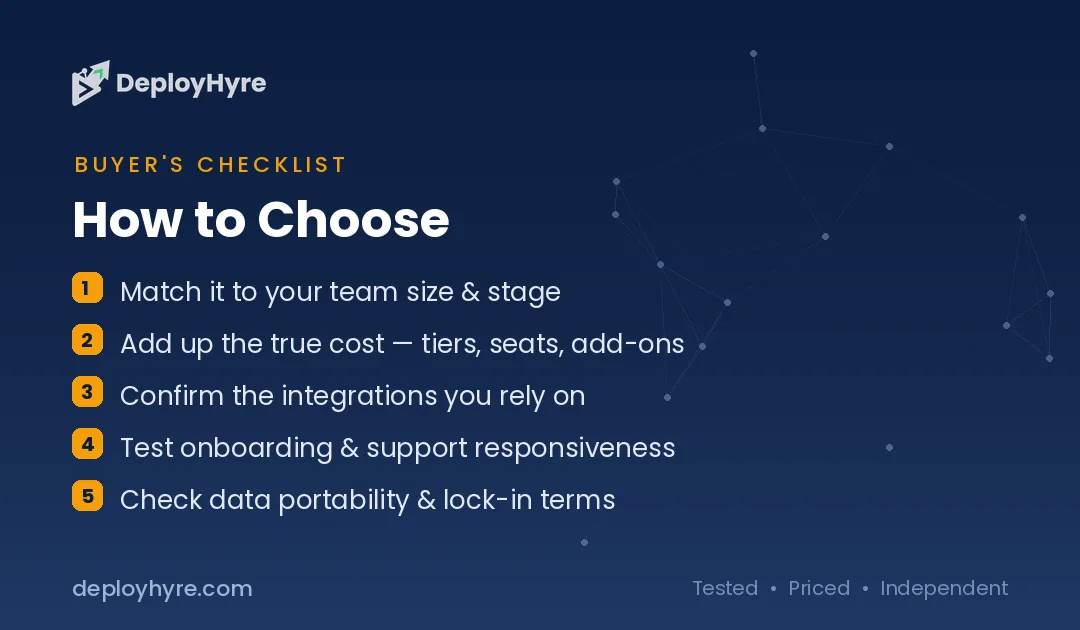
How Do You Choose the Right AI Marketing Tools?
Choose AI marketing tools by starting with your biggest bottleneck, then matching one tool to that job before adding more. Test the free tier, check integrations, and confirm the output quality. Avoid buying a suite you will not fully use.
Start with the problem, not the product. Ask where you lose the most time or money. If email is weak, fix email first. Do not buy ten tools at once.
Next, run a trial. Feed the tool your real content and your real data. Judge the output honestly. A demo looks great; your use case is the true test.
Check how it fits your stack. The tool should connect to your CRM, your website, and your ad accounts. A tool that does not integrate creates more work, not less.
Watch the total cost. Prices climb as you add users and volume. Salesforce found that high performers using AI agents reclaim about 8 hours a week. Measure time saved against what you pay.
The Bottom Line
AI marketing tools are now core infrastructure, not a nice-to-have. They write content, personalize email, run ads, build pages, and read your data. The 82 billion dollar market forecast for 2030 shows this is a permanent shift, not a fad.
The smart approach is focused, not sweeping. Pick your biggest bottleneck. Add one tool that solves it. Test the output, protect your brand voice, and keep a human on every final decision. Then expand as you see results.
Start with the channel that hurts most. Explore our category guides for AI email marketing software, AI social media management, and AI SEO tools to find the right platform for your team. For the full picture of AI across your company, return to our AI for business hub.
Frequently Asked Questions
What are AI marketing tools?
AI marketing tools are software platforms that use machine learning and generative AI to automate and improve marketing tasks. They create content, personalize emails, schedule social posts, build ad creative, design landing pages, and analyze data. Marketers use them to work faster and make smarter, data-based decisions across every channel.
Are AI marketing tools worth it?
Yes, for most teams. AI marketing tools cut content and campaign production time sharply and improve results in key channels. Meta reports a 22% average lift in return on ad spend from AI-optimized campaigns, and email personalization raises revenue. The value depends on choosing the right tool for your biggest bottleneck and keeping human oversight.
Can AI replace human marketers?
No. AI handles volume tasks like drafting, scheduling, and data analysis, but it cannot set strategy, understand your customers, or make judgment calls. AI also invents facts and drifts from your brand voice without guidance. The strongest results come from people using AI as a tool, not a replacement for human insight.
What is the best free AI marketing tool?
The best free AI marketing tool depends on your channel. Many strong platforms offer free tiers for content writing, design, and social scheduling that work well for small teams and testing. Free plans usually cap usage and hide automation. See our guide to free AI marketing tools for genuinely useful no-cost options by category.
How much do AI marketing tools cost?
AI marketing tools range from free tiers to enterprise plans costing hundreds of dollars per month. Most single-channel tools start around 15 to 50 dollars per month for small teams. Costs rise with usage, extra users, and advanced automation. Start with a free trial and scale your spend as the tool proves its return.
Know AI, SaaS, or cloud tools inside out? Pitch a guest post and get in front of thousands of buyers researching their next tool.

David Austin is a technology writer and software analyst at DeployHyre, where he covers AI tools, SaaS platforms, cloud hosting, and business automation. He focuses on hands-on comparisons of pricing, features, and real-world performance so teams can pick the right software with confidence.