Global AI spending hit $2.52 trillion in 2026, up 44% year over year. Yet only 5% of companies achieve substantial ROI from their AI initiatives. This guide breaks down how AI is transforming every business department (HR, sales, project management, finance), how much it actually costs to implement, and what separates the companies making money from AI from those burning cash on experiments. Real tools, real numbers, real strategy.
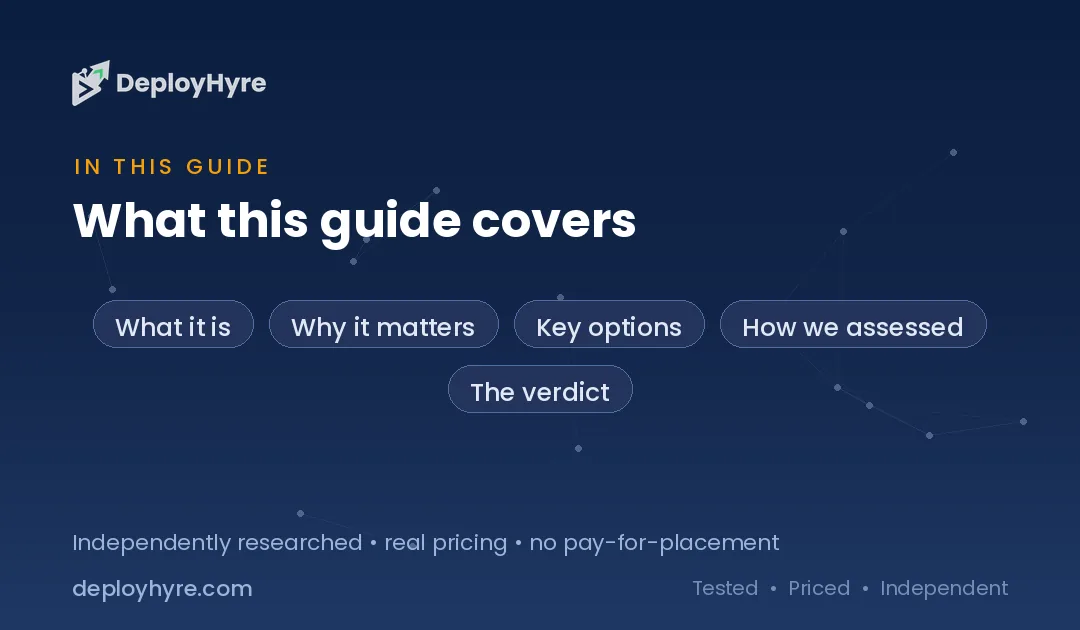
Table of Contents
Worldwide AI spending reached $2.52 trillion in 2026, according to Gartner. That’s a 44% increase from the year before. Every software vendor is adding AI features. Every CEO is asking about AI strategy. Every board wants to see AI ROI on the next quarterly report.
But here’s what the headlines miss: only about 5% of companies achieve substantial value from AI, while 35% report partial returns. The average payoff reaches just 1.7x investment. The remaining 60%? They’re still stuck in pilot mode, spending money on experiments that never reach production.
The best AI for business isn’t about chasing the newest model or the flashiest demo. It’s about identifying the specific department, workflow, or bottleneck where AI creates measurable value, then deploying the right tool with the right strategy.
This guide covers exactly that. We’ll walk through how AI transforms each business function, which tools actually deliver, how much implementation costs, and the step-by-step process for getting positive ROI within 12 months. Everything links to our detailed tool reviews where you can go deeper on specific categories.
How Is AI Changing Every Business Department?
AI is no longer a single technology you “adopt.” It’s a layer that sits across your entire organization, automating different tasks in different departments. 72% of enterprises now have at least one AI workload in production, up from 55% in 2024 and just 20% in 2020.
But adoption isn’t evenly distributed. Some departments have embraced AI faster because the ROI is clearer and more immediate. According to Deloitte’s 2026 State of AI report, two-thirds (66%) of organizations report productivity and efficiency gains from AI, but only 20% are seeing actual revenue growth from it so far.
Here’s how AI is reshaping each function, with links to our detailed tool reviews for each.
How Are the Best AI Tools for HR Changing Recruiting and Retention?
AI in HR automates the tasks that consume over half of an HR professional’s workday: resume screening, onboarding checklists, engagement surveys, and payroll processing. The global AI in HR market hit $6.25 billion in 2026 and is growing at 24.8% annually.
The impact is measurable. Companies using AI-assisted hiring report 25 to 35% higher first-year retention rates and up to 40% cost reduction in North American HR processes. AI tools handle candidate sourcing, apply consistent screening criteria, automate onboarding workflows, and predict which employees are at risk of leaving before they start looking.
Top tools for HR: Deel AI for global hiring compliance, HireVue for AI video interviews, BambooHR for SMB all-in-one HR, Lattice for performance management, and Eightfold AI for talent intelligence.
What to read next: Our complete guide to the best AI tools for HR in 2026 ranks 9 platforms by function, pricing, and team size. It includes comparison tables, pricing breakdowns, and our testing methodology.
How Are AI Sales Tools Transforming Prospecting and Pipeline Management?
Sales is where AI’s impact is most directly tied to revenue. Sales professionals save two hours and 15 minutes per day using AI tools, and teams using AI close 45% more deals than those operating manually.
AI sales tools automate the 75% of a rep’s day that isn’t actually selling: CRM data entry, prospect research, follow-up scheduling, and call note-taking. The tools that matter most in 2026 combine data enrichment (finding the right contacts), outreach automation (sending personalized sequences), and conversation intelligence (analyzing what works in sales calls).
Top tools for sales: Apollo.io for outbound prospecting with 210M+ contacts, HubSpot Sales Hub for all-in-one CRM with AI, Gong for conversation intelligence and coaching, Clay for data enrichment workflows, and Outreach for multi-channel engagement sequences.
What to read next: Our complete guide to the best AI tools for sales teams covers 10 platforms tested for prospecting, CRM automation, email outreach, and call analytics. Includes a “which tool for which use case” decision framework.
How Can AI Project Management Tools Cut Admin Time in Half?
Project managers spend more time updating status documents than managing their teams. AI project management tools fix this by automating scheduling, predicting bottlenecks, and generating reports in seconds.
A Google pilot found that workers save 122 hours per year on administrative tasks using AI tools. For a 10-person team, that’s 1,220 hours of recovered productivity annually. The best tools don’t just organize tasks. They learn how your team works, predict which projects will slip, and automate the status updates that eat your strategic time.
Top tools for project management: Monday.com for resource planning and risk assessment, ClickUp for the deepest AI features at the lowest cost, Notion AI for docs-plus-projects workflows, Asana for enterprise workflow automation, and Wrike for complex multi-project environments.
What to read next: Our complete guide to the best AI project management tools in 2026 ranks 11 platforms by category, team size, and pricing. Includes a team size decision framework (freelancer through enterprise).
How Is AI Transforming Finance and Accounting?
AI is automating the most time-consuming parts of finance: invoice processing, expense categorization, financial reporting, and compliance monitoring. Deloitte reports that AI delivers 26 to 31% cost savings in functions like supply chain, finance, and client operations.
The most immediate wins come from automating accounts payable, expense management, and financial forecasting. AI tools can reconcile transactions, flag anomalies, categorize expenses automatically, and generate financial reports that used to take days in minutes. For accounting firms, AI handles tax preparation, audit analysis, and client communication drafting.
Top tools for finance: Gusto for payroll automation (US-focused), QuickBooks AI for small business accounting, Ramp for AI-powered expense management, Stampli for accounts payable automation, and Planful for financial planning and analysis.
What to read next: If your finance team is exploring AI, our guide to hiring an AI consultant helps you decide whether to build internally or bring in external expertise. This is especially important for finance, where compliance and data security are non-negotiable.
What Does a Winning AI Implementation Strategy Look Like?
Most AI failures aren’t technology failures. They’re strategy failures. McKinsey’s research found that organizations seeing significant AI returns were twice as likely to have redesigned end-to-end workflows before selecting models. The transformation work comes first. The technology follows.
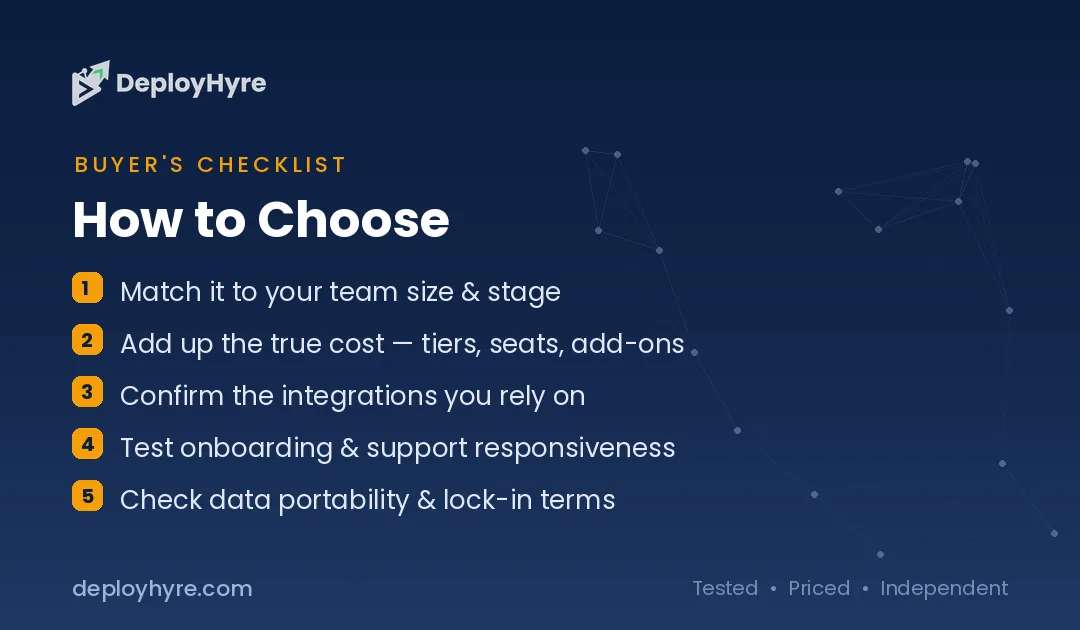
Here’s a practical implementation framework that works for companies of any size:
Step 1: Identify your biggest time drain. Don’t start with “let’s do AI.” Start with “where does our team waste the most hours on repetitive tasks?” Common answers: CRM data entry, report generation, email drafting, candidate screening, invoice processing. Pick one.
Step 2: Run a focused pilot (30 days, one team). Choose one tool from our guides above. Deploy it with your best team members (they’ll adopt faster and champion it to others). Measure hours saved and quality impact weekly.
Step 3: Measure before scaling. Track three metrics: time saved per person per week, error reduction, and user adoption rate. If the pilot doesn’t show clear wins in 30 days, the tool isn’t right for your workflow. Try a different one.
Step 4: Scale horizontally. Once one department proves ROI, expand to adjacent teams. The internal case study from your pilot makes the next rollout dramatically easier. PwC’s research shows that leading companies are nearly twice as likely to redesign workflows around AI rather than just adding AI tools on top of existing processes.
Step 5: Build internal capability. Don’t depend on one vendor forever. Use your initial implementation to train internal champions who can manage and optimize AI tools going forward. The AI skills gap is seen as the biggest barrier to integration, according to Deloitte, and education was the number one way companies adjusted their talent strategies in 2026.
When Should You Hire an AI Consulting Firm?
Not every company needs one. But if you’re stuck in pilot mode, facing regulatory complexity, or planning enterprise-wide AI transformation, external expertise can accelerate your timeline significantly.
The global AI consulting market exceeds $14.8 billion in 2026. Pricing ranges from $100/hour for junior consultants to $900+/hour for senior partners at McKinsey or BCG. The right tier depends on your company size and project scope.
You need a consultant if: Your AI pilots aren’t reaching production. Your industry has strict regulatory requirements (healthcare, finance, government). You need strategic clarity about where AI creates the most value. You’re planning a transformation spanning multiple departments.
You don’t need a consultant if: You’re deploying off-the-shelf SaaS tools. Your team has strong ML engineering skills. You have clearly defined use cases and just need more hands.
What to read next: Our complete guide to the best AI consulting firms in 2026 ranks 12 firms by specialization (enterprise, mid-market, startup), pricing, and industry expertise. Includes a detailed cost breakdown by project type.
What Does AI ROI Actually Look Like? Real Numbers from Real Companies
The AI ROI conversation has matured beyond hype. Here are the benchmarks that matter in 2026, based on data from multiple research firms:
The headline numbers. BCG’s research shows the top 5% of companies (“future-ready”) expect twice the revenue increase and 40% greater cost reductions than laggards by 2028. The gap widens over time because leaders reinvest early returns into stronger capabilities, creating a compounding effect.
Average returns by function. Deloitte reports that 66% of organizations see productivity and efficiency gains, but only 20% have achieved revenue growth from AI so far. The departments with clearest ROI: customer support (30 to 45% productivity increase), sales (2+ hours saved per rep per day), HR (40% cost reduction in hiring processes), and operations (26 to 31% cost savings).
Timeline to payoff. Initial efficiency gains typically appear within 6 to 18 months. More meaningful financial impact emerges over 18 to 36 months. Enterprise-level competitive advantages take 3 to 5 years. Companies that pursue near-term efficiency wins to fund longer-term transformation perform best.
The ROI math for a 50-person company. Conservative AI adoption can generate approximately $8,000 per week in recovered organizational capacity (20 people recovering 5 hours per week at $80/hour fully loaded cost). That’s over $400,000 per year from tools that might cost $20,000 to $50,000 annually in subscriptions.
What separates winners from losers. PwC’s 2026 AI Performance Study found that three-quarters of AI’s economic gains are captured by just 20% of companies. Those leaders are 2.6x more likely to use AI to reinvent their business model and twice as likely to redesign workflows around AI rather than just adding tools.
What Are the Biggest Mistakes Companies Make with AI?
Understanding failure patterns saves you from repeating them. Here are the four most common mistakes, based on research from KPMG, PwC, and Deloitte:
Mistake 1: Starting with technology instead of problems. Companies buy an AI platform and then look for uses. This is backwards. Start with your most expensive bottleneck, then find the tool that solves it. IBM’s research noted that some companies treated AI as “the business strategy hammer for every nail”, applying it everywhere without understanding where it would actually create value.
Mistake 2: Running too many pilots without scaling any. 88% of AI agent pilots never reach production. The most common failure pattern: launching a dozen small experiments, achieving modest results in each, but never investing enough in any single initiative to reach scale.
Mistake 3: Ignoring data readiness. AI is only as good as the data it’s trained on. Data preparation can inflate total project costs by 20 to 50% if your data needs significant cleaning. Companies that invest in data quality before AI deployment consistently outperform those that don’t.
Mistake 4: Treating AI as a technology project instead of a change management project. Only 23% of organizations offered prompt engineering training in 2025, leaving employees to teach themselves. The best AI implementations include structured training, workflow redesign, and clear accountability for adoption.
The Best AI for Business: How to Start Making Money
AI is no longer optional for competitive businesses. 78% of organizations now use AI in at least one business function. The companies pulling ahead are those that move past experimentation into disciplined, outcome-focused deployment.
Here are three things you can do this week:
1. Pick one department to start. If you’re unsure where, start with the function where your team wastes the most time on repetitive tasks. For most companies, that’s sales (CRM updates), HR (resume screening), or operations (report generation).
2. Choose one tool and run a 30-day pilot. Use our department-specific guides: AI for HR, AI for sales, or AI for project management. Start with the tool’s free plan. Measure hours saved weekly.
3. Set a 90-day ROI target. Don’t aim for transformation. Aim for measurable time savings in one workflow. Use that result to fund the next initiative. This is how the top 5% do it: they pursue near-term wins that fund long-term transformation.
The gap between AI leaders and laggards is widening. The good news? The tools are cheaper, easier, and more proven than ever. The only question is whether your organization will act in 2026 or watch from the sidelines.
How can AI help my business?
By automating work and analyzing data. AI speeds marketing, sales, support, and operations, and improves decisions across departments. Start with one high-value use case, prove results, then expand, beginning with AI tools for sales.
What are the best AI tools for business?
It depends on your goal. The best fit covers CRM and sales, marketing content, support, or operations, since leading platforms now embed AI. Choose by the problem you want to solve, such as a strong AI CRM.
How do small businesses start using AI?
Start small with one problem. Pick a clear task like drafting content or answering FAQs, use affordable tools with free trials, measure time saved, then scale. Train your team and set simple policies so adoption stays safe.
Frequently Asked Questions
What is the best AI for business?
The best AI for business depends on your department and use case. For HR: Deel AI and BambooHR. For sales: Apollo.io and HubSpot Sales Hub. For project management: Monday.com and ClickUp. For finance: Gusto and Ramp. The most successful companies deploy AI tools in one department at a time, prove ROI, then expand.
How much does AI cost for a small business?
Most AI business tools start at $7 to $30 per user per month on paid plans. Many offer free tiers (ClickUp, HubSpot CRM, Notion AI). A comprehensive AI stack for a 10-person team typically costs $500 to $2,000 per month in subscriptions. Custom AI consulting or development ranges from $10,000 to $100,000+ depending on scope.
How much is the global AI market worth?
Global AI spending reached $2.52 trillion in 2026 according to Gartner, a 44% increase year over year. The enterprise AI market specifically is valued at $301 billion according to IDC, with AI software accounting for $157 billion. The AI consulting services market alone exceeds $14.8 billion.
What percentage of companies use AI?
78% of organizations use AI in at least one business function, according to Stanford HAI. 72% of enterprises have at least one AI workload in production, according to McKinsey. Adoption rates are higher among large companies (83% of firms with 5,000+ employees) compared to smaller firms (42% of companies with 50 to 499 employees).
What is the ROI of AI for business?
Average AI ROI reaches approximately 1.7x investment. The top 5% of companies achieve substantially higher returns with twice the revenue increase and 40% greater cost reductions than laggards. Initial efficiency gains appear within 6 to 18 months. Revenue impact takes 18 to 36 months. For a 50-person company, conservative AI adoption can generate approximately $400,000 per year in recovered organizational capacity.
Which department should adopt AI first?
Start with the department that wastes the most time on repetitive tasks. For most companies, this means sales (CRM data entry, prospecting research), HR (resume screening, onboarding), or operations (reporting, scheduling). IT operations and customer service have the highest AI adoption rates because they have measurable, high-volume operational metrics.
Will AI replace jobs?
AI is displacing approximately 25,000 jobs per month in the US while creating approximately 9,000 through augmentation, according to Goldman Sachs. However, the World Economic Forum projects 170 million new jobs created by 2030 with 92 million displaced, for a net positive of 78 million new roles. AI is primarily replacing tasks, not entire jobs. Workers who adapt keep their positions.
How do I build an AI strategy for my company?
Start with a single high-impact use case, not a company-wide strategy. Identify your biggest bottleneck, select a tool from our department guides, run a 30-day pilot with your best team, measure results, then scale. McKinsey found that organizations redesigning workflows before selecting tools are twice as likely to see significant returns.
What is agentic AI and should my business care?
Agentic AI refers to AI systems that can plan, make decisions, and execute multi-step tasks autonomously. Gartner forecasts that 40% of enterprise applications will embed AI agents by end of 2026, up from less than 5% in 2025. If your business runs complex, multi-step workflows (especially in sales, customer support, or operations), agentic AI is worth investigating.
What are the risks of AI for business?
The biggest risks are data privacy (76% of enterprises cite this as their top concern), bias in AI decision-making, regulatory compliance (the EU AI Act classifies many business AI applications as high-risk), and over-reliance on AI for decisions that require human judgment. Mitigation strategies include choosing tools with explainable AI, conducting regular audits, and maintaining human oversight for critical decisions.
More AI for Business Guides
Go deeper with our business software guides: the best AI recruiting software, best AI meeting assistants, best AI customer service software, best AI CRM software, best AI accounting software, and best AI legal software.
Related Articles

David Austin is a technology writer and software analyst at DeployHyre, where he covers AI tools, SaaS platforms, cloud hosting, and business automation. He focuses on hands-on comparisons of pricing, features, and real-world performance so teams can pick the right software with confidence.
Know AI, SaaS, or cloud tools inside out? Pitch a guest post and get in front of thousands of buyers researching their next tool.